人民币国际化

Search documents
2026年中国股市如何“稳稳地幸福”?这场大会给出关键答案
Xin Lang Cai Jing· 2026-01-15 08:23
Group 1: Forum Overview - The "Sina Finance 2025 Annual Conference and the 18th Golden Unicorn Forum" will be held on January 15, 2026, in Beijing, focusing on the theme "Starting the 15th Five-Year Plan, New Economic Voyage - Reshaping Growth Paradigms, Co-creating Future Prosperity" [1][35] - Key speakers include Sina Finance CEO Deng Qingxu, Liu Shijin, Liu Shangxi, Li Daokui, and Li Ling, who will present their insights during the main forum [1][35] Group 2: Economic Insights - Deng Qingxu emphasized the need to reshape growth paradigms through technological, institutional, and model innovations to activate new development momentum [4][39] - Liu Shijin highlighted that China's strong export performance amidst a challenging international environment reflects improvements in technological and industrial competitiveness [5][42] - Liu Shijin also suggested implementing a balanced trade strategy to enhance imports and promote the use of the RMB in international settlements [5][42] Group 3: Consumer and Market Dynamics - Liu Shijin pointed out that China's consumption as a percentage of GDP is approximately 20 percentage points lower than the global average, indicating a structural gap that needs to be addressed for China to become a major consumer market [8][43] - Liu Shangxi discussed the importance of addressing rural issues as a key to achieving common prosperity, emphasizing the need for a paradigm shift in development [9][44] Group 4: Capital Market Perspectives - Wu Xiaoqiu expressed optimism about the future growth of China's capital market, attributing recent positive developments to systematic reforms across various sectors [18][55] - He noted that the capital market's growth is driven by both reform logic and industrial structure transformation logic, making its future promising [18][55] - He also mentioned that the market's performance in 2026 is expected to be strong, with short-term fluctuations presenting good entry opportunities for investors [18][55] Group 5: Health Industry Insights - Li Ling discussed the significant potential of the new health industry, which could surpass the real estate sector in scale, emphasizing the need for a shift from a disease-centered to a health-centered approach in healthcare [15][50] - She highlighted the importance of preventive measures and the integration of various health-related sectors to form a comprehensive health industry [15][50] Group 6: Investment Strategies - Summer proposed constructing two "wealth pyramids" for asset allocation, focusing on a balanced approach between low-risk and high-risk assets [28][66] - He also predicted that Hong Kong could potentially replace London as the second-largest international financial center within the next five to ten years [28][63]

和讯投顾周大勇:黄金又创历史新高了 后市怎么看?
Sou Hu Cai Jing· 2026-01-15 03:27
1月15日,和讯投顾周大勇表示,黄金又创历史新高了!2026年刚开年,黄金便大涨,今日盘中突破 4600美元一盎司,虽有所回落,但仍是重大事件。回顾2025年,黄金全年涨幅超60%,共出现三次大行 情:年初补货行情,8月美元降息使其突破4300美元,年底涨至4380美元一盎司。进入2026年,市场普 遍认为美联储降息周期进入下半场,但宽松货币环境仍在延续。从长远看,支撑黄金的底层逻辑已发生 变化,不再仅依赖美联储降息政策,新的逻辑主要有四点:其一,全球央行,包括中国、印度等持续购 金,2022年以来央行购金量翻倍,超1000吨,这是战略性资产配置的转移;其二,美元信用面临考验, 美国债务快速攀升至近40万亿美元,利息支出超军费,长期财政扩张政策削弱了美元内在价值,这两大 趋势共同奠定黄金长期坚挺的基础;其三,资金结构向东转移,亚洲资金尤其是中国黄金ETF规模超 2300亿人民币,持仓超1000吨黄金,在定价权中发挥重要作用;其四,人民币国际化与黄金形成联动, 香港建大型黄金仓储,东南亚国家将黄金存入上海金交所,澳大利亚铁矿石开始用人民币结算,这些看 似独立的事件,都在强化人民币和黄金资产的通道。这四大逻辑指向 ...
值得收藏!刘世锦在2025新浪金麒麟论坛演讲的PPT
Xin Lang Cai Jing· 2026-01-15 03:22
Core Viewpoint - The conference emphasizes the need to reshape the growth paradigm in China, transitioning from investment and export-driven growth to innovation and consumption-driven growth during the 14th Five-Year Plan period [5][54]. Consumption Structure - China is not yet a consumption powerhouse, with consumption accounting for about 20 percentage points less of GDP compared to the global average [9][55]. - Addressing this structural gap is essential for China to become a consumption-driven economy, which includes increasing both domestic and international consumption [11][58]. - The focus on consumption is shifting from investment as the primary driver of economic growth to consumption as the key factor [11][58]. Industrial Structure - The manufacturing sector's share of GDP may decline, but this does not indicate a lack of transformation; rather, it highlights the need for high-tech, knowledge-intensive service industries to support manufacturing upgrades [12][59]. - The complexity of industrial structure transformation is increasing, necessitating a fair competitive environment for businesses [15][61]. Foreign Trade - Despite a challenging international environment, China's exports have remained strong, reflecting improvements in technology and industrial competitiveness [16][63]. - A significant trade deficit indicates reduced domestic consumption, which is unsustainable in the long term; thus, a balanced import-export strategy is needed [16][65]. Financial Structure - The evolution of the financial system is accelerating, with a shift from traditional banking to capital markets, which will play a more significant role in supporting economic growth [22][70]. - The capital market should foster large, innovative enterprises and increase the participation of institutional investors to support social security systems [26][72]. Urban-Rural Structure - Urbanization is slowing as the population approaches 70%, leading to more internal migration within urban areas rather than from rural to urban [27][75]. - Addressing disparities in public services between urban and rural populations is crucial for achieving balanced development [31][79]. Income Distribution - To avoid the middle-income trap, China should aim to reduce the Gini coefficient to around 0.4, promoting a stable middle-income group that constitutes over half of the population [33][84]. - Policies should focus on increasing labor income's share of GDP and improving social security for low- and middle-income groups [37][86]. Macroeconomic Policy - While macroeconomic policies are currently focused on short-term stabilization, they cannot provide the foundational growth momentum needed for the economy [40][87]. - Structural reforms are essential to address deep-rooted issues, and reliance on macroeconomic policies should be carefully managed to avoid dependency [42][89].

全文|刘世锦谈经济增长:以投资出口为主转向以创新和消费为主
Xin Lang Cai Jing· 2026-01-15 03:17
Core Viewpoint - The conference emphasizes the need to reshape the growth paradigm in China, transitioning from an investment and export-driven economy to one focused on innovation and consumption during the 14th Five-Year Plan period [5][54]. Consumption Structure - China is not yet a consumption powerhouse, with consumption accounting for approximately 20 percentage points less of GDP compared to the global average [9][55]. - To become a consumption-driven economy, China must address this structural gap and enhance both domestic and international consumption [11][58]. - The focus on consumption is shifting from investment-driven growth to consumption-driven growth, particularly in sectors like education, healthcare, and cultural services, which also contribute to human capital investment [11][58]. Industrial Structure - The manufacturing sector's share of GDP may decline, but this does not indicate a lack of transformation; rather, it highlights a shift towards high-tech, knowledge-intensive service industries [12][59]. - The transition will require a focus on developing related productive service industries to support manufacturing upgrades [12][59]. - The complexity of industrial structure transformation necessitates a fair competitive environment, as traditional government policies may become less effective [15][61]. Foreign Trade - Despite a challenging international environment, China's exports have remained strong, reflecting improvements in technological and industrial competitiveness [16][63]. - A significant trade deficit indicates reduced domestic consumption, which is unsustainable in the long term; thus, a balanced import-export strategy is essential [16][65]. - The shift towards using the Renminbi for international trade settlements is crucial for enhancing its global liquidity and status [21][68]. Financial Structure - The evolution of the financial system is accelerating, with a growing importance of capital markets as the economy transitions [22][70]. - The capital market should support the development of innovative enterprises and increase the participation of institutional investors to bolster social security systems [26][72]. Urban-Rural Structure - Urbanization is slowing as the population approaches 70%, leading to more internal migration within urban areas rather than rural to urban shifts [27][75]. - Addressing disparities in public services between urban and rural populations is critical for achieving balanced development [31][78]. - Reforms in land management and local governance are necessary to facilitate the free flow of resources and optimize urban-rural integration [32][79]. Income Distribution - Learning from successful economies, China aims to reduce its Gini coefficient to around 0.4 to avoid the middle-income trap and double the middle-income population from 400 million to 800-900 million [33][84]. - Policies should focus on increasing labor compensation's share of GDP and improving social security for low- and middle-income groups [37][84]. - A shift from indirect to direct taxation is proposed to enhance government revenue from high-income earners while ensuring property rights protection [39][86]. Macroeconomic Policy - While macroeconomic policies are currently focused on short-term stabilization, they cannot provide the foundational growth momentum needed for the economy [40][87]. - Structural reforms are essential to address deep-rooted issues, and reliance on macroeconomic policies should be carefully managed to avoid dependency [42][89]. - The transition to a new growth framework requires overcoming path dependencies and encouraging innovation and reform at various levels [44][94].
刘世锦建议实施外贸新战略:推动进出口基本平衡,并更多以人民币支付结算
Xin Lang Cai Jing· 2026-01-15 02:21
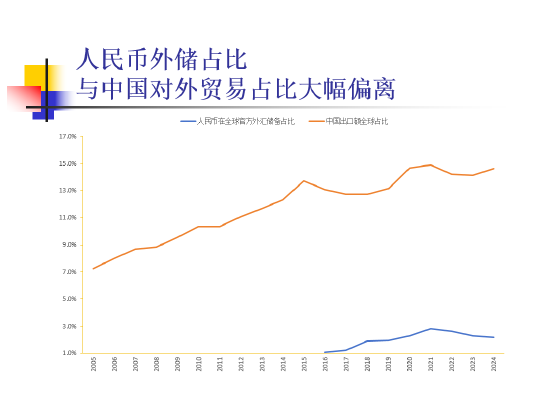
Core Viewpoint - The "Sina Finance 2025 Conference and the 18th Golden Unicorn Forum" emphasizes the need for China to balance its import and export strategies while enhancing the use of the Renminbi in international trade [1][4]. Group 1: Trade and Economic Strategy - Despite a challenging international environment, China's exports have shown strong momentum, reflecting improvements in technology and industrial competitiveness [1][4]. - A significant trade deficit indicates a reduction in domestic consumption, which is a contributing factor to insufficient domestic demand [1][4]. - It is suggested that China should implement a basic balance strategy for imports and exports, maintaining export competitiveness while expanding imports and increasing Renminbi payments [1][4]. Group 2: Renminbi Internationalization - There is a notable disparity between the proportion of Renminbi reserves and the share of foreign trade, indicating a need to shift from holding foreign exchange to using Renminbi for settlements [3][6]. - Currently, China's manufacturing sector accounts for about 30% of the economy, but the monetary function of the Renminbi is below 5%, which needs to be addressed [3][6]. - The goal is to align the Renminbi's functions with China's global economic share, promoting its status as a strong international currency and facilitating reasonable appreciation [3][6]. Group 3: Long-term Economic Impact - The transition to a Renminbi appreciation phase is expected to have more benefits than drawbacks, potentially impacting exports in the short term but enhancing productivity and competitive advantages in the long run [3][6].
小商品城20260114
2026-01-15 01:06
Summary of Conference Call for Xiaogoods City Company Overview - Xiaogoods City is positioned as a core enterprise in China's outbound system, serving as a hub for RMB internationalization and the "Belt and Road" initiative through its China goods and Yiwu配 platforms, with ongoing policy support expected to drive performance [3][10] Key Financial Projections - Xiaogoods City anticipates a 40% growth in performance for 2026, with net profit expected to reach between 4.3 billion to 4.5 billion RMB [2][8] - The company projects a net profit exceeding 6 billion RMB by 2027, with a stable growth rate of over 30% expected for 2026, despite fourth-quarter impacts from new market listing costs [2][8] Business Segments and Growth Drivers - The wearable device segment is expected to grow over 100% in 2026, potentially generating profits exceeding 400 million RMB [2][5] - The China goods service is benefiting from the establishment of a global digital trade center and increased service fees in the six district markets, with fees rising to 8,000 RMB per person annually, compared to 3,000 RMB in traditional areas [2][5] Import Business Developments - Xiaogoods City successfully completed its first import pilot for cosmetics and health products under the Yiwu import positive list in September and October 2026, with potential for expansion to a market size of 200-300 billion RMB [2][6] Yiwu配 Platform Progress - The Yiwu配 platform achieved approximately 6 billion USD in cross-border transaction volume in 2025 and aims for 10 billion USD in 2026, representing a growth of 60%-70% [2][7] - The platform has become the first to support the settlement of 1,039 market procurement trades, which constitutes 60%-70% of the transaction volume in the Yiwu Xiaogoods City market [2][7] Market and Stock Performance - Xiaogoods City's stock price increased from 65 billion RMB at the beginning of 2025 to 90 billion RMB by the end of the year, reflecting a growth of approximately 30%-40%, although it experienced a recent correction due to market adjustments in performance and valuation [4] - The company is motivated to conduct buybacks, dividends, or equity incentives to stabilize investor confidence, especially as its current market value is below the buyback cost of 104 billion RMB [2][9] Management Changes - Recent management changes are attributed to normal official appointments and are not expected to significantly impact company operations [2][9]

杨德龙:不忘初心 坚定价值投资理念
Xin Lang Cai Jing· 2026-01-14 08:34
Market Overview - The market has experienced continuous growth at the beginning of 2026, with trading volume reaching a historical record of 3.6 trillion yuan [1][6] - Margin trading balances have surpassed 2.6 trillion yuan, indicating increased market activity [1][6] - January is typically the month with the highest credit issuance, estimated between 3 trillion to 4 trillion yuan, which may contribute to capital market growth [1][6] Monetary and Fiscal Policy - China's monetary policy is expected to remain moderately accommodative, with measures such as interest rate cuts and reserve requirement ratio reductions to support low interest rates and liquidity [2][7] - The fiscal policy will be more proactive, with initiatives to boost investment and consumption, including a new subsidy policy for replacing old consumer goods [2][7] - A 12 trillion yuan local government debt relief plan is set to be implemented, easing interest payment pressures and allowing more funds for public welfare and growth [2][7] International Economic Context - The U.S. Federal Reserve is likely to continue its rate-cutting cycle in 2026, with expectations of at least two 25 basis point cuts due to weak economic data [2][8] - The U.S. inflation rate has fallen below 3%, indicating a shift in focus towards stabilizing employment rather than solely controlling inflation [2][8] Currency and Investment Trends - The dollar index has shown a downward trend, raising concerns about U.S. dollar credit, especially with the national debt exceeding 38 trillion dollars and annual interest payments over 1 trillion dollars [9] - China's central bank is reducing U.S. Treasury holdings while increasing gold reserves as a strategy to mitigate dollar credit risks [4][9] - The international influence of the dollar is expected to decline, while the internationalization of the renminbi is anticipated to progress, potentially leading to a renminbi appreciation against the dollar [10] Stock Market Dynamics - The U.S. stock market is experiencing high valuations, with major indices near historical peaks, but the AI technology revolution is supporting genuine business models [11] - Volatility in the U.S. stock market is expected to increase in 2026, with potential short-term corrections in tech stocks, but significant downturns similar to the 2001 internet bubble are unlikely [11] - A-shares and Hong Kong stocks are viewed as attractive investment opportunities due to their valuation advantages, independent of U.S. market fluctuations [11]
看多中国经济,高盛预计今年底人民币汇率将升至6.85
21世纪经济报道· 2026-01-14 08:26
Core Viewpoint - Goldman Sachs has significantly raised its GDP growth forecasts for China for 2026 and 2027 to 4.8% and 4.7% respectively, marking the largest upward adjustment since 2019, driven by a new assessment of China's export prospects [1][4]. Group 1: Economic Forecasts - Goldman Sachs' optimistic outlook is based on three main factors: a positive global economic outlook, strong competitiveness in China's manufacturing sector, and a reduction in tariffs on Chinese goods by the U.S. [4][5]. - The bank predicts a 2.6% growth rate for the U.S. economy in 2026, which is higher than the market consensus of 2.0%, indicating stable demand for Chinese exports [4]. - The Chinese government's focus on building a modern industrial system and promoting technological self-reliance is expected to enhance China's competitive edge in global markets [4]. Group 2: Export Resilience - Approximately 80% of China's exports, including machinery, chemicals, and electronics, have shown a year-on-year growth rate between 5% and 15%, indicating broad resilience across various product categories [7][8]. - China's manufacturing costs are estimated to be 30% to 40% lower than those in other countries, contributing to the sustained growth of its exports despite tariff challenges [8]. Group 3: Currency Internationalization - The internationalization of the Renminbi (RMB) is expected to accelerate in the coming years, driven by China's growing economic share in the global economy, which is around 20% for both GDP and trade [11]. - The RMB currently accounts for only 2% to 3% of the global currency system, indicating a mismatch that is likely to correct over time as China's economic influence increases [11]. - The Chinese government aims to reduce reliance on the U.S. dollar, especially in light of geopolitical risks, by promoting the RMB's use in international trade and finance [12]. Group 4: Consumer Spending - To effectively boost consumer spending, policies should focus on providing financial support to low-income individuals, such as job creation and income increases, rather than relying solely on short-term measures like subsidies [16][18]. - The government is increasingly recognizing the importance of consumer spending, with initiatives like childcare subsidies aimed at directly enhancing household financial capacity [18]. - A significant portion of overall consumption comes from government spending on public services, which could play a crucial role in driving future consumption growth [18].

瑞银:中国资产吸引力飙升 2026年市场有望延续涨势
Huan Qiu Wang· 2026-01-14 05:10
Core Viewpoint - The China Development Bank (CDB) aims to support high-quality Belt and Road Initiative (BRI) projects by providing over 290 billion RMB in funding for infrastructure, industrial cooperation, and trade in 2025, showcasing its commitment to financial support for participating countries [1][3]. Group 1: Financial Support and Investment - In 2025, CDB will focus on infrastructure connectivity, international industrial cooperation, trade, and financial collaboration, utilizing a variety of financial products such as RMB financing windows and special loans for the BRI [1][3]. - CDB's funding for the BRI includes a special loan of 30 billion RMB for the China-Europe Railway Express, aimed at enhancing operational efficiency and infrastructure [3]. - The CDB's subsidiary, the China-Africa Development Fund, will contribute 8.39 billion RMB to support African industrialization, facilitating 20.39 billion RMB in investments from Chinese companies, both figures representing historical highs [3]. Group 2: Support for Foreign Trade - CDB has established a special fund to support foreign trade amidst a complex international trade environment, focusing on new business models and addressing the financing challenges faced by small and micro foreign trade enterprises [3][4]. - The bank has supported over 10,000 small and micro foreign trade enterprises in 2025, alleviating their financing difficulties and contributing to the stability of foreign trade [3]. Group 3: Future Directions - CDB plans to continue leveraging its comprehensive financial services to enhance cooperation in traditional infrastructure while expanding into emerging areas like green finance and digital economy [4]. - The bank's significant funding in 2025 reflects its commitment to national strategies and the transition of the BRI towards a balanced development of hard and soft connectivity [4].
连续14个月狂买黄金!中国央行在布什么局?答案恐让美国坐不住
Sou Hu Cai Jing· 2026-01-14 02:10
不少人纳闷,央行为啥要这么执着买黄金?这背后藏着的大棋局,说出来恐怕让美国都坐不住! 要说这增持的时机,那可是精准踩在节点上, 正好是美国大选尘埃落定,特朗普重返白宫之际。当时大家就预判,2025年美国的全球战略肯定要大改,果不其然,特朗普上台后又是逼着美联 储降息,又是在全球掀贸易战,国际金融市场瞬间变得波诡云谲。 最新数据一曝光,全网都看明白了:中国央行的黄金储备直接创下历史新高!截至去年12月,我们手里的黄金已经达到7415万盎司,折算下来差 不多2306吨,更关键的是,这已经是连续14个月疯狂增持了! 中国这14个月不停囤黄金,说白了就是提前对冲风险!万一美国的激进政策引发金融海啸,我们手里有黄金这硬通货,心里就有底,国家金融安 全也能多一层实打实的保障。 更值得关注的是,现在地缘局势越来越紧张,尤其是台海方向。台当局频频搞事情,破坏两岸关系,让局势朝着 危险的方向发展,而咱们也在加快收台准备。 大家不妨想想,真到了收台的关键时刻,美国大概率会像对付俄罗斯那样,拉着盟友对咱们搞制裁,到时候手里的美债说不定就被冻结了。所以 央行一边狂买黄金,一边悄悄减持美债,都是未雨绸缪的关键动作。手里攥着更多"非主权 ...