
股债跷跷板效应

Search documents
宝城期货国债期货早报-20250730
Bao Cheng Qi Huo· 2025-07-30 01:42
Group 1: Report Industry Investment Rating - There is no information about the report industry investment rating in the provided content. Group 2: Core Viewpoints of the Report - The short - term view of TL2509 is to oscillate, the medium - term view is to oscillate, and the intraday view is to oscillate weakly, with an overall view of oscillation due to the rising risk appetite in the stock market and the stock - bond seesaw effect [1]. - For the main varieties of TL, T, TF, and TS, the intraday view is to oscillate weakly, the medium - term view is to oscillate, and the reference view is to oscillate. In the short term, treasury bond futures will mainly oscillate and consolidate [5]. Group 3: Summary According to the Catalog Variety Viewpoint Reference - Financial Futures Stock Index Sector - For the variety TL2509, the short - term is within a week, the medium - term is from two weeks to one month. The short - term, medium - term, and intraday views are oscillate, oscillate, and oscillate weakly respectively, with an overall view of oscillation. The core logic is the rising risk appetite in the stock market and the stock - bond seesaw effect [1]. Main Variety Price Market Driving Logic - Financial Futures Stock Index Sector - For varieties TL, T, TF, and TS, the intraday view is to oscillate weakly, the medium - term view is to oscillate, and the reference view is to oscillate. The core logic is that treasury bond futures oscillated and declined yesterday. Due to the mitigation of domestic and foreign risk factors, the risk appetite in the stock market rose rapidly, and the stock - bond seesaw effect emerged, causing treasury bond futures to face short - term pressure. However, the continuous rise of market interest rates will trigger the anchoring effect of policy interest rates, limiting the upward space of market interest rates and the downward space of treasury bond futures. From a macro - policy perspective, the problem of insufficient effective domestic demand still exists, future monetary policy will remain relatively loose, and there is still an expectation of a policy interest rate cut, providing strong support for treasury bond futures [5].
盘前资讯|6只创新药主题ETF翻倍
Sou Hu Cai Jing· 2025-07-30 01:18
③北京时间7月31日凌晨,备受瞩目的美联储7月利率决议将公布。当前市场普遍押注,美联储将继续维 持现有利率水平不变,但会议声明和美联储主席鲍威尔在会后记者会上是否会释放"鸽派"信号从而为9 月可能的降息奠定基础,更加受到重视。 中证网讯 ①7月29日,创新药主题ETF表现亮眼。今年以来,有6只ETF涨幅超100%,均为创新药主题 ETF。 ②股债"跷跷板"效应再现。一方面,权益市场近期回暖明显,市场风险偏好不断提升。另一方面,资金 正在从震荡的债市中抽离。公开数据显示,7月以来,超40只债基因大额赎回而调整基金份额净值精 度。 ...
债市“冲击波”:谁在偷笑?谁在颤抖?基金公司打出应对“组合拳”
Zhong Guo Zheng Quan Bao· 2025-07-30 00:11
Core Viewpoint - The bond fund industry is experiencing a significant redemption wave, with large-scale outflows triggered by market conditions, particularly following a notable decline in the bond market on July 24, leading to the largest single-day redemption since last year's "9.24" event [1][2]. Group 1: Redemption Trends - On July 24, the bond market saw a substantial pullback, resulting in a record single-day redemption for public bond funds, with net bond sales exceeding 120 billion yuan over three consecutive trading days [1][2]. - Since July 21, the net subscription index for public bond funds has remained negative, reaching -29.2 on July 24, indicating significant outflows [2]. - In July, over 40 bond funds had to adjust their net asset value precision due to large redemptions, a notable increase compared to previous months [2]. Group 2: Market Dynamics - The "stock-bond seesaw" effect is evident, with funds flowing from bond markets to equity markets as stock and commodity markets perform well [1][4]. - The low yield environment for bond funds has diminished their attractiveness, leading to increased risk appetite among investors, which further exacerbates outflows from bond funds [4][5]. Group 3: Fund Manager Responses - Fund managers are proactively managing redemption pressures by reducing bond holdings' leverage and duration to mitigate net asset value fluctuations [6]. - Communication with institutional investors is prioritized to encourage staggered redemptions, thereby minimizing impact [6]. - Many bond funds have resorted to dividend distributions to retain investors, with 924 pure bond funds announcing dividends since June, compared to 848 in the same period last year [6]. Group 4: Future Outlook - Compared to previous redemption waves, the current situation is characterized by a shorter duration and manageable impact, with net bond sales and related product pullbacks remaining within controllable limits [7]. - Some institutions are taking advantage of the market pullback to buy into bond funds, suggesting a balanced flow of capital [8].
债市“冲击波”:谁在偷笑?谁在颤抖? 基金公司打出应对“组合拳”
Zhong Guo Zheng Quan Bao· 2025-07-29 22:08
华西证券(002926)宏观固收团队相关研报披露的第三方债基申赎数据验证了这位基金经理的说法,7 月21日以来,公募债基净申购指数持续为负,24日已扩张至-29.2,显示公募债基遭遇去年"9·24"行情之 后的最大单日赎回。华泰证券固收研报显示,7月22日-7月24日基金已连续3个交易日净卖出债券,累计 净卖出规模超1200亿元。 从微观层面看,7月以来,债券基金因出现大额赎回并调整基金份额净值精度的公告相比之前大幅增 加。据不完全统计,7月以来因发生大额赎回而发布份额净值精度调整公告的基金多达42只。仅7月21日 以来,遭遇大额赎回的基金就有15只。而6月,仅有22只基金因发生大额赎回而发布份额净值精度调整 公告。 债券基金经理王飞(化名)又一次踏入机构客户的大门——这已是近10天内,他第3次拜访机构,只为 恳请客户暂缓或分批赎回自己管理的债券基金。 故事的背后是债券基金又一次出现"赎回风暴"。7月24日债市大幅回调引发连锁反应,公募债基创去 年"9·24"行情后最大单日赎回规模纪录,基金连续3个交易日累计净卖出债券超1200亿元。7月以来,更 有40余只债基因大额赎回而被迫调整基金份额净值精度。 股债"跷 ...



基金公司打出应对“组合拳”
Zhong Guo Zheng Quan Bao· 2025-07-29 21:07
Group 1 - Bond funds are experiencing a "redemption storm," with significant outflows following a market downturn on July 24, leading to the largest single-day redemption scale since last year's "9.24" event, with over 120 billion yuan net sold in three consecutive trading days [1][2] - The redemption pressure on bond funds has been somewhat alleviated after the People's Bank of China injected liquidity, but concerns remain as the market faced another downturn on July 29 [2][3] - The "stock-bond seesaw" effect is evident, as funds are flowing from bond markets to equity markets due to stronger performance in stocks and commodities, which has diminished the attractiveness of bonds [1][3] Group 2 - As of July 28, only 5.01% is the highest return among 4,252 pure bond funds this year, with over 72% yielding less than 1%, indicating poor performance in the bond market [4] - The majority of redemptions are driven by retail investors moving their funds into equities or other products, while institutional investors are redeeming pure bond funds to invest in higher-yielding secondary bond funds [4][5] - Fund managers are actively managing redemption pressures by reducing leverage and duration of bond holdings, and communicating with institutional clients to mitigate impacts [3][5] Group 3 - Many bond funds have announced dividends to retain investors, with 924 pure bond funds declaring dividends since June, compared to 848 in the same period last year [5] - The current redemption wave is shorter and less intense than previous ones, with manageable levels of net bond sales and product drawdowns [5] - Some institutions are taking advantage of the market correction to buy into bond funds, suggesting a balanced flow of capital rather than a spiral decline [5]
债基“赎回风暴”!资金正流向权益市场
Zhong Guo Zheng Quan Bao· 2025-07-29 12:35
Group 1 - The core issue is the significant redemption wave faced by bond funds, triggered by a sharp decline in the bond market on July 24, leading to the largest single-day redemption record since last year's "9.24" event, with over 120 billion yuan in net selling of bonds over three consecutive trading days [1][2][6] - The "stock-bond seesaw" effect is causing funds to flow from bond funds to equity markets, as the stock and commodity markets continue to rise, while bond funds are experiencing adjustments [1][3] - As of July 28, only 140 out of 4252 bond funds have yielded over 2% this year, with more than 72% yielding less than 1%, indicating a lack of attractive returns in the bond market [4] Group 2 - Fund managers are implementing various strategies to manage redemption pressures, including reducing bond leverage and duration, and communicating with institutional investors to encourage staggered redemptions [5][6] - Many bond funds are using dividend distributions as a strategy to retain investors, with 924 bond funds announcing dividends since June, compared to 848 in the same period last year [5] - Despite the redemption wave, some institutions are taking the opportunity to buy into bond funds during the market correction, suggesting a balanced flow of funds [6]
债市冲击波:超一成理财产品上周收益为负,部分机构赎回基金
2 1 Shi Ji Jing Ji Bao Dao· 2025-07-29 10:46
Core Insights - The report highlights the current state and trends in the banking wealth management industry, emphasizing the importance of timely and accurate assessments for the sector's transformation and development [1] Market Review - The bond market experienced slight adjustments with an overall balanced and loose funding environment, as evidenced by a DR007 weighted average of 1.65% and a 10-year government bond yield of 1.73% [2] - The A-share market continued to rise, with the Sci-Tech Innovation 50 Index, CSI 500 Index, and ChiNext Index showing weekly increases of 4.63%, 3.28%, and 2.76% respectively [2] Break-even Situation - The number of underperforming wealth management products remains low, with 24,604 public wealth management products in existence, of which 100 have a cumulative net value below 1, resulting in a comprehensive break-even rate of 0.41% [3] - The break-even rates for equity and mixed wealth management products decreased to 39.02% and 5.11% respectively, while fixed-income public wealth management products maintained a low break-even rate of 0.09% [3] New Issuance Situation - A total of 508 wealth management products were issued by 32 companies from July 21 to July 25, marking an 11.16% increase from the previous week [4] - Zhejiang Bank Wealth Management led in product issuance with 45 new products, followed by Huaxia Wealth Management with 43 products [4] Product Characteristics - New products primarily consisted of R2 (medium-low risk) fixed-income public products, with open-ended products increasing to 48.2% of total issuances [6] - The pricing for products with maturities of over three years saw the largest decline, dropping by 0.2 percentage points to 2.15% [6] Key Focus - Zhejiang Bank Wealth Management launched 45 new fixed-income public products, focusing on strategies such as ETF rotation, all-weather, and dividend strategies [8] - The newly issued "Zhongrong Jiuyue Tianli 180-day Holding No. 2 ETF Rotation Strategy Enhanced Wealth Management Product" aims to enhance returns through various strategies while primarily investing in fixed-income assets [8] Earnings Situation - The overall performance of wealth management products remained positive due to the rise in equity markets, with fixed-income products showing an average net value growth rate of 0.049% over the past week [11] - Cash management products yielded average annualized returns of 1.389% for RMB, 3.887% for USD, and 2.9% for AUD [12] Negative Earnings Situation - The proportion of wealth management products with negative returns increased significantly, with 15.54% of RMB public wealth management products reporting negative returns over the past week [15] - The highest proportion of negative returns was observed in fixed-income products with maturities over three years, reaching 24.83% [15] Industry Hotspots - As of June 30, the total scale of the banking wealth management market exceeded 30 trillion RMB, with 1.63 million new products issued in the first half of the year, raising 36.72 trillion RMB [19] - The industry is shifting from traditional fixed-income strategies to more diversified investment approaches, including increased allocations to short-duration assets and public funds [20]


月末人民银行加大流动性投放,资金面相对宽松,债市修复
Bei Jing Shang Bao· 2025-07-28 11:41
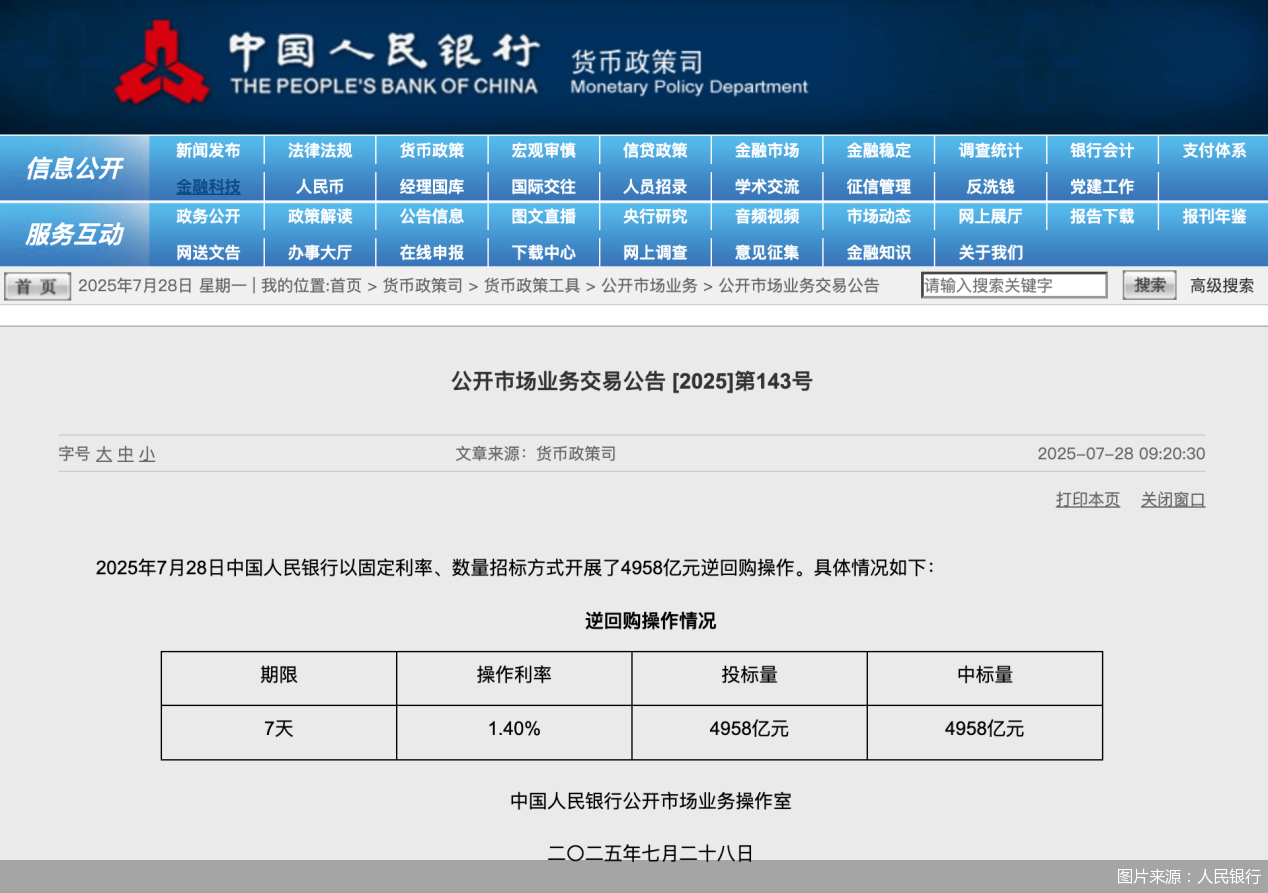
Group 1 - The People's Bank of China (PBOC) announced a 7-day reverse repurchase operation of 495.8 billion yuan at a fixed rate of 1.4%, resulting in a net injection of 325.1 billion yuan on July 28 [1][6][7] - The PBOC's actions are aimed at maintaining liquidity in the market, especially as the end of the month approaches, which typically sees seasonal tightening of funds [8][12] - The bond market has shown signs of recovery following the PBOC's increased liquidity measures, with yields on government bonds declining across various maturities [10][11] Group 2 - The recent increase in liquidity is a response to rising interest rates and tightening market conditions, particularly influenced by the recent surge in commodity prices [7][12] - Analysts expect the PBOC to continue implementing significant net liquidity injections to stabilize market expectations and prevent excessive interest rate increases [12][14] - The bond market has experienced fluctuations, with the 30-year government bond yield rising to 1.98% before the PBOC's interventions led to a decrease in yields [10][11]
宏观利率周报:股债“跷跷板”分流资金,关注重要会议及中美谈判-20250728
Hengtai Securities· 2025-07-28 11:32
Group 1: Economic Outlook - July global PMI fell short of expectations, indicating limited export growth in the second half of the year[1] - Manufacturing sector remains weak due to production restrictions, with economic growth in the first half providing a stable foundation[1] - The next round of growth stabilization measures is expected in Q4, with no need for premature tightening of monetary policy[1] Group 2: Market Dynamics - The "seesaw" effect between stock and bond markets continues, with funds being diverted from the bond market as equity markets gain momentum[1] - Major commodity exchanges issued risk warnings, leading to a broad decline in commodity futures, which may help stabilize interest rates[1] - The Shanghai Composite Index briefly surpassed 3600 points, reflecting a positive market sentiment[1] Group 3: Key Developments - The third batch of 690 billion yuan in special government bonds has been allocated to support consumption upgrades[8] - The issuance of replacement bonds has reached 90% of the annual quota, with 1.8 trillion yuan issued by the end of June[8] - The insurance industry has lowered the maximum guaranteed interest rate for new products to 2.0%[9] Group 4: International Context - The U.S. and EU reached a 15% tariff agreement, with the EU committing to invest an additional $600 billion in the U.S.[12] - The EU has paused interest rate cuts after eight consecutive reductions, citing "exceptional uncertainty" in the current environment[12] - India's trade agreement with the UK will eliminate tariffs on 99% of Indian exports to the UK[12]
公募基金泛固收指数跟踪周报(2025.07.21-2025.07.25):情绪冲击,债市调整-20250728
HWABAO SECURITIES· 2025-07-28 10:47
Report Industry Investment Rating No relevant content provided. Core View of the Report - Last week (July 21 - July 25, 2025), bond yields oscillated upwards. The ChinaBond Composite Wealth Index (CBA00201) fell 0.39%, and the ChinaBond Composite Full - Price Index (CBA00203) fell 0.44%. Interest - rate bonds and credit bonds across all tenors and ratings saw yield increases, and most credit spreads widened. The bond market adjusted due to the release of negative factors, the US Treasury yield curve flattened, and the secondary market for REITs declined while trading activity picked up [3][10]. - As of July 25, the total scale of 39 bond ETF products in the market exceeded 500 billion yuan, reaching 510.505 billion yuan, a nearly 200% increase from the beginning of the year, with science - innovation bond ETFs as the core growth driver [4]. Summary by Related Catalogs 1. Weekly Market Observation 1.1. Pan - Fixed - Income Market Review and Observation - **Bond Market Review**: Last week, bond yields oscillated upwards. Interest - rate bonds across all tenors declined, with medium - and long - term yields rising significantly more than short - term ones. Credit bond yields across all tenors and ratings increased, and most credit spreads widened. The 1 - year, 3 - year, 5 - year, and 10 - year Treasury yields rose 3.38bp, 6.64bp, 9.14bp, and 7.07bp respectively [3][10]. - **Bond Market Adjustment**: The bond market adjusted due to the release of negative factors. The central bank's net open - market injection was 10.95 billion yuan last week. The money market was tight at first and then loose, with DR007 and R007 rising 14.56bp and 18.65bp respectively. The bond market adjusted significantly due to factors such as improved fundamental expectations, a higher issuance rate of 30 - year special Treasury bonds, and the stock - bond seesaw effect. In the short term, the broad - money direction is unlikely to change, and the money market may be a disturbing factor. The central bank's support means limited liquidity risk, but the stock market may continue to affect the bond market [10][11]. - **US Treasury Yield Curve**: The US Treasury yield curve flattened. At the beginning of the week, yields declined due to risk - aversion, then rebounded as tensions eased. On Thursday, lower - than - expected initial jobless claims data pushed up short - term yields. In the future, the FOMC meeting may keep interest rates unchanged, and strong economic data may further dampen rate - cut expectations. Short - term yields can be traded on the dips, while caution is advised for long - term bonds [12]. - **REITs Market**: The secondary market for REITs declined, but trading activity picked up. The CSI REITs Total Return Index fell 1.56% last week. After the decline in July, the valuations of REITs projects adjusted, and the cash distribution rate increased. Individual bonds in sectors such as consumption and affordable housing have increased cost - effectiveness [13]. 1.2. Public Fund Market Dynamics - As of July 25, the total scale of 39 bond ETF products in the market reached 510.505 billion yuan, a nearly 200% increase from the beginning of the year. Science - innovation bond ETFs were the core growth driver, with the first batch of 10 products reaching over 100 billion yuan in scale in the first week after listing. The bond ETF market has diverse product types, and there is still room for development in terms of supply, product innovation, and investor structure [4][14][15]. 2. Pan - Fixed - Income Fund Index Performance Tracking | Index Classification | This Week | Last Month | YTD | Since Strategy Inception | | --- | --- | --- | --- | --- | | Short - Term Bond Fund Selection | - 0.08% | 0.07% | 0.59% | 4.00% | | Medium - and Long - Term Bond Fund Selection | - 0.30% | - 0.13% | 0.68% | 6.32% | | Low - Volatility Fixed - Income + Fund Selection | - 0.11% | 0.40% | 1.62% | 2.90% | | Medium - Volatility Fixed - Income + Fund Selection | 0.14% | 1.02% | 2.33% | 2.85% | | High - Volatility Fixed - Income + Fund Selection | 0.42% | 1.34% | 4.68% | 4.42% | | Convertible Bond Fund Selection | 2.24% | 4.77% | 11.60% | 15.09% | | QDII Bond Fund Selection | 0.33% | 0.42% | 3.17% | 8.16% | | REITs Fund Selection | - 1.61% | - 3.99% | 26.83% | 35.47% | 2.1. Pure Bond Index Tracking - **Short - Term Bond Fund Selection Index**: Aims at liquidity management, selects 5 funds with stable long - term returns, strict drawdown control, and significant absolute - return capabilities, and uses 50% Short - Term Pure Bond Fund Index + 50% General Money - Market Fund Index as the benchmark [17]. - **Medium - and Long - Term Bond Fund Selection Index**: Aims at stable returns by investing in medium - and long - term pure bond funds, selects 5 funds, adjusts duration and the ratio of credit and interest - rate bond funds according to market conditions [19]. 2.2. Fixed - Income + Index Tracking - **Low - Volatility Fixed - Income + Selection Index**: Has an equity central position of 10%, selects 10 funds with an equity central position of less than 15% in the past three years and recently, and uses 10% CSI 800 Index + 90% ChinaBond New Composite Full - Price Index as the benchmark [24]. - **Medium - Volatility Fixed - Income + Selection Index**: Has an equity central position of 20%, selects 5 funds with an equity central position between 15% - 25% in the past three years and recently [24]. - **High - Volatility Fixed - Income + Selection Index**: Has an equity central position of 30%, selects 5 funds with an equity central position between 25% - 35% in the past three years and recently, and focuses on funds with strong stock - picking ability in the equity segment [27]. 2.3. Convertible Bond Fund Selection Index - Selects bond - type funds with an average convertible - bond investment ratio of at least 60% in the latest period and at least 80% in the past four quarters as the sample space, and selects 5 funds based on an evaluation system [29][33]. 2.4. QDII Bond Fund Selection Index Tracking - Selects 6 QDII bond funds with stable returns and good risk control based on credit and duration [35]. 2.5. REITs Fund Selection Index Tracking - Selects 10 REITs funds with stable operations, reasonable valuations, and certain elasticity based on the underlying asset type [37].