
通胀预期

Search documents
国债期货12月报-20251128
Yin He Qi Huo· 2025-11-28 11:40
1. Report Industry Investment Rating No relevant content provided. 2. Core Viewpoints of the Report - The weak sentiment in the bond market persists, and it is waiting for the negative factors to materialize. The expectation of interest rate cuts within the year has weakened, and the improvement in inflation expectations continues to constrain the decline of Treasury bond yields. However, the current situation of the fundamentals and the capital market does not support a trend - like rebound in yields, so the bond market trend remains uncertain [6][70]. - Although the rumors of strict public - offering sales regulations and increased fund redemptions have intensified short - term fluctuations, preventive adjustments help release potential risks in advance, and regulatory statements have sent out signals to stabilize the market, so there is no excessive pessimism about the subsequent unilateral trend of the bond market [6][70]. - The current slope of the medium - and short - term end of the yield curve is relatively flat, and the long - term end is steeper. Curve trading may require event - driven factors such as interest rate cuts, inflation, or real - estate policies [6][70][71]. 3. Summary by Directory 3.1 First Part: Preface Summary 3.1.1 Market Review - In November, the bond market did not continue the previous month's recovery trend. Near the end of the month, rumors of the upcoming implementation of public - offering sales regulations resurfaced, and market sentiment quickly weakened. As of the mid - day on November 28, the main contracts of TS, TF, T, and TL decreased by 0.12%, 0.25%, 0.48%, and 1.68% respectively within the month. As of the close on November 27, the IRR of the main contracts of TS, TF, T, and TL were approximately 1.6325%, 1.6068%, 1.6707%, and 1.7541% respectively [5]. 3.1.2 Market Outlook - The weakening of the expectation of interest rate cuts within the year and the improvement in inflation expectations continue to constrain the decline of Treasury bond yields. The current fundamentals and capital market situation do not support a trend - like rebound in yields, and the bond market trend is still uncertain with few high - certainty opportunities [6]. - With the public - offering sales regulations still undecided, the market at the end of the month is more dominated by investor behavior and sentiment. The rumors of strict regulations and increased fund redemptions have intensified short - term fluctuations. However, preventive adjustments help release potential risks, and regulatory statements have sent out signals to stabilize the market, so there is no excessive pessimism about the subsequent bond market [6]. - The current slope of the medium - and short - term end of the yield curve is relatively flat, and the long - term end is steeper. Curve trading may require event - driven factors [6]. 3.1.3 Strategy Recommendations - Unilateral trading: Lightly bet on short - term rebounds, and a better window for going long may appear after the negative factors materialize [7]. - Arbitrage: Temporarily wait and see [7]. - Options: No recommendations [7]. 3.2 Second Part: Market Logic Analysis 3.2.1 "Weak Reality" Continues, Focus on Potential Expectation Gaps - In October, major domestic macro - economic indicators generally weakened. In terms of demand, in the investment sector, the single - month year - on - year growth rate of fixed - asset investment was - 12.2%, a decrease of 5.1 percentage points from the previous month, and the seasonally adjusted month - on - month growth rate was - 1.62%, a new low for the year. In the consumption sector, the year - on - year growth rate of total retail sales of consumer goods in October slightly decreased by 0.1 percentage points to 2.9% [10]. - In the foreign trade sector, in October, China's export amount decreased by 1.1% year - on - year, and the import amount increased by 1.0% year - on - year, both falling short of expectations. The decline in export growth was related to the high base in the same period last year and the intensification of Sino - US trade disputes. The weakening of import growth reflected the weak domestic demand [11]. - On the production side, although there was still resilience, the year - on - year growth rate also declined. In October, the year - on - year growth rate of industrial added value was 4.9%, a decrease of 1.6 percentage points from the previous month, and the seasonally adjusted month - on - month growth rate was 0.17%, a new low for the year [11]. - The bond market has not fully priced in the weak fundamentals because it is not difficult to achieve the annual economic growth target, and the decline in indicators may be temporary. However, the continuous weakening of some domestic demand indicators since the second half of the year may indicate that the multiplier effect of previous policies is not obvious, and the self - repair ability of the domestic economy is weak. Geopolitical factors also cannot be ignored [12][15]. 3.2.2 Prices Continue to Recover, Inflation Expectations Are Optimistic - Price indicators continued to recover. In October, the year - on - year and month - on - month growth rates of CPI were both 0.2%, an increase of 0.5 and 0.1 percentage points respectively from the previous month. The year - on - year and month - on - month growth rates of core CPI both increased by 0.2 percentage points to 1.2% and 0.2% respectively. In October, the year - on - year and month - on - month growth rates of PPI were - 2.1% and 0.1% respectively, an increase of 0.2 and 0.1 percentage points respectively from the previous month, and the month - on - month growth rate turned positive for the first time this year [21]. - The current recovery of CPI is driven by structural factors, and there may still be deflationary pressure. The high - frequency data shows that the upward momentum of industrial product prices is not strong, and price recovery may require demand - side policy support. Multiple factors may lead to the GDP deflator turning positive at least temporarily, which suppresses the performance of the bond market, especially long - term bonds [22][35]. 3.2.3 The Growth Rate of Social Financing Continues to Slow Down, and an Inflection Point in M1 Appears - In October, financial data was mediocre. New RMB loans were 220 billion yuan, a year - on - year decrease of about 280 billion yuan. The balance of loans increased by 6.5% year - on - year, a decrease of 0.1 percentage points from the previous month. The social financing scale was 815 billion yuan, a year - on - year decrease of 597 billion yuan, and the year - on - year growth rate of social financing was 8.5%, a decrease of 0.2 percentage points from the previous month [36]. - The slowdown in credit expansion affected deposit creation. In October, the year - on - year growth rate of M2 was 8.2%, a decrease of 0.2 percentage points from the previous month, and the year - on - year growth rate of M1 was 6.2%, a decrease of 1.0 percentage point from the previous month, showing an inflection point [39][41]. - Weak financial data is favorable for the bond market, but the market has already priced in the weakness to a certain extent. The probability of the central bank increasing monetary policy due to weak financial data is not high. In November, the loan situation may improve, and the social financing scale may be supported, but the year - on - year growth rate of some financial indicators such as M1 may continue to slow down [49]. 3.2.4 The Central Bank's Support Remains, but It's Difficult for Fund Prices to Decline - In November, the market's capital supply and demand were generally balanced. As of November 27, DR001 and DR007 were 1.3740% and 1.4685% respectively, up 3.68bp and 1.06bp from the previous month. The central bank's attitude towards maintaining liquidity is unchanged, and the reverse - repurchase operation shows a peak - shaving and valley - filling characteristic, and the pace of "long - term money" injection is stable [55]. - The third - quarter monetary policy report of the central bank continues to have a relatively loose tone, but the expectation of interest rate cuts and reserve requirement ratio cuts within the year has further decreased. It is difficult for fund prices to decline, which restricts the decline of Treasury bond yields, especially short - term yields. The report may also imply that the upper limit of the 30 - year Treasury bond yield is around 2.25% [65][67]. 3.2.5 The Public - Offering New Regulations Are Uncertain, and Incremental Information Is Mostly Negative - In mid - to late November, some investors may have briefly speculated on the central bank's Treasury bond trading information in November, causing the TF and T contracts to perform relatively strongly. However, near the end of the month, rumors of public - offering sales regulations suppressed bond market sentiment. Incremental information such as potential mortgage interest subsidy policies, Sino - US leader phone calls, and rumors of the central bank's bond purchases falling short of expectations are relatively negative [68]. - If the mortgage interest subsidy policy is implemented next year with a large subsidy amount and wide coverage, it will be negative for the bond market in the long - term, but the short - term impact may be mainly on sentiment [68]. 3.3 Third Part: Future Outlook and Investment Strategies - The expectation of interest rate cuts within the year has weakened, and the improvement in inflation expectations continues to constrain the decline of Treasury bond yields. The current fundamentals and capital market situation do not support a trend - like rebound in yields, and the bond market trend remains uncertain. The public - offering sales regulations are uncertain, and short - term fluctuations are intensified, but there is no excessive pessimism about the subsequent bond market [70]. - The current slope of the medium - and short - term end of the yield curve is relatively flat, and the long - term end is steeper. Curve trading may require event - driven factors [70][71]. - In terms of operations, after the sharp decline in Treasury bond futures at the end of the month, short - term unilateral trading can moderately bet on oversold rebounds. In the long - term, it is reasonable to allocate some long positions in Treasury bond futures to hedge against macro - expectation gaps. In terms of arbitrage, it is recommended to wait and see [71].
Euro zone consumers continue to see benign inflation path, ECB survey shows
Reuters· 2025-11-28 09:12
Euro zone consumers raised their near-term inflation expectations a touch but kept them unchanged further out, a European Central Bank survey showed, supporting bets that price growth remains around target and no more rate cuts are needed. ...


3万吨,雅化集团新建锂盐产线,锂矿走强!紫金矿业涨超1%,持股川西超级金矿!有色50ETF(159652)一度涨2%,盘中强势吸金1300万元!
Sou Hu Cai Jing· 2025-11-28 03:27
Core Viewpoint - The A-share market shows a mixed trend with the non-ferrous sector experiencing upward fluctuations, particularly highlighted by the performance of the Non-Ferrous 50 ETF (159652), which has seen significant inflows and a year-to-date increase of 70.77% [4][6]. Group 1: Market Performance - As of November 28, the Non-Ferrous 50 ETF (159652) rose by 1.64%, with a peak increase of over 2%, attracting net subscriptions of 900,000 units, amounting to over 13 million yuan [1]. - The majority of the constituent stocks of the Non-Ferrous 50 ETF have shown strong performance, with notable increases such as Yahua Group rising over 5% and Huayou Cobalt and Chifeng Jilong Gold increasing over 3% [3][5]. Group 2: Industry Insights - Yahua Group announced a lithium salt production capacity of 99,000 tons, with an additional 30,000 tons production line expected to be operational by the end of 2025 [6]. - The exploration project in Songpan County has identified an additional gold resource of 28.24 tons, bringing the total to 81.06 tons, valued at over 76 billion yuan [6]. Group 3: Investment Outlook - Analysts express a positive outlook for the non-ferrous sector, with Citic Securities indicating that the sector is poised for further advancement [6]. - The financial attributes of metals like gold and copper are expected to strengthen due to declining real interest rates and increasing inflation expectations, making them attractive as inflation hedges [8][11]. - The supply-demand dynamics for copper and aluminum are expected to improve, driven by new demand from sectors like AI and renewable energy, suggesting a bullish trend for these metals [7][13]. Group 4: ETF Characteristics - The Non-Ferrous 50 ETF (159652) has a high concentration of key metals, with copper accounting for 33% and gold for 13%, making it a leading choice in the sector [17]. - The ETF has demonstrated superior performance since 2022, with a cumulative return that outpaces its peers while maintaining a reasonable valuation, as indicated by a PE ratio of 23.74, down 61% from five years ago [19].



欧央行10月会议纪要:“不急于降息”成共识,当前观望是最佳策略
Zhi Tong Cai Jing· 2025-11-27 13:44
Core Points - The European Central Bank (ECB) consensus from the October meeting indicates a reluctance to lower interest rates, citing high uncertainty and the adequacy of current monetary policy [1] - The ECB decided to maintain interest rates, believing the current policy is in a "good state" due to economic resilience and inflation being close to target levels [1] - Market sentiment suggests that there is only about a one-third chance of further monetary easing by the ECB until 2026 [1] Summary by Sections Monetary Policy Stance - The ECB's October meeting minutes reveal a preference for maintaining a wait-and-see approach, with current policy rates viewed as robust enough to handle shocks [1] - Some officials believe the rate-cutting cycle may have ended, as favorable economic prospects are expected to persist unless risks materialize [1] Economic Indicators - Subsequent economic data released since the meeting has reinforced market expectations, showing that the Eurozone economy continues to grow, albeit at a slow pace [1] - Inflation rates remain anchored near the ECB's target of 2%, contributing to the confidence in the current monetary policy stance [1] Future Inflation Concerns - There is a potential for next year's inflation rate to fall below the target level due to the base effect from declining energy prices, which could reignite discussions on rate cuts [2] - Despite the ECB's traditional disregard for inflation fluctuations caused by energy price volatility, some board members warn that sustained low inflation readings could lower inflation expectations and lead to prolonged weak price growth [2]
【环球财经】土耳其家庭与实业部门11月通胀预期趋缓
Xin Hua Cai Jing· 2025-11-26 13:49
土耳其财政部长穆罕默德·希姆谢克表示,家庭与实业部门通胀预期下降反映出政府自2023年中期实施 的"去通胀计划"正在发挥越来越明显的效果,预期持续改善将有助于逐步缓和企业定价行为。 虽然家庭与实业部门通胀预期下降支持官方"去通胀"叙事,但市场预期上行也表明通胀风险仍受到投资 者关注。值得注意的是,通胀预期下降的同时,认为未来一年通胀会回落的家庭比例也在下降,显示消 费者对价格稳定的节奏与持续性存疑。 (文章来源:新华财经) 新华财经伊斯坦布尔11月26日电(记者许万虎)土耳其央行25日发布的一项调查显示,尽管市场机构的 通胀预期小幅上升,但11月家庭与实业部门对未来12个月的通胀预期整体回落。 根据调查结果,市场专业人士预计未来12个月的年通胀率为23.49%,较上月上升0.23个百分点。相比之 下,实业部门与家庭的预期继续走弱,其中,实业部门将未来12个月通胀预期下调0.6个百分点至 35.70%,家庭部门则将预期下调2.15个百分点至52.24%。 ...
斯里兰卡央行:预计核心通胀将以温和的速度加速上升
Sou Hu Cai Jing· 2025-11-26 02:24
来源:金融界AI电报 斯里兰卡央行:理事会认为,当前的货币政策立场将有助于引导通胀朝着5%的目标水平发展。预计通 胀率的上升速度将比此前预测的更为缓慢,并在2026年下半年趋近目标水平。预计核心通胀将以温和的 速度加速上升。中期通胀预期仍围绕通胀目标保持稳定。随着外汇流动性改善,卢比贬值压力得到缓 解。斯里兰卡法定准备金率设定为2%。 ...
Consumer confidence hits lowest point since April as job worries grow
CNBC· 2025-11-25 15:14
A hiring sign is displayed in the window of a business in Manhattan on Nov. 27, 2025 in New York City.Consumers soured on the current economy and their prospects for the future, with worries growing over the ability to find a job, according to a Conference Board survey released Tuesday.The board's Consumer Confidence Index for November slumped to 88.7, a drop of 6.8 points from the prior month for its lowest reading since April. Economists surveyed by Dow Jones were looking for a reading of 93.2.In addition ...

通胀预期重燃!PPI公布在即 美债市场率先承压
智通财经网· 2025-11-25 12:40
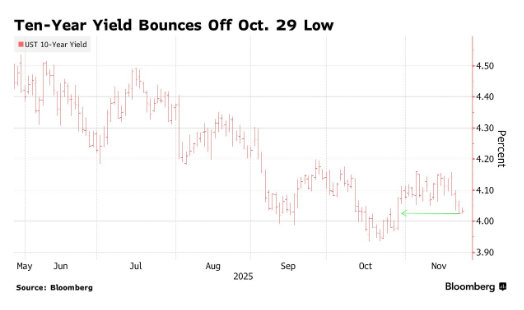
Group 1 - U.S. Treasury prices have declined ahead of key economic data releases, with expectations of rising inflation pressures that may weaken market expectations for Federal Reserve rate cuts [1][3] - The yield on the 10-year Treasury rose by 1 basis point to 4.04%, ending a three-day upward trend, while earlier it had dropped to the lowest level of the month [1] - Economists anticipate a rebound in the Producer Price Index (PPI) data, which is set to be released soon [1] Group 2 - Traders are betting on an approximately 80% probability of a 25 basis point rate cut by the Federal Reserve on December 10, but a rebound in inflation could impact future policy direction [3] - The Chief Investment Officer at Northern Trust Asset Management indicated that delayed economic data due to government shutdowns may lead the Fed to implement a "preventive rate cut" next month [3] - The U.S. Treasury is set to auction 5-year notes and restart the issuance of 2-year notes, with investors showing avoidance in recent short-term Treasury auctions [3] Group 3 - There is a risk that yields may retreat from current levels as the 10-year yield approaches the critical 4% level, which has previously acted as resistance [4]
每日机构分析:11月25日
Xin Hua Cai Jing· 2025-11-25 09:41
·摩根士丹利:印度财政赤字目标面临严峻挑战,收支失衡加剧 ·澳洲联邦银行:澳储行或于2026年重启加息,潜在增长放缓推升通胀风险 ·澳新银行-罗伊摩根数据显示,新西兰11月下旬通胀预期升至5.4%,创2023年12月以来新高,较10月上 升0.4个百分点。过去六个月周度预期均值维持在5.0%高位,持续高企的通胀预期将显著制约新西兰联 储进一步降息的空间,加大货币政策决策难度。 ·穆迪分析指出,亚太地区GDP增速将从2025年的4.1%放缓至2026年的3.6%,2027年进一步降至3.5%。 报告指出,今年出口激增主要受美国关税上调前的抢运效应驱动,难以持续;叠加疲弱的亚太多国国内 需求,不仅削弱抵消外部冲击的能力,也加剧通缩压力,区域增长前景面临挑战。 ·AMP经济学家指出,澳大利亚住房短缺约20万至30万套,主因移民增长长期超出住房供应能力。建议 将年度净移民从当前31.6万人削减至约20万人,以重建供需平衡,缓解日益严峻的住房负担能力危机。 ·澳联邦银行经济学家指出,若澳大利亚通胀压力持续、劳动力市场趋紧,澳洲联储可能在2026年重启 加息。尽管当前概率不高,但受生产率疲软拖累,澳大利亚潜在经济增长放缓 ...
黄金4000美元保卫战
Xin Lang Cai Jing· 2025-11-25 02:54
Group 1 - The core point of the article indicates that the market experienced a weak opening last Friday, with a minimum drop to 4022, close to the support level of 4000, followed by a strong rebound during the European and American sessions, peaking at 4102 before retreating [3] - The U.S. November one-year inflation expectation final value showed a decrease in concerns compared to the previous value, leading to a reduced expectation of rising inflation [4] - The probability of a 25 basis point rate cut by the Federal Reserve in December increased to 69.4%, up from 39.6% just a week prior, influenced by comments from influential Federal Reserve officials [4] Group 2 - Short-term gold prices are fluctuating between the 4000-4100 range, with a higher probability of a decline, and there is a need to be cautious about the 4000 support level [5] - Last Friday, gold prices showed a rebound from a low, but the daily line indicates a potential for a bearish trend if the price does not break above 4101 [8] - The current key resistance level for gold is at 4073.2, and if this level is not surpassed, a bearish outlook is favored, with support around 4035 [8]
