
AI科技

Search documents
A500ETF基金(512050)连续两日获资金净流入,机构:建议优先配置核心资产及低位板块
2 1 Shi Ji Jing Ji Bao Dao· 2025-05-27 03:08
Group 1 - The A-share market is experiencing a divergence in hotspots, with sectors like 6G, optical chips, and AI technology concepts undergoing corrections, while cultivated diamonds, emulsions, and the three-child policy concepts are performing well [1] - The A500 ETF (512050) has seen a trading volume exceeding 1.27 billion yuan, ranking first among its peers, despite a decline of 0.32% [1] - The A500 ETF has recorded a cumulative net inflow of over 280 million yuan in the past two trading days, indicating strong investor interest [1] Group 2 - Citic Securities suggests that with increasing external uncertainties and accelerated theme rotation, there is a growing preference for core assets and low-position sectors [2] - The current market is characterized by high sentiment but increased volatility, with a shift in focus from grand narratives to certainty [2] - Key themes to watch include edge AI, military industry, mergers and acquisitions, and public fund underweighting, driven by domestic stimulus policies and global geopolitical changes [2]
第一参编!九牧发布《既有住宅厨卫换新改造技术规程》团标
Sou Hu Wang· 2025-05-27 00:27
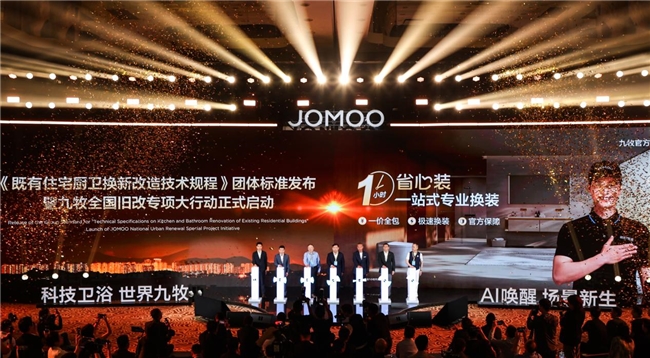
Core Viewpoint - The article highlights the launch of AI-driven innovations in the home improvement sector, particularly in the bathroom and kitchen renovation industry, led by JOMOO, which aims to enhance living quality in line with national standards for housing. Group 1: Industry Transformation - The global bathroom industry leader, JOMOO, held a technology innovation conference in Shanghai, unveiling two new AI-driven brands: JOMOO AI BATH and Xiao Mu YOUNG BATH [1] - JOMOO, as the first participating unit, collaborated with the China Building Materials Industry Economic Research Association to release the group standard for kitchen and bathroom renovation, marking a new phase of standardization and intelligence in home improvement services [1][3] Group 2: Standardization and Quality Improvement - The newly released group standard fills the gap in existing renovation standards, providing a scientific reference for the industry and promoting the advancement of renovation service systems [3] - The standard aims to address the renovation needs of aging residential areas, where issues like outdated facilities and poor insulation are prevalent, thus enhancing overall living quality [4] Group 3: Implementation and Services - To facilitate the implementation of the new standard, JOMOO announced a nationwide renovation initiative, introducing the "JOMOO Official Worry-Free Installation" service, which promises a one-hour, all-inclusive professional installation experience [6] - This service will address common consumer pain points such as long renovation times, lack of price transparency, and unprofessional service, covering eight product categories and 62 renovation scenarios [6] Group 4: Consumer Engagement and Promotions - JOMOO has launched various promotional activities, including "National Subsidy Season" and partnerships with major platforms like Red Star Macalline and JD.com, to provide consumers with tangible benefits and convenience [9] - The company has established over 4,000 service points nationwide, employing more than 10,000 service engineers, and has completed over 100 million service orders, demonstrating its commitment to quality and customer service [9]

小鹏汽车-W(09868):2025年Q1业绩点评:汽车毛利率创新高,减亏幅度超预期
Changjiang Securities· 2025-05-24 13:43
Investment Rating - The investment rating for the company is "Buy" and is maintained [7]. Core Insights - In Q1 2025, the company achieved revenue of 15.81 billion, representing a year-on-year increase of 141.5% and a quarter-on-quarter decrease of 1.8%. The gross margin reached 15.6%, up 2.7 percentage points year-on-year and 1.1 percentage points quarter-on-quarter. The net loss was 660 million, narrowing by 700 million year-on-year, while the Non-GAAP net loss was 430 million, a reduction of 980 million year-on-year. The company's smart driving capabilities remain leading, and with a strong new vehicle cycle, combined with channel reforms and enhanced marketing systems, sales are expected to accelerate [2][4]. Summary by Sections Financial Performance - In Q1 2025, the automotive business generated revenue of 14.37 billion, a year-on-year increase of 159.2%, with a delivery volume of 94,000 vehicles, up 330.8% year-on-year. The average revenue per vehicle was 168,000. The delivery volume structure showed significant contributions from models MONA M03, P7+, G6, and G9, with respective deliveries of 47,000, 24,000, 13,000, and 5,600 vehicles, accounting for 50.1%, 25.4%, 14.0%, and 6.0% of total deliveries. The automotive gross margin was 10.5%, up 5.0 percentage points year-on-year and 0.4 percentage points quarter-on-quarter [4][9]. Service Revenue - The service business revenue for Q1 2025 was 1.44 billion, reflecting a year-on-year increase of 43.6% and a quarter-on-quarter increase of 0.5%. The service gross margin was 66.4%, up 12.4 percentage points year-on-year and 6.8 percentage points quarter-on-quarter. The high gross margin from the service business significantly enhanced the overall service gross margin [9]. Cost and Expenses - The company experienced a significant increase in sales volume, which diluted the expense ratio. In Q1 2025, R&D expenses were 1.98 billion, up 46.7% year-on-year, with an R&D expense ratio of 12.5%. Selling and general expenses were 1.95 billion, up 40.2% year-on-year, with a selling and general expense ratio of 12.3% [9]. Future Outlook - For Q2 2025, the expected delivery volume is between 102,000 and 108,000 vehicles, representing a year-on-year increase of 237.7% to 257.5%. Expected revenue is projected to be between 17.5 billion and 18.7 billion, a year-on-year increase of 115.7% to 130.5%. The strong new vehicle cycle and continuous monthly sales growth, along with the successful launch of new models like G6 and G9, are anticipated to sustain sales momentum [9].
净水行业“矿泉战争”打响,云米未来10年将投入30亿
Bei Jing Ri Bao Ke Hu Duan· 2025-05-19 03:48
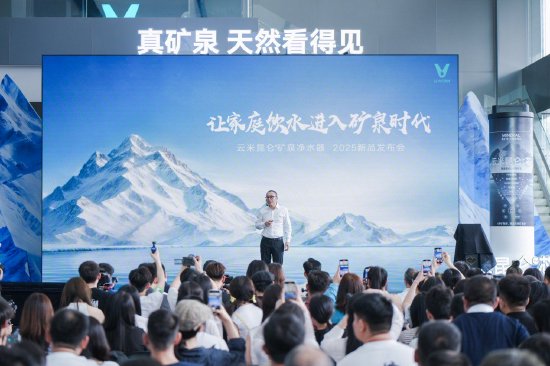
Core Viewpoint - Cloud-based technology brand Viomi Technology has introduced the Kunlun 4 mineral water purifier, which utilizes AI technology to replicate the natural mineral water formation process, enabling consumers to enjoy mineral water at home, thus promoting a "mineral water era" for household drinking [1] Group 1: Product Features and Technology - The Kunlun core is the key component of the Kunlun 4 mineral water purifier, featuring a 7+1 stage filtration process that includes PP cotton for removing impurities, activated carbon for absorbing chlorine and odors, RO membrane for eliminating bacteria and heavy metals, and natural Kunlun stone rich in six beneficial minerals [2] - The AI technology employed by Viomi mimics the mineral water formation process, allowing minerals to be released slowly over time, resulting in water that closely resembles natural mineral water [2] Group 2: Market Position and Consumer Insights - According to iiMedia Research, 43.9% of consumers in China prefer to purchase a box of bottled mineral water (12 bottles) at once, with water quality and mineral content being significant factors influencing their purchasing decisions [2] - Viomi has established the first industry standard for "Household and Similar Use Mineral-Level Water Purifiers" in collaboration with the China Inspection and Testing Association, positioning the Kunlun 4 as a certified product for maternal and infant use [3] Group 3: Future Plans and Investments - Viomi has invested 1 billion yuan over three years to establish the Kunlun Mineral Technology Research Center, employing over 100 researchers to select natural Kunlun stones for their products [1] - The company plans to invest 3 billion yuan over the next decade to further develop the water purification sector, focusing on AI technology innovations to enhance mineral water purifiers [3] - A digital "super water purification factory" has been completed with an annual production capacity of 5 million units and 30 million filter elements, demonstrating Viomi's commitment to improving consumer health through advanced technology [3]
云米发布昆仑4矿泉净水器,创始人陈小平:未来10年投入30亿all in净水
Xin Lang Ke Ji· 2025-05-16 13:26
Core Insights - Cloud Mi Technology launched the Kunlun 4 mineral water purifier, utilizing AI technology to replicate the natural mineral water formation process, marking a shift towards a "mineral water era" in home drinking water [2] - The increasing public awareness of health has led to a growing preference for mineral water, positioning mineral water purifiers as a new direction for home drinking water upgrades [2] Group 1 - Cloud Mi established the "Kunlun Mineral Technology Research Center," investing over 100 million yuan over three years and employing over 100 researchers to select natural Kunlun minerals for the Kunlun 4 purifier [2] - The core component, Kunlun Core, features a 7+1 level filtration system that purifies over 100 harmful substances while enriching water with six beneficial mineral elements, closely resembling natural mineral water [2] - The AI mineralization release system addresses the challenge of achieving long-lasting and uniform mineral release from the mineral filter, with over 150 patents applied for the Kunlun filter alone [2] Group 2 - Cloud Mi introduced four standards for true mineral water: using natural minerals, visible slow release of six minerals, weak alkaline water with visible pH, and compliance with dual authoritative certifications [3] - A digital water purification super factory, with an investment of 1 billion yuan, has been completed, with an annual production capacity of 5 million units and 30 million filter elements [3] - The company plans to invest 3 billion yuan over the next decade to continue innovating in the water purification sector using AI technology [3]

理财档案|降准降息,增厚投资收益有方法
Guang Zhou Ri Bao· 2025-05-15 15:37
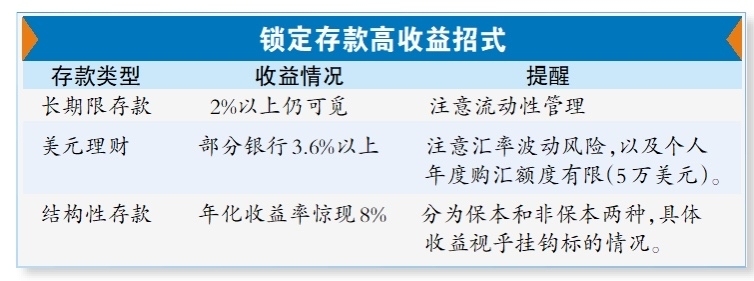
Core Viewpoint - The recent interest rate cuts by the central bank are expected to lead to a decrease in the Loan Prime Rate (LPR) by 0.1 percentage points, prompting commercial banks to lower deposit rates accordingly [1] Group 1: Deposit Strategies - Investors are advised to lock in high-yield deposits by choosing long-term deposits, such as 3-5 year large certificates of deposit (CDs) or fixed-term savings products, to secure current interest rates [2] - Some small banks are offering deposit products with interest rates exceeding 2%, such as Guangdong Huaxing Bank's 5-year CD at 2.35% and Guangzhou Bank's 3-year deposit at 2.15% [2] - Investors should also consider foreign currency deposits, with some banks offering annualized rates above 3.7% for USD deposits, but must be cautious of exchange rate fluctuations and annual purchase limits [2][4] Group 2: Structured Deposits - For investors with a certain risk tolerance, structured deposit products can be considered, with guaranteed returns ranging from 0% to 2.7% and potential maximum returns of 3.5% to 6% for guaranteed products, while non-guaranteed products can yield up to 8% [3] - It is important to monitor the performance of the underlying assets linked to structured deposits, as poor performance may lead to lower-than-expected returns [3] Group 3: Investment Portfolio Strategies - Analysts recommend diversifying investment portfolios, suggesting that risk-averse investors consider government bonds, which may benefit from the current monetary easing and global trade tensions [5][7] - For investors with higher risk tolerance, a balanced stock-bond portfolio strategy is advised to capture stable returns from fixed-income assets while participating in equity markets to benefit from policy support [7] - Focus areas for equity investments include emerging technologies such as AI, robotics, and biomedicine, as well as sectors related to consumer spending [7]
跃升全球保险业品牌价值第一位!中国平安蝉联BrandZ“最具价值全球品牌价值百强”
Cai Jing Wang· 2025-05-15 11:34
Group 1 - The core viewpoint of the article highlights that China Ping An has achieved the highest brand value in the global insurance industry, valued at over $26.3 billion, with a year-on-year growth of 25%, ranking 84th in the BrandZ global brand value top 100 list, an increase of 6 positions from the previous year [1] - China Ping An has maintained its position as the top insurance brand in China for ten consecutive years and is the only Chinese insurance group to be included in this year's BrandZ list [1] - BrandZ attributes the rise in brand value over the past 20 years to technology-driven disruptive business brands, emphasizing China Ping An's resilience and innovative capabilities [1] Group 2 - China Ping An aims to become an internationally leading integrated financial and healthcare service group, providing comprehensive solutions that cover the entire customer lifecycle, thereby creating value for customers, employees, shareholders, and society [2] - As of March 31, 2025, China Ping An has nearly 245 million personal customers, a 1.0% increase since the beginning of the year, with a retention rate of 98.0% for customers holding four or more contracts within the group [2] - Approximately 63% of China Ping An's personal customers enjoy services from its healthcare and elderly care ecosystem [2] Group 3 - The company focuses on user needs by implementing a comprehensive financial model that simplifies services for consumers, providing a "省心、省时、又省钱" (worry-free, time-saving, and cost-effective) service experience [3] - China Ping An has extended its car insurance services to include 82 convenient services for its 236 million car owners, and its home care services cover 75 cities nationwide [3] - The company has achieved a 93% instant underwriting rate for life insurance policies through technology empowerment [3] Group 4 - In Q1 2025, China Ping An's AI service volume reached approximately 450 million, covering 80% of its total customer service [4] - The intelligent claims interception in property insurance has reduced losses by 3.42 billion yuan, a year-on-year increase of 14.0% [4] - The company has built a robust AI infrastructure, processing over 1 billion data entries daily across 9 major databases, and has accumulated over 3.2 trillion high-quality text data for model training [4] Group 5 - China Ping An has invested nearly 10.14 trillion yuan in supporting the real economy and has a green investment scale of 124.71 billion yuan [4] - The company has achieved an MSCI ESG rating upgrade to AA, ranking first in the Asia-Pacific region for three consecutive years in the "comprehensive insurance and brokerage" category [4] - The BrandZ global brand top 100 list is recognized as one of the most authoritative brand valuation reports, with 12 Chinese brands making the list this year, including China Ping An [5]

电商5-6月迎来促销高峰:5月主送礼、6月多囤货 超九成用户认定买现货
Sou Hu Wang· 2025-05-13 08:50
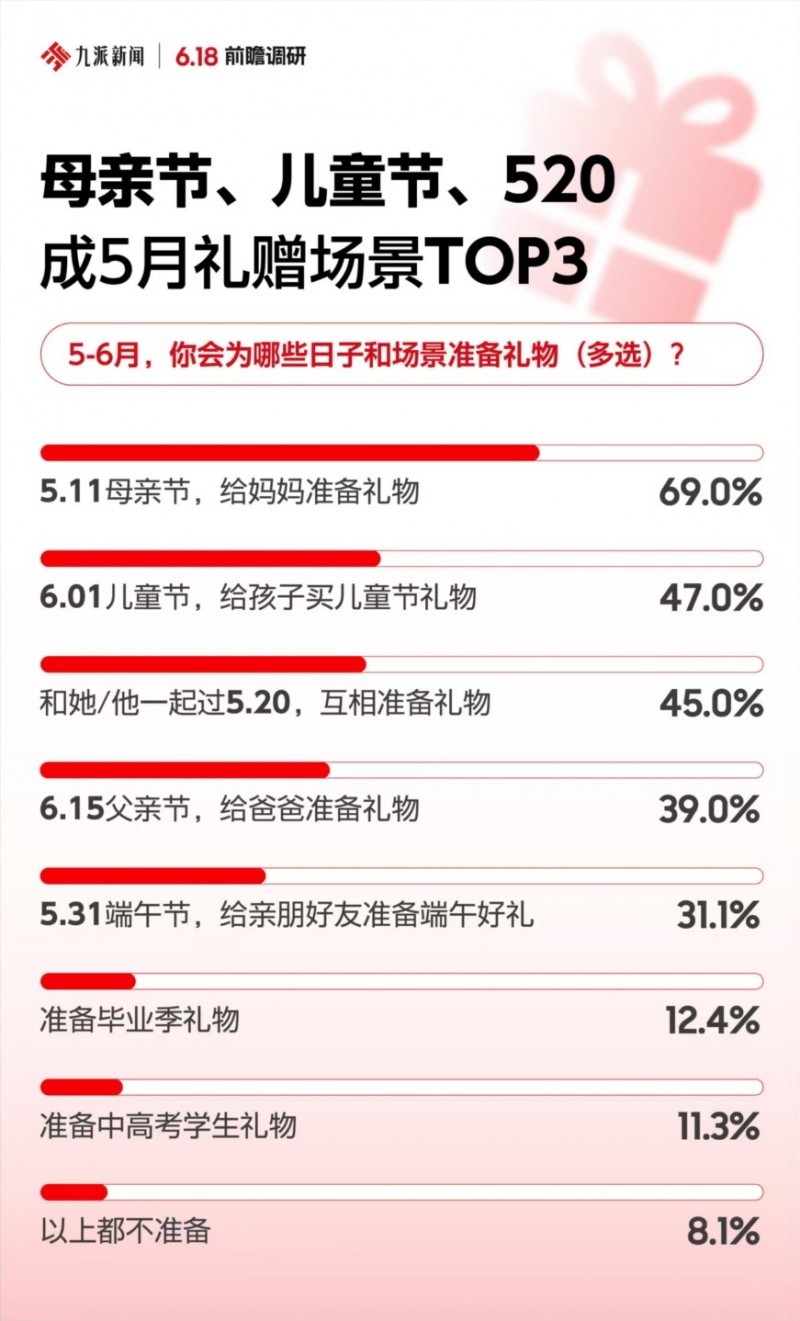
Core Insights - The period from May to June is a peak time for emotional and consumer spending, driven by various holidays and the 618 e-commerce promotion, which serves as a significant opportunity for consumer spending release [1][10] Consumer Behavior Trends - In May, nearly 40% of consumers focused on gift-giving, with Mother's Day (69.0%), Children's Day (47.0%), and 520 (45.0%) being the top occasions for gifts [3][5] - In June, consumers are more inclined to stock up on goods, with 66.1% planning to spend twice their gift budget during the 618 promotion [1][13] - A significant shift in consumer sentiment is noted, with 93.1% preferring to buy in-stock items rather than pre-sale products, indicating a desire for immediacy in purchases [1][14] E-commerce Dynamics - JD.com emerges as the preferred shopping platform for 92.2% of consumers during the 618 promotion, attributed to its advantages in price, quality, logistics, and service experience [19][21] - Over 40% of consumers are willing to pay a fair price for quality products, with JD.com being recognized for its balanced pricing, product offerings, and services [2][19] Promotional Strategies - Consumers express a preference for shorter promotional periods, with over 80% wanting the 618 promotion to last no longer than two weeks, reflecting a shift towards planned shopping rather than impulsive buying [10][11] - The majority of consumers (58.5%) perceive that the 618 promotion began earlier than usual, yet they remain focused on June for the best deals [10][13] Product Preferences - There is a growing interest in domestic brands and AI technology products, with 38.2% of consumers focusing on domestic goods and 34.8% planning to purchase AI-related products during the 618 promotion [16][17] - The trend towards experiential gifts is evident, with consumers opting for practical gifts that also provide emotional value, such as health-related products for Father's Day [5][6] Consumer Expectations - Consumers are increasingly seeking transparency and simplicity in promotional offers, with 46.7% favoring straightforward pricing models over complex discount schemes [15][19] - The emphasis on quality and value is reshaping consumer expectations, with 40.3% prioritizing high-quality products and being willing to pay a fair price for them [15][19]

恒生科技HKETF(513890)高开涨超2%,港交所推出“科企专线”备受市场热议
Sou Hu Cai Jing· 2025-05-12 02:19
Group 1 - The Hang Seng Technology HKETF (513890) opened up over 2% on May 12, 2025, with a turnover of 5.66% and a transaction value of 23.15 million yuan, while the Hang Seng Technology Index (HSTECH) rose by 1.26% [1] - Key stocks such as Sunny Optical Technology (02382) increased by 4.66%, BYD Electronics (00285) by 4.65%, and NIO-SW (09866) by 4.58%, indicating strong performance in the technology sector [1] - The Hong Kong Securities and Futures Commission and the Hong Kong Stock Exchange announced the launch of the "Tech Company Fast Track" on May 6, aimed at facilitating the listing of specialized technology and biotech companies, which is expected to encourage more companies to list in Hong Kong [1] Group 2 - Dongwu Securities expressed optimism about AI technology and domestic consumption, suggesting a focus on high-dividend stocks for defensive positioning due to ongoing overseas risks [2] - The report highlighted that the overall overseas risks remain, and a potential decline in US tech stocks could impact Hong Kong stocks, while a dividend payout wave is anticipated in the second quarter [2] - The political bureau meeting at the end of April emphasized the need to expand consumption and enhance its role in economic growth, reinforcing the focus on domestic consumption as a key theme for the year [2] Group 3 - Morgan Asset Management is integrating its "Global Vision Investment Technology" product line to help investors capitalize on quality tech companies globally, driven by the AI wave [3] - The actively managed funds focus on emerging industry trends, AI opportunities, and sectors like the new energy vehicle supply chain and humanoid robots [3] - The passive investment options include the Morgan Hang Seng Technology ETF (QDII) and other funds targeting innovative pharmaceutical companies and global tech leaders [4]



机构:看好港股AI科技,港股科技30ETF(513160)跳空高开,比亚迪电子涨超4%
2 1 Shi Ji Jing Ji Bao Dao· 2025-05-12 01:47
Group 1 - The Hong Kong stock market opened strongly on May 12, with the Hang Seng Index and the Hang Seng China Enterprises Index rising over 1%, and the Hang Seng Tech Index increasing by 2.15% [1] - The Hang Seng Stock Connect China Technology Index opened nearly 2% higher, with notable gains in stocks such as Highway Electronics rising over 6%, and AAC Technologies, BYD Electronics, and Sunny Optical Technology rising over 4% [1] - The Hong Kong Tech 30 ETF (513160) closely tracks the Hang Seng Stock Connect China Technology Index and opened with a gap up, currently up over 2% [1] Group 2 - Huatai Securities noted that the Hong Kong stock market shows strong relative return resilience, benefiting from a marginal easing of trade conflicts and mid-term market structural advantages, indicating further upward potential [2] - The April manufacturing PMI was below expectations, but the impact on Hong Kong stocks is limited due to low dependence on the export chain and midstream manufacturing [2] - Recent signals from the US regarding tariff negotiations and a stronger offshore RMB are expected to boost short-term market risk appetite [2] - Global funds seeking alternatives to US stocks may lead to a reallocation of capital towards Hong Kong stocks [2] - Dongwu Securities is optimistic about AI technology in Hong Kong stocks, citing strong performance in US tech earnings and favorable conditions for thematic trends [2]
