
智能座舱

Search documents
首发8大黑科技,2026款岚图梦想家成都车展开启预售
Zhong Guo Qi Che Bao Wang· 2025-08-29 07:13
Core Viewpoint - The Chengdu International Auto Show showcased the 2026 Lantu Dreamer, a high-end new energy MPV, which features advanced technology and competitive pricing, aiming to capture the high-end market segment in the new energy vehicle industry [1][3]. Group 1: Product Features - The 2026 Lantu Dreamer offers two power versions: intelligent super hybrid and intelligent pure electric, with a pre-sale price range of 389,900 to 459,900 yuan [1]. - It boasts eight cutting-edge technologies, including an 800V high-voltage architecture, long pure electric range, and advanced driving assistance systems [3][4]. - The pure electric range reaches 305 km, surpassing the average level of hybrid MPVs, and it features a peak charging power of 320 kW, allowing for a rapid charge from 20% to 80% in just 12 minutes [6]. Group 2: Performance and Efficiency - The new model is equipped with a hybrid engine with a thermal efficiency of 45.18%, dual motors with a total power of 490 kW, and a peak torque of 915 N·m, achieving 0-100 km/h acceleration in just 5.9 seconds [6]. - The CLTC fuel consumption is only 5.2 L/100 km, which is 30% lower than competitors in the same class [6]. Group 3: Intelligent Features - The Lantu Dreamer integrates Huawei's advanced driving assistance system (ADS 4) and HarmonyOS cockpit, providing a comprehensive intelligent experience with 27 sensing devices [7][9]. - The vehicle features a 15.6-inch HDR smart screen and supports seamless connectivity between mobile devices and the vehicle [9]. Group 4: Comfort and Luxury - The interior design incorporates traditional Chinese culture, with a focus on luxury and user experience, featuring high-tech materials and customizable seating options [10][12]. - The front seats utilize cloud-sensing technology, while the second row includes an AI zero-gravity massage function, enhancing passenger comfort [12]. Group 5: Market Position and Strategy - Lantu has established itself as a leader in the high-end new energy MPV market, with over 130,000 high-net-worth users and a strong recommendation score [3][14]. - The company is expanding its product lineup, including the launch of the Lantu ZhiYin and the Lantu Chasing Light L, to strengthen its market presence and meet diverse consumer needs [12][14].


理想汽车成绩单亮眼,成都车展盛大启幕!港股通汽车ETF(159323)午后涨近2%
Mei Ri Jing Ji Xin Wen· 2025-08-29 06:12
Group 1 - The Hong Kong stock market indices collectively rose on August 29, with strong performance in the lithium battery and new energy vehicle sectors, while semiconductor stocks mostly declined [1] - The Hong Kong Stock Connect Automotive ETF (159323) experienced fluctuations, rising nearly 2% during the afternoon session, with leading stocks including Tianneng Power, China Nonferrous Mining, Horizon Robotics, Nexperia, Li Auto, and Luoyang Molybdenum [1] - Li Auto reported its Q2 2025 earnings on August 28, showing a revenue of 30.2 billion yuan, a year-on-year decrease of 4.5% but a quarter-on-quarter increase of 16.7%, with a net profit of 1.1 billion yuan, remaining stable year-on-year and increasing by 69.6% quarter-on-quarter [1] Group 2 - The Hong Kong Stock Connect Automotive ETF (159323) is based on the Hong Kong Stock Connect Automotive Index (931239.CSI), which focuses on the Hong Kong vehicle sector, particularly passenger cars and new energy vehicle manufacturers [2] - The index includes companies like Zhixing Technology and Horizon Robotics, which are part of the intelligent driving industry chain, and has a higher concentration of intelligent driving stocks compared to A-share automotive indices [2] - As of August 28, Li Auto accounted for 10.11% of the weight in the Hong Kong Stock Connect Automotive ETF's underlying index [2]

德赛西威涨2.06%,成交额6.39亿元,主力资金净流入2130.68万元
Xin Lang Zheng Quan· 2025-08-29 03:08
Core Viewpoint - Desay SV's stock has shown significant growth in 2023, with a year-to-date increase of 20.65% and a notable rise in recent trading days, indicating strong market interest and performance in the automotive electronics sector [1][2]. Financial Performance - For the first half of 2025, Desay SV reported a revenue of 14.644 billion yuan, representing a year-on-year growth of 25.25%. The net profit attributable to shareholders was 1.223 billion yuan, reflecting a 45.82% increase compared to the previous year [2]. - Cumulatively, Desay SV has distributed 2.237 billion yuan in dividends since its A-share listing, with 1.438 billion yuan distributed over the last three years [3]. Shareholder and Market Activity - As of June 30, 2025, the number of shareholders increased by 20.92% to 59,000, while the average number of circulating shares per person decreased by 17.30% to 9,374 shares [2]. - On August 29, 2023, Desay SV's stock price reached 131.40 yuan per share, with a trading volume of 639 million yuan and a market capitalization of 72.92 billion yuan [1]. Business Overview - Desay SV, established on July 24, 1986, specializes in the research, design, production, and sales of automotive electronic products. Its main revenue sources are smart cockpits (64.59%), intelligent driving (28.32%), and connected services and others (7.09%) [1]. - The company operates within the software development sector, focusing on vertical application software, and is involved in various concept sectors including smart cockpits, Chery Automobile concepts, sensors, autonomous driving, and millimeter-wave radar [1].
上汽集团单月销量“六连涨”上半年扣非净利增逾4倍
Zheng Quan Shi Bao· 2025-08-28 23:06
Core Viewpoint - SAIC Motor Corporation reported a mixed performance in its 2025 semi-annual report, with revenue growth but a decline in net profit, highlighting both opportunities and challenges in the automotive market. Group 1: Financial Performance - The company achieved a consolidated operating revenue of 299.88 billion yuan, a year-on-year increase of 5.23% [1] - The net profit attributable to shareholders was 6.018 billion yuan, a year-on-year decrease of 9.21% [1] - The net profit after deducting non-recurring gains and losses was 5.431 billion yuan, showing a significant year-on-year increase of 432.21% [1] - The net cash flow from operating activities was 21.037 billion yuan, up 85.89% year-on-year [1] Group 2: Market Performance - Domestic vehicle sales increased by 11.7% year-on-year, driven by the "old-for-new" policy [1] - Total vehicle wholesale reached 2.053 million units, a year-on-year increase of 12.4% [1] - The company maintained its position as the leading player in the domestic market with retail sales of 2.207 million units [1] - Sales of the company's own brands reached 1.304 million units, up 21.1% year-on-year, with a market share increase to 63.5% [1] - New energy vehicle sales grew by 40.3% year-on-year, totaling 646,000 units [1] - Overseas sales reached 494,000 units, a year-on-year increase of 1.3% [1] Group 3: Strategic Initiatives - The company launched various initiatives to enhance consumer engagement, including trade-in subsidies and new vehicle offerings [2] - SAIC Motor is expanding its overseas market presence, with the MG brand becoming the top-selling Chinese brand in Western Europe [2] - The company is accelerating the development of key technologies, including second-generation solid-state batteries and smart cockpit systems in collaboration with OPPO [2] - The application rate of domestic chips is increasing, with ongoing technical collaborations with companies like Horizon [2] Group 4: Partnerships and New Projects - The company is advancing its collaboration with Huawei on the "SAIC尚界" project, focusing on product development and marketing strategies [3] - Preparations for the launch of the first product under the new brand are underway, with plans for additional products in the pipeline [3]

京东方精电(00710.HK):经营体现韧性 关注高端产品成长
Ge Long Hui· 2025-08-28 20:00
Core Viewpoint - The company reported a slight increase in revenue and profit for the first half of 2025, driven by growth in sales of TFT products, touch screen display modules, and automotive systems [1] Group 1: Financial Performance - In H1 2025, the company's revenue reached HKD 6.67 billion, representing an 8% year-on-year increase [1] - The automotive display segment generated HKD 6.25 billion, accounting for 94% of total revenue, with a 9% year-on-year growth [2] - The company's EBITDA for H1 2025 was HKD 340 million, a 7% increase year-on-year, with an EBITDA margin of approximately 5.1% [1] - The net profit attributable to shareholders increased by 5% year-on-year to HKD 180 million, with a net profit margin of 2.7% [1] Group 2: Business Segments - The automotive display business is a key growth driver, with a strong market position, particularly in the 8-inch and larger display segments [2] - The industrial display segment generated HKD 430 million in revenue, a 5% year-on-year increase, driven by demand in consumer electronics [2] - The company is focusing on dual-driven strategies in automotive and industrial sectors, leveraging AI and new industrial products to explore high-potential markets [2] Group 3: Expansion and Market Strategy - The company is actively expanding its overseas production capabilities, with the second phase of its Vietnam factory launched in June 2025 to mitigate tariff risks [3] - The company anticipates total revenue growth of approximately 13% to 15% from 2025 to 2027, with net profit expected to grow by 17% to 22% during the same period [3]


上汽集团单月销量“六连涨” 上半年扣非净利增逾4倍
Zheng Quan Shi Bao· 2025-08-28 17:51
Core Viewpoint - SAIC Motor Corporation reported a mixed performance in its 2025 semi-annual report, with revenue growth but a decline in net profit, highlighting the challenges and opportunities in the automotive industry amid increasing competition and evolving consumer demands [1][2][3] Financial Performance - The company achieved a consolidated operating revenue of 299.58 billion yuan, a year-on-year increase of 5.23% [1] - The net profit attributable to shareholders was 6.02 billion yuan, a year-on-year decrease of 9.21% [1] - The net profit excluding non-recurring items was 5.43 billion yuan, showing a significant year-on-year increase of 432.21% [1] - The net cash flow from operating activities reached 21.04 billion yuan, up 85.89% year-on-year [1] Market Performance - Domestic vehicle sales increased by 11.7% year-on-year, driven by the "old-for-new" policy [1] - Total vehicle wholesale reached 2.053 million units, a year-on-year increase of 12.4% [1] - Retail sales of vehicles amounted to 2.207 million units, maintaining the leading position in the domestic industry [1] - Sales of the company's own brands reached 1.304 million units, up 21.1% year-on-year, with a market share increase to 63.5% [1] - New energy vehicle sales grew by 40.3% year-on-year, totaling 646,000 units [1] - Overseas market sales reached 494,000 units, a year-on-year increase of 1.3% [1] Strategic Initiatives - The company launched various initiatives to stimulate consumer demand, including trade-in subsidies and new vehicle offerings [2] - SAIC Motor is expanding its overseas market presence, with the MG brand becoming the top-selling Chinese brand in Western Europe in the first half of the year [2] - The company is accelerating the development of key technologies, including second-generation solid-state batteries and smart cockpit systems in collaboration with OPPO [2] - The application rate of domestic chips is increasing, with ongoing technical collaborations with companies like Horizon [2] Collaborative Projects - The company is advancing its collaboration with Huawei on the "SAIC尚界" project, focusing on product development and marketing strategies [3] - The first product under this brand is set to launch in September, with additional products in development to enhance market coverage [3]
AI大模型正加速“上车”
AI研究所· 2025-08-28 13:00
Core Viewpoint - Tesla's integration of local AI models into its vehicles signifies a response to the growing demand for enhanced smart cockpit experiences in China, addressing previous shortcomings in user interaction and technology [1][2][25] Group 1: Market Trends and Predictions - The market for smart cockpit solutions in China's passenger vehicle sector is projected to reach 156.4 billion yuan by 2025, driven by the transformation of human-vehicle interaction through AI models [3] - The competition in the smart cockpit space is intensifying, with companies either developing their own AI models or partnering with leading tech firms to enhance user experience [3][25] Group 2: New Energy Vehicle Companies' Strategies - New energy vehicle companies like Xiaomi and NIO are focusing on self-developing AI models to create a closed-loop data and industry chain for their smart cockpits [4][10] - Xiaomi's "Human-Vehicle-Home Ecosystem" strategy exemplifies a successful model, integrating various devices for a seamless user experience [4][5][10] Group 3: Traditional Automakers' Collaborations - Traditional automakers are opting to collaborate with top tech companies to quickly address their AI deficiencies, as seen in Chery's partnership with iFlytek [11][12] - Chery's sales reached 2.6 million units in 2024, marking a 38.4% year-on-year increase, showcasing the effectiveness of its strategic focus on AI [12][14] Group 4: AI Model Development and Implementation - iFlytek is a leading player in the automotive AI model space, providing a comprehensive platform that supports various intelligent applications for vehicles [17][22] - The integration of iFlytek's AI model allows for voice command control of 90% of vehicle functions, enhancing user convenience and safety [16][25] Group 5: Competitive Landscape Among Tech Giants - Major tech companies like Huawei and Baidu are also entering the automotive AI space, with Huawei's HarmonySpace and Baidu's intelligent cockpit solutions [23][24] - The evolution of human-vehicle interaction is shifting towards emotional engagement and integrated decision-making, indicating a broader trend in automotive AI development [25]


上汽集团上半年扣非净利增432.21% 单月销售“六连涨”
Zheng Quan Shi Bao Wang· 2025-08-28 12:30
Core Insights - SAIC Motor Corporation reported a consolidated revenue of 299.59 billion yuan for the first half of 2025, representing a year-on-year growth of 5.23% [1] - The net profit attributable to shareholders decreased by 9.21% to 6.02 billion yuan, while the net profit excluding non-recurring items surged by 432.21% to 5.43 billion yuan [1] - The net cash flow from operating activities increased by 85.89% to 21.04 billion yuan [1] Group 1: Sales Performance - The company achieved a total vehicle wholesale of 2.053 million units, marking a year-on-year increase of 12.4%, with retail sales reaching 2.207 million units, maintaining the top position in the domestic industry [2] - Sales of the company's own brands reached 1.304 million units, up 21.1%, with a market share increase to 63.5% [2] - New energy vehicle sales rose by 40.2% to 646,000 units, while overseas market sales grew by 1.3% to 494,000 units [2] Group 2: Market Strategies - The company leveraged the national "trade-in" policy and local government consumption promotion activities, introducing measures such as "replacement subsidies, purchase packages, and after-sales rights" to stimulate consumer demand [2] - New models such as the Roewe D6, new IM L6, Buick GL8, and Baojun Xiangjing were launched to enhance product offerings [2] - SAIC Motor is intensifying efforts in overseas markets, with its MG brand becoming the top-selling Chinese brand in Western Europe during the first half of the year [2] Group 3: Technological Advancements - The company accelerated the development of key core technologies, including the second-generation solid-state battery and a new intelligent cockpit in collaboration with OPPO, set to be mass-produced in the new MG4 by the end of the year [3] - The "end-to-end" large model has been integrated into the IM L6 for mass production, with ongoing upgrades [3] - The company is also advancing its partnership with Huawei on the "SAIC Shangjie" project, focusing on product development and marketing strategies ahead of a September launch [3]
华为智能汽车杀入15万元以下市场
3 6 Ke· 2025-08-28 10:58
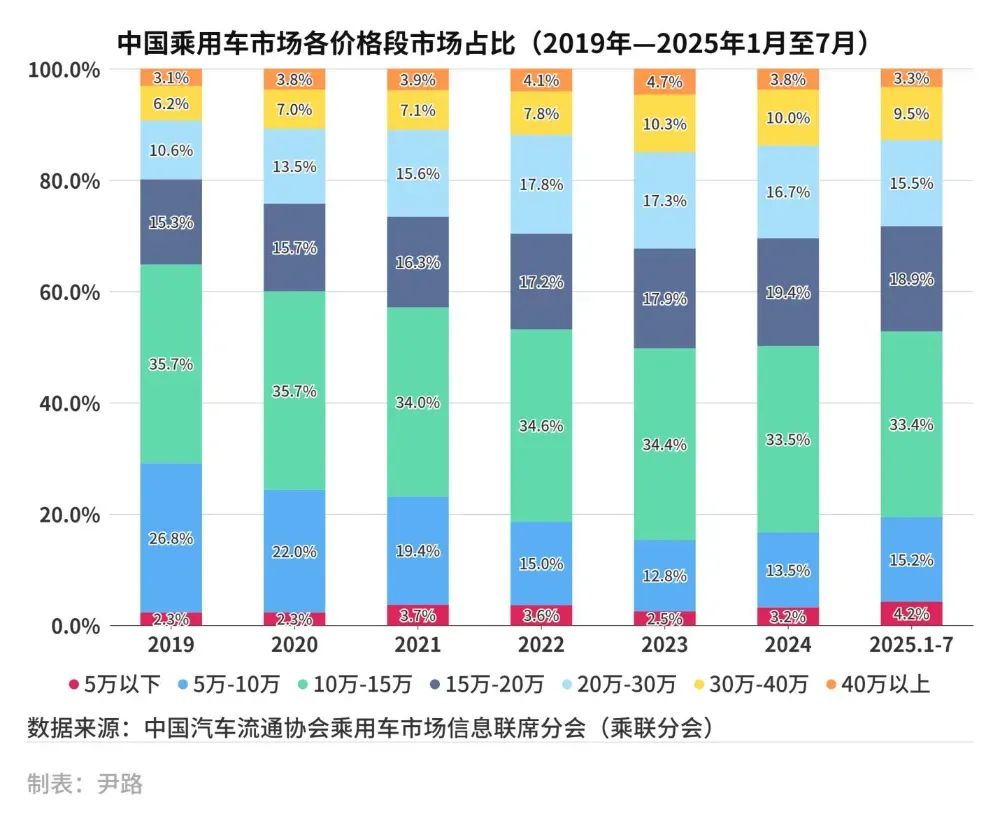
Core Insights - The penetration rate of intelligent assisted driving in China reached 50% in just five years, while the penetration rate of new energy vehicles took ten years to reach the same level [1] - Huawei's intelligent automotive solutions have now entered the mainstream price range of 150,000 to 200,000 yuan, with the launch of the Shangjie brand's first model priced at 169,800 yuan, which can drop below 150,000 yuan with subsidies [1][2] - The market share of Huawei's intelligent driving system in vehicles priced above 350,000 yuan has reached 50% [1] Market Dynamics - The shift from high-end to mainstream pricing is a strategic choice by Huawei to adapt to changes in the Chinese passenger car market, focusing on the 150,000 yuan price segment, which is crucial for many domestic brands [2][5] - The market structure for passenger vehicles is changing, with a notable decline in the market share of vehicles priced above 200,000 yuan, which dropped from 32.3% in 2023 to 28.3% in the first half of 2025 [9] Price Point Strategy - Huawei's intelligent automotive solutions have seen their price anchor drop from 300,000 yuan to 150,000-200,000 yuan, with intentions to further penetrate the 100,000-150,000 yuan segment [3][4] - The 10,000-20,000 yuan price range is identified as the largest incremental market for intelligent automotive solutions, with significant growth expected in this segment [12] Competitive Landscape - Huawei and CATL are the only companies in the Chinese automotive parts industry that can set prices, while other suppliers are engaged in price wars [1] - The competitive strategy involves offering flexible technology and cooperation models, allowing automakers to choose specific components based on their market positioning and cost requirements [13][14] Technological Advancements - Huawei's intelligent automotive solutions include five core technologies, and the company has achieved significant scale, with over 1 million vehicles equipped with its systems [13] - The rapid growth of intelligent systems in the 100,000-200,000 yuan price range is a key factor driving Huawei's strategy to penetrate this market [12]
天有为上半年实现净利润5.26亿元 拟设立摩洛哥子公司
Zheng Quan Shi Bao Wang· 2025-08-28 10:32
Core Viewpoint - The company reported a slight decline in revenue and net profit for the first half of 2025, while continuing to invest heavily in R&D to maintain its competitive edge in the automotive instrument sector and expand into the smart cockpit market [1][2][3][4] Group 1: Financial Performance - In the first half of 2025, the company achieved revenue of 2.029 billion yuan, a year-on-year decrease of 0.49% [1] - The net profit attributable to shareholders was 526 million yuan, down 4.5% year-on-year [1] - R&D expenses reached 109 million yuan, reflecting a significant increase of 50.29% compared to the previous year [1] Group 2: Product Development and Market Strategy - The company is focusing on the smart cockpit product market, which has significant growth potential due to the increasing demand for automotive intelligence [2] - The company is optimizing its product structure and expanding its customer base, maintaining close communication with major automotive clients such as Hyundai, BYD, and Changan [2] - The customer base has been further enhanced, with multiple project allocations from both domestic and international automotive manufacturers [2] Group 3: International Expansion - The company plans to enhance its global market share and international business through the establishment of subsidiaries and production bases in Mexico and South Korea [3] - A new factory in Mexico has commenced operations, targeting North American clients, with future plans to expand into the European market [3] - The company intends to invest 65 million euros to establish a wholly-owned subsidiary in Morocco, which will serve as a key overseas production base to leverage local customer resources and enhance international collaboration [4]