通用人工智能(AGI)

Search documents
智驾人才涌入具身智能,热钱有了新叙事
晚点Auto· 2025-12-17 16:01
Core Viewpoint - The article discusses the current state and investment trends in the field of embodied intelligence, highlighting the influx of new startups and the challenges they face in terms of technology and market viability [3][11]. Investment Trends - In 2023, there has been a significant interest in embodied intelligence, with over 100 active investment firms in China and early-stage funding exceeding $10 billion [4]. - Investors are increasingly favoring teams with backgrounds in intelligent driving, as they bring practical experience and operational knowledge to the table [4][5]. - The emergence of new entrepreneurs from the intelligent driving sector is seen as a positive development, as they are expected to address real-world problems more effectively [4][5]. Entrepreneurial Landscape - Notable startups in the embodied intelligence space include those founded by alumni from prestigious universities like UC Berkeley, Carnegie Mellon, and MIT, reflecting a shift in investor preferences towards teams with substantial product experience [5][6]. - Several startups have secured significant funding, such as "It Stone Intelligent Navigation" raising over 1.22 billion yuan and "Zhi Jian Power" receiving approximately $50 million in angel funding [6][7]. Technological Challenges - The transition from intelligent driving to embodied intelligence involves complex challenges, including the need for high-quality interaction data and the high costs associated with robot production [10]. - The current market for embodied robots is hindered by the high initial costs, with robots priced around 600,000 yuan, which is expected to decrease to 350,000-400,000 yuan by 2027 [10]. Market Sentiment - There is a growing pessimism in the secondary market regarding embodied intelligence startups, with some analysts suggesting that the best opportunities may have already passed [11]. - The Chinese government has issued warnings about the risks of oversaturation in the humanoid robot market, emphasizing the need for balance between speed and potential market bubbles [11]. Investment Logic - Investors are focusing on projects that prioritize the development of embodied intelligence models and control systems, indicating a trend towards investing in companies with similar technological foundations [12]. - The article notes that while small investments are common, larger investments exceeding $20 million are rare, which are crucial for the long-term success of startups [13].


何小鹏谈AI:当前没泡沫,物理AI未来三年将迎来关键突破
Nan Fang Du Shi Bao· 2025-12-17 10:35
Core Insights - The future of humanoid robots is expected to be a competitive arena for major players, while specialized robots will see numerous successful opportunities [3] - Significant breakthroughs in physical AI are anticipated within the next three years, with autonomous driving potentially reaching Level 4 capabilities [4][5] - The current AI landscape is viewed as being in its early stages, with a rational perspective on the so-called AI bubble, suggesting that the market holds substantial opportunities [6] Group 1: Industry Trends - There is a noticeable divergence in the development paths of AI robotics between China and the United States, with the U.S. focusing on software and algorithm breakthroughs, while Chinese companies emphasize hardware and control technologies [3] - The competition in humanoid robots is expected to be intense due to high entry barriers, whereas various players will emerge in specialized robot sectors [3] Group 2: Future Predictions - Major advancements in physical AI are predicted, with autonomous driving and humanoid robots likely to achieve rapid progress from Level 1 to Level 4 capabilities [5] - The transition from language models to multimodal and world models is anticipated, indicating a shift in the focus of AI development [4] Group 3: Company Strategy - The company has recently repositioned itself as an "explorer of physical AI world mobility," unveiling several new technologies including the second-generation VLA model, Robotaxi, and flying cars [7] - Recognition from industry leaders, such as Huawei's founder praising the company's innovative approach, highlights the growing attention on its technological direction [7]


汽车视点 | AI加速“上车” 智能汽车操作系统迈向千亿级市场
Xin Hua Cai Jing· 2025-12-17 08:16
Group 1 - Major automotive companies are increasingly adopting AI as a core strategy, with significant investments in AI technologies, such as Xiaopeng's annual investment of 4.5 billion yuan in AI [1] - The 2025 China Automotive Software Conference highlighted the irreversible trend of software-defined vehicles and AI-driven design, marking the transition to the AIDV (AI Defined Vehicle) era [1] Group 2 - The automotive software industry is experiencing structural changes, with the value focus shifting from hardware manufacturing to software and services, and profit structures evolving from "one-time delivery" to "full-cycle services" [2] - In 2020, hardware accounted for 79% of automotive profits, while software only represented 6%. By 2025, hardware's share is expected to drop to 69%, with software rising to 17%, and by 2030, hardware is projected to be 59% and software 25% [2] Group 3 - Software is becoming a bridge for industry integration, connecting various stakeholders such as automakers, chip manufacturers, and research institutions, facilitating resource optimization [3] - The commercial value of in-vehicle operating systems is increasing, with the market expected to reach approximately 60 billion yuan by 2025 and exceed 100 billion yuan by 2030 [3] Group 4 - The future trend of automotive software development is expected to be integration, moving towards highly adaptive intelligent operating systems that support resource scheduling and sharing across vehicles, roads, clouds, and edge [4] - AI capabilities are anticipated to be deeply integrated into operating systems, evolving from simple application-level integration to native AI fusion that understands user intent [4] Group 5 - Open-source development is recognized as a vital technical pathway, with companies like Li Auto and Dongfeng actively participating in open-source projects to address cross-enterprise collaboration challenges [5] Group 6 - The market for software-based autonomous driving solutions in China is projected to grow from 350 million yuan in 2024 to over 1.9 billion yuan in 2025, and surpass 6 billion yuan by 2030 [6] - Challenges related to AI systems, such as their "black box" nature and difficulties in safety verification, need to be addressed for effective development [7] Group 7 - The automotive software ecosystem faces challenges, including the lack of a unified, open hardware-software platform, which complicates collaboration and development processes [7] - Cross-enterprise collaboration mechanisms are often inefficient, leading to difficulties in achieving consensus on costs, timelines, and technical directions [7] Group 8 - The establishment of a unified standard and interface is crucial for accelerating technology implementation and shortening development cycles, with a focus on defining standards for chips, operating systems, and middleware [10] - The integration of forward-looking safety features into the ecosystem is essential for building sustainable competitive advantages [11] Group 9 - The industry is encouraged to explore the integration of satellite technology into the existing vehicle-road-cloud system to enhance data and computing networks, expanding application scenarios [12] - The automotive industry is seen as a significant platform for AI applications, with the potential for AI to evolve through interaction with the physical world [12]
AI智能体时代中的记忆:形式、功能与动态综述
Xin Lang Cai Jing· 2025-12-17 04:42
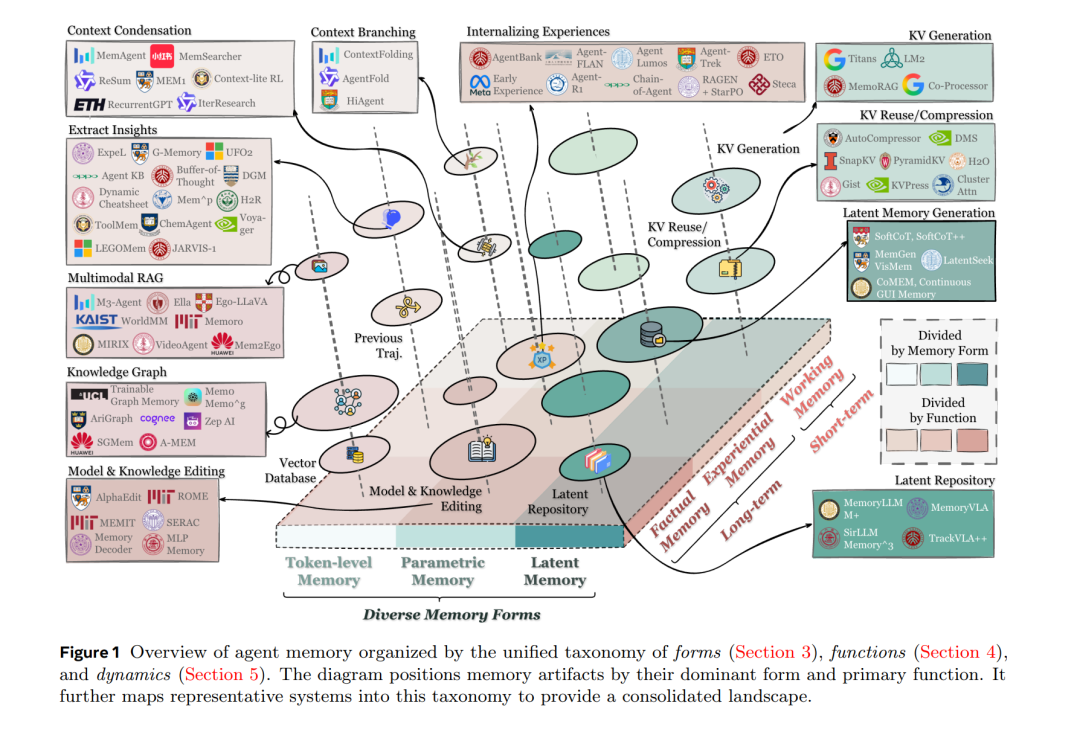
Core Insights - Memory is identified as a core capability for agents based on foundational models, facilitating long-term reasoning, continuous adaptation, and effective interaction with complex environments [1][11][15] - The field of agent memory research is rapidly expanding but is becoming increasingly fragmented, with significant differences in motivation, implementation, assumptions, and evaluation schemes [1][11][16] - Traditional classifications of memory, such as long-term and short-term memory, are insufficient to capture the diversity and dynamics of contemporary agent memory systems [1][11][16] Summary by Sections Introduction - Over the past two years, powerful large language models (LLMs) have evolved into robust AI agents, achieving significant progress across various fields such as deep research, software engineering, and scientific discovery [4][14] - There is a growing consensus in academia that agents require capabilities beyond just LLMs, including reasoning, planning, perception, memory, and tool usage [4][14][15] Importance of Memory - Memory is crucial for transforming static LLMs into adaptive agents capable of continuous adaptation through environmental interaction [5][15] - Various applications, including personalized chatbots, recommendation systems, social simulations, and financial investigations, depend on agents' ability to manage historical information actively [5][15] Need for New Classification - The increasing importance of agent memory systems necessitates a new perspective on contemporary agent memory research [6][16] - Existing classification systems are outdated and do not reflect the breadth and complexity of current research, highlighting the need for a coherent classification that unifies emerging concepts [6][16] Framework and Key Questions - The review aims to establish a systematic framework to reconcile existing definitions and connect emerging trends in agent memory [19] - Key questions addressed include the definition of agent memory, its relationship with related concepts, its forms, functions, and dynamics, as well as emerging research frontiers [19] Emerging Research Directions - The review identifies several promising research directions, including automated memory design, integration of reinforcement learning with memory systems, multimodal memory, shared memory in multi-agent systems, and issues of trustworthiness [20][12] Contributions of the Review - The review proposes a multidimensional classification of agent memory from a "form-function-dynamics" perspective, providing a structured view of current developments in the field [20] - It explores the applicability and interaction of different memory forms and functions, offering insights on aligning various memory types with different agent objectives [20] - A comprehensive resource collection, including benchmark tests and open-source frameworks, is compiled to support further exploration of agent memory systems [20]
AI天才少女首秀 罗福莉称小米开源模型能力全球前二
Sou Hu Cai Jing· 2025-12-17 04:25
Core Insights - Xiaomi's MiMo model has entered the top two globally in terms of code and agent capabilities, as per a world-class evaluation ranking [1][5] - The recent conference marked the first public appearance of Luo Fuli, who leads the MiMo model team, indicating Xiaomi's commitment to advancing in the field of Artificial General Intelligence (AGI) [3] Group 1 - Luo Fuli, a notable AI expert, officially launched and open-sourced the latest hybrid expert model, MiMo-V2-Flash, which has a total parameter count of 309 billion and an active parameter count of only 15 billion, designed for agents [5] - The MiMo-V2-Flash model has achieved top rankings in various agent evaluation benchmarks, outperforming all open-source models in code capabilities and nearing the performance of leading closed-source models, while maintaining significantly lower inference costs [5][6] - Xiaomi's first open-source inference model, "Xiaomi MiMo," released earlier this year, surpassed some larger models in public evaluations of mathematical reasoning and coding competitions with a parameter count of 7 billion [5]


Alex Wang“没资格接替我”,Yann LeCun揭露Meta AI“内斗”真相,直言AGI是“彻头彻尾的胡扯”
3 6 Ke· 2025-12-17 02:45
Core Viewpoint - Yann LeCun criticizes the current AI development path focused on scaling large language models, arguing it leads to a dead end and emphasizes the need for a different approach to achieve true AI capabilities [1][2]. Group 1: AI Development Path - LeCun believes the key limitation in AI progress is not reaching "human-level intelligence" but rather achieving "dog-level intelligence," which challenges the current evaluation systems centered on language capabilities [2]. - He advocates for the development of "world models" that can understand and predict the world, contrasting with mainstream models that focus on generating text or images [2][8]. - LeCun's new company, AMI, aims to pursue this alternative technical route, emphasizing cognitive and perceptual fundamentals rather than merely scaling existing models [2][7]. Group 2: Research and Open Science - LeCun stresses the importance of open research, arguing that true research must be publicly shared and scrutinized to avoid the pitfalls of insular corporate environments [5][6]. - He believes that allowing researchers to publish their work fosters better research quality and motivation, which is often overlooked in many industrial labs [6]. Group 3: World Models and Learning - The concept of world models involves creating abstract representations of the world to predict outcomes, rather than relying on pixel-level predictions, which are ineffective in high-dimensional data [8][10]. - LeCun emphasizes that effective learning requires filtering out unpredictable details and focusing on relevant aspects of reality, which is crucial for developing intelligent systems [10][22]. Group 4: Data and Training - LeCun highlights the vast difference in data requirements between language models and video data, noting that video data is richer and more valuable for learning due to its structural redundancy [18][19]. - He argues that relying solely on text data will never lead to human-level intelligence, as it lacks the necessary complexity and richness found in real-world data [19][25]. Group 5: Future of AI and AGI - LeCun expresses skepticism about the concept of "general intelligence," suggesting it is a flawed notion and that true progress will be gradual rather than sudden [30][32]. - He predicts that achieving "dog-level intelligence" will be the most challenging part of AI development, with significant advancements expected in the next 5 to 10 years if no unforeseen obstacles arise [32][34]. Group 6: Industry Trends and Company Direction - LeCun's departure from Meta and the establishment of AMI reflect a desire to pursue a different technological path amid a trend of companies focusing on large language models [1][48]. - He notes that the competitive environment in Silicon Valley often leads to a monoculture where companies pursue similar technological routes, which can stifle innovation [48].


万字拆解371页HBM路线图
半导体行业观察· 2025-12-17 01:38
Core Insights - The article emphasizes the critical role of High Bandwidth Memory (HBM) in supporting AI technologies, highlighting its evolution from a niche technology to a necessity for AI performance [1][2][15]. Understanding HBM - HBM is designed to address the limitations of traditional memory, which struggles to keep up with the computational demands of AI models [4][7]. - Traditional memory types like DDR5 and LPDDR5 have significant drawbacks, including limited bandwidth, high latency, and inefficient data transfer methods [4][10]. HBM Advantages - HBM offers three main advantages: significantly higher bandwidth, reduced power consumption, and a compact form factor suitable for high-density AI servers [11][12][14]. - For instance, HBM3 has a bandwidth of 819GB/s, while HBM4 is expected to double that to 2TB/s, enabling faster AI model training [12][15]. HBM Generational Roadmap - The KAIST report outlines a roadmap for HBM development from HBM4 to HBM8, detailing the technological advancements and their implications for AI [15][17]. - Each generation of HBM is tailored to meet the evolving needs of AI applications, with HBM4 focusing on mid-range AI servers and HBM5 addressing the computational demands of large models [17][27]. HBM Technical Innovations - HBM's architecture includes a "sandwich" 3D stacking design that enhances data transfer efficiency [8][9]. - Innovations such as Near Memory Computing (NMC) in HBM5 allow memory to perform computations, reducing the workload on GPUs and improving processing speed [27][28]. Market Dynamics - The global HBM market is dominated by three major players: SK Hynix, Samsung, and Micron, which together control over 90% of the market share [80][81]. - These companies have secured long-term contracts with major clients, ensuring a steady demand for HBM products [83][84]. Future Challenges - The article identifies key challenges for HBM's widespread adoption, including high costs, thermal management, and the need for a robust ecosystem [80]. - Addressing these challenges is crucial for transitioning HBM from a high-end product to a more accessible solution for various applications [80].

从“AI创新者”到“AI建造者”,李彦宏把AI落到真实世界
Xin Lang Cai Jing· 2025-12-16 14:03
Core Insights - The central theme of the article is the recognition of "The Architects of AI" by Time magazine, marking a shift from the hype of AI to a more grounded phase of development and application [1][24]. Group 1: Recognition and Evolution - On December 11, Time magazine announced its 2025 Person of the Year as "The Architects of AI," indicating a transition in the global narrative of artificial intelligence from a prophetic phase to a construction phase [1][24]. - Baidu's founder, Li Yanhong, has been recognized multiple times by Time magazine, evolving from "Innovator" in 2018 to "AI Leader" in 2023, and now to "AI Builder," reflecting Baidu's strategic implementation of AI [6][29]. - Baidu has transformed from a search engine company to a leading full-stack AI company, with a diverse portfolio including chips, cloud infrastructure, models, agents, applications, and consumer products [7][30]. Group 2: AI Applications and Strategy - At the Baidu World Conference on November 13, the company showcased a series of advanced AI products and applications, emphasizing the importance of real-world applications in creating sustainable value [8][31]. - The article highlights the intense competition in the AI sector, with model parameters skyrocketing from hundreds of billions to trillions, leading to a significant increase in training costs and a homogenization of foundational models [9][32]. - Li Yanhong emphasizes that the focus should be on applications rather than creating a superintelligent AI, pointing out the need for AI to address challenges in China's strong manufacturing sector [10][33]. Group 3: Innovative Solutions - A key example of Baidu's application of AI is the recently launched super-intelligent agent "Famu," designed to find optimal solutions in real industrial environments [11][34]. - Unlike most generative AIs focused on chat and image generation, "Famu" aims to solve complex problems such as supply chain scheduling and traffic signal optimization [12][35]. - Li Yanhong anticipates that the most significant breakthrough in the industry by 2025 will be in multimodal AI, with hopes for revolutionary changes in drug development through AI [13][36]. Group 4: Long-term Vision and Strategy - Baidu's strategy is clear: leveraging full-stack technology to tackle challenging problems, which may not seem as grand as the concept of general artificial intelligence (AGI) but will create substantial value for the real economy [15][38]. - The article suggests that Li Yanhong's focus on applications is a higher-dimensional strategic determination, as models without applications may merely be code without real-world impact [15][38]. - The evolution of Li Yanhong's identity as a "builder" has been a long-term strategy, with roots tracing back seven years [16][39]. Group 5: Future of AI - The article concludes that future AI giants will not be those with the largest parameter models but those that can effectively solve real human problems using AI [23][46]. - Li Yanhong's shift from a prophetic role to a builder's mindset is seen as essential for AI companies to thrive in the evolving landscape [24][47].


AI只是可控工具: AI伦理学者乔安娜·布赖森谈AGI神话与未来治理
3 6 Ke· 2025-12-16 10:50
Group 1 - The core argument is that AI is fundamentally a controllable tool, and its rapid development since the release of ChatGPT has significant implications for society, economy, and scientific research [1][2] - AI can accelerate scientific research but should not be overemphasized as a unique entity; it is similar to other tools used in various work contexts [1] - In economic terms, automation can lead to both substitution effects (reducing labor demand) and enhancement effects (creating more jobs through increased productivity) [1][2] Group 2 - The political implications of AI include potential political polarization driven by economic insecurity, particularly through targeted information dissemination on social media [2] - The concept of AGI (Artificial General Intelligence) is tied to the complexity of organizations like governments and companies, which amplify human intelligence through technology [3][4] - The narrative surrounding AGI may signal market overheating, as companies strive for dominance, potentially undermining competitive factors [4] Group 3 - AI's impact on employment is complex; while some jobs may be replaced, new opportunities will arise, necessitating reforms in education and social security systems to support workforce adaptation [5][6] - The nature of work may evolve to focus more on social connections and personal identity rather than purely economic benefits, especially in a future where many jobs are automated [7] Group 4 - Current AI does not possess consciousness; the notion of moral agency is crucial in understanding human-AI interactions, which remain fundamentally different [8][9] - AGI will always be a tool designed and controlled by humans, and the focus should be on ensuring AI systems are transparent and accountable [9][10] Group 5 - The responsibility chain for AI products is critical, and the EU's AI Act emphasizes the need for clear accountability in AI development and deployment [10][15] - Effective regulation of AI is necessary to prevent market concentration and ensure fair competition, similar to how GPS is regulated [17] Group 6 - The EU's AI Act has significant implications for AI governance, including the legal status of AI as a product and the prohibition of certain AI services incompatible with privacy rights [15][16] - Challenges in implementing the AI Act include ensuring compliance across different jurisdictions and establishing global standards for AI regulation [16] Group 7 - Important overlooked issues include the need for cross-national regulation of tech companies and the impact of these companies on data usage and advertising [18] - AI regulation should be viewed as a controllable engineering product, requiring clear oversight mechanisms to align AI development with human interests [19]
AI只是可控工具: AI伦理学者乔安娜·布赖森谈AGI神话与未来治理
腾讯研究院· 2025-12-16 09:34
Core Viewpoint - AI is fundamentally a controllable tool, and its development should not be overly emphasized as a unique entity separate from other tools used in various fields [5]. Economic Impact - The introduction of automation can lead to two effects: substitution effect, which reduces labor demand, and enhancement effect, which increases productivity and creates more jobs. Current research indicates that the UK has not shown a significant substitution effect, but rather an increase in employment in high-productivity sectors [5]. - The high costs associated with creating large language models raise questions about whether the economic benefits can justify these investments [5]. Political Implications - Economic downturns can lead to political polarization, exacerbated by social media and AI's role in targeted information dissemination. Loss of economic security can trigger identity crises and extreme behaviors [5]. AGI and Market Dynamics - The concept of AGI is relevant when considering governments and companies as forms of AI, as they amplify human intelligence through complexity. The real challenge lies in managing and regulating these systems to ensure transparency and accountability [6]. - Some tech companies are incentivizing employees based on AI outcomes rather than understanding AI systems, which poses risks if focus is solely on results without understanding operational mechanisms [6]. - The push for AGI narratives may signal an overheated market, necessitating attention to potential market control issues [7]. Employment and Skills - AI's impact on jobs is often misunderstood; work represents control over productivity and resources. Automation may replace some jobs but also centralizes power within companies [8]. - The revaluation of skills is crucial as technological advancements can diminish the value of long-acquired skills. Education and social security systems need reform to support individuals in adapting to new job markets [9]. Redefining Work - The definition of work may evolve in a future where many jobs are automated, focusing more on social connections and personal identity rather than purely economic benefits [10]. - Certain jobs related to core societal functions, such as national defense and climate crisis management, will remain essential [11]. AI Consciousness and Responsibility - Current AI does not possess consciousness; it operates under human-defined goals. The distinction between AI's operational independence and human decision-making is critical [13][14]. - AGI will always be a tool designed and controlled by humans, and the focus should be on ensuring AI systems are transparent and accountable [14]. AI Governance - The responsibility chain for AI products is vital, as highlighted by the EU AI Act, which mandates clarity on who is accountable for AI systems [15][19]. - Effective regulation of AI platforms is necessary to prevent market concentration and ensure fair competition [21]. Global Regulatory Challenges - Cross-national regulation of tech companies is an overlooked issue, with the EU taking a proactive stance compared to the US's relaxed approach [22]. - The role of advertising and data usage by multinational companies needs reevaluation to ensure it serves public interest rather than just corporate profit [22]. Conclusion - AI regulation should be treated as a controllable engineering product, requiring clear oversight mechanisms to align with human interests [23].