
金融强国

Search documents
早新闻 | 商务部:11月10日起停止实施
Zheng Quan Shi Bao· 2025-11-05 23:49
Macro Trends - The central financial office emphasizes the strategic deployment for building a financial powerhouse during the "14th Five-Year Plan" period, highlighting the necessity of a strong financial sector for achieving a modern socialist country [1] - The Ministry of Commerce announces adjustments to export control lists and unreliable entity lists, effective from November 10, 2025, impacting 15 U.S. entities [1] - The Ministry of Commerce also decides to stop anti-circumvention measures on specific U.S. imports of optical fibers starting November 10, 2025, due to changes in the trade environment [1] International Trade - Li Chenggang, the international trade representative, meets with a U.S. agricultural trade delegation, discussing the fluctuations in agricultural trade due to unilateral tariff measures from the U.S. [2] Energy and Technology - China's new energy storage capacity exceeds 100 million kilowatts, ranking first globally, with a growth of over 30 times compared to the end of the "13th Five-Year Plan" [3] - The industrial robot export growth rate exceeds 51% this year, with expectations of an average growth rate of 100% in the smart robot industry [3] - Xiaopeng Motors launches the new generation IRON humanoid robot, featuring advanced AI capabilities and a design that mimics human anatomy [4][5] Battery Technology - Tianjin University and other research institutions discover new high-performance battery materials, providing significant theoretical support for battery technology development [6] Semiconductor Industry - SK Hynix completes negotiations with NVIDIA for HBM4 supply, with prices confirmed at approximately $560, which is over 50% higher than HBM3E [7] Company News - Zhongneng Electric reports normal operational conditions with no significant changes in the internal and external business environment [8] - Zhangzhou Development also states that its production and operational conditions are normal [9] - Aerospace Hongtu is suspended from participating in military procurement activities from July 6, 2024, to July 6, 2027 [10] - Jinlong Automobile reports a 14.71% year-on-year decline in bus sales for October, totaling 4,121 units [11] - Jindi Group experiences a 65.78% year-on-year decline in signed contracts for October, amounting to 1.92 billion yuan [12]
顶层设计指明奋进方向,衍生品市场迎来历史性机遇
Sou Hu Cai Jing· 2025-11-05 23:34
Core Viewpoint - The "14th Five-Year Plan" suggests a steady development of futures, derivatives, and asset securitization, significantly elevating the strategic position of derivatives in the financial landscape [1] Group 1: Strategic Importance - The inclusion of derivatives in the five-year plan is a strategic move aimed at establishing a more resilient modern financial system [1] - This initiative is part of a broader strategy to build a strong financial nation, reflecting the need for enhanced risk governance [1] Group 2: Industry Transformation - The futures industry is accelerating its transformation and upgrading in response to new strategic positioning and development requirements [1] - Experts emphasize the necessity for the futures sector to address shortcomings and strengthen risk prevention measures [1] Group 3: Market Quality and Efficiency - There is a focus on achieving simultaneous improvements in market quality and efficiency within the futures industry [1]
盘前必读丨贵州茅台大手笔回购+分红300亿元;嘉元科技斩获宁德时代大单
Di Yi Cai Jing· 2025-11-05 23:24
Market Outlook - The A-share market is expected to show a sideways consolidation pattern in November, with potential for an index-level rally by year-end [9] - Historical data indicates that market volatility in November typically decreases compared to October, providing a more stable environment for investors to build positions [9] - Recent market activity has shown increased competition among investors, with profit-taking leading to short-term technical adjustments [9] Corporate Actions - Guizhou Moutai announced a mid-term dividend of 30 billion yuan and plans to repurchase shares worth 1.5 to 3 billion yuan for cancellation [8] - Jia Yuan Technology signed a cooperation framework agreement with CATL [8] - Hao Neng Co. plans to issue convertible bonds to raise no more than 1.8 billion yuan for its smart manufacturing core components project [8] - Jinshiyuan's controlling shareholder increased holdings by 540 million yuan, raising ownership to 46% [8] - Hao Er Sai was fined 7 million yuan due to a bribery conviction [8] Financial Performance - Northeast Pharmaceutical is required to pay 16.45 million yuan in damages due to a contract dispute [9] - Muyuan Foods reported a revenue of 10.331 billion yuan from the sale of live pigs in October, a year-on-year decrease of 22.28% [9] - Wentai Technology's major shareholder plans to reduce its stake by up to 3% [9]



谷歌股价创收盘新高;茅台宣布“回购+300亿分红”|南财早新闻
2 1 Shi Ji Jing Ji Bao Dao· 2025-11-05 23:24
Macro Economy - The Central Financial Office emphasizes the need to strengthen six key financial elements to build a strong financial nation, including a robust currency, central bank, financial institutions, international financial center, financial regulation, and talent pool [2] - The 8th China International Import Expo opened in Shanghai, with participation from 155 countries and regions, and over 600 new exhibiting companies compared to last year, setting a new record for scale [2] Investment News - On November 5, the A-share market experienced a rebound, with the Shanghai Composite Index rising by 0.23%, the Shenzhen Component Index by 0.37%, and the ChiNext Index by 1.03%. The electric grid equipment sector saw significant gains, with nearly 20 stocks hitting the daily limit [5] - As of November 5, 1,035 companies announced interim dividends this year, totaling 735.686 billion yuan, surpassing last year's interim dividend amount. Among these, 316 companies are declaring interim dividends for the first time [5] - In the first three quarters, Shenzhen-listed companies achieved revenue growth of 4.31% year-on-year, totaling 15.72 trillion yuan, and a net profit of 903.018 billion yuan, up 9.69% year-on-year, with over 70% of companies reporting profits [5] - Huatai Securities and China Merchants Securities announced an increase in the upper limit of their margin financing business, following similar actions by other listed brokerages [5] Company Movements - Kweichow Moutai announced a share repurchase plan with a total fund of no less than 1.5 billion yuan and no more than 3 billion yuan, with a repurchase price not exceeding 1,887.63 yuan per share. The company also revealed a cash dividend of 23.957 yuan per share, totaling 30 billion yuan [6] - Seres officially listed on the Hong Kong Stock Exchange, becoming the first luxury electric vehicle company to achieve "A+H" listing, with its stock closing at the issue price of 131.5 HKD after a drop of over 10% during the day [6] - XPeng Motors plans to launch three fully self-developed Robotaxi models in 2026, with Gaode becoming the first global ecological partner for XPeng's Robotaxi service [6]




顶层设计指明奋进方向 衍生品市场迎来历史性机遇
Zhong Guo Zheng Quan Bao· 2025-11-05 20:08
Core Insights - The inclusion of derivatives in the "14th Five-Year Plan" marks a significant elevation in their strategic position within the financial system, transitioning from a supplementary tool to a core component of national economic planning [1][2][3] Group 1: Strategic Importance of Derivatives - The derivatives market is being assigned a new historical mission, emphasizing its role in risk management and as a vital part of the national financial system [1][2] - The shift in policy reflects a deeper strategic consideration for building a more resilient modern financial system, which requires strong risk pricing, dispersion, and capacity [2][3] - The "14th Five-Year Plan" indicates a deepening phase of financial reform, highlighting the strategic value of derivatives in achieving high-quality economic development [2][3] Group 2: Market Growth and Participation - The total funds in China's futures market surpassed 2 trillion yuan, reaching approximately 2.02 trillion yuan, a 24% increase from the end of 2024 [3] - The number of listed companies participating in futures and options trading has increased, with 529 out of 5,383 A-share companies involved, representing 9.8% of all listed companies and 35.8% of market capitalization [3][4] Group 3: Evolving Demand for Derivatives - The demand for derivatives has shifted from optional tools to essential components for risk management among various enterprises, including large state-owned and small to medium-sized enterprises [5][6] - There is a growing need for comprehensive solutions rather than traditional hedging methods, integrating derivatives into daily business decision-making [5][6] Group 4: Industry Transformation and Challenges - The futures industry is undergoing a transformation to adapt to new strategic requirements, aiming to extend its role from providing risk management services to contributing to national financial security [6][7] - Key challenges include the need for refined legal frameworks, improving investor structure, enhancing international market connectivity, and innovating key financial futures products [6][7] - The industry requires policy support for regulatory updates, investor ecosystem optimization, and expanded cross-border risk hedging channels [6][7]
加快建设金融强国 为中国式现代化提供有力支撑
Zhong Guo Zheng Quan Bao· 2025-11-05 20:08
Core Insights - The construction of a financial power is a strategic deployment made by the 20th Central Committee of the Communist Party of China, emphasizing its significance for the modernization of socialism in China [2][3] - The financial power construction is essential for achieving high-quality development and addressing risks in the financial sector during the 14th Five-Year Plan period [3][4] Group 1: Significance of Building a Financial Power - The construction of a financial power is a necessary requirement for building a modern socialist country, as a strong financial system is crucial for supporting modernization efforts [2] - The financial power construction is not isolated; it must serve a high-level socialist market economy to achieve the overarching goal of modernization [2][3] Group 2: Key Tasks and Measures for Financial Power Construction - Financial systems must enhance support for major strategies, key areas, and weak links, such as developing a technology finance system to support innovation [3][6] - The construction of a financial power requires strengthening six key financial elements: a strong currency, a powerful central bank, robust financial institutions, an international financial center, effective financial regulation, and a talented workforce [4][5] - The financial system should focus on risk prevention, strong regulation, and promoting high-quality development [6][7] Group 3: Principles and Theoretical Framework - The construction of a financial power must adhere to the principles outlined in the 20th Central Committee's deployment, which reflects a deepened understanding of economic and social development [4][5] - The path to building a financial power is characterized by systematic, innovative, and practical approaches, emphasizing the importance of a unique Chinese financial development model [5][6] Group 4: Specific Initiatives - Continuous improvement of the central bank system is necessary, including establishing a sound monetary policy framework and maintaining the stability of the RMB exchange rate [6][7] - The financial system should support green transformation and the construction of a comprehensive pension finance system to address demographic changes [7][8] - Enhancing the international financial center in Shanghai and supporting Hong Kong's position as an international financial hub are critical for global financial integration [7][8]
货币市场日报:11月5日
Xin Hua Cai Jing· 2025-11-05 16:36
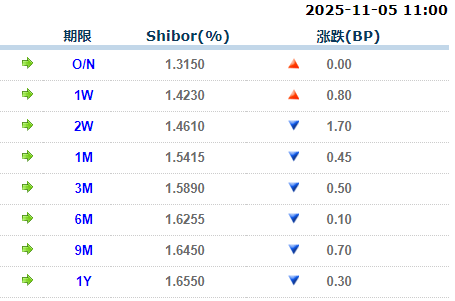
Group 1 - The People's Bank of China conducted a 655 billion yuan 7-day reverse repurchase operation on November 5, maintaining the operation rate at 1.40%, resulting in a net withdrawal of 4,922 billion yuan due to 5,577 billion yuan of reverse repos maturing on the same day [1] - The Shanghai Interbank Offered Rate (Shibor) showed minor fluctuations in short-term varieties, with the overnight Shibor remaining unchanged at 1.3150%, the 7-day Shibor rising by 0.80 basis points to 1.4230%, and the 14-day Shibor decreasing by 1.70 basis points to 1.4610% [1][2] - In the interbank pledged repo market, most varieties saw slight increases, with the overnight weighted average rates for DR001 and R001 at 1.3151% and 1.3615%, respectively, while the transaction volumes for these instruments increased by 1,220 billion yuan and 1,638 billion yuan [4] Group 2 - The funding environment on November 5 was characterized by a loose stance, with major banks lending out funds, leading to a stable transaction rate for overnight repos around 1.40%-1.42% [7] - A total of 105 interbank certificates of deposit were issued on November 5, with an actual issuance amount of 1,696.8 billion yuan [7][8] - The trading sentiment for primary certificates of deposit was relatively active, particularly for 6-month and 9-month maturities, while secondary certificates of deposit showed general activity with slight yield declines [8]
中央金融办最新发声
21世纪经济报道· 2025-11-05 13:57
Core Viewpoint - The article emphasizes the importance of accelerating the construction of a financial powerhouse as a crucial support for China's modernization, highlighting the strategic deployment made by the 20th Central Committee of the Communist Party of China [1][3]. Group 1: Significance of Building a Financial Powerhouse - Accelerating the construction of a financial powerhouse is essential for achieving a modern socialist strong country, as a robust financial system is a key support for modernization [3][4]. - The construction of a financial powerhouse is also a necessary requirement for promoting high-quality development, necessitating increased financial support for major strategies and key areas [4]. - It is vital to balance development and security in the financial sector, enhancing overall financial strength, international competitiveness, and risk resistance [4]. Group 2: Theoretical and Practical Requirements - The construction of a financial powerhouse must adhere to the principles outlined in the 20th Central Committee's decisions, emphasizing the importance of the Party's leadership in financial development [5][6]. - Building a financial powerhouse is characterized by its systemic, innovative, and practical nature, requiring a deep understanding of its main features and essential tasks [6][7]. Group 3: Key Tasks and Measures - Continuous improvement of the central bank system is necessary, including establishing a sound monetary policy framework and maintaining the stability of the RMB exchange rate [10][11]. - Support for high-level technological self-reliance and green transformation is crucial, alongside the development of a multi-layered and sustainable inclusive financial system [10][11]. - Enhancing the health and stability of capital markets is essential, focusing on accommodating new industries and technologies while ensuring effective regulation [10][11]. - Strengthening financial institutions and infrastructure is important for effective service to the real economy [11]. - The construction of international financial centers, particularly in Shanghai and Hong Kong, is a priority to enhance their global influence [11]. - Improving financial regulatory capabilities is critical, ensuring comprehensive oversight of all financial activities and enhancing early risk detection mechanisms [11][12].

加快建设金融强国 为中国式现代化提供有力支撑——访中央金融办分管日常工作的副主任、中央金融工委分管日常工作的副书记王江
中国基金报· 2025-11-05 12:40
Core Viewpoint - The article emphasizes the importance of accelerating the construction of a financial power as a crucial support for China's modernization, as outlined in the strategic deployment of the 20th Central Committee of the Communist Party of China [2][4]. Group 1: Significance of Accelerating Financial Power Construction - Accelerating the construction of a financial power is a necessary requirement for building a modern socialist country, as a strong financial system is essential for modernization [4]. - It is also a requirement for promoting high-quality development, necessitating increased financial support for major strategies and key areas [5]. - The construction of a financial power must be rooted in and serve a high-level socialist market economy, ensuring that it aligns with the broader goals of Chinese-style modernization [4][5]. Group 2: Theoretical and Practical Requirements - The construction of a financial power must adhere to the principles outlined in the 20th Central Committee's deployment, emphasizing the importance of the Party's leadership in financial development [7]. - It requires strengthening six key financial elements: a strong currency, a powerful central bank, robust financial institutions, an international financial center, effective financial regulation, and a talented financial workforce [7][8]. - The development path must be characterized by Chinese features, focusing on continuous exploration and innovation in financial practices and theories [8]. Group 3: Key Tasks and Important Measures - The financial system must enhance the central bank's framework, ensuring a sound monetary policy and macro-prudential management [10]. - There is a need to support high-level technological independence and green transformation through improved financial supply quality [10]. - The capital market should be developed to accommodate new industries and technologies, promoting long-term investment and comprehensive regulation [11]. - Financial institutions and infrastructure must be optimized to effectively serve the real economy [11]. - The construction of an international financial center, particularly in Shanghai and Hong Kong, is essential for enhancing global financial influence [11]. - Strengthening financial regulation and legal frameworks is critical to ensure compliance and mitigate risks [11].

中央金融办副主任王江:加快建设金融强国,为中国式现代化提供有力支撑
Xin Hua She· 2025-11-05 12:26
Core Insights - The article emphasizes the strategic importance of accelerating the construction of a financial power in China as part of the broader goal of achieving socialist modernization [2][3][4] - It outlines the necessity of a robust financial system to support high-quality development and address risks in the financial sector [3][7] Group 1: Significance of Building a Financial Power - Accelerating the construction of a financial power is essential for the comprehensive establishment of a modern socialist country, as a strong financial system is a key support for modernization [2][3] - The construction of a financial power is not isolated but must be rooted in and serve a high-level socialist market economy [2][3] Group 2: Key Tasks and Measures - The financial system must enhance support for major strategies, key areas, and weak links, such as establishing a technology finance system to support innovation [3][7] - There is a need to strengthen the central bank system and improve the monetary policy framework to maintain the stability of the RMB and promote its internationalization [7][8] - The article highlights the importance of promoting the healthy and stable development of capital markets to adapt to the needs of technological innovation and new industries [7][8] Group 3: Principles and Theoretical Framework - The construction of a financial power must adhere to the principles outlined in the 20th Central Committee, emphasizing the leadership of the Party as a fundamental characteristic of China's financial development [4][6] - The financial power construction is characterized by its systematic, innovative, and practical nature, requiring a deep understanding of its main features and essential tasks [4][5] Group 4: Key Financial Elements - Building a financial power requires strengthening six key financial elements: a strong currency, a powerful central bank, robust financial institutions, an international financial center, effective financial regulation, and a talented workforce [5][6] Group 5: Regulatory and Legal Framework - The article stresses the need for comprehensive financial regulation, including enhancing oversight across various financial activities and ensuring early detection and management of financial risks [8][9] - It calls for the completion of financial legislation to guide and regulate the financial sector effectively [8][9]