创新驱动

Search documents
重磅解读来了!中央政治局会议研究明年经济工作,如何理解8项“坚持”?
券商中国· 2025-12-08 15:07
Core Viewpoint - The article emphasizes the importance of a proactive macroeconomic policy in 2026, focusing on domestic demand and supply optimization to support economic recovery and growth [1][2][3]. Group 1: Macroeconomic Policy - The macroeconomic policy will continue to be "more proactive and effective," maintaining a supportive stance through fiscal and monetary measures [2][3]. - Fiscal policy may see an increase in central government spending, with a potential budget deficit rate raised to 4.5% and continued issuance of special government bonds [2]. - Monetary policy will remain "appropriately loose," with structural tools supporting key sectors while overall monetary conditions remain stable [2][3]. Group 2: Domestic Demand and Supply - The meeting highlighted the need to "continuously expand domestic demand and optimize supply," indicating a strong focus on enhancing domestic market capabilities [5][6]. - Domestic demand has contributed an average of 93.1% to economic growth from 2013 to 2024, but challenges remain in aligning supply with demand [5]. - The government aims to create a sustainable mechanism for expanding domestic demand, addressing the mismatch between high-end supply and weak demand [5][6]. Group 3: Innovation and New Growth Drivers - The meeting called for "innovation-driven development" to foster new economic momentum, aligning with the goals of the 14th Five-Year Plan [7][8]. - Emphasis is placed on creating a collaborative innovation ecosystem that integrates government, market, and social resources to enhance technological advancements [7][8]. - Current challenges include insufficient investment in basic research and a disconnect between research outcomes and practical applications [8]. Group 4: Open Economy and International Cooperation - The importance of "expanding high-level opening up" and promoting win-win cooperation in various fields was underscored, particularly in response to complex global changes [9][10]. - China aims to diversify trade partnerships and enhance resilience in trade development, with significant projected imports and foreign direct investments from 2013 to 2024 [10]. - Future cooperation will focus on areas such as green trade and international industrial chain collaboration [10]. Group 5: Risk Management - The meeting stressed the need for proactive and prudent risk management in key areas, including real estate and local government debt [11][12]. - Measures have been implemented to address risks in the real estate sector, including optimizing financial policies and establishing a financing coordination mechanism [12]. - The focus will shift towards long-term management of local government debt, with an emphasis on preventing the accumulation of hidden debts [13][14].


中央政治局会议释放六大信号
2 1 Shi Ji Jing Ji Bao Dao· 2025-12-08 15:03
Core Viewpoint - The meeting of the Central Political Bureau on December 8 emphasized the need for a stable yet progressive economic strategy for 2026, focusing on enhancing quality and efficiency while implementing proactive fiscal and moderately loose monetary policies [2][5]. Group 1: Economic Policy Direction - The meeting highlighted the importance of maintaining a stable yet progressive work guideline, better coordinating domestic economic work with international trade, and enhancing the forward-looking, targeted, and coordinated nature of macroeconomic policies [5][6]. - The proactive fiscal policy and moderately loose monetary policy will continue, aiming to ensure effective transmission of fiscal expansion to the real economy while maintaining a stable financing environment [8][9]. Group 2: Economic Growth and Demand - The meeting called for continuous expansion of domestic demand and optimization of supply, emphasizing the need for a consumption-driven economic model to address current demand weaknesses [14][15]. - It was noted that the real estate sector is still facing challenges, with significant declines in investment and sales, indicating a need for targeted measures to stabilize this sector [5][12]. Group 3: Innovation and New Growth Drivers - The meeting stressed the importance of innovation-driven development and the cultivation of new growth drivers, with a focus on technology and manufacturing upgrades [17]. - There will be an emphasis on increasing fiscal spending in technology sectors and supporting the integration of technological innovation with industrial development [17]. Group 4: Risk Management - The meeting reiterated the commitment to maintaining stability in employment, enterprises, markets, and expectations, while actively managing risks in key areas such as real estate and local government debt [19][20]. - It was acknowledged that the current debt pressures faced by residents, enterprises, and local governments require careful management to prevent the accumulation of new ineffective debts [20].

中央政治局会议释放六大信号
21世纪经济报道· 2025-12-08 14:05
据新华社报道,中共中央政治局12月8日召开会议,分析研究2026年经济工作。会议对当前经 济形势作出判断,我国经济运行总体平稳、稳中有进,新质生产力稳步发展,改革开放迈出新 步伐,重点领域风险化解取得积极进展,民生保障更加有力,社会大局保持稳定。 会议指出,明年经济工作要坚持稳中求进、提质增效,继续实施更加积极的财政政策和适度宽 松的货币政策,发挥存量政策和增量政策集成效应,加大逆周期和跨周期调节力度,切实提升 宏观经济治理效能。 会议还对下半年持续扩大内需、因地制宜发展新质生产力、纵深推进全 国统一大市场建设、持续防范化解重点领域风险等方面的重点工作作出部署。 信号一: 实施更加 积极有为的宏观政策 增强政策前瞻性针对性协同性 会议强调,做好明年经济工作,要坚持稳中求进工作总基调,更好统筹国内经济工作和国际经 贸斗争,更好统筹发展和安全,实施更加积极有为的宏观政策,增强政策前瞻性针对性协同 性。 粤开证券首席经济学家罗志恒告诉记者,本次会议继续强调"实施更加积极有为的宏观政策", 主要是基于当前宏观经济面临需求不足,尤其是消费不足、投资效益有待进一步提高、房地产 止跌回稳还要加码的形势。2025 年前三季度 ...

中国制造硬实力跃迁,这家企业“硬核”打样
Xin Lang Cai Jing· 2025-12-08 12:28
Core Viewpoint - The article emphasizes that China's manufacturing sector is undergoing a transformation towards high-quality development, driven by innovation, quality management, and global market expansion, as outlined in the "14th Five-Year Plan" [1][9]. Group 1: Innovation-Driven High-End Development - China has made significant advancements in high-tech fields such as electric vehicles and wind turbines, with companies like Hisense leading in high-end display technology, surpassing international competitors by 1.5 years in mass production of RGB three-dimensional control color LCD technology [2][10]. - Hisense's commitment to long-term R&D has positioned it as a key player in the technological iteration of the display industry, showcasing the importance of innovation in breaking into high-end markets [2][10]. - The collaborative innovation across the entire industry chain, including partnerships with suppliers and universities, is crucial for advancing new display technologies like Mini LED [2][10]. Group 2: Quality Management as a Foundation - Quality is identified as the lifeline of enterprises and a cornerstone for the upgrade of Chinese manufacturing, shifting focus from scale expansion to quality enhancement [5][14]. - Hisense has received multiple national quality awards and is recognized for its rigorous quality management practices, including a comprehensive R&D quality assurance system [5][14]. - The company has implemented a digital quality management system that transitions quality control from post-production checks to proactive prevention, utilizing AI and data-driven decision-making [6][15]. Group 3: Global Market Expansion - The "14th Five-Year Plan" encourages high-standard openness, facilitating the integration of Chinese manufacturing into global value chains [7][18]. - Hisense has established a global presence with 30 R&D institutions, 37 industrial parks, and 64 overseas offices, promoting international competitiveness and collaboration within the supply chain [7][16]. - The internationalization of Chinese manufacturing, exemplified by Hisense, is reshaping the global industrial landscape, moving from a position of "catching up" to "leading" in various sectors [9][18].


明年经济工作怎么干?中央政治局会议释放六大信号
2 1 Shi Ji Jing Ji Bao Dao· 2025-12-08 11:59
Group 1 - The core viewpoint of the meeting is to maintain a stable yet progressive economic approach, emphasizing the need for proactive fiscal and monetary policies to enhance macroeconomic governance and address current economic challenges [1][5][9] - The meeting highlighted the importance of expanding domestic demand and optimizing supply, with a focus on developing new productive forces tailored to local conditions and advancing the construction of a unified national market [6][7][8] - The meeting underscored the necessity of innovation-driven growth, aiming to cultivate new economic drivers and enhance the quality of development through increased investment in technology and manufacturing [8][9] Group 2 - The meeting called for the implementation of more proactive fiscal policies and moderately loose monetary policies, continuing the approach established in previous meetings [5][6] - It was noted that the macroeconomic policy environment for 2026 is expected to maintain a "wide fiscal, wide monetary" framework, with fiscal policy playing a crucial role in stabilizing growth and structural adjustments [6][7] - The meeting emphasized the need to address key risks in specific sectors, including real estate and local government debt, while ensuring the stability of employment, enterprises, markets, and expectations [9][10]

中央政治局会议:2026年宏观政策料更灵活有刺激
Sou Hu Cai Jing· 2025-12-08 11:52
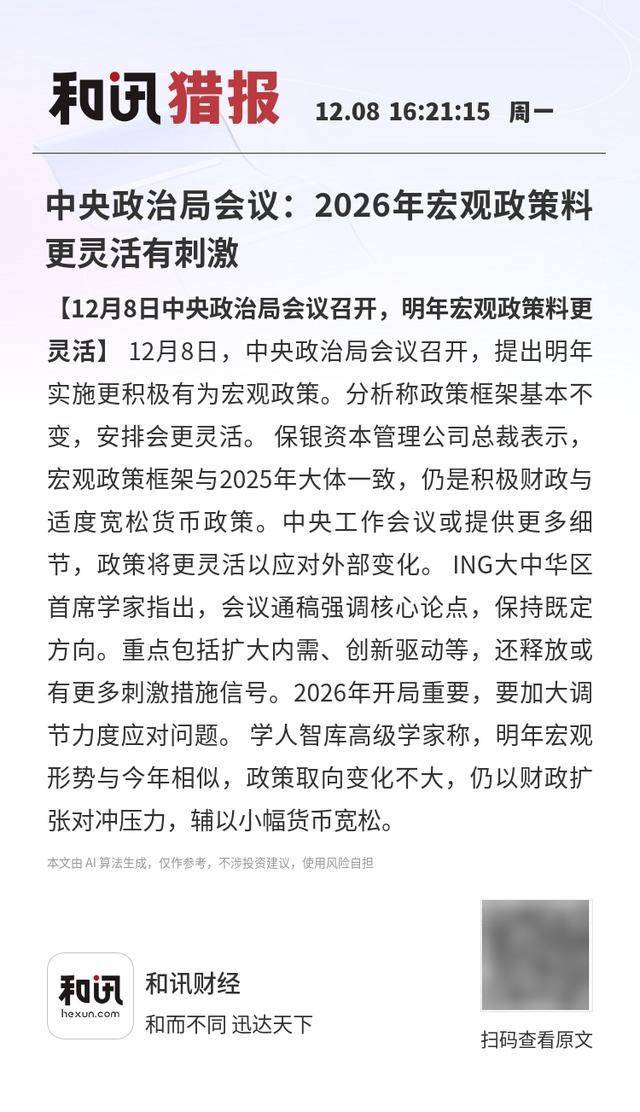
【12月8日中央政治局会议召开,明年宏观政策料更灵活】12月8日,中央政治局会议召开,提出明年实 施更积极有为宏观政策。分析称政策框架基本不变,安排会更灵活。保银资本管理公司总裁表示,宏观 政策框架与2025年大体一致,仍是积极财政与适度宽松货币政策。中央工作会议或提供更多细节,政策 将更灵活以应对外部变化。ING大中华区首席学家指出,会议通稿强调核心论点,保持既定方向。重点 包括扩大内需、创新驱动等,还释放或有更多刺激措施信号。2026年开局重要,要加大调节力度应对问 题。学人智库高级学家称,明年宏观形势与今年相似,政策取向变化不大,仍以财政扩张对冲压力,辅 以小幅货币宽松。 本文由 AI算法生成,仅作参考,不涉投资建议,使用风险自担 和讯财经 FUL hexun.con 和而不同 迅达天下 扫码查看原文 本文由 Al 算法生成,仅作参考,不涉投资建议,使用风险自担 ...
银河证券解读解读政治局会议:明年的结构性主线将更加清晰,重点关注“两条主线+两条辅助线”
Xin Lang Cai Jing· 2025-12-08 11:28
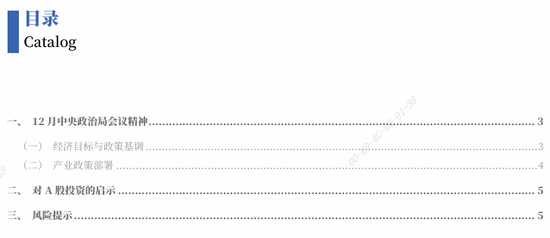
Core Viewpoint - The December Central Political Bureau meeting emphasizes the importance of maintaining a stable yet progressive approach to economic work in 2026, focusing on expanding domestic demand and optimizing supply to enhance resource allocation efficiency [1][6][21]. Economic Goals and Policy Framework - The meeting highlights the need to continue expanding domestic demand and optimizing supply, aiming for both qualitative and quantitative growth in the economy during the "14th Five-Year Plan" period [1][21]. - The overall policy framework for 2026 will maintain a proactive stance, with a focus on enhancing the quality and effectiveness of development, alongside a more active fiscal policy and moderately loose monetary policy [2][8][22]. Industry Policy Deployment - The meeting outlines a clear path for industry planning in 2026, prioritizing domestic demand and innovation, which will benefit sectors such as consumer goods, AI, digital economy, and new energy [3][10][24]. - Emphasis is placed on reform, opening up, and coordinated development to enhance high-quality growth, benefiting state-owned enterprises and infrastructure-related sectors [3][10][24]. Implications for A-Share Investment - The meeting provides initial guidance for economic work in 2026, focusing on domestic demand, innovation, and reform, which is expected to stabilize market expectations and boost confidence in the A-share market [4][17][26]. - Upcoming central economic work meetings are anticipated to detail specific fiscal, monetary, and industrial measures, further activating market vitality [4][17][26]. Investment Focus Areas - The current policy window indicates a clearer structural focus for 2026, with attention on new productive forces such as AI, renewable energy, and quantum technology, alongside recovery paths for manufacturing and resource sectors [12][26]. - The consumer sector is expected to see a favorable investment environment due to policies aimed at boosting domestic demand, while the trend of companies expanding overseas will enhance profit potential [12][26].
稳中求进谋开局,法治护航启新程
Huafu Securities· 2025-12-08 11:23
Group 1 - The core viewpoint of the report emphasizes a stable yet progressive approach to economic work, focusing on quality and efficiency improvements while implementing proactive macro policies [2][3][21] - The meeting highlighted the importance of a multi-dimensional policy system that covers both supply and demand, aiming for a transformation in economic growth dynamics through domestic demand and innovation [14][18] - The report outlines the significance of institutionalizing the leadership of the Communist Party in the rule of law, enhancing the governance system and capacity modernization [18][21] Group 2 - The report suggests that the economic work for the upcoming year will adhere to the principle of "seeking progress while maintaining stability," with a focus on quality enhancement and efficiency [3][21] - It emphasizes the need for a coordinated policy approach that integrates fiscal, monetary, industrial, and technological policies to effectively support the real economy [13][14] - The report identifies key areas for future investment opportunities, including domestic demand-driven sectors, innovation-driven industries, and the financial sector [22]
12月中央政治局会议对投资的启示
Yin He Zheng Quan· 2025-12-08 10:45
Group 1 - The December Central Political Bureau meeting emphasizes the importance of expanding domestic demand and optimizing supply, aiming to stimulate new growth points and improve resource allocation efficiency [2][5][6] - The macro policy framework for 2026 will continue to focus on stability while promoting progress, with a shift towards enhancing quality and effectiveness in economic development [6][7] - The meeting outlines a clear path for industrial policy, prioritizing domestic demand and innovation, which will benefit sectors such as consumer goods, AI, digital economy, and new energy [8][11] Group 2 - The meeting provides initial guidance for A-share investment, focusing on domestic demand, innovation, and reform, which will support market stability and investor confidence [11][12] - The upcoming Central Economic Work Conference is expected to detail specific fiscal, monetary, and industrial policies, further activating market dynamics [11][12] - The report identifies two main investment themes: the transition to new productive forces and the recovery of manufacturing and resource sectors, alongside a focus on consumer-driven policies [12]
重磅解读!中央政治局会议研究明年经济工作 如何理解8项“坚持”?
Zheng Quan Shi Bao· 2025-12-08 10:43
最新解读。 据新华社,中共中央政治局12月8日召开会议,分析研究2026年经济工作,审议《中国共产党领导全面 依法治国工作条例》。 对于如何做好明年的经济工作,会议提出一些重要表述,包括"更好统筹国内经济工作和国际经贸斗 争""实施更加积极有为的宏观政策""持续扩大内需、优化供给"等,并提出八项"坚持"的重点工作。多 位受访专家表示,明年经济增长转型诉求不减,政策需要兼顾短期与长远,内需将继续发挥助力经济总 体回升向好的"助推器"作用,并坚持以开放促改革促发展,重点领域风险化解将更加积极稳妥。 延续"更加积极有为"取向 明年加大逆周期与跨周期力度 今年以来,我国实施更加积极有为的宏观政策,支持实体经济发展力度加大,推动经济持续回升向好。 根据中央政治局会议部署,"十五五"开局之年,我国宏观政策"更加积极有为"的取向不变,继续实施更 加积极的财政政策和适度宽松的货币政策。同时,明年将加大逆周期和跨周期调节力度。 "继续实施"今年的财政、货币政策取向,不仅意味着明年政策将保持连续性、稳定性,营造出稳定的宏 观政策环境,还意味着明年政策力度依然可期,将坚持支持性的政策立场。 从财政政策看,"更加积极"意味着明年财政 ...