自由现金流

Search documents
自由现金流资产系列13:现金流指数为何今年偏弱,往后会强吗?
Huachuang Securities· 2025-08-22 06:35
Group 1 - The cash flow index has shown weak performance in 2025, primarily due to the profit fluctuations in the coal and petrochemical industries leading to valuation adjustments [5][10][29] - The absolute return of the cash flow index is significantly lower compared to historical averages, with the National and CSI cash flow total return indices yielding 4.1% and 4.6% respectively, while the broader market (Wande All A) returned 13% [5][10] - The banking sector's absence has been a major drag on the cash flow index's relative performance against the dividend index, which has benefited from strong bank contributions [29][30] Group 2 - The value strategy should not only focus on the level of ROE but also on the stability of ROE to enhance returns and mitigate volatility during periods of declining profitability [7][18] - The Huachuang strategy's cash flow combination has achieved a cumulative return of 31% from April 2024 to August 2025, outperforming benchmarks significantly [7][20] - The cash flow index tends to favor large-cap stocks, which has contributed to its underperformance in small-cap favorable market conditions [30][31] Group 3 - The expectation of a return to inflation could lead to the cash flow index outperforming both the dividend index and the broader market, as historical patterns suggest [31] - The cash flow index's performance is expected to improve as M1 growth has been rising for three consecutive quarters, indicating a potential shift in asset allocation logic [31]
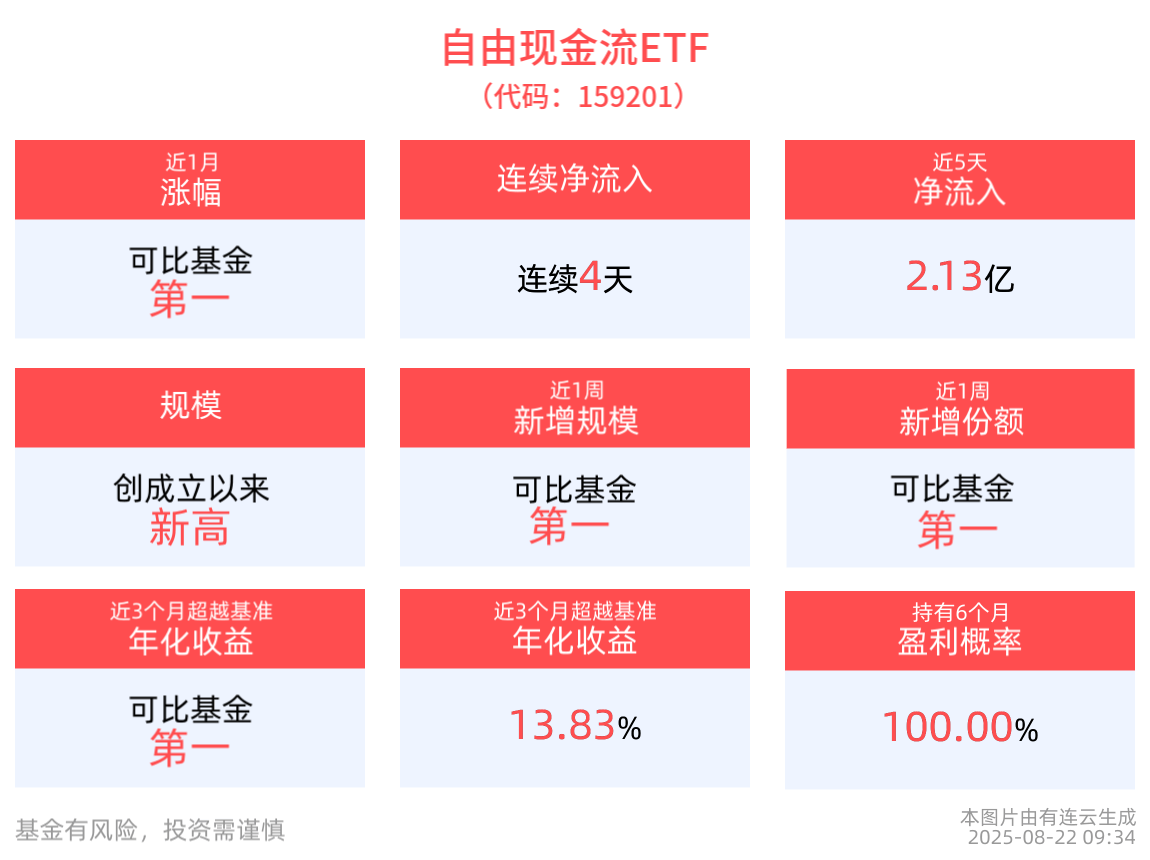
自由现金流ETF(159201)连续4日合计“吸金”2.39亿元,规模创成立以来新高
Sou Hu Cai Jing· 2025-08-22 02:03
Core Insights - The Guozheng Free Cash Flow Index has increased by 0.05%, with leading stocks including Anfu Technology, Xuefeng Technology, Huashu Media, Mould Technology, and Nanjing Xinbai [3] - The Free Cash Flow ETF (159201) has shown a 2.79% increase over the past week, ranking first among comparable funds [3] - The Free Cash Flow ETF has seen a net inflow of 239 million yuan over the last four days, with a total share increase of 21.8 million shares, also ranking first among comparable funds [3] Performance Metrics - As of August 21, the Free Cash Flow ETF has achieved a net value increase of 10.40% over the past six months [4] - The ETF's highest single-month return since inception is 3.62%, with a maximum consecutive monthly gain of 9.05% [4] - The ETF has a historical six-month profit probability of 100% and an average monthly return of 2.58% [4] Tracking and Holdings - The tracking error of the Free Cash Flow ETF over the past month is 0.039%, the highest precision among comparable funds [4] - As of July 31, the top ten weighted stocks in the Guozheng Free Cash Flow Index account for 57.66% of the index, including SAIC Motor, China National Offshore Oil, Midea Group, and Gree Electric [4][6]

药明生物(02269):1H25继续复苏,中长期确定性边际改善;当前估值合理,维持中性
BOCOM International· 2025-08-21 14:02
Investment Rating - The report maintains a Neutral rating for WuXi Biologics (2269 HK) with a target price of HKD 34.00, indicating a potential upside of 11.0% from the current closing price of HKD 30.62 [1][12]. Core Insights - The company's performance in the first half of 2025 (1H25) shows a continued recovery trend, with a strong order intake of 86 new contracts, marking a historical high for the first half of the year. However, there are concerns regarding the impact of changes in overseas financing and market dynamics on early-stage clinical projects, leading to a decrease in revenue from this segment [2][6]. - The management has raised the full-year revenue growth guidance to a range of 14-16%, up from the previous 12-15%, while maintaining a positive free cash flow outlook [6][7]. - The report highlights that the long-term growth drivers for the company remain strong, particularly through its proprietary technologies and the increasing number of projects in hand, which have grown by 10% compared to the end of 2024 [6][7]. Financial Summary - Revenue for 2025 is projected at RMB 21,312 million, with a growth forecast of 16% for 1H25 compared to the previous period. The gross profit is expected to reach RMB 9,157 million, reflecting a gross margin of 43.0% [5][13]. - The adjusted net profit for 2025 is estimated at RMB 5,005 million, with a net profit margin of 23.5% [5][13]. - The company’s market capitalization is approximately HKD 124.64 billion, with a year-to-date stock price increase of 74.37% [4][12]. Order and Project Insights - In 1H25, the company secured 86 new comprehensive projects, with over 70% being dual/multi-antibody and ADC projects. The report notes that the number of M-end projects has increased to 24, with expectations to complete 25 PPQ projects in 2025 [6][7]. - The report emphasizes the importance of proprietary technology in generating future revenue streams, including collaboration income and sales commissions [6][7]. Market and Regional Performance - Revenue growth in North America was 20%, while the Chinese mainland saw an 8.5% decline due to financing environment impacts. Japan and South Korea showed strong performance, indicating potential for further growth in these regions [6][7].
保险资金顺势加仓A股资产,同类规模最大的自由现金流ETF(159201)持续获益
Mei Ri Jing Ji Xin Wen· 2025-08-21 04:46
Group 1 - The core viewpoint of the articles highlights the recovery of the Guozheng Free Cash Flow Index, with a 0.31% increase as of August 21, driven by leading stocks such as Dongmagnet and Zhejiang Jiantou [1] - The largest free cash flow ETF (159201) has seen a net inflow of 156 million yuan over the past three days, indicating strong investor interest [1] - A state-owned insurance institution emphasizes the importance of optimizing equity asset allocation in a declining interest rate environment to enhance long-term returns and support the real economy [1] Group 2 - The Free Cash Flow ETF (159201) closely tracks the Guozheng Free Cash Flow Index, selecting stocks with positive and high free cash flow after liquidity, industry, and ROE stability screening, making it suitable for long-term investment [2] - The fund management fee is set at an annual rate of 0.15%, and the custody fee at 0.05%, both of which are among the lowest in the market, maximizing benefits for investors [2]
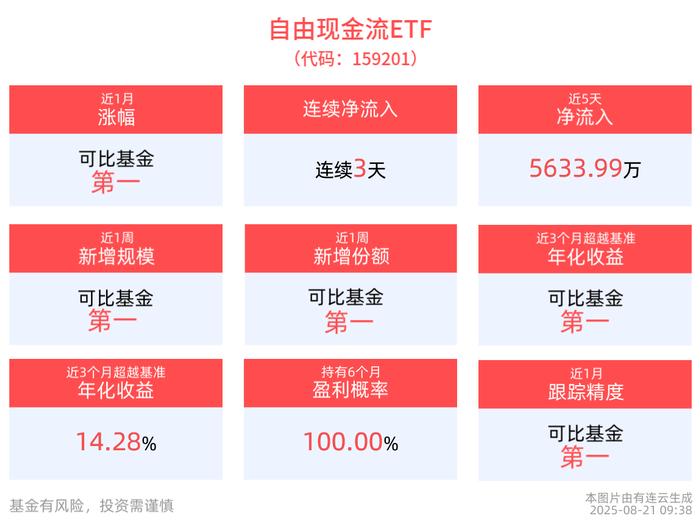
自由现金流ETF(159201)连续3天获资金净流入,合计“吸金”1.56亿元
Xin Lang Cai Jing· 2025-08-21 02:16
Group 1 - The Guozheng Free Cash Flow Index increased by 0.28%, with leading stocks including Hengdian East Magnetic, Guodian Nanzi, Shanghai Steel Union, Tianjin Port, and Baoshui Technology [2] - The Free Cash Flow ETF (159201) followed the index's upward trend, with a cumulative increase of 2.21% over the past week, ranking first among comparable funds [2] - The Free Cash Flow ETF saw an average daily trading volume of 356 million yuan over the past week, also ranking first among comparable funds [2] Group 2 - The Free Cash Flow ETF experienced continuous net inflows of 156 million yuan over the past three days, with a total share increase of 11.9 million shares and a scale growth of 22.5 million yuan in the past week, both ranking first among comparable funds [2] - Leveraged funds have been actively positioning, with the Free Cash Flow ETF receiving net purchases of leveraged funds for three consecutive days, reaching a maximum single-day net purchase of 13.7 million yuan, with the latest financing balance at 53.02 million yuan [2] - As of July 31, 2025, the top ten weighted stocks in the Guozheng Free Cash Flow Index accounted for 57.66% of the total index, including SAIC Motor, China National Offshore Oil, Midea Group, and Gree Electric [3]
同类规模最大的自由现金流ETF(159201)成交额超3亿元,模塑科技、上汽集团涨停
Mei Ri Jing Ji Xin Wen· 2025-08-20 06:13
Group 1 - The A-share market showed a mixed performance on August 20, with the Guozheng Free Cash Flow Index rising over 1.2%, driven by stocks like Mould Technology and SAIC Motor hitting the daily limit [1] - The largest free cash flow ETF (159201) followed the index upward, with trading volume exceeding 300 million yuan during the day, indicating significant investor interest [1] - Analysts believe the current A-share rally is supported by diverse funding sources, shifting from "institutional clustering" to a "multi-dimensional coexistence" model, suggesting a maturing market ecosystem [1] Group 2 - The free cash flow ETF (159201) focuses on industry leaders with abundant free cash flow, covering sectors such as home appliances, automotive, non-ferrous metals, power equipment, and oil and petrochemicals, effectively mitigating single-industry volatility risks [2] - The fund management annual fee rate is 0.15%, and the custody annual fee rate is 0.05%, both of which are among the lowest in the market [2]

最低费率一档的自由现金流ETF(159201)规模、流动性领跑同类产品,布局价值凸显
Sou Hu Cai Jing· 2025-08-20 02:17
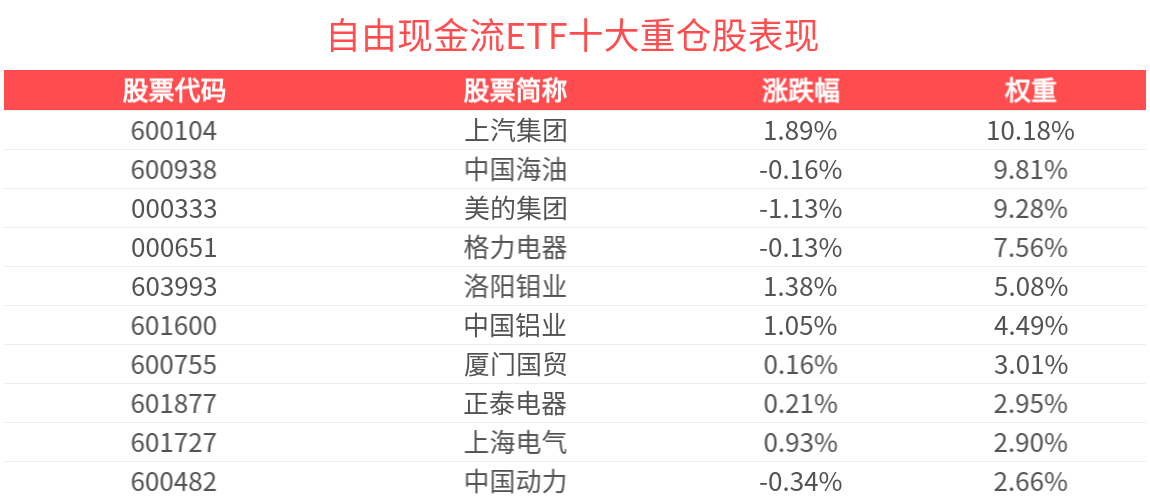
Core Insights - The Guozheng Free Cash Flow Index has increased by 0.50% as of August 20, 2025, with leading stocks including Yuntianhua, Mould Technology, Mulinsen, Jiejia Weichuang, and Baiyin Nonferrous Metals [1] - The Free Cash Flow ETF (159201) has risen by 0.55%, with a latest price of 1.09 yuan, and has seen a turnover rate of 1.76% with a transaction volume of 68.6096 million yuan [1] - Over the past week, the Free Cash Flow ETF has averaged a daily transaction volume of 343 million yuan, ranking first among comparable funds [1] Fund Performance - As of August 19, 2025, the Free Cash Flow ETF has achieved a net value increase of 8.74% over the past six months [2] - The ETF's highest single-month return since inception is 3.62%, with the longest consecutive monthly gain being three months and a maximum increase of 9.05% [2] - The ETF has a monthly profit percentage of 80.00% and a historical six-month holding profit probability of 100.00% [2] Fund Metrics - The management fee for the Free Cash Flow ETF is 0.15%, and the custody fee is 0.05%, making it the lowest among comparable funds [2] - The tracking error for the ETF over the past month is 0.040%, indicating the highest tracking precision among comparable funds [2] - The ETF closely tracks the Guozheng Free Cash Flow Index, which reflects the price changes of listed companies with high and stable free cash flow levels [2] Top Holdings - The top ten weighted stocks in the Guozheng Free Cash Flow Index account for 57.66% of the index, including SAIC Motor, China National Offshore Oil, Midea Group, and Gree Electric [2][4] - The weightings of the top stocks are as follows: SAIC Motor (10.18%), China National Offshore Oil (9.81%), Midea Group (9.28%), and Gree Electric (7.56%) [4]





牧原股份(002714):深度报告:行业新常态,牧原新阶段
Changjiang Securities· 2025-08-20 01:36
Investment Rating - The investment rating for the company is "Buy" and is maintained [12]. Core Views - The report highlights that the pig farming industry has transitioned from rapid growth to a stable phase, with capacity regulation becoming a new norm, positively impacting the industry. The company is entering a new development stage, focusing on efficiency, cost reduction, and improving free cash flow [4][20]. - Future capital expenditures for the company are expected to decrease significantly, with domestic capacity expansion slowing down, leading to healthier high-quality development in domestic operations. The company is also poised for growth in overseas markets [4][20]. Summary by Relevant Sections Industry New Normal - The Chinese pig farming industry has entered a new normal characterized by reduced price volatility and an elevated profit center. The proportion of large-scale farming entities has increased significantly, with those producing over 500 pigs annually now accounting for 70% of total output. This shift has led to more stable production capacities and tighter financing conditions, limiting large-scale expansions [8][27][36]. - The industry is now subject to long-term capacity regulation, which is expected to stabilize production and enhance profitability for quality enterprises [8][27]. Company’s New Stage - The company has entered a new development phase, with capital expenditures projected to decline from a peak of 461 billion yuan in 2020 to 124 billion yuan by 2024, and further down to 50 billion yuan thereafter. Free cash flow is expected to improve significantly, reaching 179 billion yuan in 2024 [9][22]. - The company maintains a cost advantage, with a projected complete cost of 12.1 yuan/kg by June 2025, the lowest among listed companies. This cost efficiency, combined with stable profit growth, positions the company favorably for future cash flow generation [9][22]. Overseas Expansion - The company is well-positioned to compete globally, with plans to expand its operations in overseas markets, particularly in Vietnam, where there is significant growth potential. The company aims to establish a substantial presence in the Vietnamese market by 2030, targeting 450,000 breeding sows and 10 million market pigs [10][39]. - The global distribution of pig production indicates that while China leads with approximately 703 million pigs, there remains considerable room for growth in countries like Vietnam, where the scale of production is still developing [10][39].

金鹰中证全指自由现金流指数基金18日起发行
Zhong Zheng Wang· 2025-08-18 09:21
Group 1 - The article highlights the increasing market attention on free cash flow strategy products, particularly in a low-interest-rate environment, with Jin Ying Fund launching the Jin Ying CSI All Share Cash Flow Index Fund on August 18 to provide investors with a tool for investing in high-quality cash flow companies [1] - Warren Buffett refers to free cash flow as "the real gold and silver of value investing," emphasizing that it better reflects a company's sustainable cash generation ability compared to accounting profits. Free cash flow serves as the basis for dividend distribution and is considered "unrealized dividends," enabling companies to reward investors and supporting high dividend yields [1] - The CSI All Share Free Cash Flow Index selects 100 "cash cow" companies from non-financial and real estate sectors based on liquidity, industry, and profit quality, offering investors superior equity asset investment choices. Since the base date of December 31, 2013, the CSI Cash Flow Total Return Index has increased by 659.18%, with an annualized return of 19.64%, demonstrating strong medium to long-term allocation value [1] Group 2 - The Jin Ying CSI All Share Cash Flow Index Fund uses a performance benchmark of 95% of the CSI All Share Free Cash Flow Index return plus 5% of the after-tax bank demand deposit rate, employing an index investment strategy to closely track the underlying index while minimizing tracking deviation and error [2] - The fund is managed by Sun Qianqian, Deputy General Manager of the Absolute Return Investment Department at Jin Ying Fund, who has 14 years of experience in the securities industry and 6 years in public fund management. Her current managed products focus on high dividend safety and enhance returns through cash flow-based quantitative indicators in stock selection [2]
中证全指自由现金流指数,投资价值如何?|第399期精品课程
银行螺丝钉· 2025-08-18 04:01
Core Viewpoint - The article discusses the concept of the Free Cash Flow Index, its characteristics, and how it differs from dividend and value indices, emphasizing its relevance in investment strategies [1][10][64]. Group 1: Free Cash Flow Index Overview - The Free Cash Flow Index is a strategy index closely related to the investment philosophies of Warren Buffett and Benjamin Graham, focusing on selecting stocks with the highest free cash flow rates [10][19]. - Free cash flow is defined as the cash available after necessary operational expenses and capital expenditures, which can be freely allocated by the company [14][19]. - The Free Cash Flow Rate is calculated as free cash flow divided by enterprise value, where enterprise value is the total market capitalization plus total liabilities minus cash and cash equivalents [17][19]. Group 2: Comparison with Other Indices - The Free Cash Flow Index differs from dividend and value indices in that it includes companies with high free cash flow that may not necessarily pay dividends or have low valuation metrics [22][23]. - Dividend and value indices tend to focus on traditional industries, while the Free Cash Flow Index can include emerging industry leaders with strong cash flows but low dividend payouts [23][25]. - The Free Cash Flow Index is more selective, excluding companies with high leverage that may show high dividend yields but low free cash flow [24][25]. Group 3: Index Characteristics and Performance - The China Securities Index for Free Cash Flow was launched in December 2024, and it selects the top 100 stocks with the highest cash flow rates from the broader market, excluding financial and real estate sectors [31][32][64]. - The index has shown a historical annualized return of 14.12% from December 31, 2013, to August 6, 2025, with a total return of 18.88% when including dividends, significantly outperforming the broader market index [40][41][64]. - The index's composition is heavily weighted towards industries such as industrials, materials, and consumer staples, with a concentration of over 50% in the top ten holdings [34][37][64]. Group 4: Future Outlook and Strategy - The Free Cash Flow Index is considered a valuable addition to investment strategies, particularly for investors looking to diversify away from financial-heavy indices [61][64]. - The index's methodology and focus on cash flow make it suitable for pairing with traditional dividend and value indices, providing a balanced approach to investment [61][64].