
新消费

Search documents
三大主线驱动中国资产价值重估向纵深演进
Zheng Quan Ri Bao· 2025-11-13 17:19
Group 1 - The core viewpoint is that China's asset prices are undergoing a significant revaluation driven by multiple factors, marking the beginning of a new era for the Chinese capital market [1] - The institutional opening of China's capital market is deepening, reshaping global capital allocation logic, as evidenced by the Shanghai Stock Exchange's focus on expanding cross-border investment channels and enhancing international competitiveness [3][4] - China's economic resilience is providing a solid foundation for asset value revaluation, with GDP growth expected to remain around 5% in 2026, and the attractiveness of RMB assets in global capital allocation is increasing [4][5] Group 2 - New growth drivers are emerging, with innovation, mergers and acquisitions, and globalization creating diverse investment paths that expand valuation space for Chinese assets [6][7] - The innovation sector, particularly in AI and new consumption, is becoming a hotspot for global capital, while mergers and acquisitions are enhancing asset quality through industry consolidation [7][8] - The globalization of Chinese enterprises is accelerating, broadening revenue sources and reconstructing the valuation system on a global scale, indicating that the revaluation of Chinese assets is not just a forecast but a current reality [8]
上市以来股价累涨460%!西普尼的成色如何?
Sou Hu Cai Jing· 2025-11-13 08:49
Group 1 - The core performance of Xipuni (02583.HK) on its debut was remarkable, with a 258% increase on the first day and a further 71% rise the next day, leading to an overall increase of over 460% to date, making it one of the strongest new stocks of the year [2] - The rise of new consumption trends has favored companies like Xipuni, which designs, manufactures, and sells traditional and smart watches, as well as precious metal accessories, appealing particularly to younger consumers [3][5] - Xipuni operates under an OBM business model with two self-owned watch brands, "HIPINE" and "GOLDBEAR," and plans to expand its product offerings significantly by 2025 [3] Group 2 - Xipuni also develops and manufactures ODM products for well-known domestic jewelry brands, benefiting from the rising popularity of gold watches among the younger generation [5] - The company's financial performance has shown continuous growth, with revenues increasing from 324 million RMB in 2022 to 457 million RMB in 2024, alongside rising profits attributed to higher average selling prices of gold watches due to increasing gold prices [7] - Future plans include building new production facilities to expand smart watch capacity and strategic partnerships with overseas distributors to enhance market reach, which could elevate performance potential [8]


消费有望迎来轮动补涨!消费ETF(159928)翻红冲击两连阳!港股通消费50ETF(159268)获资金净流入超4600万元!机构:关注消费板块胜率和赔率
Sou Hu Cai Jing· 2025-11-13 06:45
Group 1: Market Performance - The consumer sector is experiencing a rebound, with the Consumer ETF (159928) rising by 0.47% and achieving a trading volume exceeding 660 million yuan [1] - The Hong Kong Stock Connect Consumer 50 ETF (159268) also saw a slight increase of 0.2%, with trading volume surpassing 126 million yuan, indicating strong capital inflow [2] - Notable stocks include Samsonite, which surged over 17% with a 11% year-on-year profit growth and a gross margin increase to 59.6% [4] Group 2: Economic Indicators - The core CPI, excluding food and energy, rose by 1.2% year-on-year in October, marking the sixth consecutive month of growth, which has drawn attention to the recovery of consumer spending [5] - The government plans to continue implementing measures to boost consumption, including financial subsidies for personal consumption loans and support for key sectors like elderly care and childcare [15] Group 3: Valuation and Investment Opportunities - The Consumer ETF (159928) has a TTM price-to-earnings ratio of 20.55, which is at the 7.45% percentile over the past decade, indicating it is cheaper than 92% of the historical time frame [5] - Despite a strong performance in technology and cyclical sectors, the consumer sector has shown relatively weaker growth of only 10.85% year-to-date, suggesting potential for catch-up [8] Group 4: Sector Analysis - The consumer sector is expected to see a rotation and rebound, with specific segments like healthcare, aviation, home appliances, personal care, and non-white liquor showing strong earnings growth while remaining at historically low valuations [12] - The new consumption trends are driven by the Z generation, with sectors like trendy toys and jewelry expected to grow due to changing consumer preferences and technological integration [16][17] Group 5: Company Innovations - Anta Group has launched the first AI design model in the sports goods industry, which has already generated over 2.5 billion yuan in orders, indicating a significant boost in sales conversion rates [18] - Upbeauty Co. has introduced a new baby care brand, expanding its IP strategy to capture the growing demand in the baby personal care market [19]

港股定价权增强 市场正循环显现
Zheng Quan Shi Bao· 2025-11-12 22:28
Core Viewpoint - The Hong Kong stock market has reached a new milestone with southbound capital inflows exceeding 1.3 trillion HKD this year, marking a significant increase in liquidity and activity, driven by strategic allocations from mainland investors seeking undervalued assets and high-quality stocks [1][2][3]. Group 1: Market Performance - As of November 10, 2023, the southbound capital through the Stock Connect has net inflows of 66.54 billion HKD, bringing the total for the year to 13,053.49 billion HKD, surpassing the 1.3 trillion HKD mark [2]. - Major indices in the Hong Kong market, including the Hang Seng Index, Hang Seng Tech Index, and Hang Seng China Enterprises Index, have all seen year-to-date increases of over 30%, ranking among the top global markets [2]. Group 2: Factors Driving Inflows - The influx of southbound capital is attributed to five main factors: valuation discounts compared to A-shares, a declining domestic interest rate environment, continuous optimization of the Stock Connect mechanism, inherent demand from long-term domestic funds, and global expectations of liquidity easing [3][4]. - The phenomenon of "asset scarcity" is also noted, where domestic funds are seeking effective allocation opportunities in the Hong Kong market due to limited high-return assets available domestically [4]. Group 3: Market Dynamics and Trends - The continuous inflow of southbound capital has improved liquidity in the Hong Kong market and enhanced the pricing power of mainland investors [5]. - In 2024, southbound capital is expected to account for approximately 34.64% of the total trading volume in the Hong Kong market, a significant increase from previous years [6]. - The composition of southbound capital is primarily driven by insurance funds and public funds, with public funds showing a compound annual growth rate of 23.5% in their holdings from 2020 to 2025 [6]. Group 4: Future Outlook - The Hong Kong market is anticipated to benefit from a "positive cycle" as more mainland companies list in Hong Kong, attracting further capital inflows and enhancing liquidity [8]. - Despite significant gains in the Hong Kong market this year, its valuation remains attractive compared to other global markets, providing further incentive for mainland investors to allocate capital southward [9].
投资中国、携手共赢 2025年上交所国际投资者大会传递投资强信心
Shang Hai Zheng Quan Bao· 2025-11-12 13:05
Core Insights - The 2025 Shanghai Stock Exchange International Investor Conference opened on November 12, focusing on "Value Leadership, Open Empowerment - New Opportunities for International Capital Investment and Mergers" [1] - The conference attracted over 100 renowned investment institutions and nearly 400 representatives from regions including Europe, America, Asia-Pacific, and the Middle East, discussing new opportunities in Chinese investment and mergers, technology innovation, and high-level capital market openness [1][2] - Global asset management leaders expressed optimism about the long-term investment value in China, citing a stable macroeconomic environment, improved policy conditions, and accelerated technological innovation [1][2] Market Developments - China's capital market is steadily expanding its institutional openness, with ongoing optimization of the Qualified Foreign Institutional Investor (QFII) system, which has received high recognition for its stability, transparency, and predictability [2] - The Shanghai Stock Exchange and Singapore Exchange launched the China Securities Index Singapore Exchange Asia 100 Index series during the conference, marking a significant step in international cooperation [2] - The conference highlighted the achievements of the Shanghai Stock Exchange in supporting technological innovation and the development of new productive forces, particularly in the context of the seventh anniversary of the Sci-Tech Innovation Board [2] Future Outlook - The Shanghai Stock Exchange aims to enhance market inclusivity and adaptability while improving its attractiveness and competitiveness in response to complex internal and external changes in the capital market [3] - The exchange plans to leverage favorable opportunities for open cooperation to promote the long-term and stable development of the capital market in collaboration with global investors [3]
2025年上海证券交易所国际投资者大会开幕 百余家知名投资机构参会
Zheng Quan Ri Bao Wang· 2025-11-12 12:11
Core Viewpoint - The 2025 Shanghai Stock Exchange International Investor Conference emphasizes the theme of "Value Leading, Open Empowerment - New Opportunities for International Capital Investment and Mergers" and highlights the growing interest of global investors in China's market due to improving macroeconomic conditions and policy environments [1][2]. Group 1: Conference Highlights - The conference attracted over 100 renowned investment institutions and nearly 400 representatives from regions including Europe, America, Asia-Pacific, and the Middle East [1]. - Key executives from leading global asset management firms expressed optimism about the long-term investment value in China, citing stable macroeconomic conditions and accelerated technological innovation [2]. - The Shanghai Stock Exchange (SSE) announced the release of the China Securities Index Singapore Exchange Asia 100 Index series during the conference, showcasing its international cooperation efforts [2]. Group 2: Market Developments - The A-share market has shown a steady upward trend this year, with major indices rising and investor confidence improving, leading to continued inflow of international capital [2]. - The SSE has made significant progress in serving technological innovation and the development of new productive forces, with successful initiatives in green finance and high-level openness [3]. - The conference included discussions on various sectors such as artificial intelligence, new consumption, biomedicine, and high-end manufacturing, as well as a dedicated session on mergers and acquisitions [3]. Group 3: Future Directions - The SSE aims to enhance market inclusivity and adaptability while continuously improving its attractiveness and competitiveness in the context of complex internal and external changes [4]. - The "14th Five-Year Plan" suggests a steady expansion of institutional openness, providing guidance for the capital market's open cooperation [4].
李迅雷专栏 | 把握“十五五”结构性机会,四大配置主线浮现
中泰证券资管· 2025-11-12 11:32
Global Landscape - The strategic interaction and policy choices between China and the US significantly impact global trade, industrial chain layout, and capital flows [4] - China is estimated to account for over 40% of global manufacturing capacity, reinforcing its influence in trade and industry [4] - The debt-driven growth model poses challenges but also reflects China's substantial policy resources and market development potential [4] Chinese Economy - The current economic situation is characterized as "high at the front and low at the back," with a GDP growth rate of 5.2% in the first three quarters, making the annual target achievable [6] - Consumption grew by 4.5%, supported by policies like "old-for-new" exchanges, while investment saw a decline of 0.5% [6] - Exports were a highlight, increasing by 6.1%, particularly strong in emerging markets like Africa and ASEAN [6] "14th Five-Year" Plan Highlights - The plan emphasizes accelerating "technological self-reliance," aiming to build a modern industrial system with advanced manufacturing as its backbone [8] - There is a strong push for consumption and increased social welfare spending, particularly in response to an aging population [8] - The establishment of a nationwide unified market is prioritized, optimizing resource allocation in energy, public services, and data [8] Asset Allocation Strategies - In a low-interest-rate environment, high-dividend assets are highlighted as scarce and valuable, with Hong Kong stocks offering a dividend rate 30% higher than A-shares [11] - Sectors like military, gold, and rare earths are recommended as strategic allocations in response to global geopolitical tensions [11] - Focus on AI technology sectors, including computing power and robotics, is essential as they represent a significant investment opportunity [11] - New consumption trends driven by younger demographics and single-person economies present emerging investment opportunities [11]

封单超9万手!1分钟,直线涨停
Zhong Guo Zheng Quan Bao· 2025-11-12 08:28
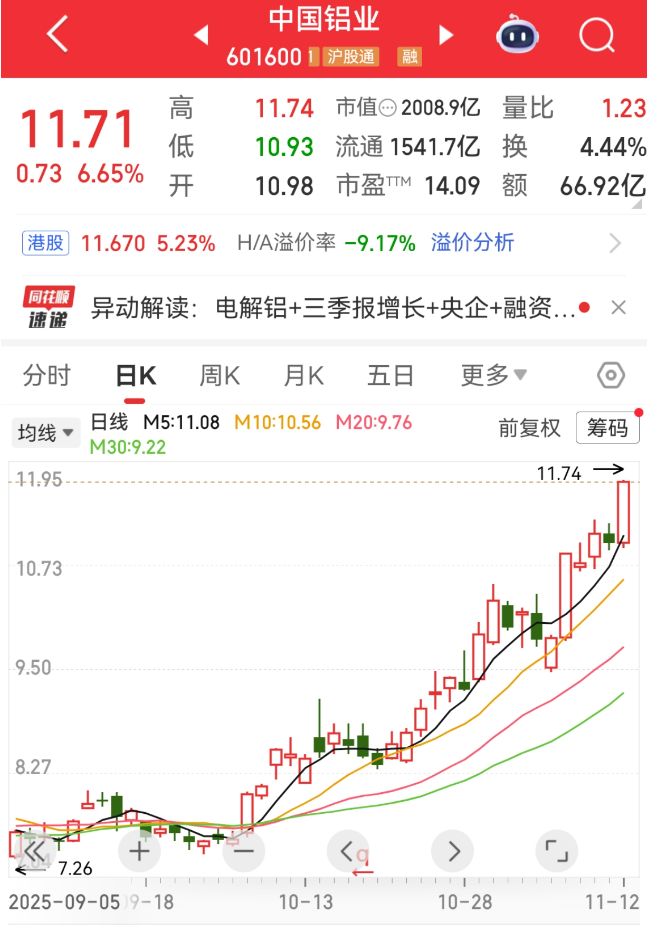
Group 1 - The A-share market shows a diverse performance with strengths in both technology and cyclical sectors, highlighted by significant gains in leading stocks such as China Aluminum, which rose over 6% to reach a market value of approximately 200.8 billion yuan [1] - AI hardware concepts are performing well, with major stocks like Zhongji Xuchuang increasing by 5.06% and achieving a trading volume of 19.891 billion yuan, leading the A-share market [3] - The banking sector is strong, with Agricultural Bank and Industrial and Commercial Bank reaching historical highs, while the oil and gas sector also sees significant gains [5] Group 2 - The storage chip sector is experiencing notable activity, with stocks like Dagang Co. hitting the daily limit within a minute, indicating strong market interest [6] - Companies are focusing on integrated circuits and environmental resource services to enhance core competitiveness and operational standards, with a total of 91,600 A-share shareholders reported as of October 31 [8] - The storage industry is expected to maintain a tight supply-demand balance due to rising storage prices and increasing demand driven by AI infrastructure development [8] Group 3 - Recent market trends suggest a potential style shift in the A-share market, with some analysts attributing this to a change in market dynamics [9] - As the year-end approaches, historical patterns indicate that small and medium themes often outperform, with potential style shifts observed in previous years [10] - Analysts predict that while technology stocks may experience volatility, traditional sectors like materials and banking are likely to continue providing excess returns until year-end [10]

乘势 • 谋新 | 中金公司2025年度投资策略会盛大开幕!
中金点睛· 2025-11-12 05:39
Core Viewpoint - The 2025 Annual Investment Strategy Conference hosted by CICC is themed "Ride the Momentum, Seek New Opportunities," gathering over 500 executives from listed companies and numerous experts from government, industry, and academia for in-depth discussions on various emerging themes [1]. Group 1: Conference Overview - The conference takes place from November 12 to 14, featuring a total theme day on the first day and ten thematic sub-forums over the following two days [1]. - Key discussion topics include new supply, new technology, new consumption, new finance, new intelligent driving, new medicine, new applications, new materials, and new energy [1]. Group 2: Key Participants - Notable speakers include Wang Shuguang, Vice Chairman and President of CICC [3], Liu Shijun, Chief Advisor of the China Council for International Cooperation on Environment and Development [5], Dr. Teh Kok Peng, Chairman of the East Asian Institute at National University of Singapore [7], Peng Wensheng, Chief Economist and Head of Research at CICC [8], and Miao Yanliang, Executive Head of the Research Department at CICC [9].
港股新消费概念股持续活跃,港股消费ETF(513230)现涨近1.5%
Mei Ri Jing Ji Xin Wen· 2025-11-12 03:09
Group 1 - The Hong Kong stock market's new consumption concept stocks are actively performing, with the Hong Kong Consumption ETF (513230) rising nearly 1.5% during trading [1] - Among the holdings, Mixue Group leads with a gain of over 5%, while other companies like Smoore International, Shenzhou International, Midea Group, Giant Bio, and Nongfu Spring also see increases of over 3% [1] - The Ministry of Finance's report highlights a more proactive fiscal policy since 2025, focusing on stabilizing employment, businesses, markets, and expectations, with plans for six key areas of work to boost consumption [1] Group 2 - The growth of emerging consumer goods reflects the new consumption concepts of the younger generation in the current social environment, which is crucial for identifying growth opportunities in new consumption companies [2] - In the gold jewelry sector, it is recommended to focus on head brands in the ancient gold segment that are favored by younger consumers, such as Laopu Gold [2] - For trendy toys, companies with strong IP creation and operational experience, like Pop Mart, are suggested for attention [2] - In the ready-to-drink tea segment, it is advised to focus on leading tea brands with strong brand power and wide business coverage, such as Mixue Group and Guming [2] - The Hong Kong Consumption ETF (513230) tracks the CSI Hong Kong Stock Connect Consumption Theme Index, encompassing a wide range of sectors including leading new consumption companies and major internet e-commerce players like Tencent, Kuaishou, Alibaba, and Xiaomi [2]
