存款搬家

Search documents
以为存定期最踏实?算完账才发现,钱躺银行竟不如买点 “稳当货”
Sou Hu Cai Jing· 2025-09-17 20:47
Core Viewpoint - The article discusses the changing attitudes towards traditional bank savings due to declining interest rates, prompting individuals to seek alternative investment options to preserve and grow their wealth [2][11][21]. Group 1: Interest Rate Changes - The interest rate for a three-year fixed deposit has decreased from 2.45% to 1.55%, resulting in a reduction of interest income by 5,400 yuan for a 200,000 yuan deposit [3][4]. - Current interest rates for demand deposits are as low as 0.05% to 0.2%, leading to concerns about the diminishing purchasing power of savings [5][11]. Group 2: Alternative Investment Strategies - Individuals are exploring new strategies, such as splitting their savings between bank wealth management products (with expected returns of 3%) and gold, which has increased in price from 660 yuan per gram to 830 yuan per gram [5][9]. - The article highlights the experiences of individuals like Liu Ayi and Li Yao, who have adopted diversified investment approaches, including gold ETFs and mutual funds, to enhance their financial management [9][16]. Group 3: Market Trends - Data indicates a significant shift in household savings, with a net decrease of 1.11 trillion yuan in July alone, while non-bank financial institutions saw an increase of 4.69 trillion yuan in deposits [17][18]. - The number of new accounts opened in the A-share market increased by over 70% year-on-year in July, reflecting a growing interest in alternative investment avenues [18]. Group 4: Investment Mindset - The article emphasizes that investment should be tailored to individual preferences, with some prioritizing stability through wealth management and gold, while others prefer more flexible options like diversified funds [20]. - The overarching theme is that as traditional savings become less appealing, individuals are taking proactive steps to ensure their money remains productive and resilient against inflation [21].


非银存款“吸金” 居民资产配置换轨显端倪
Zhong Guo Zheng Quan Bao· 2025-09-17 20:19
Group 1 - The central theme of the articles discusses the emerging "see-saw" effect between resident deposits and non-bank deposits, indicating a trend of "deposit migration" as residents shift funds into financial investments due to strong equity market performance [1][2] - In August, resident deposits increased by 110 billion yuan, a year-on-year decrease of 600 billion yuan, marking two consecutive months of negative growth, while non-bank deposits rose by 1.18 trillion yuan, a year-on-year increase of 550 billion yuan [1] - Analysts suggest that the increase in non-bank deposits is primarily driven by the migration of resident funds to brokerage margin accounts and equity public funds, with A-share new account openings reaching 2.65 million in August, a 35% month-on-month increase and a 165% year-on-year increase [2] Group 2 - The trend of "deposit migration" reflects a significant change in residents' asset allocation, with a strong demand for asset diversification as high-interest fixed-term deposits mature [2][3] - The growth in M1, which reached a balance of 111.23 trillion yuan with a year-on-year increase of 6%, indicates a narrowing gap between M1 and M2 growth rates, suggesting that more funds are being converted into demand deposits, which can stimulate consumption and investment [3] - The narrowing of the M1 and M2 growth rate gap to 2.8 percentage points is the lowest since June 2021, indicating an increase in the liquidity of funds and a shift from savings to transactional needs among residents [3]
公募新发回暖!近一个月14只主动权益类基金提前结募
Bei Jing Shang Bao· 2025-09-17 10:31
Core Viewpoint - The recent trend of early closure of actively managed equity funds indicates a significant improvement in market conditions, with increased profitability in the stock market and a shift of household savings into investments [1][2][3][4] Fund Closure Trends - As of September 17, 2023, a total of 7 actively managed equity funds closed early in September, with 14 funds closing early in the past month, marking a year-on-year increase [1][2] - Notable funds that sold out in one day include the Huashang Hong Kong Stock Connect Value Return Mixed Fund and the招商均衡优选混合, which exceeded their fundraising limits on the first day of sale [2][3] Market Conditions - The A-share market has shown a significant recovery, with the Shanghai Composite Index, Shenzhen Component Index, and ChiNext Index rising by 12.54%, 26.28%, and 46.18% respectively since the third quarter began [3] - Analysts attribute the resurgence in fund issuance to improved market conditions and the enhanced profitability of the stock market, alongside a rapid conversion of household savings into investments [3][4] Future Outlook - There is an expectation for continued warming in the issuance of actively managed equity funds, with predictions that the stock market may challenge the 4000-point mark in the third or fourth quarter of 2026 [3][4] - The trend of household savings moving into the stock market is anticipated to persist, driven by lower deposit rates, rising inflation, and attractive returns from other asset classes [4]
非银存款新增1.18万亿,流向了哪儿?券商观点现分歧
券商中国· 2025-09-17 09:05
Core Viewpoint - The recent increase in non-bank deposits by 1.18 trillion yuan in August, a year-on-year increase of 550 billion yuan, has sparked significant market interest, with differing opinions among analysts regarding the reasons behind this growth [1][2]. Group 1: Reasons for Non-Bank Deposit Increase - One perspective suggests that the increase in non-bank deposits is primarily due to the growth in stock account margins, as residents shift their savings into brokerage margin accounts and equity mutual funds [3]. - According to China International Capital Corporation (CICC), the increase in non-bank deposits correlates with a decrease in resident deposits, which grew by only 110 billion yuan in August, a year-on-year decrease of 600 billion yuan. This shift is attributed to the active capital market environment [3]. - Another viewpoint from Everbright Securities indicates that the "wealth effect" from a strong equity market has led to a transfer of resident deposits into non-bank deposits, with trading volumes in the stock market nearing peak levels [4]. Group 2: Alternative Explanations - Some analysts, like those from Xinda Securities, argue that the increase in non-bank deposits may also stem from a rising willingness to hold cash in non-bank products, especially given the weak bond market conditions in August [5]. - Huaxi Securities highlights that while the stock market's performance has driven some deposits into brokerage accounts, the overall speed of capital inflow into the market may not meet expectations, as evidenced by the number of new stock accounts opened in August [5]. - Additionally, data from the top 14 wealth management companies shows a net increase in their balances, suggesting that a portion of the funds may have flowed into non-bank deposits from wealth management products [6]. Group 3: Historical Context and Future Implications - Historical analysis by Galaxy Securities indicates that signs of a "deposit migration" are emerging, with a continuous decline in resident deposit growth and a potential shift towards equity assets [7]. - The correlation between non-bank deposit growth and the performance of the CSI 300 index has been noted, suggesting that the recent increase in non-bank deposits may reflect a broader trend in the equity market [8].

非银存款环比少增加近万亿元,居民入市脚步在放缓?
Hua Xia Shi Bao· 2025-09-17 01:38
Core Insights - The article discusses the trend of residents' deposits decreasing while non-bank deposits are increasing, indicating a shift of funds towards financial products and capital markets [2][3] - In August, despite a strong A-share market, the growth of non-bank deposits slowed down, raising questions about the sustainability of this trend [2][4] Group 1: Deposit Trends - In July, residents' deposits decreased by 1.1 trillion yuan, while non-bank deposits increased by 2.14 trillion yuan, indicating a significant shift of funds [2] - In August, non-bank deposits increased by 1.18 trillion yuan, which is a year-on-year increase of 0.55 trillion yuan but a month-on-month decrease of nearly 1 trillion yuan [2][4] - The trend of residents moving deposits to non-bank financial institutions is continuing but at a slower pace, suggesting potential changes in investor behavior [2][5] Group 2: Market Performance - The A-share market saw a rise from 3,562 points on August 1 to 3,871 points on August 26, leading many to believe that the market had entered a bull phase [3] - Despite the bullish market, the slowdown in non-bank deposit growth raises questions about investor confidence and potential profit-taking behavior [5][6] Group 3: Financial Products and Investment Behavior - The scale of bank wealth management products remained stable, with a slight increase in August, indicating continued interest in these investment vehicles [4][5] - The majority of bank wealth management investments are still in bonds, which have experienced volatility, yet there remains a preference for stable investment products among residents [5][6] - The overall trend of decreasing deposit rates is expected to continue, which may further encourage the movement of funds into the stock market over the long term [6]

“存款搬家”大潮来袭!居民资金疯狂流入股市,银行账户空了!
Sou Hu Cai Jing· 2025-09-16 15:22
Core Insights - The article discusses a significant shift in financial behavior, termed "wealth migration," where individuals are moving their savings from bank accounts to investment vehicles like stocks and funds [2][4]. Group 1: Deposit Trends - Recent financial data indicates a decline in resident deposits for two consecutive months, suggesting a trend where individuals are no longer keeping their money locked in banks [4][6]. - Non-bank deposits have surged, with an increase of 1.18 trillion yuan in August, indicating a strong movement of funds from bank accounts to investment accounts [6]. Group 2: M1 and M2 Dynamics - The difference between M1 (liquid money) and M2 (more stable deposits) has narrowed, reflecting increased activity in liquid funds as individuals shift from saving to investing [8]. - The rise in M1 activity is attributed to a booming stock market and decreasing bank deposit interest rates, prompting individuals to seek better returns through investments [8]. Group 3: Consumer Behavior and Economic Outlook - Despite the strong inflow of funds into the stock market, overall loan demand remains low, indicating a cautious approach among consumers who prefer saving over borrowing [10]. - The phenomenon of "more saving, less borrowing" highlights a general reluctance to spend, with consumers waiting for more favorable economic conditions before increasing their consumption [10][12]. Group 4: Policy Implications - The government is actively trying to stimulate consumption through various measures like consumption vouchers and subsidized loans, aiming to encourage a shift from saving to spending [10][12]. - The ongoing economic situation resembles a game of "funds migration," where money circulates between savings, investments, and consumption, filled with strategic decisions [12].

A股缩量却冲上3892点!AI狂欢背后,这三个信号才是慢牛关键
Sou Hu Cai Jing· 2025-09-16 08:26
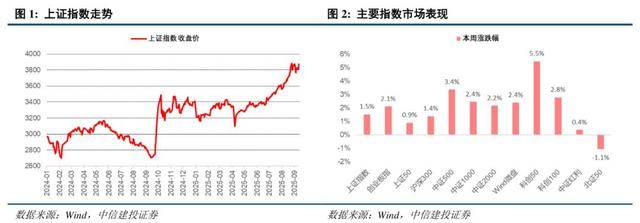
Market Overview - A-shares experienced a sudden surge, approaching 3900 points, despite a decline in trading volume from an average of nearly 3 trillion to 2.3 trillion [1] - The AI computing sector significantly boosted the Sci-Tech 50 Index, which rose by 5.5% [1] - Concerns about whether the shrinking volume indicates a trap or an opportunity are prevalent among investors [1] Fund Flows - Margin trading accounted for 11.5% of total trading volume, with a weekly net inflow of 51.8 billion, more than double the previous week [1] - Industry-themed ETFs attracted 101 billion over the past four weeks, indicating that investors are not withdrawing but rather seeking direction [1][3] Economic Indicators - August CPI fell by 0.4% year-on-year, primarily due to high base effects from last year, particularly in food prices [4] - Core CPI rose to 0.9%, indicating stable recovery in domestic demand [4] - PPI showed signs of improvement, with a month-on-month stability and a year-on-year decline of 2.9%, narrowing from -3.6% in previous months [4][6] Sector Analysis - Upstream industries such as coal, oil, steel, and non-ferrous metals showed significant PPI improvements, supported by recent anti-involution policies [6] - The recovery in upstream sectors is expected to positively impact the entire industrial chain, providing fundamental support for A-shares [6] External Environment - The U.S. is expected to lower interest rates by 25 basis points in September, with potential for two more cuts this year [8] - A weaker dollar and increased liquidity may lead to foreign capital flowing into emerging markets, including Chinese assets [8] - Sectors such as internet stocks in Hong Kong, and financial, consumer, and new energy sectors in A-shares may benefit from foreign inflows [8] Investment Strategy - The market is in a slow bull consolidation phase, with no signs of a funding collapse or disruption in high-growth sectors [9] - Focus on sectors with policy support or PPI recovery, such as pig farming, non-ferrous metals, and basic chemicals [11] - Key signals to monitor include the continued rise of core CPI and the pace of foreign capital inflows [11]
8月金融数据点评:存款搬家仍在延续
Mai Gao Zheng Quan· 2025-09-16 05:26
Financing Data - In August 2025, the social financing scale increased by 25,668 billion yuan, a decrease of 4,655 billion yuan compared to the same period last year[2] - Cumulative social financing for the first eight months of 2025 reached 265,575 billion yuan, an increase of 46,567 billion yuan year-on-year, indicating strong overall performance supported by government bond issuance[2] - New bills increased by 1,973 billion yuan in August, reflecting a year-on-year increase of 1,322 billion yuan and a month-on-month increase of 3,611 billion yuan, suggesting a recovery in short-term financing demand from the real economy[2] Credit and Loan Data - New RMB loans in August amounted to 5,900 billion yuan, an increase of 6,400 billion yuan month-on-month, but a decrease of 3,100 billion yuan year-on-year[3] - Short-term loans for enterprises showed significant improvement, with a month-on-month increase of 2,600 billion yuan and a year-on-year increase of 6,200 billion yuan, indicating heightened business activity[3] - Resident short-term loans increased by 3932 billion yuan month-on-month, driven by seasonal consumption demand and supportive consumption policies[3] Monetary Supply - M2 growth rate remained stable at 8.8% in August, supported by fiscal policy and reasonable growth in social financing and loans[3] - M1 growth rate increased to 6.0% year-on-year, reflecting improved business activity and increased liquidity for enterprises[3] - The M2-M1 gap narrowed to 2.8%, indicating enhanced liquidity and operational efficiency among enterprises[3] Deposit Trends - Household deposits decreased by 600 billion yuan year-on-year in August, while deposits in non-bank financial institutions increased by 5,500 billion yuan, indicating a trend of "deposit migration" towards non-bank sectors[5] - The trend of deposit migration is expected to continue due to declining deposit interest rates and attractive returns in the capital market, with A-share new account openings reaching 2.65 million in August, a 35% month-on-month increase[5][17]
“存款搬家”现象出现,信号意义何在?
Sou Hu Cai Jing· 2025-09-16 05:06
Core Insights - The phenomenon of "deposit migration" indicates a shift of funds from banks to investment markets, particularly during the bullish trend in the A-share market in July and August, where the index surpassed the 3700-point mark, reflecting increased market optimism [1][3] Group 1: Deposit Migration Dynamics - In July and August, there was a notable decrease of 1.01 trillion yuan in resident deposits, while non-bank financial institution deposits increased by over 3.3 trillion yuan, suggesting a significant movement of funds [1] - The current A-share market environment suggests that the migration of deposits to the stock market is likely to result in a substantial influx of new capital, which could further support market growth [3] Group 2: Market Structure and Investor Behavior - The current market dynamics indicate that profits are often derived from the losses of others, as many companies' earnings do not align with stock price increases, highlighting the speculative nature of the market [3] - The recent deposit migration differs from previous instances, as the funds are primarily directed towards leading industry stocks, similar to the "Tech Seven" in the US market, with a focus on concentrated investments through ETFs [3][4] Group 3: Market Sentiment and Risks - While the deposit migration is seen as a positive sign of increased capital in the stock market, it does not necessarily provide a favorable guide for market direction, as the A-share market has experienced structural differentiation, akin to trends seen in Hong Kong and US markets [4] - The current market sentiment should be approached with caution, as excessive optimism may lead to volatility, evidenced by the market entering a consolidation phase in late August and September [4]

多家银行密集发行高息大额存单 "季末揽储"与产品转型并行
Huan Qiu Wang· 2025-09-16 02:27
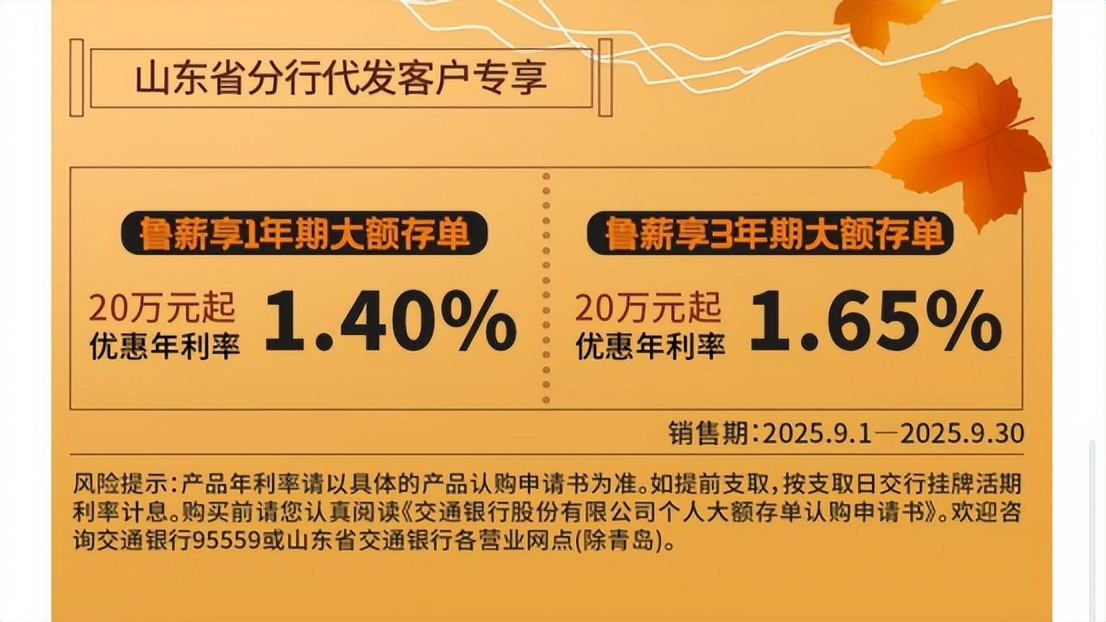
Core Viewpoint - The recent announcements from various banks regarding the issuance of high-interest large-denomination certificates of deposit (CDs) indicate a competitive market for attracting deposits, despite pressures on net interest margins [3][4]. Group 1: Bank Announcements - Bank of Communications Shandong Branch launched a one-year CD with an interest rate of 1.40% and a three-year CD at 1.65%, with a minimum deposit of 200,000 yuan, available until September 30 [1]. - Postal Savings Bank is set to issue a one-year CD with an interest rate of 1.25% starting September 26, while Dalian Bank Chengdu Branch announced a three-year CD with an interest rate of 1.90%, significantly higher than similar products from major state-owned banks [3]. Group 2: Market Analysis - Despite the attractive rates of 1.8% to 1.9% for some CDs, they remain lower than the rates of over 2.1% offered by major banks like China CITIC Bank and Zhejiang Commercial Bank in the same period last year, with some local banks even reaching rates as high as 3% [3]. - Analysts suggest that banks, particularly smaller ones, are compelled to issue high-interest CDs to attract deposits amid regulatory pressures to expand lending, even while facing net interest margin challenges [4]. Group 3: Industry Trends - There is a trend of banks being cautious about promoting high-interest CDs publicly, often opting for discreet sales through offline channels or targeting key corporate and private banking clients as a customer benefit [4]. - The issuance of high-interest CDs is seen as a temporary measure to address deposit competition, with many banks indicating a future trend of stricter control over CD issuance due to ongoing pressures [4].