数字资产

Search documents
2025年9月10日比特币(BTC)与以太坊(ETH)行情解读
Sou Hu Cai Jing· 2025-09-10 08:18
空单:112500附近介入,防守113000,止损500点,目标111000 以太坊当前报价4285,同样处于下跌趋势中。技术信号显示市场弱势格局占据主导,"乌云盖顶"形态与 均线死叉形成共振看空信号,成交量持续萎缩也削弱反弹动力,短期内缺乏有效上行动能。日线在4300 附近持续震荡,整体呈现高位回调后的整理形态,2小时级别上方抛压显著,低点逐步下移,短期弱势 迹象明显。MACD日线方向模糊,2小时空头信号增强,EMA短期均线拐头向下,存在进一步回调风 险。预计行情短期内将继续维持箱体震荡,可在前低附近布局多单,压力位附近开空。 ——— 当前比特币报价110950,整体走势呈现明显下行趋势。从技术面来看,价格正逐步逼近关键支撑位 110450,均线系统已形成死叉结构,动能持续减弱,进一步强化短期看跌预期。日线级别在112920附近 形成高点后回落并收出大阴线,2小时周期呈现高点逐步下移、低点短暂抬升但最终被跌破的格局,最 新K线出现明显下跌信号,短期内或继续向下测试支撑。MACD日线动能收缩,2小时指标偏空,EMA 日线趋势转弱,113000已成为有效压力位,整体空头态势明确,操作上建议以高空为主要思路。 比 ...


Ether Treasury Company SharpLink Gaming Buys Back $15M in 'Undervalued' Shares
Yahoo Finance· 2025-09-09 13:03
Company Overview - SharpLink Gaming (SBET) is a Nasdaq-listed ether treasury firm led by Ethereum co-founder Joe Lubin, which recently repurchased $15 million worth of shares, indicating a market cap below its $3.6 billion in ETH holdings [1][3] - The firm repurchased approximately 939,000 shares at an average price of $15.98 as part of its share buyback program [1] Market Valuation - The company believes its common stock is significantly undervalued, and the buybacks reflect confidence in its long-term strategy and growth prospects [2] - The stock experienced a 3.6% increase in pre-market trading following the buyback announcement, alongside a more than 1% rise in the price of ETH [2] Financial Metrics - SharpLink holds about $3.6 billion worth of ETH, with nearly all holdings staked, generating an income stream [3] - The stock currently trades at a 0.87 multiple of net asset value (mNAV), which limits the firm's ability to raise funds through share sales for ETH purchases [3] Market Conditions - The firm has not utilized its at-the-market facility to sell shares while trading below net asset value, as such actions would dilute ETH holdings per share [4] - The digital asset treasury sector has faced significant declines, with firms like SharpLink and BitMine (BMNR) experiencing drops of approximately 60%-70% since their July highs [4]

马云持股公司斥资3.1亿元购入1万枚以太坊
Cai Jing Wang· 2025-09-08 01:42
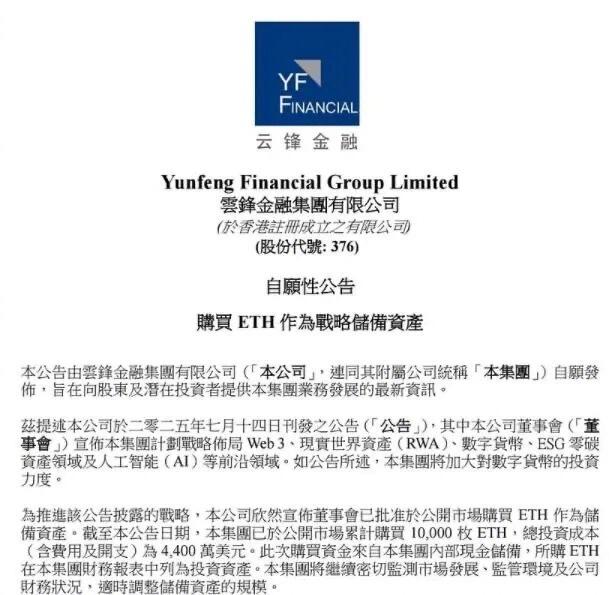
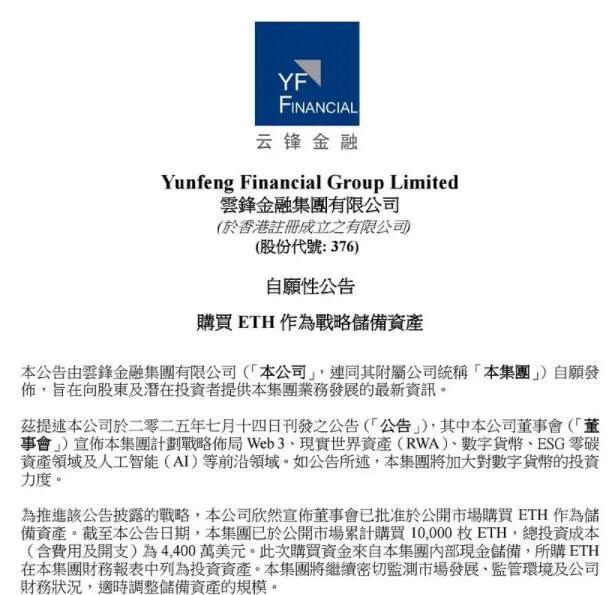
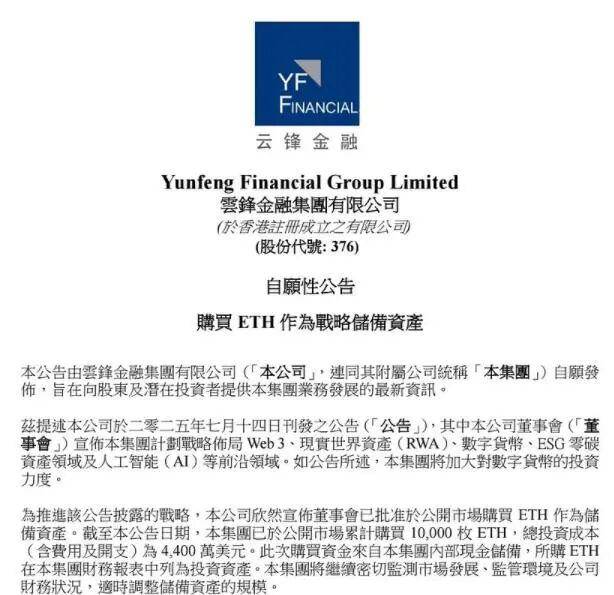
Core Viewpoint - Yunfeng Financial has approved the purchase of Ethereum (ETH) as a reserve asset, indicating a strategic shift towards digital assets [1] Group 1: Investment in Digital Assets - Yunfeng Financial has invested approximately 3.14 billion RMB (4400 million USD) to acquire a total of 10,000 ETH, funded entirely from internal cash reserves [1] - The company plans to continue increasing its investment in digital assets in the future [1] Group 2: Strategic Partnerships - On September 1, Yunfeng Financial entered into a strategic cooperation agreement with Ant Group's Ant Financial Technology [1] - The company has also made a strategic investment in Pharos Network Technology Limited, aiming to explore tokenization of real-world assets (RWA) and next-generation internet (Web3) through Pharos' high-performance blockchain platform [1] Group 3: Ownership Structure - Shanghai Yunfeng Investment Management Co., Ltd. is represented by Yu Feng, with Jack Ma holding a 40% stake in the company [1]
云锋金融投资超三亿元购买ETH作为公司储备资产-股票-金融界
Jin Rong Jie· 2025-09-08 00:04
Group 1 - Company has approved the purchase of ETH as a reserve asset, with a total acquisition of 10,000 ETH and an investment amount of $44 million (approximately 314 million RMB) sourced entirely from internal cash reserves [1] - The company plans to continue increasing its investment in digital assets in the future [1] Group 2 - Company has entered into a strategic cooperation agreement with Ant Group's Ant Financial and made a strategic investment in Pharos Network Technology Limited [3] - The collaboration aims to expand into the tokenization of real-world assets (RWA) and next-generation internet (Web3) through the Pharos high-performance public chain platform [3] Group 3 - Shanghai Yunfeng Investment Management Co., Ltd. is represented by Yu Feng, with Jack Ma holding a 40% stake in the company [4]
马云持股40%的云锋金融斥资3.1亿购入万枚ETH,持续加码数字资产领域
Sou Hu Cai Jing· 2025-09-07 21:10
Strategic Developments - Yunfeng Financial Group signed a cooperation agreement with Ant Group's Ant Financial on September 1, and announced a strategic investment in Pharos Network Technology Limited. The collaboration aims to explore the compliant development path of tokenizing real-world assets (RWA) and Web3 through Pharos's high-performance public chain platform [2] - These initiatives indicate Yunfeng Financial's proactive positioning in blockchain technology and digital asset applications [2] Market Performance - Yunfeng Financial's stock price has shown strong performance this year, with a cumulative increase of nearly 277% as of the market close on September 5, making it one of the most notable stocks in the secondary market [2] - The virtual currency market has experienced volatility recently, with major cryptocurrencies like Bitcoin and Ethereum seeing significant price drops. As of September 7, Ethereum's price slightly rebounded but was still down 0.19% from the previous trading day, with trading volume decreasing by nearly 40% in the last 24 hours [2] - Market analysts suggest that the price fluctuations in virtual currencies are influenced by multiple factors, advising investors to remain cautious [2]
马云持股公司花3.1亿元买以太坊
2 1 Shi Ji Jing Ji Bao Dao· 2025-09-07 14:49
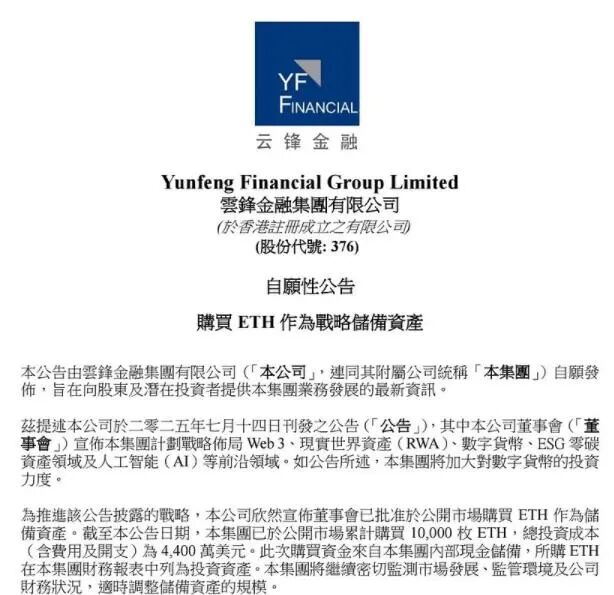
Group 1 - Yunfeng Financial announced the board's approval to purchase ETH as a reserve asset, with a total of 10,000 ETH acquired at an investment of $44 million (approximately 314 million RMB) sourced entirely from internal cash reserves [1] - The company plans to continue increasing its investment in digital assets in the future [1] Group 2 - On September 1, Yunfeng Financial Group entered into a strategic cooperation agreement with Ant Group's Ant Financial, and made a strategic investment in Pharos Network Technology Limited [3] - The collaboration aims to explore the tokenization of real-world assets (RWA) and the next generation of the internet (Web3) through the Pharos high-performance public chain platform [3] Group 3 - As of September 5, Yunfeng Financial's stock price has surged nearly 277% year-to-date [4] - Recent market conditions have seen a sudden drop in cryptocurrency prices, including Ethereum, which experienced a slight recovery but still showed a 0.19% decline as of September 7 [6][7]
马云持股公司花3.1亿元买以太坊
21世纪经济报道· 2025-09-07 14:40
Core Viewpoint - Yunfeng Financial has approved the purchase of ETH as a reserve asset, indicating a strategic shift towards digital assets and a commitment to increasing investment in this area [1][3]. Group 1: Investment Activities - As of the announcement date, Yunfeng Financial has acquired a total of 10,000 ETH, with a total investment amount of $44 million (approximately 314 million RMB), funded entirely from the company's internal cash reserves [1]. - The company has entered into a strategic partnership with Ant Group's Ant Financial and made a strategic investment in Pharos Network Technology Limited to explore tokenization of real-world assets (RWA) and Web3 applications [3]. Group 2: Market Performance - As of September 5, Yunfeng Financial's stock price has surged nearly 277% year-to-date, reflecting strong market interest and confidence in the company's strategic direction [3]. Group 3: Market Conditions - Recent market conditions have seen a sudden drop in cryptocurrency prices, with Ethereum experiencing a slight recovery but still down 0.19%, and trading volume decreasing by nearly 40% in the last 24 hours [5].

Tom Lee 发起 SPAC,拟募资 2.5 亿美元聚焦 AI 与金融科技
Xin Lang Cai Jing· 2025-09-07 12:56
Group 1 - FutureCrest Acquisition, a SPAC founded by Tom Lee of Fundstrat, filed for an IPO on September 5, aiming to raise $250 million [1] - The company plans to invest in growth sectors such as AI, fintech, and digital assets [1] - FutureCrest Acquisition intends to list on NASDAQ under the ticker symbol FCRSU [1]
2025外滩大会开幕在即 晶科科技受邀参会
Zheng Quan Shi Bao Wang· 2025-09-07 12:43
Group 1 - The 2025 Inclusion Bund Conference will take place from September 10 to 13 in Shanghai, focusing on high-level dialogues in technology, finance, and industry, with digital assets as a key topic [1] - Jinko Technology (601778) has received an invitation to participate in the conference, indicating its active engagement in the fintech sector [1] - The company is exploring innovative financing methods for the photovoltaic industry, aiming to enhance asset issuance efficiency through smart contract technology [1] Group 2 - Jinko Technology has been implementing a "light and heavy asset combination" operational strategy, focusing on product strength and high turnover models in its operations [1] - The company is also paying attention to the development of integrated energy storage, direct green electricity connections, and new financial models for future growth opportunities [1] - A recent internal training session on "RWA Tokenization: Key Principles, Global Trends, and Hong Kong Practices" was held to discuss forward-looking trends and investment opportunities in the sector [1]

等你来投!《清华金融评论》10月刊 “前瞻全球数字资产” 征稿启事
清华金融评论· 2025-09-05 10:35
Core Viewpoint - The digital asset trading industry is a product of the deep integration of blockchain technology and financial innovation, which has become a significant force in reshaping the global economic landscape amid the acceleration of global digitalization [2][4]. Submission Directions - The editorial team of "Tsinghua Financial Review" is inviting submissions on the topic of global digital assets, focusing on providing insights for policymakers, business decision-makers, researchers, and investors [4][13]. - The submission should be original and unpublished, with a suggested word count of 4,000 to 6,000 words, including charts and tables [8][15]. - The deadline for submission is September 20, 2025 [9]. Topics for Discussion - The article outlines 12 specific topics for discussion, including: 1. Development trends and policy comparisons of global central bank digital currencies 2. Exploration of the synergy between RWA (Real World Assets) and central bank digital currencies 3. Redefinition of traditional financial assets by RWA 4. Comparative study of global policies and regulatory frameworks for RWA 5. International trends and legislative dynamics in digital asset regulation 6. Risk identification, assessment, and prevention mechanisms for digital assets 7. The impact and challenges of digital assets on the traditional financial system 8. Legal attributes and compliance pathways for digital assets 9. The role and prospects of digital assets in cross-border payments 10. Construction of investor protection mechanisms in the digital asset field 11. Trends of "de-risking" in digital assets and industry transformation 12. Digital assets and financial stability [7]. Editorial Guidelines - The articles can be analytical or interpretative, aiming to provide practical insights and stimulate thought among readers [13][15]. - The editorial team emphasizes the importance of a solid academic foundation for the viewpoints and conclusions presented, while avoiding overly complex theories and models [14][15].