债务上限

Search documents
沪铜日评:国内铜治炼厂7月检修产能或环减,国内电解铜社会库存量环比减少-20250703
Hong Yuan Qi Huo· 2025-07-03 06:41
Report Summary 1. Report's Investment Rating for the Industry No investment rating for the industry is provided in the report. 2. Core View of the Report The expansion of the US fiscal deficit, the Fed's expectation of interest - rate cuts, the easing of Sino - US reciprocal tariffs, the traditional consumption off - season, disruptions in overseas copper mine production or transportation, and the downward trend of domestic and foreign electrolytic copper inventories have led to a relatively strong copper price. It is recommended that investors hold their previous long positions cautiously and pay attention to the support and resistance levels of copper prices in different markets [3]. 3. Summary According to Relevant Catalogs 3.1 Market Data - **Futures Market**: The closing price of the active contract of Shanghai copper futures on July 2, 2025, was 80,540, down 100 from the previous day. The trading volume was 101,958 lots, down 11,491 lots from the previous day, and the open interest was 223,122 lots, down 861 lots from the previous day. The inventory was 22,425 tons [2]. - **Spot Market**: The average price of SMN 1 electrolytic copper on July 2, 2025, was 80,208, up 785 from the previous day. The basis of Shanghai copper was 450, up 885 from the previous day. The spot premiums and discounts of electrolytic copper in different regions showed different changes [2]. - **LME Market**: The closing price of LME 3 - month copper futures (electronic trading) on July 2, 2025, was 9,943, up 67 from the previous day. The total inventory of registered and cancelled warrants was 93,475, down 93,250 from the previous day [2]. 3.2 Important Information - **Macro - level**: The US House - version "Big Beautiful" bill was passed, planning to raise the debt ceiling to $5 trillion, and the fiscal deficit may expand by more than $3 trillion. The Fed may appoint a successor to Chairman Powell in advance. The US ADP employment in June was 33,000, lower than expected, which slightly reduced the probability of no interest - rate cut in July, but the expected time for interest - rate cuts is still September/October/December [3]. - **Upstream**: The copper concentrate transportation of some mines was interrupted due to road blockades by informal miners. Some copper smelters had production disruptions, while some new smelters were expected to be put into production. The domestic copper concentrate production (import) in July may decrease month - on - month, and the domestic scrap copper production (import) in July may increase. The domestic electrolytic copper production in July is expected to increase, and the import volume may be affected by the closed import window [3]. - **Downstream**: Some copper rod enterprises may cut production due to high finished - product inventories. The capacity utilization rates of various copper - related downstream industries are expected to decline due to factors such as the traditional consumption off - season and the easing of Sino - US reciprocal tariffs [3].
“大而美”法案引爆美各方争吵,民主党批评“劫贫济富”
Huan Qiu Shi Bao· 2025-07-02 23:02
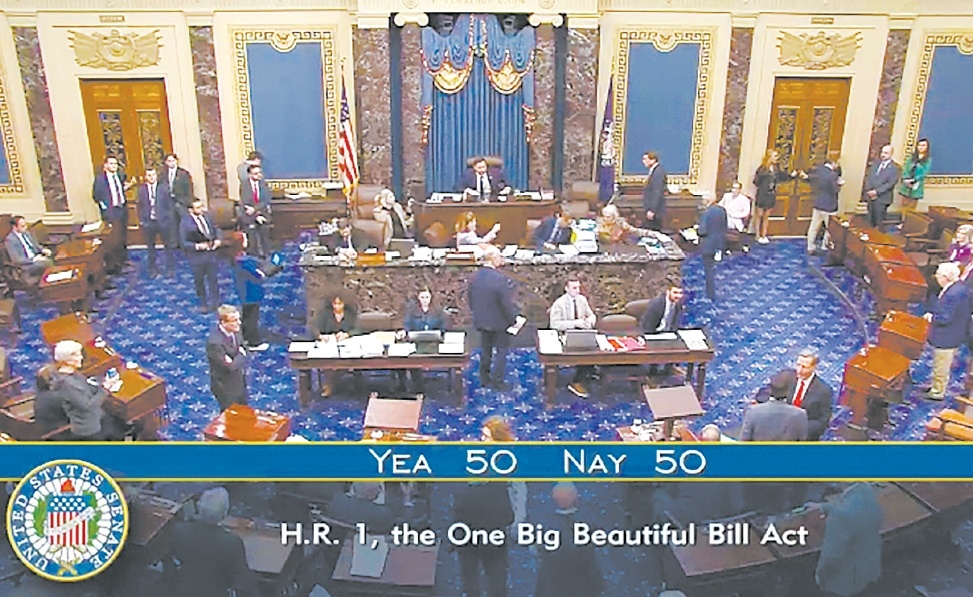
Core Points - The Senate passed Trump's "Big and Beautiful" tax and spending bill with a narrow vote of 51-50, aided by Vice President Pence's tie-breaking vote, despite opposition from three Republican senators [1] - Critics argue that the bill disproportionately benefits the wealthy while harming the poorest Americans, with Senator Bernie Sanders labeling it a "gift to billionaires" [1][2] - The bill's passage in the Senate requires further approval from the House of Representatives before it can be signed into law by the President [1][5] Group 1: Opposition from Republican Senators - Senator Susan Collins from Maine opposed the bill due to cuts to Medicaid, which would significantly reduce funding by $5.9 billion over the next decade, affecting healthcare access for approximately 400,000 residents [2] - Senator Thom Tillis from North Carolina expressed concerns that the bill would jeopardize health insurance for 600,000 residents in his state [2] - Senator Rand Paul, a proponent of controlling government spending, criticized the bill for increasing the debt ceiling by $5 trillion and projected a $3.3 trillion increase in the deficit over the next decade [4] Group 2: Impact on Taxation - The bill is expected to provide significant tax breaks to high-income earners, with approximately 60% of tax reductions benefiting individuals earning $217,000 or more, while low-income families earning $35,000 or less would see an average tax cut of only $150 [4] - The Democratic opposition has framed the bill as "robbing the poor to give to the rich," highlighting the adverse effects on low-income Americans [4] Group 3: Legislative Process and Challenges - The House of Representatives, which has a Republican majority, previously passed the bill with a narrow margin and is now faced with the Senate's modified version, which may face resistance from some House Republicans [5] - The House Rules Committee has moved to advance the Senate version for a full vote, with potential delays due to weather-related travel issues affecting some members [5] - President Trump has been actively engaging with dissenting Republican senators in an effort to secure support for the bill [5] Group 4: Elon Musk's Criticism - Elon Musk has publicly criticized the "Big and Beautiful" bill, arguing that it increases government spending and supports declining industries while undermining future sectors [7] - Trump's threats to expel Musk from the U.S. have drawn significant media attention, although legal experts suggest that such actions would be difficult to implement given Musk's citizenship status [7][8]

美国“大而美法案”表决进展及两院分歧
LIANCHU SECURITIES· 2025-07-02 12:24
Group 1: Legislative Progress - The "Big and Beautiful Act" narrowly passed in the Senate with a vote of 51:50 and will be sent to the House for a final vote[1] - The Senate version of the bill differs significantly from the House version submitted in May, necessitating a return to the House for a new vote[1] - House Speaker Mike Johnson aims to pass the bill before July 4[1] Group 2: Budgetary Differences - The Senate's revised budget plan is projected to increase the deficit by $3.4 trillion, compared to the House's $2.4 trillion increase[2] - Including interest costs, the Senate's total potential debt impact is $3.94 trillion, while the House's is $2.97 trillion[2] - The Senate version proposes a $5 trillion increase in the debt ceiling, while the House version suggests a $4 trillion increase[2] Group 3: Key Issues and Risks - Major points of contention between the two chambers include Medicaid cuts, SNAP reductions, and the SALT deduction cap[2] - Internal divisions within the Republican Party may affect the speed and success of the bill's passage[4] - The potential for the House to reject the revised Senate version remains, depending on the extent of disagreements[3]
美国参议院通过“大而美”法案,3.3万亿债务炸弹将引发众议院激战
Jin Shi Shu Ju· 2025-07-01 23:51
Core Points - The Senate narrowly passed a comprehensive tax and spending bill proposed by Trump, which is referred to as an "economic nuclear bomb" due to its significant tax cuts and social safety net reductions, while increasing military and immigration enforcement spending, leading to a projected $3.3 trillion increase in national debt [1][2] - The bill has been sent to the House for a final vote, but some Republican lawmakers have publicly opposed the Senate version [1] Summary by Sections Key Provisions of the Bill - Extension of Trump's 2017 tax cuts - New tax benefits for tip income and overtime pay - Increased budget for military and immigration enforcement - Reduction of approximately $930 billion in Medicaid and food assistance for low-income individuals - Repeal of several green energy incentives from the previous Biden administration - The bill highlights divisions among Republicans regarding the $36.2 trillion national debt and raises the federal debt ceiling by $5 trillion [2] Legislative Process and Challenges - The Senate passed the bill with a 51-50 vote, with Vice President Vance casting the tie-breaking vote; three Republican senators voted against it alongside all Democratic senators [3] - The final version included provisions to secure support from Senator Lisa Murkowski, such as additional food assistance for certain states and $50 billion in funding for rural hospitals [3] - The House, with a narrow Republican majority of 220-212, is expected to have a contentious vote, with Trump planning to engage deeply in lobbying efforts [3] Reactions and Implications - Billionaire Elon Musk criticized the bill for excessive spending and pledged to support challengers to current Republican lawmakers in the midterm elections [4] - Democratic leaders condemned the bill as the largest theft in U.S. healthcare history, claiming it would deprive hungry children of food [4] - The Tax Foundation indicated that the primary beneficiaries of the Senate version of the bill would be the top 1% of earners with incomes exceeding $663,000 in 2025 [5] - Independent analyses suggest that tightening food and healthcare eligibility will significantly reduce income for impoverished populations, with an estimated 12 million people losing healthcare coverage [6]
特朗普深夜炮轰马斯克,特斯拉股价大跌
凤凰网财经· 2025-07-01 06:27
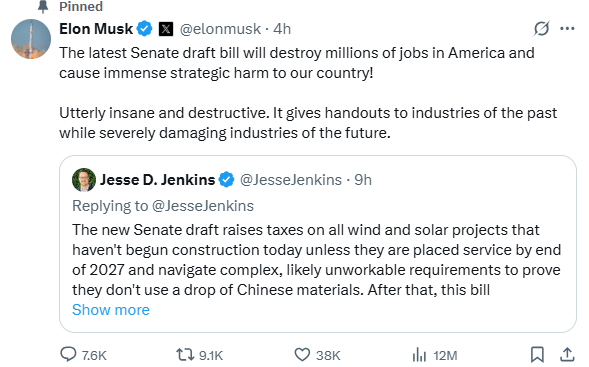
Core Viewpoint - The ongoing conflict between Elon Musk and Donald Trump highlights significant political and economic implications, particularly regarding electric vehicle subsidies and their impact on the future of American industries and employment [1][3]. Group 1: Musk's Criticism of Trump's Policies - Musk criticized the recent tax reform bill proposed by the Trump administration, arguing that cuts to electric vehicle and clean energy subsidies would harm the future of American industries and lead to millions of job losses [1][3]. - He expressed that supporting such a bill would be political suicide for the Republican Party and accused the government of favoring outdated traditional industries [1][3]. - Musk's statements indicate a shift in his political strategy, as he previously invested $250 million to support Trump during the 2024 election cycle [3]. Group 2: Trump's Response - Trump responded to Musk's criticisms by stating that without subsidies, Musk's companies would likely fail, suggesting that Musk might return to South Africa [4][5]. - He emphasized that he has always opposed forced electric vehicle policies, framing them as absurd and a key issue in his campaign [4][5]. - Trump claimed that Musk has received more subsidies than anyone in history and suggested that the government should investigate the subsidies Musk's companies have received [5]. Group 3: Political Implications - Musk's comments may disrupt the internal dynamics of the Republican Party and introduce uncertainty into the party's primary elections for the 2026 midterms [1]. - The record increase in the debt ceiling by $5 trillion, as criticized by Musk, reflects broader concerns about government spending and its implications for future political landscapes [2].

贵金属日评:特朗普政府减税法案参议院获批,美国消费端通胀PCE环比升高-20250630
Hong Yuan Qi Huo· 2025-06-30 05:51
1. Report Industry Investment Rating - Not provided in the content 2. Core View of the Report - Concerns about the rebound in consumer - end inflation have delayed the expected timing of the Fed's interest rate cuts. However, continuous gold purchases by central banks around the world and geopolitical risks that are difficult to resolve may cause precious metal prices to weaken first and then strengthen. It is recommended that investors mainly lay out long positions on dips [1]. 3. Summary by Relevant Catalogs Precious Metal Market Data - **Gold**: - Shanghai gold futures' closing price was 773.26 yuan/gram. The trading volume of the active contract was 169,217, and the open interest was 129,822. The inventory was 18,237 (in ten - gram units). The spread between the near - month and far - month contracts was 1.50, and the basis between the spot and futures was - 3.32 [1]. - COMEX gold futures' closing price was 8,792.00. The trading volume of the active contract was 469,549, and the open interest was 331,807. The inventory was 37,784,179.63 (in troy ounces). London gold spot price was 3,271.75 dollars/ounce [1]. - SPDR gold ETF holdings were 954.82, and iShare gold ETF holdings were 441.92 [1]. - **Silver**: - Shanghai silver futures' closing price was 8,773.00 (in yuan/ten - gram). The trading volume of the active contract was 469,549, and the open interest was 331,807. The inventory was 1,295,663 (in ten - gram units). The spread between the near - month and far - month contracts was - 2.00, and the basis between the spot and futures was - 23.00 [1]. - COMEX silver futures' closing price was 36.17. The trading volume of the active contract was 65,468, and the open interest was 24,788. The inventory was - 930,224.12 (in troy ounces). London silver spot price was 37.16 dollars/ounce [1]. - US iShare silver ETF holdings were 14,763, and Canadian PSLV silver ETF holdings were 5,959.97 [1]. Important Information - **Policy and Politics**: - The Trump administration's tax - cut bill was approved by the US Senate. The US House of Representatives' Republican tax bill plans to raise the debt ceiling to 5 trillion dollars and make three corporate tax breaks permanent [1]. - Trump criticized Canada's digital tax, terminated all US - Canada trade negotiations, and threatened to impose new tariffs. The US Treasury Secretary warned of a 301 investigation [1]. - The EU and the US believe they can reach a tariff agreement by the end of July. The US Treasury Secretary hinted that the "tariff deadline" in July might be extended to September 1st [1]. - **Macroeconomic Data**: - The US May consumer - end inflation core PCE annual rate was 2.7%, higher than expected and the previous value. The Fed's expected interest - rate cut times are still in September/October/December [1]. - The European Central Bank cut interest rates by 25 basis points in June, and the market expects one more rate cut by the end of 2025 [1]. - The Bank of England cut the key interest rate by 25 basis points in May, and the market expects two more rate cuts by the end of 2025 [1]. - The Bank of Japan raised interest rates by 25 basis points in January, and there is still an expectation of an interest - rate hike by the end of 2025 [1]. Trading Strategy - For investors, it is recommended to mainly lay out long positions on dips. For London gold, pay attention to the support level around 3,000 - 3,200 and the resistance level around 3,500 - 3,700. For Shanghai gold, focus on the support level around 730 - 750 and the resistance level around 840 - 900. For London silver, pay attention to the support level around 31 - 34 and the resistance level around 38 - 40. For Shanghai silver, focus on the support level around 8,300 - 8,500 and the resistance level around 9,500 - 10,000 [1].
帮主郑重:美国5万亿法案落地!20年财经老炮带你看透这三个机会与风险
Sou Hu Cai Jing· 2025-06-29 07:23
Group 1: Economic Impact - The recent "Big and Beautiful" bill passed by the U.S. Senate is expected to significantly influence the global economy over the next decade [1] - The bill raises the U.S. debt ceiling by $5 trillion, bringing the total to $41 trillion, which could lead to increased inflation and interest rates in the long term [3][5] - The market's reaction to the debt ceiling increase has been unusual, with minimal movement in U.S. Treasury yields and a decline in the dollar, as investors anticipate potential interest rate cuts by the Federal Reserve [3] Group 2: Tax Policies - The bill extends Trump's 2017 tax cuts to all income groups, maintaining the highest tax rate at 37% and increasing the estate tax exemption to $15 million per person [3] - While the tax cuts may benefit wealthier individuals, the bill also reduces spending on Medicaid and food stamps, requiring beneficiaries to work 80 hours per month to receive benefits [3] Group 3: Defense and Energy Sectors - The bill allocates $157 billion for military spending, with significant funds directed towards missile defense systems and shipbuilding, likely benefiting established defense contractors like Raytheon Technologies and General Dynamics [4] - The cancellation of clean energy tax credits and the termination of electric vehicle purchase subsidies may negatively impact companies in the renewable energy sector, such as Tesla and Sunrun, while traditional energy firms like ExxonMobil could benefit from expedited oil and gas drilling approvals [5] Group 4: AI Regulation - The bill includes AI regulatory provisions that tie federal broadband funding to state compliance with AI oversight, potentially affecting the global strategies of tech giants like Microsoft and Google [5]

“共和党的政治自杀”,马斯克再度猛批“大漂亮”法案
Hua Er Jie Jian Wen· 2025-06-29 01:13
Core Viewpoint - Elon Musk strongly criticizes the Trump administration's latest tax reform bill, arguing that it will cut subsidies for electric vehicles and clean energy, leading to significant job losses and strategic damage to the U.S. economy [1][5][11] Summary by Relevant Sections Tax Reform Impact - The Senate's latest bill draft is expected to destroy millions of jobs in the U.S. and cause substantial strategic harm to the nation [1][5] - The bill proposes to raise the debt ceiling by $5 trillion, marking a historical high and potentially leading the U.S. into a state of debt dependency [8] Electric Vehicle Subsidies - The bill plans to eliminate the $7,500 tax credit for consumers purchasing electric vehicles, a crucial subsidy for boosting EV sales [9] - The previous proposal aimed to end most EV subsidies by the end of the year, but the new version accelerates this termination to September 30, affecting both used and commercial electric vehicles [10] Political Ramifications - Polls indicate that this bill could be politically detrimental for the Republican Party, potentially viewed as political suicide [3] - Musk's criticism may reignite public tensions between him and Trump, especially given Musk's previous role in the Trump administration [11]