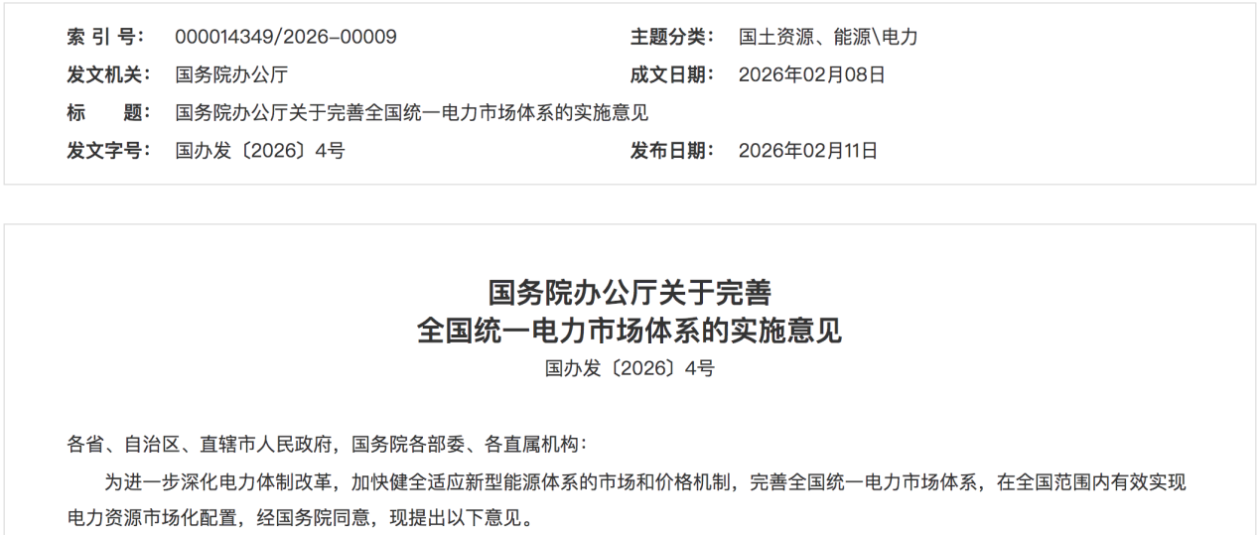
全国统一电力市场体系

Search documents
伊戈尔股价涨停,受H股上市计划及海外业务拓展等多重因素推动
Jing Ji Guan Cha Wang· 2026-02-12 07:16
Group 1 - The company's stock price reached the daily limit on February 12, 2026, driven by multiple factors including strategic initiatives and market conditions [1] - The company has received approval for its H-share listing plan, which is expected to broaden international financing channels and enhance brand influence, attracting market attention [2] - The company is expanding its overseas operations with factories in Thailand and Mexico, and a storage project in Uzbekistan, accelerating its international layout [2] Group 2 - The electric grid equipment sector showed strong performance due to favorable policies related to "computing power + electricity" and the establishment of a unified national electricity market, positively impacting the company's stock [3] - The global demand for Artificial Intelligence Data Centers (AIDC) is increasing, leading to a rise in transformer demand, with the company strategically positioning itself in this market [3] - The company has entered the supply chains of well-known domestic and international enterprises, resulting in significant growth in related orders [3] Group 3 - On February 12, the company experienced a net inflow of over 100 million yuan in main funds, indicating active buying interest [4] - The stock price closed at 46.38 yuan, reaching the daily limit and breaking through key technical resistance levels [4] Group 4 - The company's stock price surge is attributed to a combination of its fundamental developments (H-share plan, overseas business), industry policies (electric grid, AIDC), and market funding and technical factors [5]

国新证券每日晨报-20260212
Guoxin Securities Co., Ltd· 2026-02-12 06:35
Domestic Market Overview - The domestic market experienced a contraction and mixed performance on February 11, with the Shanghai Composite Index closing at 4131.99 points, up 0.09%, while the Shenzhen Component Index closed at 14160.93 points, down 0.35% [1][4] - The total trading volume of the A-share market was 20,010 billion, showing a decrease compared to the previous day [1][4] - Among the 30 first-level industries, 13 saw an increase, with construction materials, non-ferrous metals, and petroleum and petrochemicals leading the gains, while communication, media, and defense industries experienced significant declines [1][4] Overseas Market Overview - The three major U.S. stock indices experienced slight declines on February 11, with the Dow Jones down 0.13%, the S&P 500 remaining flat, and the Nasdaq down 0.16% [2][4] - IBM's stock fell over 6%, leading the decline in the Dow [2][4] Economic Data - The National Bureau of Statistics reported that in January, the Consumer Price Index (CPI) rose by 0.2% month-on-month and year-on-year, while the core CPI increased by 0.8% year-on-year [9][12] - The Producer Price Index (PPI) rose by 0.4% month-on-month, marking the fourth consecutive month of increase, while year-on-year it decreased by 1.4% [9][12] News Highlights - The State Council issued an implementation opinion on improving the national unified electricity market system, aiming to establish a unified market by 2030 and fully complete it by 2035 [10][11] - The successful flight test of the Long March 10 and the Dream Chaser spacecraft marks a significant milestone in China's manned lunar exploration program [12] - A "New Year gift package" worth 2.05 billion will be distributed to consumers during the Spring Festival, including cash vouchers and subsidies [13]
电改系列:电力市场开启黄金十年,打破壁垒释放发展活力
GF SECURITIES· 2026-02-12 06:14
Investment Rating - The industry investment rating is "Buy" [2] Core Insights - The report emphasizes that the electricity market is entering a golden decade, breaking down barriers and releasing development vitality [1] - The recent issuance of the "Implementation Opinions on Improving the National Unified Electricity Market System" by the State Council highlights the acceleration of market and pricing mechanisms suitable for the new energy system [5] - The report outlines a goal to fully establish a national unified electricity market system by 2035, with a steady increase in the proportion of market-based electricity transactions [5] - It identifies the construction of a multi-dimensional market system, including long-term markets, spot markets, auxiliary service markets, green electricity markets, and capacity markets, with a focus on the spot market [5] - The report suggests that by 2030, all types of power sources and electricity users, except for guaranteed users, will directly participate in the electricity market, with market-based transactions accounting for about 70% of total electricity consumption [5] - Investment recommendations include focusing on software companies like Guoneng Rixin and Langxin Technology, hardware companies benefiting from market volatility such as Sunshine Power and Haibosi Chuang, and supporting companies like Guodian Nanrui and State Grid Xintong for grid operation control and digital systems [5] Summary by Sections - **Policy and Market Structure**: The report discusses the high-level issuance of the recent policy, the introduction of a 2035 target, and the clear direction for market composition and reform [5] - **Market Participation**: It emphasizes the importance of nationwide unification and smooth circulation in electricity trading, with a shift from individual pricing to unified pricing and joint trading [5] - **Investment Opportunities**: The report highlights potential beneficiaries in the new energy storage sector and suggests various companies across software, hardware, and supporting sectors for investment [5][6]


2030年,中国将基本建成全国统一电力市场体系
Zhong Guo Jing Ying Bao· 2026-02-12 05:25
Core Viewpoint - The State Council has issued the "Implementation Opinions on Improving the National Unified Electricity Market System," aiming to establish a unified electricity market by 2030, with market-based transactions accounting for approximately 70% of total electricity consumption [1][4]. Group 1: National Unified Electricity Market System - The national unified electricity market system is a significant marker of the construction of a unified national market and a key outcome of electricity system reform [2]. - By the end of 2025, market-based electricity transactions are expected to reach 6.6 trillion kilowatt-hours, increasing about sevenfold from 2015, with the market share rising from less than 15% to 64% of total electricity consumption [2]. - Cross-provincial and cross-regional electricity trading is projected to grow from less than 0.1 trillion kilowatt-hours in 2015 to approximately 1.6 trillion kilowatt-hours by 2025 [2]. Group 2: Implementation Goals and Tasks - The "Opinions" outline two phased goals: by 2030, a basic national unified electricity market system will be established, and by 2035, the system will be fully developed with mature market functions [3][4]. - The document emphasizes optimizing electricity resource allocation nationwide, enhancing market functions, and ensuring equal participation of various operators in the electricity market [4]. - Specific tasks include establishing a unified pricing and trading system, and developing mechanisms for different market categories such as spot, medium-long term, and ancillary services [3].
20cm速递|利好来袭!创业板新能源ETF华夏(159368)上涨1.04%,同类费率最低
Mei Ri Jing Ji Xin Wen· 2026-02-12 04:48
Group 1 - The core viewpoint of the news is the implementation of the "Implementation Opinions on Improving the National Unified Electricity Market System" by the State Council, which outlines the goals and tasks for the electricity market over the next 5 to 10 years [1] - The implementation opinions emphasize the need to improve cross-provincial and cross-regional electricity trading systems, promoting regular market transactions between State Grid and Southern Grid, and increasing the scale of cross-regional transmission and the proportion of clean energy delivery [1] - The opinions also encourage greater participation of private enterprises in the electricity market and aim to refine the electricity pricing mechanism primarily determined by supply and demand, prohibiting local governments from unlawfully implementing preferential pricing policies [1] Group 2 - The China Securities report indicates that during the "14th Five-Year Plan" period, the country faces a contradiction between increasing decarbonization pressure and slowing growth in new energy installations, necessitating policy support for further low-carbon transitions [1] - A national capacity pricing policy is set to be introduced in January 2026, which will encourage the construction of stable power sources and open up space for new energy installations, while providing high-yield investment options for power companies [1] - The report estimates that even with lower capacity price subsidies, the profitability of energy storage projects will improve, potentially driving demand for energy storage not only in northern regions but also in central and eastern provinces [1] Group 3 - The ChiNext New Energy Index covers various segments of the new energy and electric vehicle industries, including batteries and photovoltaics, and is the only new energy index on the ChiNext with a 20% daily price fluctuation limit [2] - The ChiNext New Energy ETF (159368) is characterized by high elasticity, with a maximum increase of 20%, and has the lowest fees, with a total management and custody fee of only 0.2% [2] - The ETF has a nearly 90% allocation to energy storage and solid-state batteries, aligning with current market trends [2]


专家解读丨完善全国统一电力市场体系:能源转型与高质量发展的制度性探索
中国能源报· 2026-02-12 03:53
Core Viewpoint - The establishment of a national unified electricity market system is a significant innovation in the energy sector, reflecting China's unique institutional exploration and aiming to optimize resource allocation across the country [1][2]. Group 1: Key Tasks and Objectives - The "Implementation Opinions" outlines two critical timelines and identifies five major areas with 19 key tasks to achieve a unified electricity market, which is part of a broader strategy for national economic development [1][2]. - The primary goal is to resolve the spatial mismatch between resource endowment and energy consumption, breaking down market segmentation caused by administrative divisions to maximize social welfare [3]. Group 2: Market Structure and Value System - The construction of the national unified electricity market involves a restructuring of the pricing mechanism, moving from a bundled pricing model to a more nuanced value system that includes six distinct markets: spot, medium-to-long-term, ancillary services, green electricity, capacity, and retail [4][5]. - This new pricing structure aims to reflect the diverse values of electricity, allowing for better transmission of price signals to consumers and fostering a societal consensus on green and low-carbon responsibilities [5]. Group 3: Investment Logic and Market Dynamics - The unified electricity market will reshape investment logic by providing price signals that guide future energy investments and technology choices, emphasizing the need for traditional energy sources like coal to adapt to new roles in flexibility and reliability [6]. - New energy sources will face challenges as market dynamics evolve, necessitating more precise forecasting and adaptation to maintain competitiveness [6]. Group 4: International Trade and Green Energy - The establishment of a unified electricity market is strategically significant in the context of global green trade barriers, such as the EU's carbon border adjustment mechanism, which aims to enhance China's competitive edge in international markets [7]. - The implementation of blockchain technology for green electricity certification will create a credible and traceable carbon accounting system, aligning with international standards and enhancing China's position in global trade [7]. Group 5: Energy Security and Economic Development - The unified electricity market is not only a reform in the energy sector but also a foundational element for national economic security and long-term development, providing reliable and cost-effective energy support for emerging industries [8][9]. - The vision for 2030 includes a fully developed national unified electricity market that optimizes resource allocation and enhances the resilience of the energy system, contributing to China's modernization efforts [9].


债市早报:1月CPI涨幅回落,PPI降幅继续收窄;资金面整体仍偏紧,债市延续暖意
Sou Hu Cai Jing· 2026-02-12 03:16
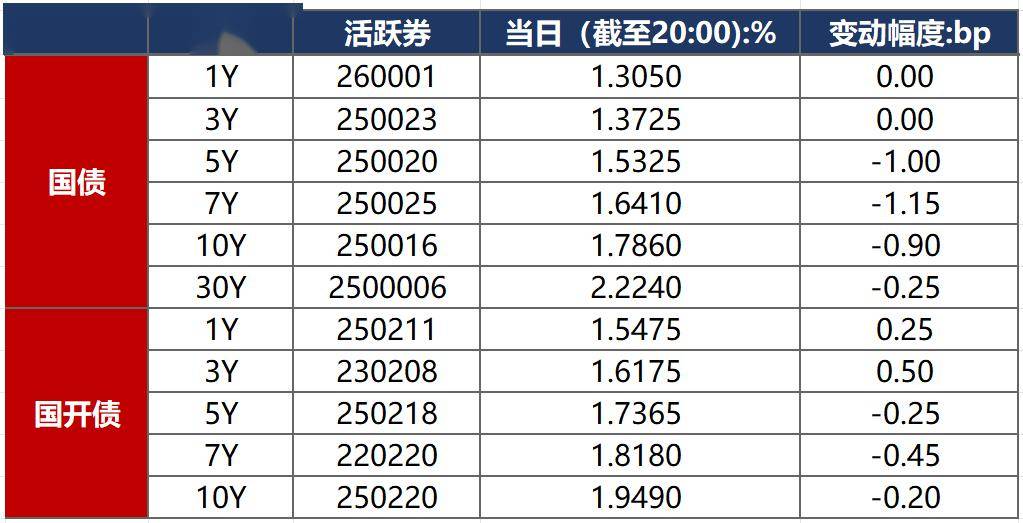
Group 1: Domestic Market Insights - The People's Bank of China reported that the average daily transaction volume of interbank lending in 2025 was 3610.7 billion yuan, a decrease of 12.1% compared to 2024 [2] - The net financing of government bonds in 2025 reached 13.8 trillion yuan, an increase of 2.5 trillion yuan from 2024 [2] - The total custody balance of the bond market at the end of 2025 was 196.7 trillion yuan, with foreign institutions holding 3.5 trillion yuan, accounting for 1.8% of the total [2] Group 2: Economic Indicators - In January 2026, the Consumer Price Index (CPI) rose by 0.2% year-on-year, while the Producer Price Index (PPI) fell by 1.4%, indicating a narrowing decline compared to the previous month [3] - The average hourly wage in the U.S. increased by 0.4% in January, surpassing expectations, while the unemployment rate dropped to 4.3% [6] Group 3: Government Policies - The State Council emphasized the need to curb new hidden debts and proposed measures to enhance government investment efficiency, including strict accountability for local government borrowing [4] - The State Council's implementation opinion aims to establish a unified national electricity market system by 2035, with market transactions expected to account for about 70% of total electricity consumption by 2030 [5] Group 4: Bond Market Dynamics - The bond market showed a warming trend as institutions preferred to hold bonds during the holiday season, with the yield on the 10-year government bond decreasing by 0.90 basis points to 1.7860% [11] - In the secondary market, seven industrial bonds experienced significant price deviations, with some bonds seeing price drops exceeding 64% [13] Group 5: Convertible Bonds and Stock Market - The convertible bond market experienced mixed performance, with the China Convertible Bond Index and Shenzhen Convertible Bond Index rising by 0.05% and 0.28%, respectively, while the Shanghai Convertible Bond Index fell by 0.13% [20] - The A-share market showed slight fluctuations, with the Shanghai Composite Index rising by 0.09% and the Shenzhen Component Index and ChiNext Index declining by 0.35% and 1.08%, respectively [20]
“数”说全国统一电力市场体系 “能涨能跌”市场化电价机制初步建立
Yang Shi Wang· 2026-02-12 02:51
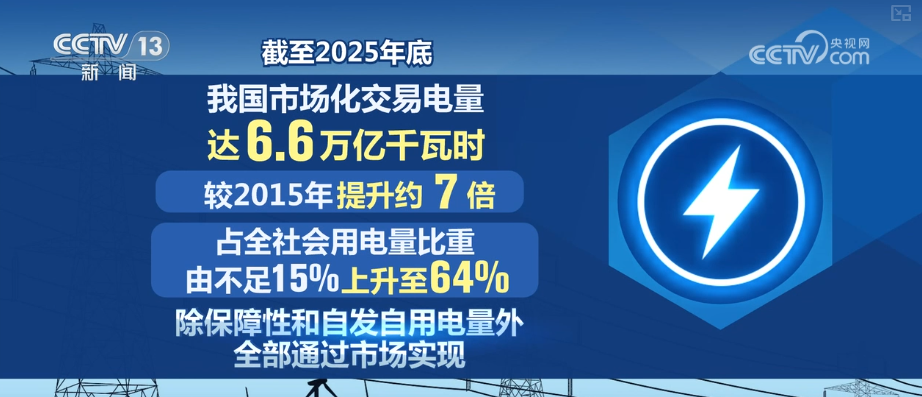
Core Viewpoint - China's electricity production organization has transitioned from a planned system to a market-oriented approach over the past decade, achieving significant progress in establishing a nationwide unified electricity market system [1] Group 1: Market Participation - A preliminary market structure has formed with orderly participation from various entities, with over 1.09 million registered market participants by the end of 2025, which is 22 times the number in 2015 [3] - By the end of 2025, all commercial and industrial users, all coal power, nearly 60% of new energy, 40% of hydropower, and nearly half of gas and nuclear power will have entered the electricity market [3] Group 2: Market Transactions - The volume of market-based electricity transactions is expected to reach 6.6 trillion kilowatt-hours by the end of 2025, a sevenfold increase from 2015, accounting for 64% of total electricity consumption, excluding guaranteed and self-consumed electricity [4] - The scale of inter-provincial and inter-regional electricity trading has grown from less than 0.1 trillion kilowatt-hours in 2015 to approximately 1.6 trillion kilowatt-hours by 2025 [6] Group 3: Pricing Mechanism - A comprehensive coverage of electricity trading across all categories has been largely achieved, and a market-based pricing mechanism that allows for price fluctuations has been initially established [6]
2026/2/12:申万期货品种策略日报——股指-20260212
Shen Yin Wan Guo Qi Huo· 2026-02-12 02:28
1. Report Industry Investment Rating - No relevant information provided 2. Core View of the Report - In February, the overall market is expected to continue the phased positive pattern. It is in the "Spring Market" window period, with the release of policy dividends at the beginning of the "15th Five - Year Plan", clear profit expectations for AI and overseas expansion themes, and seasonal recovery in the consumer sector and implementation of investment projects will further boost market confidence. However, due to the upcoming Spring Festival holiday, there may be significant fluctuations in overseas capital markets during the holiday, especially geopolitical risks, and potential disturbances need to be vigilant [2] 3. Summary by Relevant Catalogs 3.1 Stock Index Futures Market - **IF Contracts**: The previous day's closing prices of IF contracts for different periods (current month, next month, next quarter, and the quarter after next) showed different changes compared to the day before. The trading volume and open interest also varied, with open interest changes of -2160, -1114, 1719, and 1091 respectively for different periods. The price changes and percentage changes of the underlying CSI 300 index were also presented [1] - **IH Contracts**: Similar to IF contracts, the previous day's closing prices, price changes, trading volume, and open interest of IH contracts for different periods (current month, next month, next quarter, and the quarter after next) were reported, along with the price changes and percentage changes of the underlying SSE 50 index [1] - **IC Contracts**: The previous day's closing prices, price changes, trading volume, and open interest of IC contracts for different periods (current month, next month, next quarter, and the quarter after next) were provided, and the price changes and percentage changes of the underlying CSI 500 index were also given [1] - **IM Contracts**: The previous day's closing prices, price changes, trading volume, and open interest of IM contracts for different periods (current month, next month, next quarter, and the quarter after next) were shown, and the price changes and percentage changes of the underlying CSI 1000 index were presented [1] - **Inter - month Spreads**: The inter - month spreads between different contracts (IF, IH, IC, IM) were reported, including the current values and previous values [1] 3.2 Stock Index Spot Market - **Major Indexes**: The previous values, previous two - day values, and percentage changes of the CSI 300, SSE 50, CSI 500, and CSI 1000 indexes were provided, along with their trading volumes (in billions of lots) and total trading amounts (in billions of yuan) [1] - **Industry Indexes**: The previous values, previous two - day values, and percentage changes of different industry indexes (energy, raw materials, industry, optional consumption, etc.) were reported [1] 3.3 Futures - Spot Basis - The basis between futures contracts (IF, IH, IC, IM) and their underlying spot indexes (CSI 300, SSE 50, CSI 500, CSI 1000) were reported, including the previous values and previous two - day values [1] 3.4 Other Domestic and Overseas Indexes - **Domestic Indexes**: The previous values, previous two - day values, and percentage changes of domestic major indexes (Shanghai Composite Index, Shenzhen Component Index, Small and Medium - sized Board Index, ChiNext Index) were provided [1] - **Overseas Indexes**: The previous values, previous two - day values, and percentage changes of overseas major indexes (Hang Seng Index, Nikkei 225, S&P 500, DAX Index) were reported [1] 3.5 Macro Information - On February 11, the State Council conducted the 18th special study on deepening and expanding "Artificial Intelligence +" to empower all industries. Premier Li Qiang emphasized promoting AI innovation, industry development, and application [2] - In January, China's CPI rose 0.2% month - on - month and 0.2% year - on - year, with core CPI rising 0.8% year - on - year. PPI rose 0.4% month - on - month, up for four consecutive months, and fell 1.4% year - on - year, with the decline narrowing by 0.5 percentage points [2] - In the US, the seasonally adjusted non - farm payrolls increased by 130,000 in January, far exceeding market expectations. The unemployment rate was 4.3%, the lowest since August 2025. Hourly wages rose 0.4% month - on - month, exceeding expectations [2] - A French institution proposed a 30% overall tariff on China to the EU. China may initiate anti - dumping, anti - subsidy investigations on EU wines and anti - discrimination investigations on France and the EU. If the EU unilaterally imposes tariffs on China, China will take "reciprocal tariffs" on relevant EU products [2] 3.6 Industry Information - The General Office of the State Council issued an implementation opinion on improving the national unified power market system, aiming to fully establish the system by 2035 and proposing a shift from "separate quotation and separate trading" to "unified quotation and joint trading" [2] - The State - owned Assets Supervision and Administration Commission of the State Council held a deployment meeting on the "AI +" special action for central enterprises, emphasizing investment in computing power, promoting the coordinated development of "computing power + electricity", and enhancing data governance capabilities [2] - In January, China's automobile production and sales were 2.45 million and 2.346 million respectively, with a year - on - year increase of 0.01% and a decrease of 3.2%. New energy vehicle production and sales were 1.041 million and 0.945 million respectively, with year - on - year increases of 2.5% and 0.1%. New energy vehicle exports reached 302,000, doubling year - on - year [2] - In January, the scale of bank wealth management decreased by billions of yuan, failing to achieve the traditional "good start". The scale fluctuation was due to the re - balance of funds among deposits, wealth management, insurance, and equity assets and the active adjustment of wealth management companies in terms of fees, products, and investment strategies [2]
国办发文,我国2030年基本建成全国统一电力市场体系
Huan Qiu Wang· 2026-02-12 02:08
Core Viewpoint - The State Council of China has officially released the "Implementation Opinions on Improving the National Unified Electricity Market System," outlining a clear timeline and roadmap for electricity market reform over the next decade, aiming for a 70% market transaction volume by 2030 and a fully established market by 2035 [1][3]. Group 1: Strategic Goals - The implementation opinions set a two-step strategic goal for the establishment of a unified electricity market, with key milestones in 2030 and 2035 [3]. - The document addresses current issues such as market barriers and insufficient participation, proposing systematic reforms to optimize electricity resource allocation nationwide [3]. Group 2: Market Functions and Pricing Logic - The implementation opinions define six major market functions: spot, medium- and long-term, ancillary services, green electricity, capacity, and retail markets, marking a significant breakthrough in pricing systems [4]. - The establishment of a multi-value market indicates that price signals will guide future investment directions and transformation paths, moving beyond traditional energy quantity pricing [4]. Group 3: Green Electricity and International Integration - The construction of a green electricity market is emphasized, with plans to strengthen the traceability of green electricity consumption and explore the integration of green certificates into carbon accounting [5]. - Analysts highlight the importance of aligning China's green electricity standards with international standards to enhance the marketability of renewable energy sources like wind and solar [5].