
协调发展

Search documents
【图解】速览!2026年经济工作八大重点任务
Zhong Guo Jing Ji Wang· 2025-12-11 12:29
Core Viewpoint - The Central Economic Work Conference held on December 10-11 in Beijing outlined eight key tasks for economic work in 2026, focusing on domestic demand, innovation, reform, openness, coordinated development, green transformation, public welfare, and risk management. Group 1: Domestic Demand - Emphasis on leading domestic demand and building a strong domestic market through actions to boost consumption and implement urban and rural income increase plans [1] - Expansion of quality goods and services supply, optimization of "two new" policy implementation, and removal of unreasonable restrictions in the consumption sector to unleash service consumption potential [1][2] - Encouragement of investment stabilization, with an increase in central budget investment scale and optimization of local government special bond usage [1] Group 2: Innovation - Focus on innovation-driven growth by developing a comprehensive plan for education, technology, and talent development [2] - Establishment of international technology innovation centers in key regions such as Beijing, Shanghai, and the Guangdong-Hong Kong-Macau Greater Bay Area [2] - Strengthening the role of enterprises in innovation and improving intellectual property protection in emerging fields [2] Group 3: Reform - Commitment to reform efforts to enhance high-quality development, including the establishment of a unified national market and further deepening state-owned enterprise reforms [3] - Initiatives to clear overdue payments to businesses and promote win-win scenarios for platform enterprises and their operators [3] - Expansion of market-oriented reforms and improvement of the local tax system [3] Group 4: Openness - Promotion of multi-field cooperation and gradual advancement of institutional openness, including the expansion of service sector autonomy and optimization of free trade zone layouts [4] - Encouragement of service exports and development of digital and green trade [4] - Strengthening of foreign investment promotion mechanisms and enhancing overseas service systems [4] Group 5: Coordinated Development - Coordination of urban-rural integration and regional collaboration, focusing on high-quality development in county economies [5] - Maintenance of arable land and food production stability, ensuring reasonable prices for key agricultural products [5] - Support for major economic provinces and enhancement of cooperation among key urban clusters [5] Group 6: Green Transformation - Advancement of energy-saving and carbon reduction initiatives in key industries and the establishment of a new energy system [6] - Strengthening of the national carbon emissions trading market and implementation of comprehensive waste management actions [6] - Promotion of environmental protection initiatives and improvement of disaster response infrastructure [6] Group 7: Public Welfare - Implementation of actions to stabilize employment for key groups such as college graduates and migrant workers, and support for flexible employment [7] - Adjustment of educational resource allocation to increase high school and quality university enrollment [7] - Optimization of drug procurement and deepening of medical insurance payment reforms [7] Group 8: Risk Management - Focus on stabilizing the real estate market with city-specific policies to control inventory and encourage the acquisition of existing housing for social welfare [8]


“八个坚持”!明年经济工作重点任务来了
Zhong Guo Xin Wen Wang· 2025-12-11 12:14
Core Viewpoint - The Central Economic Work Conference held on December 10-11 in Beijing outlined eight key tasks for economic work in the coming year, emphasizing the importance of domestic demand, innovation, reform, and sustainable development. Group 1: Domestic Demand and Market Development - Emphasis on domestic demand as the main driver for economic growth, with plans to implement actions to boost consumption and increase residents' income [1] - Initiatives to expand the supply of quality goods and services, and to optimize the implementation of new policies [1] - Measures to stabilize investment, including increasing central budget investments and optimizing the use of local government special bonds [1] Group 2: Innovation and New Growth Drivers - Focus on innovation-driven development, with plans to enhance education, technology, and talent development [2] - Establishment of international technology innovation centers in key regions such as Beijing, Shanghai, and the Guangdong-Hong Kong-Macau Greater Bay Area [2] - Strengthening the role of enterprises in innovation and improving intellectual property protection in emerging fields [2] Group 3: Reform and High-Quality Development - Commitment to reform efforts to enhance the vitality of high-quality development, including the establishment of a unified national market [2] - Plans to deepen state-owned enterprise reforms and improve regulations supporting the private economy [2] - Initiatives to clear overdue payments to businesses and promote win-win development for platform enterprises and their operators [2] Group 4: Opening Up and International Cooperation - Promotion of multi-field cooperation and gradual expansion of service sector openness [2] - Encouragement of service exports and development of digital and green trade [2] - Efforts to enhance the foreign investment promotion system and support the Belt and Road Initiative [2] Group 5: Coordinated Development and Urban-Rural Integration - Focus on urbanization and rural revitalization, with an emphasis on county-level economic development [3] - Commitment to maintaining food production and stabilizing prices of essential agricultural products [3] - Strengthening coordination among major urban clusters and enhancing cross-administrative cooperation [3] Group 6: Green Transformation and Carbon Neutrality - Initiatives to promote energy efficiency and carbon reduction in key industries [3] - Development of a new energy system and expansion of green electricity applications [3] - Implementation of comprehensive waste management actions and environmental protection measures [3] Group 7: Social Welfare and Employment - Actions to stabilize employment for key groups such as college graduates and migrant workers [4] - Plans to optimize educational resource allocation and increase the supply of quality educational opportunities [4] - Initiatives to enhance healthcare services and support for vulnerable groups [4] Group 8: Risk Management and Financial Stability - Focus on stabilizing the real estate market with tailored measures for different cities [4] - Efforts to reform the housing provident fund system and promote the construction of affordable housing [4] - Strategies to manage local government debt risks and optimize debt restructuring methods [4]
明年经济工作怎么干,记住“八个坚持”
Xin Hua She· 2025-12-11 12:04
Core Viewpoint - The Central Economic Work Conference has outlined eight key tasks for economic work in 2026, focusing on domestic demand, innovation, reform, openness, coordinated development, green transformation, improving people's livelihoods, and risk management [1] Group 1: Domestic Demand and Market Development - Emphasis on maintaining domestic demand as the primary driver and building a strong domestic market [1] Group 2: Innovation and New Momentum - Focus on innovation-driven strategies to cultivate and strengthen new growth drivers [1] Group 3: Reform and High-Quality Development - Commitment to reform efforts aimed at enhancing the vitality and momentum for high-quality development [1] Group 4: Openness and Cooperation - Advocacy for sustained openness to promote win-win cooperation across multiple fields [1] Group 5: Coordinated Development - Promotion of coordinated development to facilitate urban-rural integration and regional collaboration [1] Group 6: Green Transformation - Leadership in "dual carbon" initiatives to drive comprehensive green transformation [1] Group 7: Livelihood Improvement - Prioritization of people's livelihoods with efforts to address practical issues for the populace [1] Group 8: Risk Management - Focus on maintaining bottom lines and actively managing risks in key areas [1]
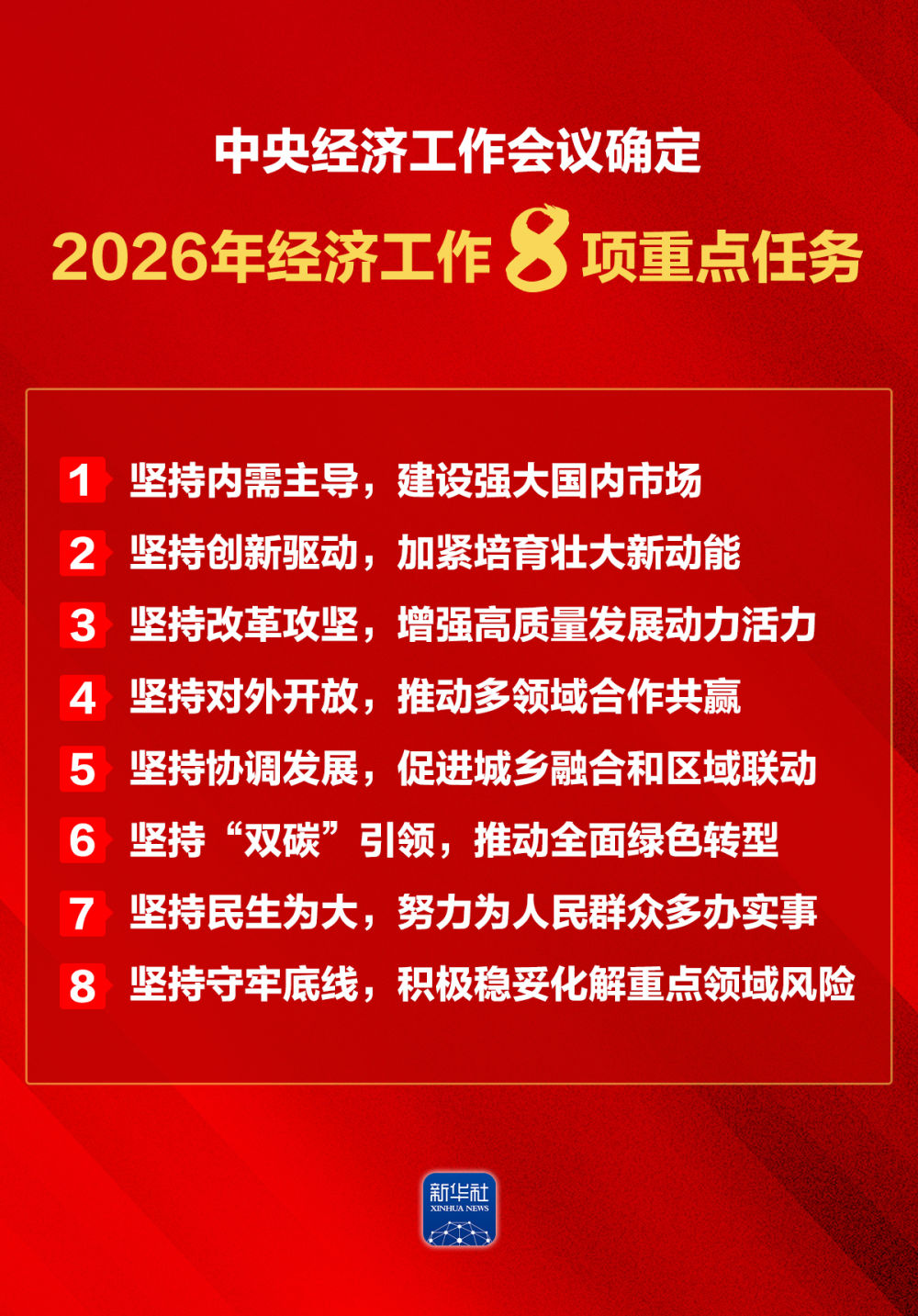
中央经济工作会议:确定明年八大重点任务
2 1 Shi Ji Jing Ji Bao Dao· 2025-12-11 11:21
Core Viewpoint - The Central Economic Work Conference held on December 10-11 in Beijing outlined key tasks for economic work in the coming year, emphasizing a focus on domestic demand, innovation, reform, openness, coordinated development, green transformation, people's livelihood, and risk management [1] Group 1: Economic Focus Areas - Emphasis on domestic demand as the main driver to build a strong domestic market [1] - Innovation-driven approach to accelerate the cultivation and growth of new economic drivers [1] - Commitment to reform efforts to enhance the vitality and momentum for high-quality development [1] Group 2: External Relations and Development - Focus on promoting cooperation and win-win outcomes in multiple fields through openness [1] - Coordination in development to promote urban-rural integration and regional linkage [1] Group 3: Sustainability and Social Welfare - Leadership in "dual carbon" initiatives to promote comprehensive green transformation [1] - Prioritization of people's livelihood with efforts to address practical issues for the populace [1] Group 4: Risk Management - Commitment to maintaining a bottom line by actively and prudently addressing risks in key areas [1]
华夏时评:以“积极宽松”政策锚定“八个坚持”
Hua Xia Shi Bao· 2025-12-11 11:16
Core Viewpoint - The central economic work conference held on December 10-11, 2023, emphasized the importance of utilizing fiscal and monetary policies effectively to achieve the goals set for 2026, marking the beginning of the "15th Five-Year Plan" [2][4]. Group 1: Economic Policy Direction - The conference reiterated the implementation of a more proactive fiscal policy and moderately loose monetary policy, aiming to enhance macroeconomic governance effectiveness [2][4]. - The "Eight Persistences" were highlighted as key strategies for economic work in 2026, focusing on domestic demand, innovation, reform, openness, coordinated development, carbon neutrality, people's livelihood, and risk management [3][4]. Group 2: Implementation Strategies - Fiscal and monetary policies are expected to work in tandem to support the "Eight Persistences," with fiscal funds directed towards infrastructure and innovation, while monetary policy aims to provide low-cost funding to high-tech enterprises [4][5]. - Specific measures include fiscal support for necessary reforms, maintaining a stable financial environment, and promoting regional balance and rural revitalization through targeted fiscal transfers [5][6]. Group 3: Long-term Goals - The success of China's economic development in 2026 will not solely be measured by GDP growth but also by the integration of macro policy resources with the strategic layout of the "Eight Persistences" [6]. - The proactive policies are seen as essential for navigating complex challenges and ensuring a strong start to the "15th Five-Year Plan" [6].

中央经济工作会议:加强重点城市群协调联动 深化跨行政区合作
Xin Lang Cai Jing· 2025-12-11 09:46
Core Viewpoint - The meeting emphasizes the importance of coordinated development, promoting urban-rural integration and regional collaboration [1] Group 1: Urbanization and Rural Revitalization - The focus is on advancing urbanization with counties as key carriers and comprehensively revitalizing rural areas to drive high-quality county economic development [1] - Strict adherence to the farmland red line is highlighted, ensuring food production is prioritized and maintaining reasonable prices for essential agricultural products [1] Group 2: Poverty Alleviation and Economic Support - Continuous consolidation and expansion of poverty alleviation achievements are essential, with regular assistance integrated into the rural revitalization strategy to prevent large-scale return to poverty [1] - Support for major economic provinces to take on significant roles is encouraged [1] Group 3: Regional Cooperation and Marine Economy - Strengthening coordination among key urban agglomerations and deepening inter-administrative cooperation is a priority [1] - Emphasis on overall planning for major bays to promote high-quality development of the marine economy is noted [1]
中央经济工作会议:坚持协调发展,促进城乡融合和区域联动
Xin Lang Cai Jing· 2025-12-11 09:46
中央经济工作会议12月10日至11日在北京举行。会议确定,坚持协调发展,促进城乡融合和区域联动。 统筹推进以县城为重要载体的城镇化建设和乡村全面振兴,推动县域经济高质量发展。严守耕地红线, 毫不放松抓好粮食生产,促进粮食等重要农产品价格保持在合理水平。持续巩固拓展脱贫攻坚成果,把 常态化帮扶纳入乡村振兴战略统筹实施,守牢不发生规模性返贫致贫底线。支持经济大省挑大梁。加强 重点城市群协调联动,深化跨行政区合作。加强主要海湾整体规划,推动海洋经济高质量发展。 ...
彭博:中国将提振内需列为2026年首要目标
彭博· 2025-12-08 15:37
Investment Rating - The report provides a positive investment rating for the industry, emphasizing growth potential and favorable market conditions [12]. Core Insights - The industry is expected to prioritize domestic demand and build a strong domestic market, which will drive consumption and improve investment returns [12]. - Innovation is highlighted as a key driver for new growth, with a focus on accelerating the cultivation of new growth drivers through technological advancements [12]. - The report emphasizes the importance of reform efforts to strengthen the vitality of high-quality development and promote coordinated urban-rural integration [12]. - There is a strong push for opening-up policies to foster win-win cooperation and stabilize foreign trade and investment [12]. - The report outlines a commitment to a comprehensive green transition, aiming to cut carbon emissions and expand the green economy while improving social security and people's livelihood [12].
周绍东:持续夯实高质量发展安全根基
Jing Ji Ri Bao· 2025-11-20 00:40
Group 1: Innovation and Technology - The current technological revolution and industrial transformation are characterized by unprecedented levels of innovation, particularly in fields like artificial intelligence and quantum communication, which are reshaping global order and development patterns [2] - China's original innovation capabilities remain relatively weak, especially in critical core technologies, leading to risks in certain industrial sectors [2] - There is a need to enhance security guarantees while promoting innovation and industrial upgrades, focusing on mastering core technologies to ensure national economic security [2] Group 2: Economic Coordination and Development - Long-standing issues of uncoordinated development in China manifest in industrial and regional disparities, necessitating a focus on supply chain stability and the promotion of new industries [3] - The strategy for regional coordination and urban-rural integration aims to optimize productivity distribution and reduce urban-rural gaps [3] Group 3: Ecological and Energy Security - Emphasizing the importance of ecological and energy security, there is a call for a green and low-carbon transformation of development methods, alongside improving ecological environment quality [4] - The establishment of a multi-faceted energy supply system that includes traditional fossil fuels, new energy, and renewable energy is crucial for ensuring energy security [4] Group 4: Open Economy and Security - Increased openness in China's economy necessitates a focus on security, particularly in foreign trade and investment, to avoid over-reliance on single trade partners [5] - The "Belt and Road" initiative and other international collaborations require robust policy guidance and emergency management to protect overseas interests [5] Group 5: Shared Development and Social Equity - Shared development aims to address social equity issues, ensuring that development benefits are distributed fairly among the population [6] - Enhancing public services in education, healthcare, and social security is essential for improving the overall well-being and stability of society [6]
【省发展改革委】陕西“十四五”经济社会发展亮点多成色足
Shan Xi Ri Bao· 2025-11-19 23:09
Economic Development Achievements - The province's GDP has reached 3.5 trillion yuan, with per capita GDP expected to exceed 13,000 USD, and residents' disposable income growing at an annual rate of approximately 6.6%, outpacing economic growth [1][2] - The province has seen a strong innovation system with R&D expenditure intensity ranking first in Western China, and the number of technology-based SMEs and high-tech enterprises growing by around 30% annually [1][2] Industrial and Economic Structure - The modern industrial system is taking shape, with five industrial clusters entering the "national team," and the province leading in global production of titanium processing, monocrystalline silicon wafers, and heavy-duty truck transmissions [1] - The digital economy now accounts for over 40% of the province's GDP, indicating a significant shift towards modern economic structures [1] Open Economy and Business Environment - The business environment has improved significantly, with over 1.5 million new business entities established, and the private economy's contribution to GDP rising to 50% [2] - The province's international trade with Belt and Road countries has seen an annual growth rate of 11.7% [2] Social Development and Quality of Life - Social security and employment expenditures account for over 20% of the general public budget, with over 2.1 million new jobs created [2] - Education investment has surpassed 500 billion yuan, achieving full coverage of standardized high schools at the county level [2] Environmental Improvements - The environmental quality in the Qinling Mountains has improved, with 99.4% of the area now rated as good, and the water quality of the Yellow River in the province has maintained a Class II rating for three consecutive years [3]