
央行数字货币

Search documents
支持成都搭建跨境投融资数字平台
Xin Lang Cai Jing· 2025-12-24 17:46
Core Viewpoint - The People's Bank of China and eight other departments have jointly issued 21 key financial support measures to promote the high-quality development of the Western Land-Sea New Corridor, focusing on enhancing the core financial functions of "financing" and "settlement" [1][2] Group 1: Financial Support Measures - The opinion emphasizes the development line of "corridor drives logistics, logistics drives trade, trade drives industry" and aims to deepen financial reform and innovation [1] - It proposes to enhance the financial organization collaboration system by increasing the coordination of financial resources and encouraging financial institutions to explore integrated credit mechanisms across provinces [1] - A fund for the Western Land-Sea New Corridor will be established in Chongqing to support infrastructure and industrial park construction along the corridor [1] Group 2: Financial Open System - The opinion supports the establishment of financial hubs in various regions, including the China-ASEAN Financial City in Guangxi and a cross-border investment and financing digital platform in Chengdu [2] - It encourages participation in multilateral central bank digital currency bridge projects and promotes the use of central bank digital currencies for cross-border payments with countries like Thailand and the UAE [2] - The People's Bank of China and the Chongqing Municipal Government will work with relevant departments to implement these measures, aiming to leverage financial services for broader connectivity and cooperation [2]
八部门联合发文!支持探索推进内地与新加坡数字人民币跨境支付试点
Bei Jing Shang Bao· 2025-12-24 10:36
Group 1 - The People's Bank of China, along with several government agencies, issued an opinion to support the construction of the Western Land-Sea New Corridor [1] - The opinion emphasizes the exploration of digital financial international cooperation, particularly in cross-border payment systems using central bank digital currencies (CBDCs) [1] - It supports pilot projects for cross-border payments with countries such as Thailand, Hong Kong, UAE, and Saudi Arabia, as well as a digital RMB pilot with Singapore [1] Group 2 - The opinion encourages the development of cross-border e-commerce digital service platforms in certain provinces, aiming to enhance service capabilities in collaboration with digital platforms from countries like Singapore [1]

八部门:支持探索推进内地与新加坡数字人民币跨境支付试点
Zheng Quan Shi Bao Wang· 2025-12-24 07:41
Core Viewpoint - The central government, along with eight departments, has issued guidelines to enhance financial support for the construction of the Western Land-Sea New Corridor, emphasizing the exploration of digital financial international cooperation [1] Group 1: Digital Financial Cooperation - The initiative encourages provinces along the corridor to participate in multilateral central bank digital currency bridge projects, facilitating cross-border payments using central bank digital currencies with countries such as Thailand, Hong Kong, UAE, and Saudi Arabia [1] - It supports the exploration of cross-border payment pilot projects for digital renminbi between mainland China and Singapore [1] Group 2: E-commerce and Digital Services - The guidelines advocate for provinces with suitable conditions to establish cross-border e-commerce digital service platforms, aiming to connect with e-commerce and trade digitalization platform companies in countries like Singapore to enhance cross-border e-commerce service capabilities [1]
新版人民币已经落地,纸币会消失吗?苏州率先试行6年揭晓答案
Sou Hu Cai Jing· 2025-12-17 02:48
Core Viewpoint - The emergence of digital RMB (DC/EP) is not intended to eliminate cash but to coexist with it, providing a more convenient and secure payment option while maintaining the traditional cash system [4][11]. Group 1: Digital RMB Overview - Digital RMB is an electronic form of legal currency issued by the central bank and operated by commercial banks, allowing citizens to use it through bank accounts or digital wallets [3]. - The pilot program for digital RMB began in 2020 in cities like Suzhou, integrating into daily life with various payment applications [4]. - As of August 2024, over 180 million personal wallets for digital RMB have been opened, with transaction counts exceeding 360 million and total transaction amounts surpassing 7.3 trillion RMB [4]. Group 2: Relationship Between Digital RMB and Cash - The central bank's goal for digital RMB is to replace M0, which refers to cash in circulation, but this does not imply the complete elimination of cash [4][8]. - Cash will remain necessary for individuals who do not have access to smartphones or digital payment methods, particularly the elderly and those in remote areas [5]. - Digital RMB is designed to enhance payment convenience and security without completely replacing cash, allowing for a diversified payment ecosystem [8][11]. Group 3: Global Context and Historical Perspective - Many countries are developing their own central bank digital currencies (CBDCs), such as the digital dollar in the US and the digital euro in Europe, with no intention of completely abolishing cash [8]. - The evolution of currency has historically involved transitional periods, and the gradual decline of cash is expected to be a long-term process rather than an immediate shift [9]. Group 4: Current Payment Landscape - In Suzhou, despite the widespread adoption of digital RMB, cash transactions remain common, especially in local markets and among older populations [7][11]. - The coexistence of digital RMB and cash is seen as a healthy transition, providing consumers with multiple payment options based on their preferences [11].


新财观 | 国际货币体系的历史演变、影响因素与改革方向
Xin Hua Cai Jing· 2025-12-09 11:53
Core Viewpoint - The international monetary system has evolved through various phases, including the gold standard, the Bretton Woods system, and the Jamaica system, each with its own characteristics and challenges. The current system, characterized by sovereign credit currencies, faces calls for reform to enhance stability, efficiency, and fairness in response to geopolitical tensions and market innovations [1][2]. Historical Evolution of the International Monetary System - The international monetary system has transitioned through different stages influenced by both monetary and non-monetary factors, with each phase revealing its own issues and providing lessons for future reforms [2]. - The gold standard was characterized by a singular monetary system that lacked true systemic formation, lasting from the 15th century until the early 20th century, with gold and silver serving as the primary international currencies [3][4]. - The Bretton Woods system, established in 1944, marked a significant shift towards collective monetary governance, creating institutions like the IMF and World Bank, and establishing a dollar-gold peg that lasted until 1971 [5][6]. - The Jamaica system, established in 1976, introduced a more diversified approach to currency reserves and exchange rates, allowing for greater flexibility in international payments [6][7]. Challenges of the Jamaica System - The Jamaica system, while promoting a more flexible monetary framework, has been criticized for lacking a hard anchor, leading to potential over-issuance of sovereign credit currencies and exacerbating global financial imbalances [7][8]. - The dominance of the US dollar within the Jamaica system raises concerns about the implications of US monetary policy on global financial stability, as evidenced by the significant US national debt [7][8]. - The governance structure of international financial institutions like the IMF and World Bank is seen as inequitable, with the US holding disproportionate control, complicating effective global monetary governance [7][8]. Factors Influencing Reform of the International Monetary System - The internal dynamics of the international monetary system are increasingly driven by the need for reform, as historical reliance on sovereign currencies has led to recurring financial crises [9][10]. - Geopolitical tensions and the rise of emerging economies are reshaping the global monetary landscape, prompting countries to seek alternatives to the dollar and explore bilateral and regional currency cooperation [11][12]. - Technological innovations in finance, particularly the rise of stablecoins and digital currencies, are challenging traditional monetary systems and pushing for reforms to enhance efficiency and security in cross-border payments [12][13]. Directions for Reforming the International Monetary System - Future reforms should aim to create a more robust international monetary system that maintains stability while allowing for flexibility in currency use and exchange [14][16]. - Enhancing the role of Special Drawing Rights (SDRs) as a super-sovereign currency could address the inequities of relying solely on sovereign credit currencies [17][18]. - Promoting a competitive environment among a limited number of strong sovereign currencies may provide a more balanced approach to international monetary functions, reducing over-reliance on any single currency [18].
金融学家黄益平:兼具政策影响力与学术权威的数字货币研究者|数字货币专家赋能
Sou Hu Cai Jing· 2025-12-09 08:37
"稳定币和央行数字货币并非零和",黄益平在 2025 夏季达沃斯访谈中提出,两者可在不同场景互补:CBDC 侧重法偿性与监管可控,适合大额、跨境及公 共支付;合规稳定币则依托市场机制,满足零售与链上生态需求。他建议,可在香港先行试点"盯住离岸人民币"的稳定币,既为境外人民币资产提供链上结 算工具,也为内地资本项目未完全开放留出"风险隔离墙"。 【邀请诺贝尔奖、图灵奖得主、两院院士、各行业专家,请联系五洲名家智库】 1957 年生于浙江的黄益平,拥有澳大利亚国立大学经济学博士,是北京大学国家发展研究院教授、院长,两度被任命为中国人民银行货币政策委员会委员 (2015—2018、2024—至今),并兼任中国金融四十人论坛学术委员会主席、北京大学数字金融研究中心主任。丰富的政策咨询与海外投行经历,使他对数 字货币、宏观金融与监管科技始终保持前沿视角。 数字货币:全球货币体系重构的"增量变量" 黄益平指出,数字货币并非短期风口,而是"正在改写支付、清算与储备资产规则"的增量变量。全球九成以上的虚拟资产交易已借助稳定币完成,而 90% 的稳定币与美元挂钩,"这相当于在现有跨境支付系统之外,再建一条由私营机构主导的美元清 ...
多边数字货币桥的新征途
Jing Ji Guan Cha Wang· 2025-11-27 13:55
Core Insights - The multilateral digital currency bridge (JISR) project has officially launched, aiming to create an efficient, low-cost, and scalable cross-border payment solution centered around central bank digital currencies (CBDCs) [1][2] - The project is expected to significantly enhance the efficiency of fund transfers and reduce transaction fees by at least 50% compared to traditional cross-border payment methods [2][4] - The implementation of the JISR project is seen as a step towards promoting the international use of the digital renminbi and reducing reliance on the US dollar for cross-border transactions [4][5] Project Overview - The JISR project was initiated in February 2021 by the People's Bank of China, Hong Kong Monetary Authority, Bank of Thailand, and Central Bank of the UAE, with the Saudi Central Bank joining in June 2024 [1] - The platform is built on distributed ledger technology (DLT), allowing multiple central banks to issue their own CBDCs and facilitate their exchange [1][2] Operational Principles - The project adheres to three main principles: non-destructive, compliant, and interoperable, ensuring that CBDCs promote healthy international monetary systems and comply with local regulations [2][3] - The operational process involves four steps: transferring digital dirhams to the JISR platform, initiating cross-border payments, synchronizing foreign exchange settlements, and transferring digital renminbi to the Chinese enterprise [3][4] Future Implications - The JISR project is expected to accelerate the process of cross-border trade and investment currency settlement between China and the UAE, thereby mitigating exchange rate risks for trade enterprises [4][5] - The establishment of the digital renminbi international operation center in Shanghai aims to provide standardized services for cross-border payments and blockchain applications [5][6] Market Reception - The JISR project is gaining traction among enterprises in regions with stringent cross-border fund flow regulations, as it facilitates compliance and operational efficiency [6][7] - There is a growing interest in tokenized cross-border transfer services among Western companies, while Asian enterprises prioritize compliance and regulatory requirements in cross-border trade payments [6][7]
央行数字货币改善跨境支付清算:现状与有效性分析
Sou Hu Cai Jing· 2025-11-20 03:05
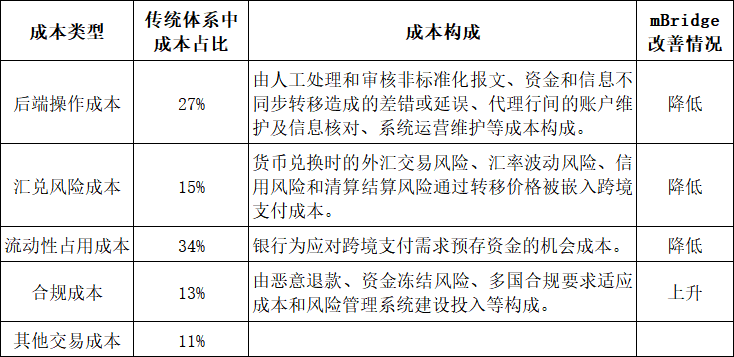
Core Insights - Emerging technologies such as blockchain and smart contracts are driving the development of digital currencies, reshaping the underlying logic of payment systems, and providing innovative opportunities for cross-border payment clearing through Central Bank Digital Currencies (CBDCs) [1] Traditional Cross-Border Payment Clearing System Challenges - The traditional cross-border payment clearing system, primarily based on the correspondent banking model, faces significant challenges including slow transaction speeds, high costs, lack of transparency, insufficient market coverage, and geopolitical risks [2][3][4] - Cross-border clearing is slow, taking at least 1 to 3 business days due to multiple intermediaries and varying operational hours across countries [2] - High costs are associated with the correspondent banking model, with global remittance costs reaching 6.3% in 2023, driven by various operational and compliance costs [2] - Transparency issues arise from the independent systems of different banks and institutions, leading to difficulties in tracking transactions and resolving disputes [3] - The traditional system's reliance on SWIFT for information flow exposes it to geopolitical risks, as seen in the U.S. leveraging SWIFT for sanctions [4] Current Research on CBDCs Improving Cross-Border Payment Clearing - CBDCs, issued by central banks, can be categorized into wholesale and retail types, with the latter aimed at enhancing domestic payment efficiency and the former focused on improving cross-border payments [5] - A significant majority (91%) of surveyed central banks are engaged in CBDC-related work, with many countries entering trial phases [5] - Three interoperability models for wholesale CBDCs are identified: compatibility, interconnection, and a single multi-currency payment system [6] Effectiveness of the mBridge Project in Improving Cross-Border Payment Clearing - The mBridge project, initiated by several central banks, aims to create a multilateral cooperation mechanism for cross-border payment clearing using distributed ledger technology [7][8] - The project has evolved from bilateral CBDC corridors to a standardized multilateral CBDC corridor network, allowing for direct currency exchanges and faster transaction times [8][10] - The average transaction time on the mBridge network is significantly reduced to 6-9 seconds compared to traditional systems [10] Cost Analysis of Cross-Border Payments - The mBridge project aims to reduce various cost components associated with traditional cross-border payments, including backend operational costs, foreign exchange risk costs, liquidity costs, and compliance costs [11][12][14] - The backend operational costs, which account for 27% of total costs, are expected to decrease due to improved synchronization of funds and information [12] - Foreign exchange risk costs, currently at 15%, are also anticipated to decline as participants can view real-time exchange rates [12] - Liquidity costs, which traditionally require banks to pre-fund accounts, will be reduced as mBridge allows for real-time settlement [13] - Compliance costs may rise due to the complexity of regulatory frameworks across different jurisdictions [14] Future Outlook and Strategic Recommendations - The increasing demand for optimized cross-border payment environments necessitates the development of CBDCs, with a focus on enhancing the international role of the renminbi [15] - Recommendations include accelerating the establishment of multilateral cooperation mechanisms for cross-border payments and promoting the internationalization of the renminbi through digital currency applications [16][17]
香港百亿数字绿债落槌,全球首次应用央行数币交收
2 1 Shi Ji Jing Ji Bao Dao· 2025-11-13 12:37
Core Insights - The Hong Kong Special Administrative Region government successfully priced its third batch of digital green bonds, totaling HKD 100 billion, marking the largest digital bond issuance globally to date [2][3] - The issuance received over HKD 130 billion in subscriptions, indicating a 12-fold oversubscription, reflecting strong market support for tokenized products [2][3] - The issuance aims to establish a comprehensive benchmark for the market and expand the broader application of digital finance [2][3] Group 1: Issuance Details - The third batch of digital green bonds includes multiple currencies: HKD, RMB, USD, and EUR, with maturities extended from 2 years to a maximum of 5 years [2][5] - The issuance represents a significant increase from previous batches, with a nearly 70% increase in total issuance compared to the second batch of HKD 60 billion [5] - The number of participating banks increased from 4 in the first issuance to 10 in the latest, indicating a significant rise in market participation [4][7] Group 2: Technological Innovations - The issuance introduced the use of tokenized central bank digital currencies (CBDCs) for settlement, marking the first global application of CBDCs in bond issuance [6][9] - This innovation allows for near real-time delivery versus payment (DvP), significantly reducing settlement times and counterparty credit risk [6][9] - The integration of tokenized bonds with CBDCs creates a closed-loop system for bond issuance, currency, and settlement, enhancing transaction efficiency [6][9] Group 3: Strategic Vision - The Hong Kong Monetary Authority (HKMA) aims to position Hong Kong as a global digital asset center, with ongoing efforts to expand market size and seek innovation in each bond issuance [8][10] - The issuance aligns with the broader policy framework established in the "Hong Kong Digital Asset Development Policy Declaration 2.0," which emphasizes regular issuance of tokenized government bonds [8][9] - Future developments may include the integration of various digital currencies and the evolution of tokenized bonds into "smart green assets," linking bond performance to real-world environmental metrics [9][10]
主题报告 | 稳定币的风险、挑战与中国对策
Sou Hu Cai Jing· 2025-11-11 08:08
Group 1: Core Insights - The report discusses the risks, challenges, and policy recommendations regarding stablecoins, emphasizing their role as a bridge between traditional and crypto finance [1][2][3] - Stablecoins have seen rapid growth, with their market capitalization exceeding $290 billion as of late August 2023, primarily driven by USDT and USDC, which together account for over 80% of the market [2][3] - The introduction of the US "GENIUS Act" aims to establish a regulatory framework for stablecoins, requiring full reserve backing or short-term US Treasury holdings, which could significantly impact the global stablecoin landscape [9][10][11] Group 2: Characteristics of Stablecoins - Stablecoins maintain a 1:1 exchange ratio with fiat currencies, primarily the US dollar, but their stability is relative and can fluctuate under certain conditions [2][3] - They operate on public blockchains, allowing for decentralized transactions without intermediaries, which poses new challenges to traditional financial regulatory frameworks [3][4] - The issuance process involves large institutions applying for stablecoin issuance, with a significant portion of the funds being invested in low-risk, highly liquid assets like US Treasury bills [4] Group 3: Risks and Challenges - Stablecoins face risks related to illegal activities and regulatory evasion, as their cross-border usage can undermine national monetary sovereignty [6][7] - Financial stability risks arise from the potential for stablecoin issuers to invest in high-risk assets, leading to significant volatility and potential failures, as seen in past incidents like the collapse of algorithmic stablecoins [7][8] - The decentralized nature of stablecoins complicates cross-border regulatory coordination, with varying regulatory approaches across countries leading to potential regulatory arbitrage [8] Group 4: Regulatory Developments - The "GENIUS Act" mandates transparency and compliance for stablecoin issuers, including anti-money laundering measures and annual audits, addressing long-standing concerns about the lack of oversight in the stablecoin market [10][11] - The act positions stablecoin issuers as the primary responsible parties for compliance, enhancing the regulatory framework surrounding stablecoins and potentially reshaping global standards [11][12] - The anticipated growth of stablecoins could lead to increased demand for US Treasury securities, potentially reversing recent declines in demand for US debt instruments [12][14] Group 5: Geopolitical Implications - The competition between the US and China in the international financial arena has implications for the future of stablecoins, with the US's regulatory framework potentially solidifying the dollar's dominance [14][15] - The rise of stablecoins could marginalize weaker fiat currencies, impacting the internationalization of the Chinese yuan and presenting both challenges and opportunities for China's financial strategy [15][18] - Stablecoins may challenge China's financial security by facilitating cross-border transactions that bypass traditional currency controls, raising concerns about capital flight and monetary sovereignty [18][19]