新能源汽车出口

Search documents
启境首款车型将于明年年中推出;中汽协:9月我国新能源汽车出口同比增长1倍 | 汽车早参
Mei Ri Jing Ji Xin Wen· 2025-10-21 22:33
Group 1 - GAC Group and Huawei are collaborating to launch a new brand called "Qijing," with the first model expected to be released in mid-2026, featuring Huawei's advanced technology [1] - The name "Qijing" was inspired by a suggestion from Huawei's founder, emphasizing a youthful and technological image, with "Qi" representing new beginnings and "Jing" symbolizing new realms [1] - Huawei has deployed hundreds of personnel to work on the "Qijing" project, indicating a deep partnership in technology and market strategy between the two companies [1] Group 2 - As of the end of September, China's electric vehicle charging infrastructure reached 18.063 million units, marking a 54.5% year-on-year increase [2] - Public charging facilities accounted for 4.476 million units, up 40% year-on-year, while private charging facilities reached 13.587 million units, reflecting a 60% increase [2] - The growth in charging infrastructure is driven by both policy support and market demand, positively impacting related industries such as charging equipment manufacturing and energy management [2] Group 3 - In September, China's automobile exports exceeded 600,000 units, with a year-on-year increase of 21%, highlighting the strong international competitiveness of the Chinese automotive industry [3] - New energy vehicle exports reached 222,000 units, showing a remarkable year-on-year growth of 100%, despite a slight month-on-month decline [3] - The growth in exports indicates global market recognition of Chinese automobiles and reflects ongoing innovations and breakthroughs in the industry [3] Group 4 - CATL announced that its "Chocolate" battery swap stations have surpassed 700 locations, with plans to accelerate towards a target of 1,000 stations by 2025 [4] - The expansion of the battery swap network enhances CATL's competitiveness in charging infrastructure and demonstrates proactive market positioning [4] - The promotion of battery swap models is expected to boost the battery manufacturing and related service markets, improving overall supply chain efficiency [4]



广交会观察:新能源汽车成亮点 中国智造加速“出海”
Zhong Guo Xin Wen Wang· 2025-10-15 14:15
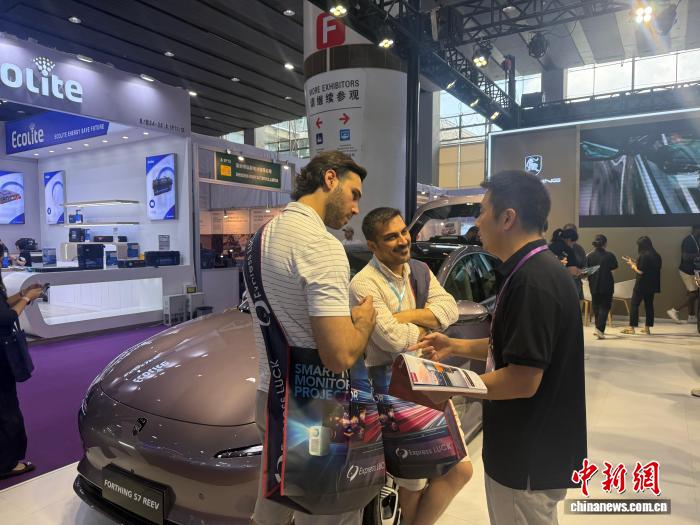
Core Insights - The 138th China Import and Export Fair (Canton Fair) opened in Guangzhou, highlighting the strong performance of the new energy vehicle (NEV) sector, with many companies showcasing intelligent products and comprehensive solutions [1][4]. Industry Performance - NEVs have become a significant growth driver for China's automotive industry, with exports reaching 1.758 million units from January to September, marking a year-on-year increase of 89.4% [4]. - The Dongfeng Liuzhou Motor Company reported a 20% increase in export volume for the first three quarters, attributed to their hybrid models that cater to markets with inadequate charging infrastructure [4]. Company Strategies - Companies like Kaiwo New Energy and GAC Group are focusing on customized solutions for different markets, enhancing battery management and vehicle performance based on regional needs [3][4]. - Kaiwo's products, including the autonomous Shuttle Bus and the large VAN, have garnered significant attention, particularly in European markets, where they plan to launch by the end of the year [3]. Future Trends - The future of NEV exports is expected to be driven by intelligence and sustainability, with companies aiming to enhance their brand and service quality to elevate "Made in China" to "Quality from China" [5].

连续5个月同比增速超10%!9月我国汽车产销量首超300万辆 中汽协:2025年车市完成情况将好于预期
Mei Ri Jing Ji Xin Wen· 2025-10-14 13:24
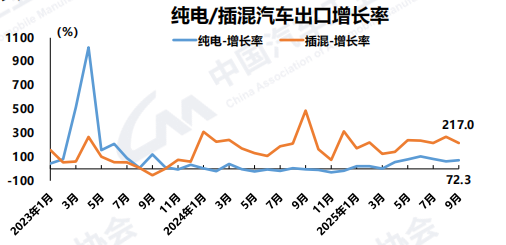
Core Insights - In September, China's automotive production and sales exceeded 3 million units for the first time in history, with production reaching 3.276 million and sales at 3.226 million, marking a month-on-month increase of 16.4% and 12.9% respectively, and a year-on-year increase of 17.1% and 14.9% [1][2] Production and Sales Performance - From January to September, China's automotive production and sales reached 24.333 million and 24.436 million units, showing year-on-year growth of 13.3% and 12.9% respectively, with growth rates expanding compared to the first eight months of the year [1][2] - The new energy vehicle (NEV) market saw significant growth, with production and sales reaching 1.124 million and 1.123 million units from January to September, reflecting year-on-year growth of 35.2% and 34.9% [5][7] Market Dynamics - The "old-for-new" vehicle policy has positively impacted consumer purchasing behavior, with many regions restarting or enhancing subsidies, leading to increased sales [2][4] - Chinese brand passenger vehicles accounted for 69% of total passenger vehicle sales from January to September, with a year-on-year increase of 5.1 percentage points [2][3] New Energy Vehicles - In September, NEV production and sales reached 1.617 million and 1.604 million units, with a year-on-year increase of 23.7% and 24.6%, making up 49.7% of total new car sales [4][5] - The mainstream price range for NEVs is now higher than that of traditional fuel vehicles, with significant sales growth in the 10-20 million yuan price range [3][5] Export Performance - From January to September, exports of pure electric vehicles reached 1.13 million units, a year-on-year increase of 54.6%, while plug-in hybrid vehicle exports surged to 628,000 units, marking a 2.2-fold increase [5][7] - Chery and BYD were among the top exporters, with Chery exporting 936,000 units and BYD achieving a remarkable growth rate of 130% in exports [7]

乘联分会:9月新能源乘用车生产150.1万辆 同比增长22.9%
Xin Hua Cai Jing· 2025-10-13 02:33
Group 1: Market Performance - In September, the retail sales of passenger cars in China reached 2.241 million units, a year-on-year increase of 6.3% and a month-on-month increase of 11.0% [1] - Cumulative retail sales for the year reached 17.005 million units, reflecting a year-on-year growth of 9.2% [1] - The retail growth rate has fluctuated, starting from 1.2% in January-February, rising to 11% in June, and stabilizing around 6% from July to September [1] Group 2: Production and Export Data - In September, passenger car production was 2.838 million units, showing a year-on-year increase of 17.2% and a month-on-month increase of 15.7% [2] - Cumulative production for the year reached 20.78 million units, with a year-on-year growth of 13.9% [2] - Passenger car exports in September totaled 528,000 units, a year-on-year increase of 20.7% and a month-on-month increase of 5.7% [1][2] Group 3: New Energy Vehicle Insights - In September, the production of new energy passenger vehicles reached 1.501 million units, a year-on-year increase of 22.9% [2] - The retail penetration rate of new energy vehicles in the overall passenger car market was 57.8%, up 5 percentage points from the previous year [3] - New energy vehicle exports reached 211,000 units in September, a year-on-year increase of 96.5% [3]
产业“底盘”稳 新能源汽车出口跑出“加速度”
Yang Shi Wang· 2025-10-12 22:13
Core Viewpoint - During the "14th Five-Year Plan" period, China has continuously promoted high-level opening-up, stabilizing the foundation of foreign trade, with a remarkable transformation in the export of new energy vehicles from an initial stage to a global leadership position [1] Group 1 - The export of new energy vehicles has evolved significantly, marking a transition from the early stages of the "14th Five-Year Plan" to becoming a global leader [1]
汽车行业出口跟踪报告:1-8M25 出口同比+13%,新能源占 35%
Huachuang Securities· 2025-10-11 14:08
Investment Rating - The report maintains a "Recommendation" rating for the automotive industry, expecting the industry index to outperform the benchmark index by more than 5% in the next 3-6 months [6][70]. Core Insights - In the first eight months of 2025, China's total vehicle exports reached 4.26 million units, representing a year-on-year increase of 13%. This growth rate has slowed compared to previous years, but the export volume now accounts for approximately 20.2% of China's total vehicle wholesale [2][10]. - The export of new energy vehicles (NEVs) accounted for 35% of total vehicle exports, with 1.51 million NEVs exported in the same period, significantly up from 22% in 2024 [2][9]. - Major contributors to the export growth include Chery, BYD, and SAIC, with Chery exporting 800,000 units (19% share) and BYD exporting 630,000 units (15% share), marking a substantial increase from previous years [9][10]. Summary by Sections Overall Export Performance - China's total vehicle exports in the first eight months of 2025 reached 4.26 million units, up 13% year-on-year, with a monthly export volume consistently above 500,000 units since March 2025, peaking over 600,000 units in August [2][10]. - The share of vehicle exports in total vehicle wholesale has increased by approximately 1.6 percentage points compared to 2024 [2]. Breakdown by Structure - In terms of vehicle type, commercial vehicles accounted for 15% of exports, while passenger vehicles made up 85%, showing little change from 2024 [9]. - The NEV export volume reached 1.51 million units, with a notable increase in market penetration, particularly driven by domestic manufacturers like BYD [9][10]. Breakdown by Brand - Chery led the exports with 800,000 units, followed by BYD with 630,000 units, and SAIC with 330,000 units. The rankings reflect a significant rise in BYD's market share from 7% in 2024 to 15% in 2025 [9][10]. Breakdown by Region - Mexico was the largest market for Chinese vehicle exports, receiving 360,000 units, followed by the UAE and Belgium with 320,000 and 290,000 units, respectively [9][10]. - The share of Chinese vehicles in overseas markets has increased from approximately 2% in 2020 to 9.4% in the first eight months of 2025 [9][10]. Export Value - The export value of complete vehicles and auto parts reached $84.29 billion and $64.46 billion, respectively, accounting for 3.4% and 2.6% of China's total exports [9][10].

稳扎稳打 中国车企深耕新兴市场本地化
Zhong Guo Chan Ye Jing Ji Xin Xi Wang· 2025-10-11 00:49
Core Insights - BYD officially entered the Argentine market on August 27, launching exclusive pre-sales for models including Yuan UP, Song PRO DM-i, and Seagull, marking a significant step in the company's global expansion strategy [1] - In the first eight months of the year, China's electric vehicle exports reached 2.2782 million units, a year-on-year increase of 52.6%, accounting for 46.2% of total vehicle exports, with an export value of $41.551 billion, up 29.7% [1] Group 1: Market Expansion - BYD's entry into Argentina signifies its commitment to supporting the country's automotive industry's transition to electric vehicles and represents a milestone for local green and smart upgrades [2] - The company plans to introduce a series of energy-efficient, cutting-edge, and zero-emission models in Argentina while also developing charging infrastructure and forming strategic partnerships with local stakeholders [2] - In Africa, BYD has entered 17 countries and regions, focusing on localized sales and brand promotion to participate in the continent's green transition [2] Group 2: Strategic Partnerships - XPeng Motors has established a strategic partnership with Ebrahim K. Kanoo in Bahrain, marking its entry into the Middle Eastern market and expanding its global footprint [2] - The collaboration will leverage Ebrahim K. Kanoo's extensive experience and sales network to introduce models like XPeng G6, G9, and X9, catering to the demand for high-quality smart electric vehicles in Bahrain [2] Group 3: Challenges in Export - Despite the growth in exports, challenges remain, including the EU's anti-subsidy investigation into Chinese electric vehicles and Mexico's proposed tariff reforms, which could impose rates as high as 50% on vehicles and parts [3] - The Secretary-General of the China Chamber of Commerce for Import and Export of Machinery and Electronic Products noted that while export trade remains mainstream, leading companies are accelerating local production overseas and enhancing their understanding of international operations and brand building [3]

纯电动乘用车纳入出口许可证管理 专家:新政助推汽车高质量出海
Zhong Guo Jing Ying Bao· 2025-09-27 08:52
Core Viewpoint - The Chinese government has announced the implementation of export license management for pure electric passenger vehicles starting January 1, 2026, to promote healthy development in the electric vehicle trade and enhance international competitiveness [1][2]. Group 1: Policy Implementation - The new policy specifies that all pure electric passenger vehicles must obtain export licenses from the Ministry of Commerce or its authorized agencies, with non-compliance leading to export bans [1]. - The policy aims to strengthen brand responsibility, improve service levels, and curb low-price competition, thereby creating a sustainable export ecosystem for Chinese electric vehicles [1][2]. Group 2: Market Dynamics - Europe remains a key market for Chinese electric vehicle exports, with Belgium, the UK, Spain, and Germany among the top five destinations in 2024 [2]. - Southeast Asia and Latin America are emerging as significant growth markets for Chinese electric vehicles, although demand in these regions can be volatile [2]. Group 3: Challenges and Adaptation - Some domestic electric vehicles have struggled to adapt to overseas conditions, facing challenges such as varying certification regulations and climate-related performance requirements [3]. - The lack of local service networks and charging infrastructure has hindered brand reputation and market competitiveness [3]. Group 4: Strategic Recommendations - Direct operation of exports by car manufacturers is recommended to ensure local adaptation and continuous service support, enhancing brand image and customer experience [3]. - A shift towards a user-centered value creation model is suggested, focusing on high-quality products and services to meet diverse international market demands [4][6]. Group 5: Industry Growth - China has established a leading position in the global electric vehicle industry, with production and sales consistently ranking first worldwide for the past decade, and exports reaching 5.859 million vehicles in 2024, with over 20% being electric vehicles [5]. - The export volume of electric vehicles surged by 87.3% year-on-year in the first eight months of 2025, indicating robust growth in this sector [5]. Group 6: Governance and Collaboration - The new export license management reflects an improvement in regulatory frameworks, allowing for better oversight and responsiveness to market changes [6]. - The collaboration between government and enterprises is emphasized as a means to enhance policy effectiveness and protect the overall interests of Chinese automotive exports [6].
绿地控股执行总裁陈军离职!半年营收已跌破千亿元大关
Zhong Guo Jing Ying Bao· 2025-09-23 12:04
Core Viewpoint - The resignation of Chen Jun, the Executive President of Greenland Holdings, highlights ongoing management instability amid significant financial losses, with the company struggling to recover from a downturn in the real estate and infrastructure sectors [3][6][8]. Management Changes - Chen Jun resigned due to personal reasons after being on leave for over two months, marking a significant leadership change as he is the second Executive President to leave this year, following Zhang Yun's retirement in May [3][6][9]. - The company appointed five new vice presidents to fill the leadership gap, indicating a restructuring effort within the management team [3][6]. Financial Performance - Greenland Holdings reported a revenue drop to 944.95 billion yuan in the first half of the year, a decrease of 18.06% year-on-year, falling below the 1 trillion yuan mark [8][9]. - The net profit attributable to shareholders was -35.06 billion yuan, reflecting a staggering year-on-year decline of 1772.4% [6][9]. - Cumulatively, the company has incurred losses exceeding 286 billion yuan over the past two and a half years, primarily due to slow project turnover and asset impairments [9]. Industry Context - The real estate and infrastructure sectors remain in a state of adjustment, contributing to the company's declining revenues as fewer projects are completed and recognized in income [8][9]. - Greenland Holdings is actively working to revive its real estate and infrastructure businesses while also exploring new avenues such as the export of electric vehicles, aiming for significant growth in this area [9].


绿地控股执行总裁陈军离职 半年营收已跌破千亿元大关
Zhong Guo Jing Ying Bao· 2025-09-23 01:55
Core Viewpoint - The resignation of Chen Jun, the Executive President of Greenland Holdings, highlights ongoing management instability amid significant financial losses for the company [1][4][6]. Management Changes - Chen Jun resigned due to personal reasons after being on leave for over two months, marking the second resignation of an executive president this year, following Zhang Yun's retirement in May [1][4][5]. - The company appointed five new vice presidents to replace Chen Jun, with their terms aligned with the current board [4][6]. Financial Performance - Greenland Holdings reported a revenue drop of 18.06% in the first half of the year, with total revenue falling below 100 billion yuan, amounting to 94.495 billion yuan [3][7]. - The net profit attributable to shareholders was -3.506 billion yuan, a staggering decline of 1772.4% year-on-year, contributing to a cumulative loss of over 28.6 billion yuan in the past two and a half years [3][8]. - The company attributed the revenue decline to a sluggish real estate and infrastructure market, with significant decreases in project turnover and related income [7][9]. Strategic Initiatives - Greenland Holdings is focusing on inventory reduction and improving market liquidity and cash flow to address its financial challenges [3][9]. - The company is also expanding into the electric vehicle export business, aiming to establish a platform for exporting 100,000 vehicles annually within three years [10].