
港股市场

Search documents
中国银河证券:料港股交投活跃度有望续升 关注科技及消费板块
智通财经网· 2026-01-05 06:53
Core Viewpoint - The Hong Kong stock market is expected to remain active and experience an upward trend due to multiple positive factors, with a focus on the technology and consumer sectors for medium to long-term investment opportunities [1] Group 1: Market Performance - The Hong Kong stock market rose by 2.01% last week, with the Hang Seng Technology Index increasing by 4.31% [2] - Among the primary sectors, 7 sectors saw gains while 4 sectors declined, with notable increases in Information Technology (4.54%), Energy (3.97%), and Materials (2.98%) [2] - In the secondary sectors, Semiconductor, Defense, Oil & Petrochemicals, Software Services, and Paper & Packaging led the gains, while Household Products, Durable Goods, Consumer Services, Daily Consumer Retail, and Textiles & Apparel faced declines [2] Group 2: Market Liquidity - The average daily trading volume on the Hong Kong Stock Exchange was HKD 171.19 billion, an increase of HKD 31.26 billion from the previous week [3] - The average daily short-selling amount was HKD 19.93 billion, up by HKD 2.96 billion from the previous week, with short-selling accounting for 11.78% of the trading volume, a decrease of 0.22 percentage points [3] - There was a net outflow of HKD 3.81 billion from southbound funds, a decrease of HKD 6.37 billion compared to the previous week [3] Group 3: Valuation and Risk Appetite - As of January 2, 2026, the Hang Seng Index had a price-to-earnings ratio of 12.09 and a price-to-book ratio of 1.23, both up by 2.36% from the previous week, positioned at the 79% and 56% percentiles since 2010 [4] - The Hang Seng Technology Index had a price-to-earnings ratio of 23.8 and a price-to-book ratio of 3.15, at the 36% and 66% percentiles since 2010 [4] - The risk premium for the Hang Seng Index was 4.08%, which is 1.82 standard deviations below the 3-year rolling mean, placing it at the 4% percentile since 2010 [4]

2025年公募“冠军基金”收益逾230%, “翻倍基金”达76只,多家研报看好后市
Yang Zi Wan Bao Wang· 2026-01-04 10:53
Group 1 - The A-share market closed 2025 with an annual increase of over 18%, and public fund performance reached a new record [1] - Yongying Technology's Smart Selection A became the "champion fund" of 2025 with an annual return of 233.29%, breaking the 18-year record previously held by Wang Yawei [1] - A total of 76 funds achieved over 100% annual returns, with E Fund alone accounting for 10 of these funds [1] Group 2 - Multiple positive factors are expected to sustain a long-term upward trend in the Chinese capital market, including low A-share valuations and improving quality of listed companies [1] - Increased dividends and buybacks are enhancing investor returns, while patient capital continues to flow into the market [1] - The Shanghai Composite Index ended December 2025 with an "11 consecutive days of gains," driven by a recovery in risk appetite and increased ETF volumes [1] Group 3 - The strong performance of the Hong Kong stock market during the New Year period is expected to positively influence A-shares post-holiday [2] - The historical strong correlation between Hong Kong and A-shares reinforces expectations for a strong A-share market following the New Year [2]
港股新年“开门红” 恒指重返26000点关口
Zhong Guo Xin Wen Wang· 2026-01-02 14:30
中新社香港1月2日电 (记者戴小橦)港股2日迎来2026年首个交易日,市场强势上行,收复26000点关口。 截至当日收盘,香港恒生指数涨707.93点,涨幅2.76%,报26338.47点;恒生科技指数涨幅4%,报 5736.44点;国企指数涨幅2.86%,报9168.99点。 (文章来源:中国新闻网) 从板块表现来看,市场呈现普涨态势,生物医药、科网、黄金、银行、券商等多个赛道联袂走高。其中 科网股表现亮眼,百度集团涨9.35%,网易涨6.62%,阿里巴巴、腾讯控股分别涨4.34%、4.01%,快 手、京东集团、小米集团、美团等龙头股亦纷纷录得涨幅。 半导体股同样上涨,华虹半导体涨9.42%,中芯国际涨5.11%,中电华大科技涨4.65%。 成交额前三的个股中,腾讯控股成交超100亿港元;阿里巴巴成交超72亿港元;壁仞科技涨75.82%,成 交超55亿港元。 1月2日,香港恒生指数涨707.93点,涨幅2.76%,收报26338.47点。全日主板成交1408.64亿港元。中新 社记者陈永诺摄 中国工商银行(亚洲)证券业务部分析员叶泽恒接受中新社记者采访时表示,踏入2026年首个交易日,港 股表现理想,恒生指 ...
港股开盘:恒指涨0.34%,恒生科指涨0.58%,新股壁仞科技开盘大涨82%
Jin Rong Jie· 2026-01-02 01:45
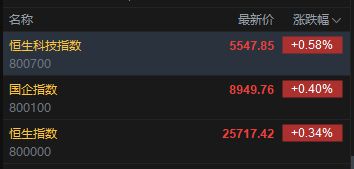
大型科技股中,阿里巴巴-W涨0.28%,腾讯控股涨0.25%,京东集团-SW涨0.63%,小米集团-W涨 0.25%,网易-S涨2.52%,美团-W平收,快手-W跌0.16%,哔哩哔哩-W涨1.4%。造车新势力普涨,理想 汽车、零跑汽车涨超1%;新股壁仞科技开盘大涨82%,市值达855亿港元。 离岸人民币兑美元升破6.97,最高升至6.9678,创2023年5月以来新高。美股在2025年最后一个交易日走 势向下,科技股走势拖低大市,三大指数均录得跌幅收市。美元低位靠稳,美国十年期债息回升至4.17 厘水平,金价急跌后有反弹,油价则有所回落。 1月2日,港股恒生指数开盘涨0.34%,报25717.42点,恒生科技指数涨0.58%,报5547.85点,国企指数 涨0.4%,报8949.76点,红筹指数涨0.56%,报4037.86点。 | 名称 | 最新价 | 涨跌幅√ | | --- | --- | --- | | 恒生科技指数 | 5547.85 | +0.58% | | 800700 | | | | 国企指数 | 8949.76 | +0.40% | | 800100 | | | | 恒生指数 | 2571 ...

2025年A股“燃爆了”!创近6年最大涨幅,540股股价翻倍!融资客年度“采购清单”出炉
Zheng Quan Shi Bao Wang· 2026-01-01 02:00
Market Performance - In 2025, the A-share market showed strong performance, with the Shanghai Composite Index closing at 3968.84 points, marking an annual increase of 18.41%, the largest since 2020 [2] - The Shenzhen Component Index surged by 29.87%, while the ChiNext Index saw a remarkable rise of 49.57% [2] - The Hong Kong market also performed well, with the Hang Seng Index increasing by 27.77% and the Hang Seng Tech Index rising by 23.45% [3] Sector Performance - The non-ferrous metals sector led the annual gains with a staggering increase of 94.73%, driven by soaring precious metal prices and rare earth export restrictions [4] - The communication sector followed with an 84.75% increase, while electronics, comprehensive, power equipment, and machinery sectors all saw gains exceeding 40% [4] - Conversely, the coal and food & beverage sectors were among the few to record declines, with decreases of 5.27% and 9.69%, respectively [4] Stock Performance - A total of 540 stocks in the A-share market doubled in price in 2025, with the top performers being Upway New Materials and Tianpu Co., with increases of 1820.29% and 1645.35%, respectively [5] - Notable stocks with significant annual gains exceeding 500% included *ST Yushun, *ST Yazhen, and Shenghong Technology, among others [5] - On the downside, 25 stocks experienced annual declines of over 40%, with Shijin Technology leading with a drop of 50.99% [5] Financing Trends - As of December 30, 2025, the A-share financing balance reached a record high of 25,385.25 billion yuan, maintaining above 25 trillion yuan for six consecutive days [9] - The financing balance increased by 6,843.8 billion yuan compared to the end of 2024, representing a year-on-year growth of 36.91% [10] - The electronics and power equipment sectors saw net inflows exceeding 1,000 billion yuan, while communication, machinery, and non-ferrous metals sectors also attracted significant investments [10] Notable Stocks in Financing - A total of 133 stocks had net financing purchases exceeding 10 billion yuan, with New Yisheng, Ningde Times, and Shenghong Technology among the top [12] - The "three swordsmen" of optical modules, New Yisheng and Zhongji Xuchuang, received substantial financing support, with net purchases exceeding 100 billion yuan [13] - Conversely, stocks like Muyuan Foods and Oriental Fortune faced significant net financing repayments, exceeding 10 billion yuan [11][13]


2025年港股收官:恒指年涨幅27.77% “深港指数”领涨全球
Mei Ri Jing Ji Xin Wen· 2025-12-31 07:22
| 序号 | 证券代码 | 证券简称 | 年涨跌幅 | | | --- | --- | --- | --- | --- | | | | | [交易日期] 最新收盘日 [単位] % ↓ | | | 1 | 399001.SZ | 深证成指 | | 30.6248 | | 2 | : HSI.HI | 恒生指数 | | 27.7697 | | 3 | : N225.Gl | 日经225 | | 26.1814 | | 4 | TWII.TW | 台湾加权指数 | | 24.6234 | | 5 | GDAXI.GI | 德国DAX | | 23.0109 | | 6 | : FTSE.GI | 英国富时100 | | 21.6284 | | 7 | IXIC.GI | 纳斯达克指数 | | 21.2746 | | 8 | 000001.SH | 上证指数 | | 18.2994 | | 9 | : SPX.GI | 标普500 | | 17.2505 | | 10 | DJI.GI | 道琼斯工业平均 | | 13.6866 | | 11 | : FCHI.GI | 法国CAC40 | | 10.6684 | | ...
2025年港股收官 恒指年涨幅27.77% “深港指数”领涨全球
Mei Ri Jing Ji Xin Wen· 2025-12-31 07:15
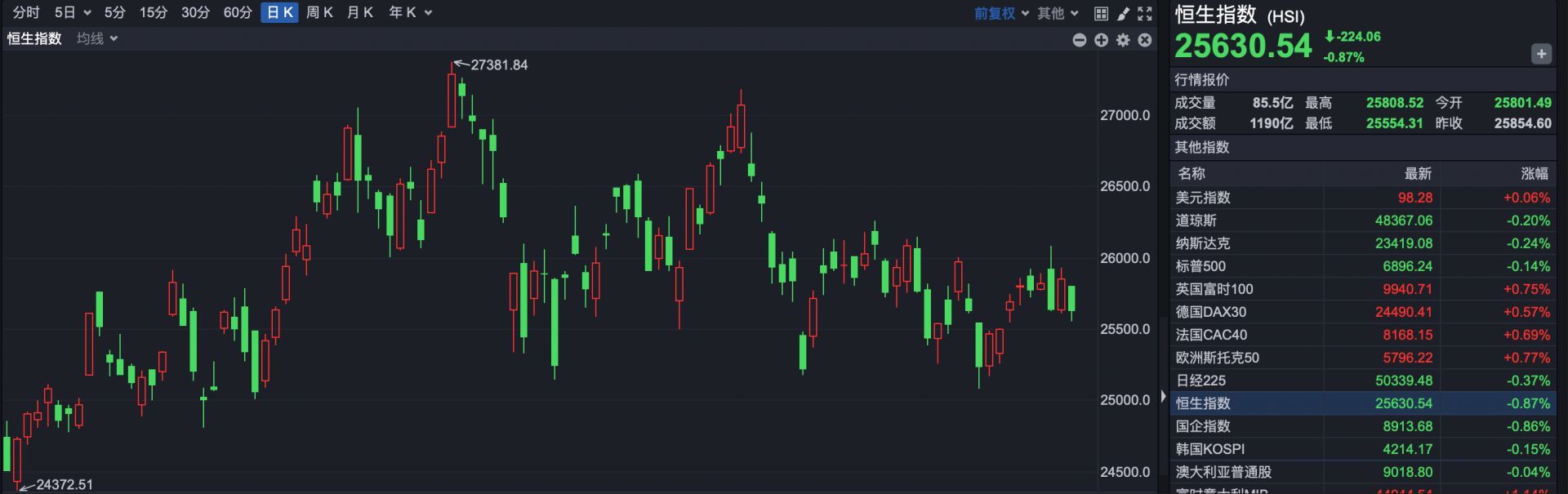
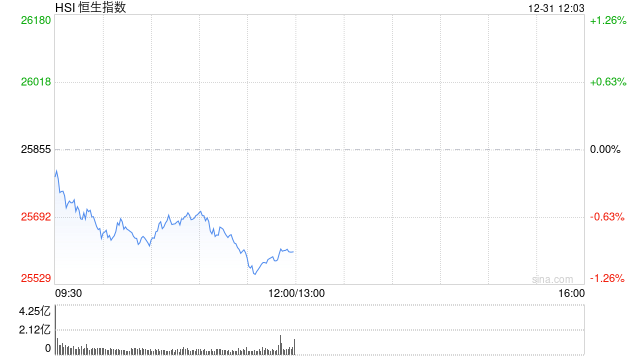
Core Viewpoint - The Hong Kong stock market experienced a mixed performance in 2025, with the Hang Seng Index achieving a year-to-date increase of 27.77%, making it the second-best performer globally after the Shenzhen Composite Index, which rose by 30% [5][6]. Group 1: Market Performance - The Hang Seng Index closed at 25,630.54 points, down 224.06 points or 0.87% on the last trading day of the year [1]. - The Hang Seng Tech Index closed at 5,514.98 points, down 62.40 points or 1.12% [3]. - In 2025, the Hang Seng Index recorded a cumulative increase of 27.77%, while the Hang Seng Tech Index also saw a two-year consecutive rise with a 23.45% increase [5]. Group 2: Sector Performance - The gold and precious metals sector showed remarkable performance, with Zhenfeng Gold (HK01815) increasing over 1200% and Lingbao Gold (HK03330) rising over 570% throughout the year [5]. - The semiconductor sector also performed well, with Huahong Semiconductor (HK01347) up over 240% and SMIC (HK00981) up over 120% [5]. - The brokerage sector saw Guotai Junan International increase by over 140% [5]. - The biopharmaceutical sector was active, with Yaojie Ankang rising over 770% [5]. - Conversely, the real estate and education sectors underperformed due to industry adjustments [5]. Group 3: Market Trends and Outlook - The market showed a subdued performance on the last trading day due to holiday factors, with mixed results among tech stocks and a notable decline in automotive stocks [7]. - In 2025, the Hong Kong market is expected to see a significant influx of southbound capital, with net purchases exceeding 1.4 trillion HKD, and cumulative net purchases surpassing 5 trillion HKD [7]. - Looking ahead to 2026, the industry anticipates a favorable environment for global liquidity, with potential improvements in the profitability of Hong Kong-listed companies driven by policies promoting technological innovation and domestic demand [9].

港股2025年收官:恒指年涨27.77%、科指年涨23.45%,黄金、有色金属及半导体亮眼,生物医药及加密货币股活跃
Jin Rong Jie· 2025-12-31 04:21
Market Performance - The Hang Seng Index closed down 0.87% at 25,630.54 points, while the Hang Seng Tech Index fell 1.12% to 5,515.98 points, and the National Enterprises Index decreased by 0.86% to 8,913.68 points [1] - The overall market saw declines in tech stocks, with Alibaba down 1.18%, Tencent down 0.17%, and JD Group down 1.76%, while Bilibili and Baidu saw gains of 0.42% and 1.39% respectively [1] - The annual performance of the Hang Seng Index increased by 27.77%, marking the best performance since 2017, while the Hang Seng Tech Index rose by 23.45%, the best since 2020 [2] Sector Performance - The gold and precious metals sector showed significant gains, with Zhu Feng Gold rising over 1200% and Lingbao Gold increasing by over 570% throughout the year [2] - The semiconductor sector performed well, with Huahong Semiconductor up over 240% and SMIC up over 120% [2] - The aviation sector saw strong performance, with Southern Airlines rising over 4% [1] Company Updates - Zijin Mining (02899.HK) expects a net profit of approximately RMB 51-52 billion for 2025, a year-on-year increase of about 59%-62% due to increased production and sales prices [3] - Xingqian Development (00640.HK) reported a revenue of approximately HKD 835 million for the year ending September 30, 2025, a 13.4% year-on-year increase, with net profit rising by 21.7% to approximately HKD 122 million [3] - Shanghai Electric (02727.HK) plans to sell a 47.4% stake in Electric Guoxuan and waive the right of first refusal for an additional 3.6% stake [4] Investment Insights - Everbright Securities noted that the overall profitability of Hong Kong stocks remains strong, with relatively low valuations despite recent increases, suggesting long-term investment opportunities [13] - Founder Securities highlighted positive signals from government policies aimed at optimizing the automotive industry, indicating potential for improved market conditions and value in leading automotive companies [14] - CITIC Securities projected a 7.9% increase in private residential transactions in Hong Kong for 2026, driven by a favorable interest rate environment and increased asset allocation demand [14]


港股2025年收官:恒指累计涨近28% 恒生科技指数累涨超23% 黄金板块年内涨幅亮眼
Xin Lang Cai Jing· 2025-12-31 04:04
12月31日消息,港股2025年最后半个交易日,三大指数低开低走,截至收盘,恒生指数跌0.96%,报 25606.37点,恒生科技指数跌1.24%,国企指数跌0.95%。今日港股盘面上,科网股跌多涨少,百度涨超 1%,网易跌超3%,京东、美团、阿里巴巴、快手跌超1%;汽车股高开低走,零跑汽车跌超2%;半导 体板块回调,中芯国际跌超1%;航空股涨幅居前,南方航空涨超4%;影视股活跃,大麦娱乐涨超5%。 | 初始 代码 | | 名称 | . | 最新 | 涨幅% ↓ | 年初至今涨幅% | | --- | --- | --- | --- | --- | --- | --- | | 1 | HSCEI | 恒生国企指数 | | 8905.74 | -0.95 | 22.17 | | 2 | મંદા | 恒生指数 | 1 | 25606.37 | -0.96 | 27.65 | | 3 | HSTECH | 恒生科技指数 | | 5509.26 | -1.24 | 23.30 | 从年线看,恒指全年涨27.65%,恒生科技指数全年涨23.30%,国企指数涨22.17%。年内黄金及有色金 属板块涨幅亮眼,珠峰黄金全年 ...
港股市场速览:场温和回升,概念与行业分化
Guoxin Securities· 2025-12-27 13:57
Investment Rating - The report maintains an "Outperform" rating for the Hong Kong stock market [4] Core Views - The market has shown a mild recovery with differentiation among concepts and industries, as evidenced by the Hang Seng Index increasing by 0.5% and the Hang Seng Composite Index by 0.4% [1] - There is a notable divergence in performance among major concept indices, with the Hang Seng Automobile index rising by 0.6% and the Hang Seng Biotechnology index declining by 2.1% [1] - Overall, 20 industries experienced gains while 8 saw declines, with notable increases in sectors such as non-ferrous metals (+4.4%) and construction materials (+2.9%) [1] Summary by Relevant Sections Market Performance - The Hang Seng Index rose by 0.5% this week, while the Hang Seng Composite Index increased by 0.4% [1] - Small-cap stocks outperformed mid and large-cap stocks, with the Hang Seng Small Cap Index up by 0.6% [1] - The report highlights a mixed performance across major concept indices, with the Hang Seng Automobile index up by 0.6% and the Hang Seng Biotechnology index down by 2.1% [1] Valuation Levels - The valuation of the Hang Seng Index slightly decreased by 0.1% to 11.6x, while the Hang Seng Composite Index's valuation increased by 0.1% to 11.4x [2] - Most major concept indices saw an increase in valuation, particularly the Hang Seng Biotechnology index, which rose by 3.1% to 27.2x [2] - A total of 19 industries saw an increase in valuation, with significant gains in sectors like electric power equipment and new energy (+13.1%) and non-ferrous metals (+3.4%) [2] Earnings Expectations - The earnings per share (EPS) for the Hang Seng Index increased by 0.4% compared to the previous week, while the Hang Seng Composite Index's EPS rose by 0.2% [3] - The report indicates that 22 industries had upward revisions in EPS, with steel (+2.5%) and defense industry (+2.3%) showing notable increases [3] - Conversely, some sectors like electric power equipment and new energy saw a downward revision of EPS by 10.7% [3]