
现代服务业

Search documents
第二届中欧班列国际合作论坛11月18日在西安举办
Shan Xi Ri Bao· 2025-11-09 23:59
Core Insights - The second China-Europe Railway International Cooperation Forum will be held on November 18 in Xi'an, focusing on deepening international cooperation and discussing logistics innovations such as the construction of the Trans-Caspian International Transport Corridor and optimization of the Asia-Europe land-sea intermodal transport route [1][2] - Xi'an has improved the operational efficiency of the route to Tashkent, the core city in Central Asia, by over 45% through process optimization, with 18 international trunk lines operating regularly, achieving a dual-line operation between Central Asia and Europe [1] - The establishment of a digital financial service platform for the China-Europe Railway has provided 18.73 billion yuan in financing support to enterprises, and the implementation of a tax refund policy has reduced the tax refund cycle for inland enterprises to 3-5 days, lowering logistics costs by over 15% [1] Industry Developments - The Xi'an Free Trade Port has achieved full-chain digitization, reducing the customs clearance process from three days to half an hour, and allowing customers to track their shipments in real-time [2] - The platform has introduced an "invoice financing" service, providing over 13.9 billion yuan in funding support in collaboration with financial institutions over the past three years [2] - The China-Europe Railway (Xi'an) is transitioning from a single transportation channel to a comprehensive platform integrating logistics, trade, and industry, with over 4,900 trains operated in the first ten months of this year, supporting global supply chain stability and new development patterns [2]
北京推进平原新城建设 顺义90个项目拟融资158亿元
Xin Jing Bao· 2025-10-31 11:03
Core Insights - Beijing Shunyi District is actively seeking 90 high-quality projects in key industrial areas, with a total investment of 93 billion yuan and financing needs of 15.8 billion yuan [1][2] Group 1: Project Overview - The 90 projects cover various sectors including new energy smart vehicles, third-generation semiconductors, healthcare, intelligent manufacturing, and modern services [1] - In the new energy smart vehicle sector, there are 10 projects with a total investment of 13.6 billion yuan and financing needs of approximately 2.6 billion yuan [1] - The aerospace sector includes 2 projects with a total investment of 2.4 billion yuan and financing needs of about 300 million yuan [1] - The third-generation semiconductor sector has 7 projects with a total investment of 4.1 billion yuan and financing needs of around 400 million yuan [1] - The intelligent equipment sector consists of 16 projects with a total investment of 7 billion yuan and financing needs of 1.8 billion yuan [1] - The healthcare sector features 29 projects with a total investment of 17.9 billion yuan and financing needs of 2.5 billion yuan [1] - The modern services sector includes 21 projects with a total investment of 28.8 billion yuan and financing needs of 8 billion yuan [1] - The intelligent manufacturing sector has 5 projects with a total investment of 19.2 billion yuan and financing needs of 200 million yuan [1] Group 2: Economic Context - Shunyi District has a solid economic foundation, with an average GDP growth of 5.8% since the 14th Five-Year Plan, reaching nearly 240 billion yuan last year [2] - The district is characterized by strong industrial features, particularly in high-end manufacturing, where it produces one out of every three cars in Beijing [2] - In the healthcare sector, Shunyi has established the only "Rare Disease Drug Guarantee Pilot Zone" in the country, showcasing its unique industrial advantages [2] - The modern service industry in the district includes over 200 aviation service companies and accounts for more than 50% of the indoor exhibition area in the city [2] Group 3: Strategic Initiatives - Shunyi is positioned as a significant window for international exchanges, with the Capital International Airport ranking among the top globally in passenger traffic [3] - The district hosts over 950 foreign-funded enterprises, including more than 80 multinational companies, and has nearly 10,000 foreign residents [3] - Shunyi has established a Foreigners' Entry and Exit Service Hall to provide efficient services for permanent residency, visas, and tax payments [3] - The district has hosted six HICOOL Global Entrepreneurs Summits, facilitating collaboration among 34,000 projects and 45,000 entrepreneurs from 167 countries and regions [3] - Current focus areas include new energy smart vehicles, aerospace, third-generation semiconductors, intelligent equipment, healthcare, and four modern service sectors: aviation services, business exhibitions, industrial finance, and technology services [3]
天津前三季度GDP同比增长4.7%
Zhong Guo Xin Wen Wang· 2025-10-28 11:23
Economic Growth - Tianjin's GDP for the first three quarters reached 13,416.08 billion yuan, with a year-on-year growth of 4.7% [1] - The primary industry added value was 162.72 billion yuan, growing by 2.5%; the secondary industry added value was 4,531.97 billion yuan, growing by 3.6%; and the tertiary industry added value was 8,721.39 billion yuan, growing by 5.2% [1] Agricultural Performance - The total output value of agriculture, forestry, animal husbandry, and fishery increased by 2.7% year-on-year [1] - Vegetable production reached 1,990,400 tons, growing by 5.9%; pork, beef, and poultry production increased by 6.7%, 2.7%, and 3.8% respectively [1] Industrial Development - The industrial added value for large-scale industries grew by 4.5%, with high-tech manufacturing increasing by 5.9% [1] - Key products saw significant growth, including a 34.0% increase in electronic computer production and 27.9% and 11.9% increases in industrial and service robot production respectively [1] Service Sector Growth - The added value of the service industry grew by 5.2%, with modern service sectors performing well [1] - Information transmission, software, and IT services, as well as leasing and business services, saw added value growth of 21.8% and 14.4% respectively [1] Investment Trends - Fixed asset investment (excluding rural households) increased by 3.0% year-on-year, with infrastructure investment growing by 12.8% [2] - Investment in water conservancy, ecological environment, and public facility management rose by 17.5% [2] Consumer Market Insights - Sales of basic living and some upgraded goods performed well, with retail sales of sports and entertainment goods, cultural office supplies, and communication equipment increasing by 52.7%, 50.1%, and 51.2% respectively [2] - Online retail remained active, with a 9.4% increase in retail sales through public networks [2] Employment and Income - The city added 268,100 new urban jobs, with per capita disposable income reaching 44,353 yuan, a year-on-year increase of 4.4% [2] - Urban residents' per capita disposable income was 47,990 yuan, growing by 4.1%, while rural residents' income was 26,112 yuan, growing by 5.3% [2] Price Stability - The price level in Tianjin remained stable, with a 0.1% year-on-year increase in consumer prices, while industrial producer prices and purchase prices both decreased by 3.7% [2]
“数”看期货:近一周卖方策略一致观点-20251021
SINOLINK SECURITIES· 2025-10-21 08:14
Group 1: Stock Index Futures Market Overview - The main performance of the four major index futures contracts showed a decline, with the CSI 500 index futures experiencing the largest drop of -5.32%, while the SSE 50 index futures had the smallest decline of -0.32% [3][11] - Average trading volumes for the current, next, and seasonal contracts of IC, IF, and IH increased, with IH showing the largest increase of 23.91% [3][11] - As of last Friday's close, the annualized basis rates for the current contracts of IF, IC, IM, and IH were -3.60%, -12.20%, -12.83%, and -0.90% respectively, indicating a deepening of the basis for IF and IC, while IH shifted from premium to discount [3][11] Group 2: Cross-Period Price Differences - The cross-period price difference rates for the current contracts of IF, IC, IM, and IH were at the 92.30%, 97.70%, 92.80%, and 85.30% percentiles since 2019 [4][12] - Currently, there are no arbitrage opportunities for the main IF contract and the next month contract based on the closing prices [4][12] - The estimated impact of dividends on the CSI 300, CSI 500, SSE 50, and CSI 1000 indices over the next year is projected to be 76.75, 82.44, 68.62, and 63.50 points respectively [4][12] Group 3: Recent Sell-Side Strategy Insights - Seven brokerages are optimistic about the A-share market outlook, while six believe that policy expectations and liquidity easing will support the market [5][49] - There is a consensus among brokerages regarding the AI industry chain, non-ferrous metals, deep technology, green transformation, modern services, and high-dividend assets [5][49] - Divergence exists among brokerages regarding market trends, with some expecting a stable or slow bull market while others anticipate short-term adjustments [5][52]
特写:“准格尔大河”上响起的摇滚音符
Zhong Guo Xin Wen Wang· 2025-10-02 09:10
Core Viewpoint - The concert held on the "Zhungr River" during the National Day holiday signifies a cultural shift in Zhungrqi, showcasing its potential for cultural tourism and modern service industry development beyond its traditional coal mining image [5][6]. Group 1: Event Overview - Zhou Xiaou, the original lead singer of the Zero Band, performed at the concert, initially planning to sing only three songs but was moved by the audience's enthusiasm and added another song [1][3]. - The concert featured a unique outdoor stage set up on the river, with performances including aerial acts by female performers [3]. - Ye Shiyong, former drummer of the band Beyond, also performed, reminiscing about the early struggles of the band [3][5]. Group 2: Audience Engagement - The audience actively participated, singing along and expressing their excitement, particularly during Ye Shiyong's performances of "Sea Wide Sky" and "Glorious Years" [5]. - Attendees expressed that the concert was a meaningful experience, highlighting the nostalgia associated with the music of Beyond [5]. Group 3: Cultural Significance - The concert served as a platform for emotional expression and cultural exchange, enhancing the local community's sense of belonging and pride [6]. - The event challenges the external perception of Zhungrqi as merely a coal mining area, revealing a diverse social structure and cultural richness [6].


2025徐州云龙区金秋招商投资暨高品质城市活力空间推介会成功举办
Yang Zi Wan Bao Wang· 2025-09-29 05:21
Group 1 - The conference held on September 28 focused on promoting high-quality urban vitality spaces and aimed to drive resource integration, project implementation, and regional collaboration through a dual-driven approach of "modern service industry + urban industry" [1][2] - Xu Zhou's Yunlong District is positioned as a core functional area with strong development momentum and is becoming a hub for high-end resources, aiming to leverage new industries, new consumption, new cultural tourism, and new finance to enhance urban quality and create a favorable business environment [1][2] - The event showcased 21 projects across key sectors such as urban industry, consumption enhancement, cultural and sports integration, and financial services, including a new materials production base and a super flagship store for Suning [2][3] Group 2 - The conference theme "Vibrancy Initiates a New Chapter, Dreams Built in Yunlong" emphasizes breaking industrial development bottlenecks and enhancing regional commercial vitality to support the construction of a modern industrial ecosystem [2] - New industrial spaces were introduced, focusing on high-end industry cultivation and the development of the real economy, while new consumption spaces aimed at creating high-quality consumption scenarios [3] - The Yunlong District continues to embrace development with an open and innovative approach, positioning the conference as a platform for showcasing urban charm and linking global resources for future industrial collaboration [3]
新华时评丨以一技之长创造美好前程
Xin Hua She· 2025-09-23 15:18
Group 1 - The third National Skills Competition concluded with 348 participants winning medals across 106 categories, highlighting the importance of skilled talent in China's manufacturing and innovation sectors [2] - China currently has over 200 million skilled workers, accounting for more than 26% of the total workforce, with over 60 million being high-skilled talents [2] - There is a growing structural mismatch between the demand for high-quality skilled workers in emerging sectors like smart manufacturing and digital economy, and the insufficient supply of such talents [2][3] Group 2 - The competition showcased various success stories of individuals who have excelled in their careers through technical skills, emphasizing that there are multiple pathways to success beyond traditional education [3] - To attract more young people to pursue skilled professions, collaboration among government, society, and enterprises is essential to enhance the status and treatment of skilled workers [3] - The government aims to elevate vocational education to a world-class level by 2035, fostering a skilled society where more individuals can realize their personal value through their expertise [3]
两江潮涌处,“渝”见服务新未来 重庆建设现代服务业发展高地观察
Xin Hua She· 2025-09-18 12:49
Group 1: Core Insights - The article highlights the transformation of Chongqing's manufacturing sector towards high-end services and digitalization, driven by innovation and modern service industries [1][2][5] - Chongqing is positioning itself as a key industrial base in China, with a significant focus on production-oriented service industries that are expected to account for 36% of the economy by 2030 [4][5] - The integration of smart technologies in manufacturing, such as AI and industrial internet platforms, is enhancing production efficiency and quality [3][4] Group 2: Manufacturing and Service Industry Developments - The number of advanced intelligent factories in Chongqing has reached 178, with basic intelligent factories totaling 980, indicating a robust growth in smart manufacturing [4] - The production of motorcycles in Chongqing is projected to reach 3.622 million units in the first half of 2025, reflecting a year-on-year growth of 23.1%, surpassing the national growth rate [4] - The city has become a hub for laptop manufacturing, with over 2,300 supporting enterprises, producing one in three laptops globally [4] Group 3: Digital and Tourism Innovations - Digital upgrades in tourism are enhancing visitor experiences, with significant increases in attendance at attractions like the Chongqing China Three Gorges Museum due to technological enhancements [7][9] - The use of drone light shows has attracted over 4 million viewers, showcasing the city's innovative approach to tourism and entertainment [8] - The integration of smart technologies in tourism management is improving service quality and operational efficiency [9] Group 4: Open Economy and International Cooperation - Chongqing is recognized as a pilot city for expanding service industry openness, with significant achievements in international standard formulation and innovative cross-border trade initiatives [12][13] - The city has established partnerships with international entities, enhancing its role as a hub for investment and trade in the western region of China [13][14] - Projects like the establishment of the Singapore-Raffles International School in Chongqing reflect the city's commitment to fostering international collaboration and talent development [14]
马上消费连续7年蝉联中国服务业企业500强
Sou Hu Cai Jing· 2025-09-18 07:15
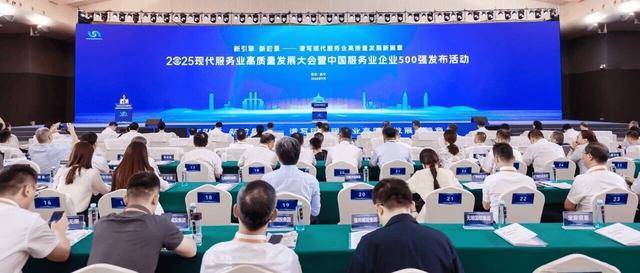
Core Insights - The "2025 China Service Industry Top 500" list was released, with Mashang Consumer being recognized for the seventh consecutive year, highlighting its operational quality and technological strength [1][4][8] - The service industry is identified as China's largest sector and a key driver of economic development, with the list serving as a benchmark for assessing corporate strength [3][4] - The rise of modern service sectors such as internet and information technology services, finance, logistics, and business services is noted as a significant trend [3][4] Company Performance - Mashang Consumer has integrated digital inclusive finance into the broader economic framework, contributing over 10 billion in taxes and serving more than 220 million users [5][6] - The company has established a research team of over 3,400 members, accounting for more than 75% of its workforce, and has applied for over 2,700 invention patents [5][6] - The company has facilitated 943 million transactions, driving consumption exceeding 1 trillion [6] Social Responsibility - Mashang Consumer has initiated projects like "Smart Breeding" to support rural revitalization, generating over 15 million in additional income for farmers and creating over 1,600 jobs [7] - The company launched a free job assistance platform, "Yili Job," benefiting 670,000 users [7] - The introduction of the personal carbon account "Mashang Oasis" has engaged over 5.78 million users, promoting carbon reduction of over 8.33 million tons [7] Industry Outlook - The event emphasized the importance of large enterprises in leading the growth of modern service industries and the need for innovation to enhance the "China Service" brand [7] - Mashang Consumer aims to solidify its technological foundation and expand its service offerings in alignment with national goals for high-quality development in the service sector [8]
周红波主持召开企业和科研院所座谈会
Nan Jing Ri Bao· 2025-09-16 01:42
Group 1 - The meeting focused on gathering opinions and suggestions for the "14th Five-Year Plan" from various enterprises and research institutions in Nanjing, emphasizing the importance of integrating technological and industrial innovation [1] - Companies such as Nanjing Steel Group, Huichuan Technology, and ZTE Communications provided insights on accelerating the intelligent transformation of traditional industries and developing a third-generation semiconductor industry cluster [1] - Recommendations included increasing investment in industrial robot research and application, promoting the integration of artificial intelligence with the real economy, and enhancing the international logistics hub capabilities of Nanjing [1][2] Group 2 - The city leadership highlighted the role of enterprises and research institutions as key drivers of new productive forces and local economic development [2] - The "14th Five-Year Plan" period is seen as crucial for achieving socialist modernization and enhancing the scale and capability of Nanjing's economy [2] - There is a focus on optimizing the innovation ecosystem and attracting high-end resources and talent to Nanjing for shared development opportunities [2]