
结构性货币政策

Search documents
国泰君安期货商品研究晨报:黑色系列-20260119
Guo Tai Jun An Qi Huo· 2026-01-19 01:39
Report Industry Investment Rating No relevant content provided. Core Viewpoints of the Report - Iron ore: High valuation, exercise caution when chasing long positions [2][4] - Rebar: Fluctuate repeatedly [2][6] - Hot-rolled coil: Fluctuate repeatedly [2][6] - Ferrosilicon: Raw material costs are loosening, with wide fluctuations [2][11] - Silicomanganese: Demand is slightly tightening, with wide fluctuations [2][11] - Coke: Disturbed by downstream accidents, oscillate at high levels [2][15] - Coking coal: Oscillate at high levels [2][15] - Steam coal: Supply-demand contradiction is not prominent, short-term prices will adjust within a narrow range [2][19] - Logs: Fluctuate repeatedly [2][20] Summary by Relevant Catalogs Iron Ore - **Fundamental Tracking**: The closing price of the futures contract I2605 was 812.0 yuan/ton, down 1.0 yuan/ton or -0.12%. The positions decreased by 3,540 hands. Among spot prices, the price of PB ore (61.5%) dropped by 1.0 yuan/ton to 819.0 yuan/ton. The basis for I2605 against Super Special decreased by 0.1 yuan/ton to 93.5 yuan/ton [4]. - **Macro and Industry News**: On January 15, the central bank decided to cut the rediscount rate by 0.25 percentage points starting from January 19 [4]. - **Trend Intensity**: 0 [4] Rebar and Hot-rolled Coil - **Fundamental Tracking**: The closing prices of RB2605 and HC2605 were 3,163 yuan/ton and 3,315 yuan/ton respectively, up 2 yuan/ton (0.06%) and 11 yuan/ton (0.33%). The positions of RB2605 and HC2605 increased by 70,217 hands and 66,309 hands respectively. Among spot prices, the price of rebar in Shanghai increased by 10 yuan/ton to 3,300 yuan/ton, and the price of hot-rolled coil in Shanghai increased by 20 yuan/ton to 3,300 yuan/ton [6]. - **Macro and Industry News**: According to the weekly data from Steel Union on January 15, rebar production decreased by 0.74 tons, hot-rolled coil production increased by 2.85 tons, and the total production of five major varieties increased by 0.62 tons. Total inventory of rebar decreased by 0.04 tons, hot-rolled coil decreased by 5.8 tons, and the total inventory of five major varieties decreased by 6.91 tons. Apparent demand for rebar increased by 14.44 tons, hot-rolled coil increased by 5.55 tons, and the total increased by 27.5 tons. In December 2025, China imported 51.7 million tons of steel, a month-on-month increase of 2.1 million tons or 4.2%. The average price was 1,810.3 US dollars/ton, a month-on-month increase of 179.0 US dollars/ton or 11.0%. From January to December, the cumulative import of steel was 6.059 billion tons, a year-on-year decrease of 756,000 tons or 11.1% [6][8]. - **Trend Intensity**: Rebar and hot-rolled coil both have a trend intensity of 0 [6][8] Ferrosilicon and Silicomanganese - **Fundamental Tracking**: The closing prices of ferrosilicon 2603 and 2605 were 5,570 yuan/ton and 5,566 yuan/ton respectively, down 40 yuan/ton and 30 yuan/ton. The closing prices of silicomanganese 2603 and 2605 were 5,828 yuan/ton and 5,866 yuan/ton respectively, down 42 yuan/ton and 32 yuan/ton. Among spot prices, the price of ferrosilicon FeSi75 - B in Inner Mongolia decreased by 30 yuan/ton to 5,320 yuan/ton, and the price of manganese ore Mn44 decreased by 0.2 yuan/ton to 43.3 yuan/ton [11]. - **Macro and Industry News**: As of January 16, the inventory of manganese ore in Tianjin Port was 3.1465 million tons, a month-on-month increase of 31,000 tons; the inventory in Qinzhou Port was 1.0449 million tons, a month-on-month increase of 22,000 tons; the total inventory of manganese ore was 4.2014 million tons, a month-on-month increase of 13,000 tons. A large steel group in Hebei increased its procurement of silicomanganese in January by 2,300 tons compared to December 2025, with the final price set at 5,920 yuan/ton, a 150 yuan/ton increase from December 2025 [12][14]. - **Trend Intensity**: Ferrosilicon and silicomanganese both have a trend intensity of 0 [14] Coke and Coking Coal - **Fundamental Tracking**: The closing prices of JM2605 and J2605 were 1,171 yuan/ton and 1,717 yuan/ton respectively, down 16.5 yuan/ton (-1.4%) and 28 yuan/ton (-1.6%). Among spot prices, the price of Linfen low-sulfur main coking coal remained unchanged at 1,620 yuan/ton, and the price of Hebei quasi - dry quenched coke remained unchanged at 1,525 yuan/ton [15]. - **Macro and Industry News**: On January 16, the CCI metallurgical coal index showed that the price of CCI Shanxi low-sulfur main coking coal remained unchanged. Due to heavy rainfall and floods in Australia, some coal mines issued force majeure notices, and the supply of Australian coking coal tightened, with the price of Goonyella coal rising by 10 US dollars to FOB 231 US dollars [15]. - **Trend Intensity**: Coke and coking coal both have a trend intensity of 0 [18] Steam Coal - **Fundamental Tracking**: No specific fundamental data provided in the text. - **Macro and Industry News**: In December 2025, China imported 58.597 million tons of coal, a year-on-year increase of 11.94% and a month-on-month increase of 33.01%. The PPI in December 2025 had a year-on-year decrease of 1.9%, with the decline narrowing, and a month-on-month increase of 0.20%, with the increase expanding. The CPI had a year-on-year increase of 0.8%, with the increase expanding, and a month-on-month increase of 0.20%, turning positive. There were rumors about the withdrawal arrangement of coal production capacity for power coal supply guarantee [19]. - **Trend Intensity**: No relevant content provided. Logs - **Fundamental Tracking**: The closing price of the 2603 contract was 778.5 yuan/ton, down 0.3%. The trading volume decreased by 0.4%, and the positions increased by 0.3%. Among spot prices, the price of 3.9 - meter 30 + radiata pine in the Shandong market remained unchanged at 740 yuan/cubic meter [21]. - **Macro and Industry News**: China's RatingDog composite PMI in December 2025 was 51.3, indicating further growth in the total production and operation volume of Chinese enterprises at the end of 2025 [23]. - **Trend Intensity**: 0 [23]
东吴证券晨会纪要2026-01-19-20260119
Soochow Securities· 2026-01-18 23:37
Macro Strategy - The report indicates that structural "targeted interest rate cuts" have been implemented, and there is still room for "reserve requirement ratio (RRR) cuts and interest rate cuts" in 2026, especially if the RMB exchange rate and bank net interest margins remain stable [1][2][9] - It is expected that monetary policy in 2026 will be adjusted based on economic and financial conditions, with specific timing to be determined through comprehensive assessment [2][9] Fixed Income and Industry Analysis Industry Overview: Spandex - As of January 15, 2026, the price of spandex in China is 23,000 yuan/ton, with a price difference of 10,864 yuan/ton, indicating a high price percentile since 2018 [3][5] - The spandex industry is nearing the end of capacity expansion, and the elimination of outdated capacity is expected to improve industry conditions [3] - By the end of 2025, China's spandex capacity is projected to be 1.44 million tons/year, with an industry operating rate of 85% [3] - The industry concentration is high, with the top five companies holding 84% of the market share, indicating a significant head effect [3] - Demand for spandex is expected to grow rapidly, with a CAGR of 11% from 2017 to 2024, driven by its applications in textiles and hygiene products [5] Company Analysis: Huafeng Chemical - Huafeng Chemical is expected to maintain a spandex capacity of 400,000 tons/year by the end of 2025, with an additional 75,000 tons/year capacity expected to be gradually put into production by the end of 2026 [5] - The company is positioned to benefit from the anticipated improvement in industry conditions due to capacity elimination and increasing demand [5] Company Analysis: Xinxing Chemical Fiber - Xinxing Chemical Fiber is projected to have a spandex capacity of 220,000 tons/year by the end of 2025, with plans for an additional 100,000 tons/year capacity, with the first phase expected to start construction in Q1 2026 [5] - The company is also expected to benefit from the industry's recovery as outdated capacities are phased out [5] Company Analysis: Taihe New Materials - Taihe New Materials is expected to have a spandex capacity of 100,000 tons/year by the end of 2025, contributing to the overall industry capacity and benefiting from the anticipated demand growth [5]
碳酸锂期货先扬后抑 旺季临近生猪震荡偏强|期货周报
2 1 Shi Ji Jing Ji Bao Dao· 2026-01-18 23:31
Commodity Market Overview - The commodity market showed mixed performance during the week of January 12 to January 16, with the base metals sector leading gains while the black metals sector declined [1] - Energy and chemical sectors saw slight increases, with fuel rising by 0.32% and crude oil by 1.22% [1] - The black metals sector experienced declines, with coking coal down 2.05%, coke down 1.77%, and iron ore down 0.31% [1] - The base metals sector saw lithium carbonate increase by 1.94%, zinc up 3.06%, and nickel up 1.62% [1] - Precious metals also gained, with gold up 2.57% and silver up 20.03% [1] - Agricultural products showed mixed results, with eggs up 1.05% and live pigs up 1.78%, while soybean meal fell by 2.12% [1] Lithium Market Dynamics - Lithium carbonate futures experienced volatility, initially rising by 17% before a significant drop, closing the week at 146,200 yuan/ton after hitting a limit down [2][3] - Supply remained slightly increased, with domestic lithium carbonate production at 22,605 tons for the week, a 0.3% increase [2] - Demand remained strong despite seasonal trends, with December sales of new energy vehicles reaching 1.71 million units, a 28% year-on-year increase [2] Pig Market Trends - The pig futures market showed a strong upward trend ahead of the Spring Festival, with the main contract rising by 1.78% to 11,950 yuan/ton [4] - The average price of live pigs increased by 0.31 yuan/kg, reflecting a synchronized rise in both futures and spot markets [4] - Supply remained low, with stable breeding sow inventory at 39.9 million heads, indicating a normal holding level [4] Export Growth Insights - December exports increased by 6.6% year-on-year, reaching 357.78 billion USD, supported by strong performance in non-US markets and high-end manufacturing [6] - The growth was driven by significant increases in automotive exports, which rose by 71.7% due to tariff adjustments and demand recovery in consumer electronics [6][7] - The overall export structure is shifting towards a focus on high-tech and machinery products, with labor-intensive products continuing to decline [7][8] Financial Data and Corporate Financing - In December, new social financing totaled 2.21 trillion yuan, with a year-on-year growth of 8.3%, indicating a recovery in corporate financing [9][10] - The increase in corporate loans was notable, with 1.07 trillion yuan added, reflecting strong financing demand from enterprises [10][11] - The People's Bank of China introduced structural monetary policy tools to support targeted sectors, indicating a shift towards more focused financial support rather than broad monetary easing [12]
结构性货币政策加码——政策周观察第64期
一瑜中的· 2026-01-18 14:59
Core Viewpoint - The article emphasizes the importance of anti-corruption measures and structural monetary policies in China, highlighting the need for strict political discipline and the promotion of economic growth through targeted financial support [2][3][4]. Group 1: Anti-Corruption Focus - The Central Commission for Discipline Inspection (CCDI) meeting underscored the need for strict adherence to political and election discipline, aiming to eliminate individuals with dual loyalties and inconsistent actions [2][9]. - Key sectors targeted for corruption eradication include finance, state-owned enterprises, energy, education, and public bidding, with a focus on new forms of corruption and hidden issues [2][14]. Group 2: Monetary Policy Adjustments - The People's Bank of China announced a 0.25 percentage point reduction in various structural monetary policy tool rates, aiming to support small and private enterprises [3][15]. - New measures include increasing the quota for agricultural and small enterprise loans by 500 billion yuan and establishing a separate quota of 1 trillion yuan for private enterprise loans [15][16]. Group 3: Financial and Capital Market Developments - The National Financial Regulatory Administration emphasized the need to improve the quality of small financial institutions and regulate industry order, while the China Securities Regulatory Commission focused on enhancing market monitoring and preventing excessive speculation [4][17]. - The minimum margin requirement for financing on three exchanges was raised from 80% to 100%, indicating a tightening of market conditions [4][11]. Group 4: Industry Initiatives - The Ministry of Industry and Information Technology outlined plans for the development of the new energy vehicle sector, including the acceleration of solid-state battery technology and advanced autonomous driving [4][12]. - A plan for the high-quality development of industrial internet platforms was introduced, aiming for over 450 influential platforms and a connection of more than 120 million industrial devices by 2028 [4][12]. Group 5: National Reserve Law - The National Development and Reform Commission released a draft for the National Reserve Security Law, which includes provisions for the storage of essential agricultural products, energy, and emergency supplies [5][19].


【策略周报】理性降温,景气度仍是避风港
华宝财富魔方· 2026-01-18 12:14
Important Events Review - On January 14, the China Securities Regulatory Commission approved an adjustment to the financing margin ratio for the Shanghai and Shenzhen Stock Exchanges, increasing the minimum financing margin ratio from 80% to 100% for new financing contracts. This adjustment aims to reduce leverage levels and protect investors' rights, promoting long-term market stability [2] - On January 15, the People's Bank of China introduced eight structural monetary policy measures, including a 0.25 percentage point reduction in the interest rates of various structural monetary policy tools and an expansion of the total quota for these tools by approximately 1.1 trillion yuan [2] - On January 15, the People's Bank of China released the 2025 financial statistics report, indicating that the total social financing scale increased by 35.6 trillion yuan for the year, which is 3.34 trillion yuan more than the previous year. As of the end of December, the broad money (M2) balance was 340.29 trillion yuan, reflecting an 8.5% year-on-year growth, while the narrow money (M1) balance was 115.51 trillion yuan, showing a 3.8% year-on-year increase [2]

大消费行业周报:细分赛道出现分化-20260118
Ping An Securities· 2026-01-18 12:06
Investment Rating - The industry investment rating is "stronger than the market," indicating an expected performance that exceeds the market by more than 5% within the next six months [25]. Core Insights - The report highlights a divergence in the performance of various segments within the consumer sector, with a stable overall market performance but most sub-sectors underperforming compared to the broader market [4][6]. - There is an expectation for consumer demand to improve ahead of the Lunar New Year, driven by sufficient market liquidity [4]. - The tourism sector is showing potential for growth, with leading companies responding effectively to changing consumer demands [4]. - The beauty industry is experiencing steady growth, with a focus on companies that adapt quickly to market dynamics [4]. - The food and beverage sector is seeing a recovery in supply-demand relationships, particularly in dairy products, while the restaurant supply chain is stabilizing [4]. - In the liquor segment, leading companies are expected to maintain market share despite recent profit adjustments [4]. Market Performance Review - The Shanghai Composite Index fell by 0.57% during the week of January 12-16, with the media sector rising by 3.34% while other sectors like food and beverage and agriculture saw declines of 2.03% and 3.49% respectively [6][8]. Social Services - The report emphasizes the importance of companies that actively respond to changes in consumer demand, particularly in tourism and beauty sectors [4]. Industry Dynamics - The People's Bank of China has introduced measures to enhance structural monetary policy support, which may positively impact consumer spending and economic recovery [10]. - The Philippines has announced visa-free entry for Chinese citizens, which could boost tourism [11]. Company Announcements - Companies like Giant Biological and Proya are making strategic moves, such as product approvals and share buybacks, indicating proactive management in response to market conditions [13][19]. - The report notes significant developments in the liquor industry, including the launch of premium products and partnerships for promotional events [20].

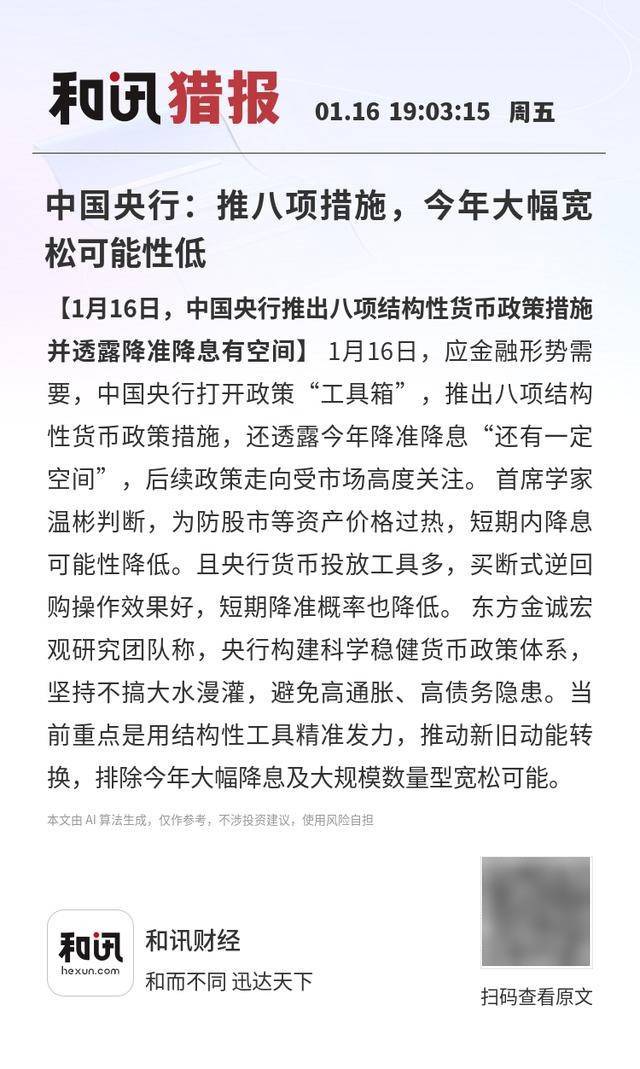
中国央行:推八项措施,今年大幅宽松可能性低
Sou Hu Cai Jing· 2026-01-17 18:28
【1月16日,中国央行推出八项结构性货币政策措施并透露降准降息有空间】1月16日,应金融形势需 要,中国央行打开政策"工具箱",推出八项结构性货币政策措施,还透露今年降准降息"还有一定空 间",后续政策走向受市场高度关注。首席学家温彬判断,为防股市等资产价格过热,短期内降息可能 性降低。且央行货币投放工具多,买断式逆回购操作效果好,短期降准概率也降低。东方金诚宏观研究 团队称,央行构建科学稳健货币政策体系,坚持不搞大水漫灌,避免高通胀、高债务隐患。当前重点是 用结构性工具精准发力,推动新旧动能转换,排除今年大幅降息及大规模数量型宽松可能。 For hexun.com 本文由 AI算法生成,仅作参考,不涉投资建议,使用风险自担 和讯财经 和而不同 迅达天下 扫码查看原文 ...
25年12月金融数据:存款搬家进行到哪一步了?
Ping An Securities· 2026-01-17 11:06
Group 1: Financial Data Overview - In December 2025, new social financing (社融) amounted to 22,075 billion RMB, a year-on-year decrease of 6,462 billion RMB, but higher than the market expectation of 18,200 billion RMB[2] - New RMB loans totaled 9,100 billion RMB, a year-on-year decrease of 800 billion RMB, exceeding market expectations by 2,306 billion RMB[2] - The overall social financing growth rate fell to 8.3%, down 0.2 percentage points from November's 8.5%[3] Group 2: Credit and Loan Trends - Corporate loans increased by 5,800 billion RMB year-on-year, with short-term loans up by 3,900 billion RMB and medium to long-term loans up by 2,900 billion RMB[4] - In contrast, household short-term loans decreased by 1,611 billion RMB and medium to long-term loans decreased by 2,900 billion RMB, indicating a slowdown in consumer spending[4] - The total amount of corporate medium to long-term loans in December was 3,300 billion RMB, close to levels seen in 2021 but lower than the 10,000 billion RMB levels of 2022-2023[4] Group 3: Deposit and Monetary Trends - M1 growth rate fell to 3.8%, down 1.1 percentage points, while M2 growth rate rose to 8.5%[5] - Non-bank deposits saw a significant increase of 28,400 billion RMB, while household deposits increased by 3,900 billion RMB[6] - The increase in non-bank deposits was influenced by a low base effect from the previous year and a rise in wealth management products, which grew by 21,000 billion RMB in December[6] Group 4: Market Implications and Strategies - The trend of "deposit migration" is accelerating, with indicators showing increased household deposit activity and a shift towards wealth management and insurance products[7] - The stock market showed signs of recovery in January 2026, with increased retail investor participation and a high level of margin financing[7] - The bond market is expected to maintain a volatile pattern, with potential for structural monetary policy adjustments and a focus on credit growth in the first quarter[9]
央广财评|结构性货币政策“降价加量” 精准滴灌实体经济
Yang Guang Wang· 2026-01-17 08:17
Group 1 - The People's Bank of China has introduced a monetary policy package aimed at supporting the real economy, particularly in key areas and weak links, to ensure a strong start for the 14th Five-Year Plan [1][2] - The policy includes a reduction in the interest rates of various structural monetary policy tools, with the one-year re-lending rate decreased from 1.5% to 1.25%, which is expected to lower financing costs and stimulate credit growth in priority sectors [1] - The new measures will increase the re-lending quota for technological innovation and technological transformation to 1.2 trillion yuan, and an additional 500 billion yuan will be allocated for supporting agriculture and small enterprises, addressing funding gaps in these critical areas [1] Group 2 - The policy also expands the scope of structural tools to include dedicated re-lending for private enterprises and high R&D investment private SMEs, enhancing financial support for these sectors and fostering a more vibrant market for economic transformation [2] - New support areas include carbon reduction financing tools and re-lending for consumer services and elderly care, aligning with China's goals for green transformation and boosting domestic demand [2] - The targeted approach of the policy aims to lower financing costs while directing financial resources towards high-quality development, thereby enhancing the effectiveness of financial services for the real economy [2]
北大光华刘俏:更大力度推动“反内卷” 大力支持企业出海
Zheng Quan Shi Bao Wang· 2026-01-17 04:40
Group 1 - The core viewpoint is that China will implement a resident income increase plan during the "14th Five-Year Plan" period, focusing on enhancing property income and consumer willingness and capacity [1] - The current fiscal policy space allows for an expansionary approach, with suggestions to increase central government debt to support both "investment in goods" and "investment in people" [1] - Recommendations include innovative policy tools to change marginal consumption tendencies, such as issuing consumption vouchers and increasing rural pension standards [1] Group 2 - The recent announcement by the central bank to lower re-lending and rediscount rates by 0.25 percentage points is expected to help repair residents' balance sheets [2] - Structural "rate cuts" can lower financing costs for small and micro enterprises, which account for over 80% of employment, thereby promoting business expansion and increasing employment demand [2] - The push for "anti-involution" policies and support for enterprises going abroad can improve corporate profits and income distribution, ultimately enhancing consumer spending [2] Group 3 - Suggestions to stabilize and recover the real estate market include a new model that utilizes social capital, involving a tripartite reform of housing provident funds, rental housing, and REITs [3] - The establishment of a "real estate mother fund" with participation from market institutions and financial institutions is proposed to facilitate rental housing construction and acquisition [3] - The aim is to create a closed-loop financing model that includes development, nurturing, exit, and redevelopment of rental housing [3]