
行业集中度提升

Search documents
大参林(603233):头部连锁药房,立足华南翼展全国
Guoxin Securities· 2025-11-18 13:58
Investment Rating - The report assigns an "Outperform" rating for the company [6] Core Views - The company has shown impressive profit growth in the first three quarters of 2025, with revenue reaching 20.068 billion yuan, a year-on-year increase of 1.7%, and net profit attributable to shareholders of 1.081 billion yuan, up 26.0% [1][9] - The company is expanding its market presence across China, leveraging a combination of self-built stores, franchises, and acquisitions, establishing a leading position in the industry [3][78] - The company is expected to achieve revenue of 27.205 billion yuan in 2025, with a projected growth rate of 2.7% [3][101] Financial Performance - In the first three quarters of 2025, the company's sales expense ratio decreased to 21.8%, while the net profit margin improved to 5.8% [2][17] - The gross profit margin for the retail business was 37.7%, reflecting a 0.4 percentage point increase [2][17] - The company anticipates a steady increase in revenue and profit over the next few years, with net profit expected to reach 1.208 billion yuan in 2025, a growth of 32.0% [3][101] Business Model and Strategy - The company operates a diversified business model that includes direct retail, franchise operations, and distribution, focusing on high-margin products [41][90] - The company has developed a robust supply chain and logistics system to enhance operational efficiency and customer service [41][88] - The franchise model is becoming a significant growth driver, with the number of franchise stores increasing substantially [82][86] Market Position and Expansion - The company has established a strong presence in South China and is expanding into other regions, including the Yangtze River Delta and Northeast China [3][78] - As of the end of Q3 2025, the company had a total of 17,385 stores, with a significant proportion being franchise stores [28][80] - The company is well-positioned to capitalize on the ongoing transformation in the pharmacy industry, which is shifting from rapid expansion to deeper integration [3][44] Future Outlook - The company is expected to benefit from structural growth opportunities in the pharmacy sector, driven by trends such as prescription drug outflow and the professionalization of retail endpoints [3][60] - The projected revenue for 2026 and 2027 is 30.071 billion yuan and 33.363 billion yuan, respectively, indicating a positive growth trajectory [3][101]

东方雨虹20251113
2025-11-14 03:48
Summary of the Conference Call for Dongfang Yuhong Industry Overview - The price war in the industry is easing, and the real estate market is stabilizing, leading to potential growth opportunities for Dongfang Yuhong [2][4] - New regulations implemented in 2023 have raised waterproofing standards, benefiting high-quality companies like Dongfang Yuhong [2] Company Performance and Strategy - Dongfang Yuhong has expanded its market share due to the exit of small and medium enterprises, resulting in increased industry concentration [2][4] - The company has raised prices multiple times despite weak demand, positively impacting gross margins and indicating an improving industry trend [2][5] - The strategic focus has shifted from infrastructure to real estate companies, establishing partnerships with major firms like Vanke and implementing a partner system and equity incentives [2][4] - The company is transitioning from reliance on direct sales to developing channel and retail businesses, with retail channel revenue increasing to 36% and engineering channel revenue decreasing to below 48% [2][9] Financial Performance - In the first three quarters of 2025, revenue was approximately 20.6 billion, a 5% year-on-year decline, while net profit attributable to shareholders dropped by 37% to 800 million [11] - The decline in profit is attributed to overall revenue drop, pricing pressure, and cost structure adjustments, although operating cash flow improved significantly to 1.42 billion [11] - The company expects net profits for 2025, 2026, and 2027 to be 970 million, 1.49 billion, and 2.01 billion respectively, with anticipated stability in the real estate market aiding performance [3][12] Product Revenue Breakdown - In 2024, revenue from waterproof membranes is expected to account for 42%, coatings for 31%, and mortar powder for 15%, with non-waterproof business revenue increasing significantly [10] Challenges and Opportunities - The company faces challenges in cash collection, particularly in the real estate sector, but has made strategic adjustments to mitigate these issues [8] - The competitive landscape is shifting, with stronger companies like Dongfang Yuhong gaining more market share as weaker players exit the market [4][6] Conclusion - Dongfang Yuhong is well-positioned to capitalize on the improving market conditions and regulatory changes, with a strategic focus on enhancing its retail and channel business while managing cash flow and profitability effectively [2][12]

招商证券:供需态势显著改观 湿法隔膜价格进入上行通道
智通财经网· 2025-11-13 07:51
Core Viewpoint - The wet separator industry is experiencing a price rebound despite historically low profitability, with major companies operating at full capacity and limited expansion plans [1][2]. Group 1: Price Trends - Wet separator prices have entered an upward trend, with the top three manufacturers operating at full capacity and dry separator utilization rates around 70-80% [1]. - Prices for 7 and 9μm wet separators have significantly increased, with base film prices rising by 0.07 yuan per square meter since August, and coated film prices increasing by 0.10 yuan per square meter [1]. Group 2: Capital Expenditure and Capacity Release - The industry is facing historical low profitability, with major players like Enjie and Xingyuan reporting losses in Q2 and Q3 of 2025 [2]. - Capital expenditure in the industry has been declining since 2023, with no new lithium battery separator capacity plans announced by listed companies in 2024 [2]. - A consensus has been reached in the industry to avoid blind expansion, with separator expansion cycles taking 1.5 to 2 years, leading to limited effective supply release in the future [2]. Group 3: Industry Concentration and Product Development - The concentration of the separator industry continues to rise, with the CR4 exceeding 70% in the first half of 2025, an increase from 2024 [3]. - There is a growing demand for 5μm ultra-thin high-strength separators due to requirements from energy storage and fast charging applications, which are expected to gain market share rapidly [3]. - Leading companies are developing the next generation of coated separators, enhancing product performance and cost advantages, which may further increase industry concentration [3].

黄金大消息!最新解读来了
中国基金报· 2025-11-10 02:46
Core Viewpoint - The new tax policy for gold aims to reshape the industry ecosystem, promote the maturity and internationalization of the gold market, and enhance market transparency and compliance [2][9][10]. Group 1: Background and Impact of the New Tax Policy - The new tax policy is a response to the increasing investment enthusiasm in gold, driven by rising gold prices, and aims to address accumulated tax issues within the gold industry [9]. - The policy encourages trading around exchanges, strengthens the position of member units, and aims to eliminate non-compliant small enterprises, thereby enhancing overall market efficiency [9][10]. - The long-term effect of the policy is expected to attract more compliant capital into the market, supporting healthy growth in the gold market [9][10]. Group 2: Specific Provisions and Their Effects on the Industry Chain - The new policy introduces three main provisions: adjustments to input tax deduction ratios, detailed rules for invoice issuance, and differential treatment between member and non-member units, leading to differentiated impacts on the industry chain [13][15]. - Upstream mining companies are largely unaffected, while member units enjoy more tax deductions on investment gold, allowing them to expand and consolidate their market position [13][18]. - Non-member units may face increased costs and compliance pressures, potentially leading to a market exit for some non-compliant enterprises [16][20]. Group 3: Changes in Different Segments of the Gold Sector - The new policy is expected to benefit leading mining companies, as they will not face additional tax burdens, while processing and retail segments may see increased market concentration towards larger companies [18][20]. - Retail companies that are members of the exchange may experience increased tax costs, but their core competitiveness in product and service quality will help maintain stable profits [18][20]. - The policy is likely to lead to price increases for gold jewelry, as companies may pass on cost pressures to consumers [16][20]. Group 4: Compliance and Transparency in the Industry - The new policy is designed to close long-standing tax loopholes and promote fair taxation, thereby increasing market transparency and compliance [11][22]. - The elimination of "offshore tax evasion" practices is expected to enhance the competitive advantage of compliant enterprises, leading to a more transparent and stable market environment [22][23]. - The policy is anticipated to improve the profitability and market share of quality enterprises, as the competitive landscape shifts towards product and channel strength [22][23]. Group 5: Attraction of Gold ETFs - Gold ETFs and other financial derivatives are expected to gain attractiveness due to their tax advantages, as they are not affected by the new VAT adjustments [26][30]. - Ordinary investors may find the appeal of physical gold investments declining, while gold ETFs will become more attractive due to lower investment thresholds and operational simplicity [26][30]. - The new policy is likely to lead to increased inflows into gold ETFs, helping investors balance convenience and tax burdens [26][30]. Group 6: Future Price Trends of Gold - The long-term outlook for gold prices remains positive, supported by factors such as inflation, central bank policies, and geopolitical tensions [30][32]. - Short-term fluctuations may occur, but the structural demand for gold, particularly from emerging market central banks, is expected to provide solid support for prices [32][30]. - The anticipated monetary easing in the coming years is likely to benefit gold assets, making significant declines in gold prices unlikely [32][30].


实探水贝黄金市场:买卖价差扩至超百元
第一财经· 2025-11-06 12:45
Core Viewpoint - The recent adjustment in gold tax policy has led to significant market disruptions, particularly in the Shenzhen gold market, resulting in increased price volatility and a widening gap between purchase and recovery prices [3][4][9]. Pricing Chaos - The gold pricing in the Shenzhen market is currently experiencing a "temporary chaos," with prices fluctuating rapidly. For instance, the price per gram rose from approximately 989 CNY to 993 CNY within a single day, including a tax component of about 70 CNY per gram [5][6]. - The gap between buying and selling prices has expanded to over 100 CNY per gram, compared to just 27 CNY six months ago [6][9]. Market Reaction - Despite a busy market, actual purchases have decreased significantly, with many consumers opting to wait and see due to the sudden price hikes. Only essential buyers, such as those preparing for weddings, are making purchases [9][12]. - The "one-price" gold products, which have smaller price adjustments and appeal to younger consumers, are gaining popularity as gifts [9]. Tax Policy Impact - The recent tax policy changes, effective from November 1, have led to increased costs for non-member jewelry brands, as their input tax deduction rates have decreased from 13% to 6%, resulting in higher VAT payments and potential profit pressure [11][12]. - The gold market's supply chain involves raw material suppliers, gold manufacturers, and retailers, with the tax burden now affecting the entire chain [12][13]. Long-term Industry Outlook - Analysts predict that non-member jewelry companies will face increased profit pressures in the short term, while member companies may be less affected. Over time, the industry is expected to consolidate, with brands that can set prices showing greater resilience [16]. - The policy aims to streamline transactions and reduce capital occupation, which could lead to increased industry concentration and improved operational efficiency in the gold jewelry sector [16].

国金证券:黄金增值税管理变动 关注具备定价能力的头部品牌
智通财经网· 2025-11-04 03:50
Core Insights - The report from Guojin Securities indicates that non-member jewelry enterprises face increased profit pressure in the short term, while member enterprises of the Shanghai Gold Exchange are relatively less affected. In the long term, industry concentration is expected to increase, with brands possessing pricing power showing stronger performance resilience [1][2]. Group 1: Policy Changes and Impacts - Starting from November 1, 2025, a differentiated VAT management system will be implemented for standard gold transactions through the Shanghai Gold and Futures Exchanges, exempting the selling party from VAT during the transaction phase [1]. - The new policy allows for "immediate collection and refund" for investment gold used for investment purposes, while non-investment gold will be exempt from VAT and can be taxed at a 6% deduction rate [1][3]. Group 2: Market Dynamics - The shift in tax policy is expected to lead to a significant decline in non-exchange investment gold demand, benefiting top-tier enterprises with membership in the Shanghai Gold Exchange, such as Caibai Co., China Gold, and Lao Feng Xiang [2]. - Non-member jewelry brands, which rely heavily on member suppliers for raw materials, will face increased VAT burdens, leading to short-term profit pressure. However, the long-term outlook suggests that demand concentration may boost sales for leading enterprises as smaller firms exit the market [3]. Group 3: Investment Opportunities - Companies with Shanghai Gold Exchange membership and investment gold operations are likely to benefit from the trend towards market concentration [1]. - Jewelry enterprises with a growing proportion of fixed-price gold products and stable high-end customer bases may present short-term investment opportunities due to potential market corrections [1].

黄金珠宝行业行业点评:黄金增值税管理变动,关注具备定价能力的头部品牌
SINOLINK SECURITIES· 2025-11-03 15:33
Investment Rating - The industry is rated as "Buy" with an expectation of an increase exceeding 15% over the next 3-6 months [5] Core Insights - The new tax policy effective from November 1, 2025, will eliminate tax arbitrage for investment gold sales, leading to a concentration of demand towards leading enterprises with membership in the Shanghai Gold Exchange [2][3] - Non-investment gold jewelry sales enterprises will face short-term profit pressure due to changes in tax policies, but long-term benefits are expected for industry leaders with pricing power [2][3] - The shift in tax policy is anticipated to improve cash flow for larger jewelry enterprises while putting pressure on smaller firms, potentially leading to market consolidation [3] Summary by Sections Event Background - Starting from November 1, 2025, a differentiated VAT management system will be implemented for standard gold transactions through the Shanghai Gold and Futures Exchange, with specific tax exemptions and requirements for different types of transactions [1] Industry Impact - Investment gold sales enterprises will see a shift in demand towards top-tier companies due to the elimination of tax arbitrage, benefiting firms like Cai Bai, China Gold, and Lao Feng Xiang [2] - Non-investment gold jewelry firms will experience increased VAT burdens, leading to short-term profit pressures, while larger firms with pricing power may benefit in the long run [2][3] Investment Recommendations - Short-term profit pressures are expected for non-member jewelry enterprises, while member enterprises of the Shanghai Gold Exchange are likely to be less affected. Long-term, the industry concentration is expected to increase, favoring brands with pricing power [3] - Recommended to focus on member enterprises engaged in investment gold business and those with a growing proportion of fixed-price gold products, such as Lao Pu Gold and Chao Hong Ji [3]
沪指再度站上4000点,聚焦A股优质龙头的中证A500ETF(560510)红盘震荡,配置机遇备受关注
Xin Lang Cai Jing· 2025-10-29 05:24
Group 1 - The core viewpoint of the news highlights the positive performance of the CSI A500 ETF and its underlying index, indicating a favorable market sentiment driven by policy support and economic recovery [1][2] - The CSI A500 ETF (560510) has seen a 0.43% increase, with a trading volume of 31.2188 million yuan, while the CSI A500 Index (000510) rose by 0.55% [1] - Notable individual stock performances include Fangda Carbon (600516) up by 10.04%, China XD Electric (601179) up by 9.99%, and Hainan Airport (600515) up by 9.64%, reflecting strong sectoral movements [1] Group 2 - The announcement of a quarterly mandatory dividend for the CSI A500 ETF, with a distribution of 0.1250 yuan per 10 fund shares, enhances cash flow planning for investors [1] - The Central Committee's Fourth Plenary Session report is seen as beneficial for A-shares, particularly in technology, manufacturing, and consumer sectors, suggesting potential for unexpected policy support [2] - The CSI A500 Index is characterized by its strong market representation and higher coverage of emerging sectors, making it a valuable tool for capturing core strengths in various industries during economic transformation [2]
茅台新掌门首秀!白酒板块估值处十年低位,布局良机或现?
Xin Lang Ji Jin· 2025-10-29 02:20
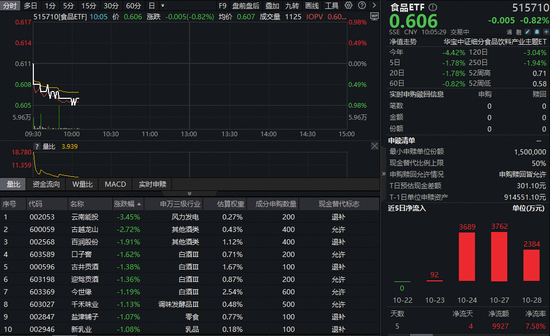
Group 1 - The food and beverage sector continues to weaken, with the Food ETF (515710) experiencing a decline of 0.82% as of the latest report, reflecting a broader downturn in the sector [1][3] - Key stocks in the sector, particularly liquor companies, are underperforming, with notable declines in shares such as Gu Yue Long Shan, which fell over 2%, and others like Kouzi Jiao and Gujing Gong Jiu, which dropped more than 1% [1][3] - The new chairman of Moutai, Chen Hua, emphasized the importance of "open sharing" and internationalization during his first public appearance, indicating a strategic direction for the company to enhance its global market presence [3][4] Group 2 - Analysts suggest that the current valuation of the food and beverage sector is at a low point, with the Food ETF's underlying index PE ratio at 20.08, which is in the 5.28% percentile of the last decade, indicating a potential opportunity for long-term investment [3][4] - The outlook for the sector is improving, with expectations of recovery in the restaurant supply chain and positive signals from the supply side, such as increased mergers among leading companies, which may enhance industry concentration [4][5] - The Food ETF (515710) is strategically positioned, with approximately 60% of its holdings in high-end and mid-range liquor stocks, and nearly 40% in other beverage and dairy segments, making it a core asset for investors in the food and beverage sector [5][6]

广发证券:纺织制造板块行业集中度有望进一步提升
Zheng Quan Shi Bao Wang· 2025-10-28 00:49
Core Viewpoint - The report from GF Securities suggests a positive outlook for the textile manufacturing sector, highlighting companies expected to exceed third-quarter performance, benefit from rising wool prices, and experience inventory appreciation, as well as a recovery in downstream orders [1] Group 1: Short-term Recommendations - Companies with third-quarter performance expected to exceed forecasts should be closely monitored [1] - Focus on companies benefiting from the significant increase in wool prices and inventory appreciation [1] Group 2: Mid-term Recommendations - Companies experiencing a recovery in downstream orders should be considered for investment [1] - Emphasis on companies with traditional business recovery and high growth in new consumer sectors with substantial future development potential [1] Group 3: Long-term Recommendations - Attention should be given to leading companies within the sector, as the impact of "reciprocal tariffs" on these companies is limited [1] - The industry concentration is expected to increase, supporting the long-term stable growth of leading companies [1]
