
智能化

Search documents
中国除湿机行业调研简报:市场洞察:从工业控湿到家居防潮,除湿机如何适配全场景高湿难题?
Tou Bao Yan Jiu Yuan· 2026-01-20 12:24
Investment Rating - The report does not explicitly state an investment rating for the industry Core Insights - The dehumidifier market has evolved from a single-function device to a diverse product that addresses various air quality needs, with significant growth in applications across multiple sectors [2][7] - The household dehumidifier segment dominates the market, accounting for over 80% of total sales, driven by consumer demand for improved living conditions, especially in high-humidity regions of southern China [7] - The industrial dehumidifier market is also growing, particularly in sectors like new energy, pharmaceuticals, and data centers, despite a smaller overall market size [7] Summary by Relevant Sections Dehumidifier Types and Applications - Compression condensation dehumidifiers are the mainstream technology for home and commercial use, suitable for typical indoor environments [2] - Desiccant wheel dehumidifiers are used in specialized environments like laboratories and archives, where humidity control is critical [3] - Household dehumidifiers focus on comfort and convenience, often featuring additional functions like air purification [4] - Commercial dehumidifiers are designed for durability and can service multiple areas, suitable for larger spaces like offices and hotels [5] - Industrial dehumidifiers are essential for maintaining optimal humidity in production environments, characterized by high stability and corrosion resistance [6] Market Demand and Regional Differences - In 2024, China's domestic and export markets for household dehumidifiers are projected to reach 1.526 million and 10.953 million units, respectively, with growth rates of 27.7% and 39.7% [11][14] - The export market is significantly larger than the domestic market, driven by differences in consumer habits and climate conditions [11] - The domestic market shows a clear regional disparity, with southern and eastern China accounting for over 50% of total sales due to their humid climate [12][16] Impact of Lithium Battery Production - The expansion of lithium battery production is expected to increase demand for high-performance industrial dehumidifiers, as strict humidity control is critical in battery manufacturing processes [19][20] - The shift towards larger, centralized production lines necessitates more efficient and customized dehumidification solutions [20] Pharmaceutical Industry Trends - The pharmaceutical sector's growth will drive demand for high-precision, energy-efficient, and multifunctional dehumidifiers, as strict humidity control is essential for drug quality and safety [26][27] - The report highlights the increasing importance of humidity control standards in pharmaceutical production, with specific requirements for various processes [30]
行业洞察 | 新能源装备制造产业城市竞争力TOP50揭晓:苏州问鼎,长三角集群领跑
Zhong Guo Jin Rong Xin Xi Wang· 2026-01-20 11:40
Core Insights - The Chinese new energy equipment manufacturing industry is transitioning from resource development to high-end manufacturing under the "dual carbon" strategy [2] - The "2025 China New Energy Equipment Manufacturing Industry City Competitiveness TOP 50" list was released, ranking cities based on six core dimensions and over 60 indicators [2] - Suzhou, Jiangsu Province, topped the list with a score of 87.71, followed closely by Shenzhen (87.63) and Changzhou (87.47) [2] Industry Overview - The list highlights a new industrial pattern characterized by "Yangtze River Delta cluster leadership and multi-polar collaborative breakthroughs" [2] - The East China region is a key player in the new energy equipment manufacturing industry, with cities from the Yangtze River Delta accounting for about half of the top 50 [12] City Rankings - The top ten cities in the new energy equipment manufacturing sector include: 1. Suzhou, Jiangsu 2. Shenzhen, Guangdong 3. Changzhou, Jiangsu 4. Wuxi, Jiangsu 5. Shanghai 6. Ningde, Fujian 7. Ningbo, Zhejiang 8. Beijing 9. Hefei, Anhui 10. Nantong, Jiangsu [8][12] Suzhou's Competitive Edge - Suzhou's success is attributed to its "full-chain layout" and "supporting advantages," with a comprehensive new energy industry system covering solar, energy storage, power batteries, wind power, smart grids, hydrogen energy, and green low-carbon + new energy vehicles [12] - The city aims to exceed 1 trillion yuan in new energy industry output by 2026, establishing itself as a fourth trillion-level industrial cluster [12] - Suzhou ranks first in "enterprise aggregation" (91.51) and "development effectiveness" (88.98) [12] Other Notable Cities - Changzhou is recognized as the "capital of new energy," with a significant share of national power battery production [13] - Wuxi focuses on a modern industrial cluster strategy, while Shanghai leads in high-end equipment with strong research and financial capabilities [13] - Shenzhen, as the only non-Yangtze River Delta city in the top three, excels in innovation with a score of 89.24 in the "innovation momentum" category [14] Future Trends - The industry is expected to shift towards green manufacturing, lifecycle carbon management, and deep integration of intelligence and digitalization [15] - The competition will evolve from production capacity to standards, green practices, and intelligence [16] - Cities that enhance core technology, optimize industrial ecosystems, and expand global markets will gain a competitive advantage in the future [16]


智启厨房新未来:浙江美大2026年会发布AI新品,共筑智慧生态新标杆
Quan Jing Wang· 2026-01-20 11:09
Core Insights - Zhejiang Meida is initiating a profound strategic restructuring in response to the ongoing challenges in the integrated stove industry, emphasizing the need to embrace change and develop new models for sustainable growth [1] Group 1: Market Challenges - The integrated stove market is experiencing significant challenges, with retail sales in Q1 2025 dropping to 2.5 billion yuan, a year-on-year decline of 34.5%, and average prices falling from 12,000 yuan to 8,000 yuan [1] - The traditional smoke stove market is expected to see a temporary boost due to national subsidy policies in 2025, but will face demand exhaustion thereafter [1] Group 2: Strategic Initiatives - The annual meeting serves as a declaration of Zhejiang Meida's strategic transformation, focusing on smart and ecological solutions to address market challenges [2] - The launch of the "AI Meida" design software aims to enhance terminal sales through rapid design capabilities and interactive experiences, marking a significant step in the company's smart kitchen ecosystem [2] Group 3: Investment and Policy Alignment - Zhejiang Meida's investment of approximately 110 million yuan in autonomous driving technology company MoVision, acquiring about 4.87% equity, aligns with national policies promoting structural optimization in the kitchen appliance industry [3] - The company's strategy is in line with the national directive to enhance the adaptability of consumer goods supply and demand, emphasizing innovation and the development of smart home solutions [3] Group 4: Industry Evolution - The kitchen appliance industry is shifting from single-category competition to cross-domain ecological competition, with smart technology recognized as the future [4] - The global integrated smart kitchen market is projected to grow from 3.1 billion USD in 2025 to 17.6 billion USD by 2031, with a compound annual growth rate of 31.5% [4] Group 5: Future Direction - Zhejiang Meida is transitioning from a product manufacturer to a smart home solution provider, aiming to create a diversified product matrix that integrates smart kitchen appliances with whole-home customization [4] - The company is focused on building an internal smart kitchen ecosystem while exploring external technological collaborations and growth opportunities [5]

乘用车行业点评报告:1月车市正值淡季,关注高端化、智能化主线
CAITONG SECURITIES· 2026-01-20 10:35
Investment Rating - The industry investment rating is "Positive" (maintained) [1][8] Core Insights - In January 2026, the passenger car market and the new energy vehicle market showed weak performance due to market policies. According to the China Passenger Car Association, retail sales of passenger cars from January 1 to 11 were 328,000 units, down 32% year-on-year and 42% month-on-month; among these, new energy vehicle retail sales were 117,000 units, down 38% year-on-year and 67% month-on-month, with a penetration rate of 35.5% for new energy vehicles [4] - The decline in sales is attributed to policies falling short of expectations. The reduction in purchase tax exemptions and the proportional subsidies have increased costs for mid-to-low-end vehicles, leading to a stronger consumer wait-and-see sentiment. This has resulted in a shift back to traditional fuel vehicles, and the anticipated demand release in January did not materialize [4] - The weakening demand for passenger cars is not necessarily negative, as it allows for clearer visibility of the competitive landscape in the mid-to-low-end market. The current market is characterized by a high preference for cost-effectiveness, and the focus remains on the new car cycle, with expectations for a surge in new car launches around the Beijing Auto Show in late April [4] Summary by Sections Market Performance - The passenger car market is currently in a seasonal downturn, with a significant drop in sales figures for both traditional and new energy vehicles [4] Investment Recommendations - The report suggests maintaining the existing strategy for the automotive sector, focusing on: 1. **High-end Market**: Recommend companies with a strong brand and clear competitive advantages, such as Jianghuai Automobile and Xiaomi Group, while paying attention to the new car cycle of BAIC Blue Valley [4] 2. **Intelligent Vehicles**: Highlighting the importance of smart technology in the automotive sector, with a core recommendation for XPeng Motors [4] 3. **Overseas Expansion**: While acknowledging the long process of overseas expansion, BYD is recommended for its potential contributions from international markets [4]
中孚实业发预增,预计2025年度归母净利润同比增加120.27%—141.59%
Zhi Tong Cai Jing· 2026-01-20 09:10
报告期内,公司以"绿色化、数字化、智能化"为方向,持续开展降本增盈和管理提升等相关工作。公司 本期业绩增长主要系电解铝业务成本下降及销售价格上涨影响。 中孚实业(600595)(600595.SH)发布2025年年度业绩预增公告,预计2025年年度实现归属于母公司所 有者的净利润为15.50亿元—17.00亿元,与上年同期相比,将增加8.46亿元到9.96亿元,同比增加 120.27%—141.59%。 ...

2025,谁笑到最后?这8家车企销量超百万!特斯拉排第十
Nan Fang Du Shi Bao· 2026-01-20 08:47
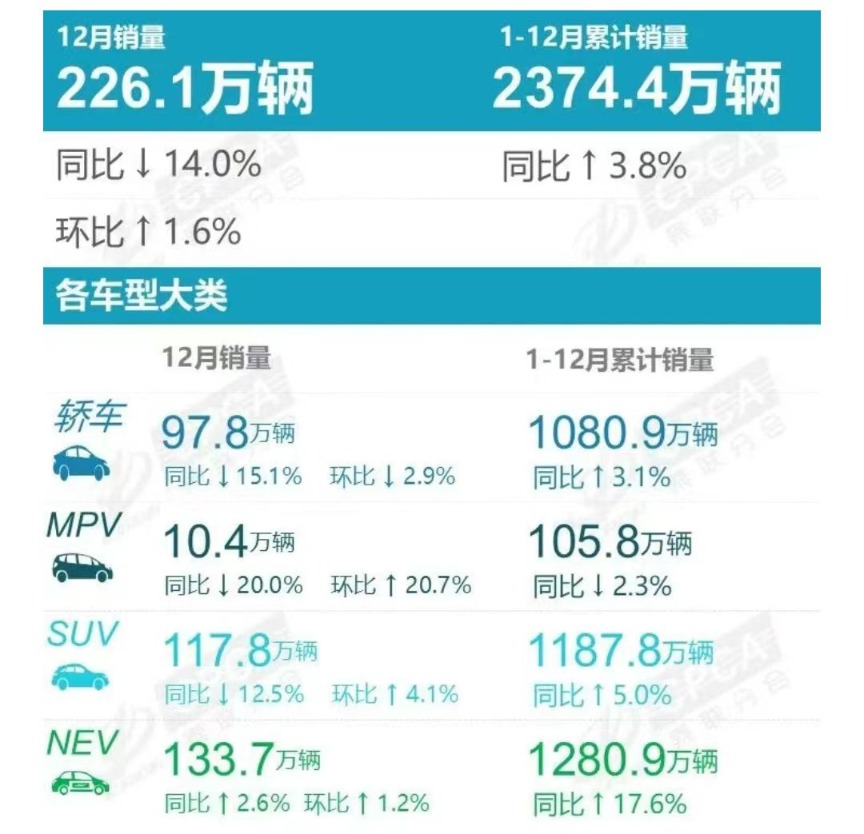
Core Insights - The automotive market in 2025 has seen a shift in competitive dynamics, with domestic brands leveraging their electric vehicle (EV) advantages to dominate the market, significantly squeezing the space for joint venture brands [1][3] - The focus of competition is evolving from mere sales and electrification to intelligence, globalization, and high-quality growth [1] - BYD remains the market leader, but its domestic retail sales have declined, while its international sales have surged, maintaining a significant lead overall [1][7] Sales Performance - In 2025, total vehicle sales reached 23.744 million units, a year-on-year increase of 3.8%, with new energy vehicles (NEVs) accounting for 12.809 million units, up 17.6% [3] - The sales breakdown shows that sedan sales were 10.809 million units (up 3.1%), SUV sales were 11.878 million units (up 5%), and MPV sales were 1.058 million units (down 2.3%) [3] - BYD's retail sales were 3.485 million units, down 6.3%, while its wholesale sales reached 4.545 million units, up 6.9%, with exports exceeding 1 million units, doubling from the previous year [7][8] Competitive Landscape - The top ten automotive manufacturers in terms of sales include BYD, Geely, Chery, and Changan, with Geely showing the most significant growth at 39% [8][10] - Geely's retail sales reached 1.688 million units, marking an 81.3% increase, making it the only other company besides BYD to exceed 1 million units in NEV sales [9][10] - Tesla has fallen out of the top three in NEV sales, ranking fifth, with a 4.8% decline in domestic sales [11][13] Export Growth - In 2025, automotive exports reached 7.098 million units, a 21.1% increase, with passenger car exports at 6.038 million units, up 21.9% [16] - BYD led the industry with 1.05 million units of NEV exports, while SAIC Group followed with 950,000 units, maintaining a strong presence in ASEAN and South American markets [16][15] - Geely's exports doubled to 420,000 units, showcasing significant growth in Southeast Asia [16]




登顶3000万辆之后,一汽-大众在中国发展迎转型考验
Zhong Guo Qi Che Bao Wang· 2026-01-20 08:11
Core Insights - FAW-Volkswagen achieved total vehicle sales of 1,587,065 units in 2025, maintaining its position as the top-selling automaker and leading in fuel vehicle sales, although this figure is significantly lower than its peak sales of over 2 million units in 2018 [1] - The company faces challenges in the rapidly growing electric vehicle (EV) market, as its EV sales have declined sharply despite the overall market growth [2][3] Group 1: Sales Performance - FAW-Volkswagen's fuel vehicle market share increased by 0.9 percentage points year-on-year, reaching a historical high, but the reliance on traditional fuel vehicles poses risks as the market shifts towards EVs [1] - In contrast to the strong performance of fuel vehicles, the sales of its EV models, such as the ID.4, have seen significant declines, with ID.4 sales dropping by 39.4% year-on-year [2][3] Group 2: Challenges in EV Transition - The company has struggled with its EV transition, as evidenced by the poor sales performance of its ID series, which contrasts sharply with the strong sales of its fuel vehicle models [3] - The rapid technological advancements in the EV sector and the shift towards software-defined vehicles have made it difficult for traditional automakers like FAW-Volkswagen to keep pace with market demands [3] Group 3: Smart Technology and Innovation - FAW-Volkswagen has launched the "Oil-Electric Intelligence" strategy to enhance the smart features of its traditional fuel vehicles, but it still lags behind newer EV brands in terms of smart technology [4][5] - The company has introduced advanced driving assistance systems, but most of its models remain at Level 2 automation, while competitors are achieving higher levels of automation [5] Group 4: Management Changes and Strategic Direction - The company has undergone significant management changes, with two leadership transitions within a year, raising concerns about the continuity of its strategic direction [6][8] - New leadership is expected to address the challenges of transitioning to smart and electric vehicles, as well as adapting to the evolving automotive market in China [8] Group 5: Dealer Network and Market Adaptation - FAW-Volkswagen has a vast dealer network, but the traditional dealership model is facing pressure from new direct sales models, necessitating a transformation in its marketing approach [8] - The company must navigate the challenges of maintaining dealer profitability while adapting to new automotive sales strategies in a competitive market [8]
财政部:扩展设备更新贷款支持领域,增加航空器材、人工智能等领域
Xin Lang Cai Jing· 2026-01-20 04:33
Core Viewpoint - The Ministry of Finance has issued a notice to optimize the implementation of the financial subsidy policy for equipment renewal loans, expanding the supported sectors significantly [1] Group 1: Expanded Support Areas - The policy now includes additional sectors such as construction and municipal services, energy equipment, aviation materials, electronic information, safety production, facility agriculture, fishing vessels, cold chain facilities, grain and oil processing, waste recycling, small hydropower, commercial facilities, artificial intelligence, and elderly care [1] - The focus is on enhancing support for high-end, intelligent, green, and digital equipment renewal [1]
财通证券:汽车销量走弱来自政策的不及预期 关注高端化智能化主线
智通财经网· 2026-01-20 03:53
Core Viewpoint - The passenger car market and new energy vehicle market are showing weak performance due to market policies, but the overall vehicle sector is believed to have bottomed out after multiple adjustments. The company maintains its existing vehicle strategy and suggests focusing on three structural directions: high-end, intelligent, and overseas expansion [1][3]. Market Performance - From January 1 to 11, 2026, nationwide retail sales of passenger cars reached 328,000 units, representing a year-on-year and month-on-month decline of 32% and 42%, respectively. Among these, new energy vehicle sales were 117,000 units, with a year-on-year and month-on-month drop of 38% and 67%. The penetration rate of new energy vehicles stands at 35.5% [2]. Demand Weakness Analysis - The decline in sales is attributed to policies falling short of expectations. The reduction in purchase tax and the proportional subsidy have increased costs for consumers in the mid-to-low-end market, leading to a stronger wait-and-see sentiment among buyers. This has resulted in a shift back to traditional fuel vehicles, with anticipated demand in January not materializing. The effectiveness of the subsidy policy appears weak at this time [3]. Market Dynamics - Weak demand for passenger cars may not necessarily be negative, as it could clarify the competitive landscape in the mid-to-low-end market. The current market is characterized by a high preference for cost-effectiveness, and the focus remains on the new car cycle. The market is currently in a low season with fewer new car launches, but a wave of new car releases is expected around late April during the Beijing Auto Show [4]. Investment Recommendations - High-end Focus: Given the weak performance in the mid-to-low-end market, the company recommends selecting firms with structural beta and a clear high-end path, such as Jianghuai Automobile and Xiaomi Group, while paying attention to the new car cycle of BAIC Blue Valley [5]. - Intelligent Development: Intelligent technology is seen as a necessary path for the next phase of the automotive industry, with a core recommendation for XPeng Motors, focusing on opportunities related to new valuations [5]. - Overseas Expansion: Although the process of overseas expansion is lengthy, opportunities still exist, with BYD being a key recommendation, particularly regarding its overseas progress and potential profit contributions [5].

构建起全链条能效提升的“晋南路径”——访山西晋南钢铁集团有限公司总裁张天福
Zhong Guo Hua Gong Bao· 2026-01-20 03:04
Core Insights - Jin Nan Steel has successfully passed the "Double Carbon Best Practice Energy Efficiency Benchmark Demonstration Process/Equipment" acceptance, showcasing its leadership in the industry and commitment to energy efficiency and green transformation [1][4] Group 1: Energy Efficiency Achievements - The company invested 1.802 billion yuan, achieving an annual energy saving of 95,600 tons of standard coal and generating direct benefits of 389 million yuan [1] - A total of 56 precise improvement measures were developed through a comprehensive energy efficiency audit, including 39 management initiatives and 17 fixed asset investment projects [2] Group 2: Strategic Implementation - Jin Nan Steel established a dedicated "Extreme Energy Efficiency Promotion Task Force" led by the president to ensure effective implementation of energy efficiency measures [2] - The company employs a full-cycle control mechanism that includes target decomposition, project implementation, accountability, and benefit closure to ensure that investments directly address core energy consumption pain points [2] Group 3: Technological Innovations - The company has implemented various energy-saving technologies across production processes, achieving significant reductions in energy consumption, such as 7.971 kgce/t in the coking process and 8.38 kgce/t in the blast furnace [3] - The establishment of a smart energy station and the application of green equipment have led to an annual electricity saving of 150 million kWh [3] Group 4: Digital and Intelligent Integration - Jin Nan Steel has integrated digital technologies such as big data and AI into energy management, creating a comprehensive smart energy control platform [3][4] - The transition from experience-driven to data-driven energy management has enhanced cross-process collaboration and operational efficiency [4] Group 5: Future Directions - The company aims to continue its focus on high-end, intelligent, and green development, further solidifying its energy efficiency achievements and exploring new pathways for green transformation [4]