
红利资产

Search documents
电子增强组合年初以来超额稳健
Changjiang Securities· 2025-07-13 15:14
- The report introduces several active quantitative strategies launched by the Changjiang Golden Engineering team since July 2023, including the Dividend Selection Strategy and the Industry High Win Rate Strategy[4][12][13] - The report tracks the performance of two dividend portfolios and two electronic portfolios, highlighting their significant excess returns relative to their respective benchmarks since the beginning of the year[4][13][20] - The Dividend Series includes the "Central State-owned Enterprises High Dividend 30 Portfolio" and the "Balanced Dividend 50 Portfolio," while the Industry Enhancement Series focuses on the electronics sector, including the "Electronic Balanced Configuration Enhancement Portfolio" and the "Electronic Sector Preferred Enhancement Portfolio"[13][14][20] - The "Electronic Sector Preferred Enhancement Portfolio" outperformed the electronics industry index by approximately 0.52% on a weekly basis, and since the beginning of 2025, the "Electronic Balanced Configuration Enhancement Portfolio" and the "Electronic Sector Preferred Enhancement Portfolio" have exceeded the electronics industry index by approximately 3.97% and 5.78%, respectively[5][23][30]
当“长钱”有了长周期“指挥棒”,险资投资会走向哪里?
Di Yi Cai Jing· 2025-07-13 11:57
进一步拉长周期考核,显然能够让险资这样的长期资本真正成为更耐心的资本。 随着考核周期的再次拉长,近35万亿元保险资金迎来了更贴合其"长钱"属性的考核指挥棒。在这一政策 导向下,险资投资又将走向哪里? "进一步拉长周期考核,显然能够让我们这样的长期资本真正成为更耐心的资本,这种耐心也表现在能 够更为坚定和持久地贯彻我们的中长期投资战略战术。"一名保险资管负责人对第一财经表示。 业内人士分析称,拉长考核周期无疑有助于险资长钱长投,进一步增加权益投资的配置。而在新会计准 则的施行叠加低利率环境下的"资产荒"背景,险资在权益投资方面预计将提升FVOCI策略(即将更多权 益资产分入"以公允价值计量且变动计入其他综合收益"类资产中),银行股等高股息红利板块是实践这 一策略的重要载体。此外,长周期考核也将强化险资对科技、先进制造等新兴产业的配置能力。 FVOCI策略将提升 7月11日,财政部发布的《关于引导保险资金长期稳健投资 进一步加强国有商业保险公司长周期考核的 通知》(下称《通知》),将国有商业保险公司净资产收益率(ROE)和资本保值增值率的考核进一步 拉长至"当年度指标+三年周期指标+五年周期指标",这较两年前净资 ...
国泰海通证券吴信坤:港股下半年牛市可期 关注四类稀缺性资产
2 1 Shi Ji Jing Ji Bao Dao· 2025-07-11 10:04
Core Viewpoint - The Hong Kong stock market has shown resilience and vitality, with the Hang Seng Index and Hang Seng Tech Index rising by 20% and 18.68% respectively in the first half of 2025, driven by significant inflows of southbound funds [1][2] Group 1: Market Performance - The Hong Kong stock market has outperformed globally, entering a technical bull market, primarily due to the revaluation of Chinese assets and the alignment with the rapid development of AI and consumption upgrades [1][3] - Southbound funds have significantly contributed to the market's strength, with net purchases exceeding 730 billion HKD in the first half of the year, nearly double the amount from the same period last year [1][2] Group 2: Characteristics of Southbound Funds - The inflow of southbound funds has been characterized by explosive growth and structural optimization, with institutional funds accounting for about 70% of the total inflow [2][3] - In the first quarter alone, southbound funds reached a record high of 440 billion HKD, indicating strong institutional interest, particularly from public funds and insurance companies [2][3] Group 3: Investment Opportunities - Four categories of scarce assets in the Hong Kong market are highlighted: AI applications, innovative pharmaceuticals, new consumption, and dividend-paying stocks [3][4] - AI-related assets represent over 60% of the market capitalization in the tech sector, making them a focal point for investment as the sector experiences significant growth [4][5] - New consumption assets also account for approximately 60% of the market capitalization in the consumption sector, reflecting changing consumer preferences [4][5] Group 4: Changing Investment Logic - The investment logic for innovative pharmaceuticals has shifted from being concept-driven to being fundamentally driven, supported by policy enhancements and improved R&D capabilities [5][6] - New consumption trends are evolving from short-term themes to long-term structural opportunities, with a focus on products that resonate with younger consumers [6][7] Group 5: Outlook for the Second Half - The Hong Kong stock market is expected to continue its bull market in the second half of the year, supported by ample liquidity and favorable industry cycles [7] - Key investment areas include scarce assets that are unique to the Hong Kong market and closely aligned with current industry trends, particularly in AI applications and dividend stocks [7]

红利低波ETF(512890)本周整体涨0.66%,成交额25.4亿
Xin Lang Ji Jin· 2025-07-11 08:40
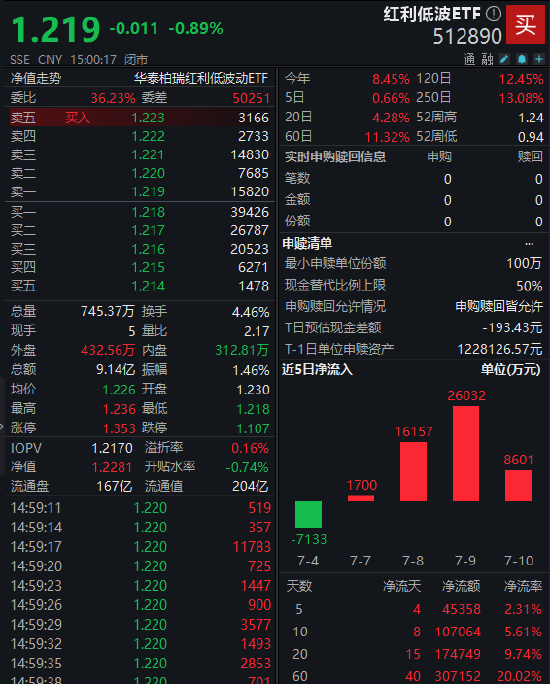
Core Viewpoint - The Reducing Volatility Dividend ETF (512890) has seen significant inflows and growth in fund size, driven by the performance of major banks and a favorable investment environment for dividend assets [1][3]. Fund Performance - On July 11, the Reducing Volatility Dividend ETF (512890) closed down 0.89% with a trading volume of 914 million yuan, while the overall weekly performance was up 0.66% with a total trading volume of 2.54 billion yuan [1]. - The fund has attracted over 520 million yuan in net inflows over four consecutive trading days, reaching a record high in fund size of 20.535 billion yuan as of July 10 [1][3]. Market Context - The banking sector continues to rise, with the stock prices of the four major banks breaking previous highs and setting historical records [1]. - Current dividend assets are considered valuable in a declining interest rate environment, with recommendations to focus on stocks with a dividend yield above 3% and low ROE volatility [1][3]. Fund Characteristics - The Reducing Volatility Dividend ETF (512890) was established on December 19, 2018, and has consistently achieved positive returns every full year since its inception, making it one of the few ETFs in the A-share market with such a track record [3]. - As of June 30, the fund ranked first in its category for five-year returns [3]. Holdings Overview - The fund's top holdings include Chengdu Bank, Yagor, and Shanghai Bank, with significant increases in their respective positions [4]. - The total market value of the top holdings amounts to approximately 3.722 billion yuan, representing 25.19% of the fund's net value [4]. Investment Opportunities - There are opportunities for rebound in sectors that have seen declines of over 4% since the beginning of the year, such as refining trade, white goods, and infrastructure [1]. - Financial stocks are transitioning from being undervalued to becoming a dynamic benchmark, with their low volatility and dividend yields exceeding 6% making them a core investment direction [1].

煤炭行业分析:稳中求胜,红利为锚
Guotou Securities· 2025-07-11 07:35
2025 年 07 月 11 日 煤炭 稳中求胜,红利为锚 年初至 630 煤炭板块涨跌幅-12%,位居行业最末:2025 年上半 年,由于国内供应端以能源保供作为生产目标的方向并未发生改 变,供应充足与下游补库积极性放缓相互叠加使得价格持续缺乏 向上动能,秦港 Q5500 动力煤平仓价从年初的 765 元/吨下跌 150 元/吨至 615 元/吨,持续处于中长期合同合理区间之内,且 3 月 下旬以来持续低于中长期合同价格;2025H1 均价为 678 元/吨, 同比-23%。京唐港主焦煤从年初的 1520 元/吨下跌 290 元/吨至 1230 元/吨,当前位于近五年来最低点;2025H1 均价 1383 元/吨, 同比-39%。现货价格的持续下跌引发投资者对于板块业绩稳定性 的质疑,叠加市场对于煤炭基本面继续供需宽松的一致预期使得 股价持续承压,截至 6 月 30 日,煤炭板块(申万)涨跌幅-12.29%, 跑输沪深 300,并位居申万行业跌幅最末。细分板块看,动力煤 (申万)涨跌幅-10.11% ,焦煤(申万)涨跌幅-19.04%。 迎峰度夏高温来袭,关注三季度电煤需求向上弹性:1)供给: 内产方面,国 ...
盘中重获净流入!中证红利质量ETF(159209)延续强势,7月14日首次分红登记
Sou Hu Cai Jing· 2025-07-11 03:26
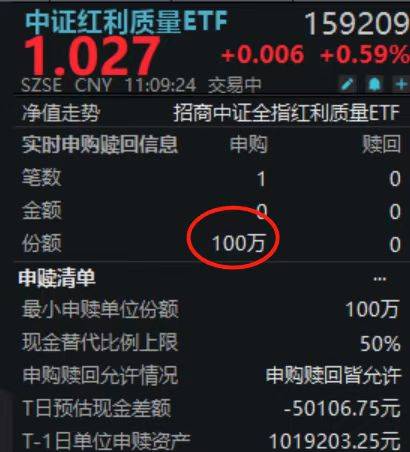
Core Viewpoint - The recent performance of the market indicates a strong interest in dividend assets, with specific ETFs showing positive returns and consistent dividend distributions [1]. Group 1: ETF Performance - The CSI Dividend Quality ETF (159209) increased by 0.59% as of 11:12 AM on July 11, with net inflows observed during the trading session [1]. - The CSI Dividend Quality ETF announced its first dividend distribution of the year, with a payout of 0.003 yuan per share, resulting in a monthly dividend yield of 0.30%, with the record date set for July 14 [1]. - The Hong Kong Dividend Low Volatility ETF (520550) also declared its third dividend distribution of the year, with a payout of 0.004 yuan per share and a monthly dividend yield of 0.35% [1]. Group 2: Market Analysis - Recent data shows that dividend assets have attracted significant capital, driven by a decline in risk-free interest rates, making equity assets more attractive in terms of investment value [1]. - The current equity risk premium (ERP) for A-shares is at a historical high, highlighting the long-term allocation value of dividend assets [1]. - A combination of CSI Dividend and Hong Kong dividend assets can facilitate cross-asset allocation, potentially reducing portfolio volatility over the long term [1]. Group 3: Investment Characteristics - As "dividend-type" assets, ETFs offer low fees and stable, frequent dividend distributions, enhancing the holding experience for long-term investors [1].
中信建投 格局重塑中的宏观经济与资产布局
2025-07-11 01:05
Summary of Key Points from Conference Call Industry and Company Overview - The conference call discusses the macroeconomic landscape in China, focusing on the structural transformation of the economy, the rise of the Southern world, and the emphasis on domestic circulation and manufacturing upgrades [1][2][5]. Core Insights and Arguments 1. **Structural Economic Changes**: China is undergoing a structural transformation characterized by the rise of the Southern world, domestic circulation, and a clear differentiation between new and old industrial structures [1][2]. 2. **"6D" Trends**: The macroeconomic environment is influenced by six trends: de-globalization or regionalization, demographic changes (with post-95s becoming the main consumer force), accelerated digital transformation, persistent debt issues, increasing income inequality, and heightened environmental protection pressures [1][5]. 3. **Global Trade Dynamics**: The global trade landscape is shifting towards "East rising, West declining," with China becoming the largest trading partner for 81 countries and regions in 2023 [1][8]. 4. **Manufacturing Strength**: China has made significant strides in manufacturing, with electricity generation surpassing that of the U.S. and manufacturing value added exceeding that of the U.S. [1][10][11]. 5. **Investment in Human Capital**: The importance of human capital is increasingly recognized, with the government emphasizing investments in areas such as fertility, education, healthcare, and elderly care [4][29]. 6. **Asset Allocation Strategies**: Recommendations for asset allocation include focusing on dividend assets and actively investing in new sectors such as high-end equipment manufacturing, new consumption, humanoid robots, artificial intelligence, and innovative pharmaceuticals [3][34][38]. Additional Important Insights 1. **Challenges in Traditional Industries**: Traditional industries, particularly real estate, are experiencing a downturn, with real estate investment growth remaining negative for three consecutive years [21][22]. 2. **Employment Issues**: Employment challenges are significant, with policies expected to be introduced to address income growth and employment stability [22][19]. 3. **GDP Growth Projections**: China's GDP target for the year is set at 5%, with a strong start in Q1 (5.4% growth) and expectations for continued growth in Q2 [23]. 4. **Service Consumption Trends**: Service consumption is growing faster than traditional goods consumption, reflecting a shift in consumer demand as GDP per capita exceeds $10,000 [24]. 5. **Fiscal Policy Direction**: China's fiscal policy is in an expansionary phase, with increased spending and investment in human capital to stabilize the economy [29][30]. 6. **Reform and Opening Up**: Continued reform and opening up are seen as vital for stabilizing the consumer market and enhancing global influence [31]. This summary encapsulates the key points discussed in the conference call, highlighting the macroeconomic trends, challenges, and strategic recommendations for investment in the Chinese market.

最高涨逾35%,银行股狂欢!公募潜在配置空间巨大
券商中国· 2025-07-10 23:23
Core Viewpoint - The banking sector has shown strong performance in 2023, with major banks' stock prices reaching historical highs and individual bank stocks experiencing significant gains, indicating a favorable investment environment for bank equities [1][4][6]. Group 1: Performance and Trends - As of July 10, 2023, the banking sector has seen individual stock gains exceeding 35% year-to-date, with the banking index rising over 20% [1][4]. - Major banks such as ICBC, Agricultural Bank of China, China Construction Bank, and Bank of China have all recorded increases, contributing to a total market capitalization exceeding 10 trillion [4]. - The ETF linked to banking stocks has also performed well, with an average return of around 20% this year [3][5]. Group 2: Investment Allocation - Public funds have significantly underweighted the banking sector, with active equity funds allocating less than 4% to bank stocks, indicating a potential for increased investment [3][8]. - The theoretical allocation for the banking sector should be around 296.5 billion, suggesting a potential influx of over 200 billion if funds align with performance benchmarks [9][10]. - The current holdings of public funds in bank stocks are low, with the largest holdings concentrated in a few banks, such as China Merchants Bank and Industrial Bank [5][8]. Group 3: Reasons for Growth - The rise in bank stocks is attributed to their attractive valuation, high dividend yield, and defensive characteristics, making them appealing in the current macroeconomic environment [2][6]. - The banking sector is seen as a low-volatility, high-return investment option, especially as the economic landscape stabilizes and policies support growth [6][10]. - Historical comparisons show that banks have outperformed other high-dividend assets, particularly as funds shift from real estate to banking stocks [7][11]. Group 4: Future Outlook - There is an expectation that public funds will increase their allocation to bank stocks, driven by the sector's strong fundamentals and improving asset quality [10][12]. - The banking sector's low correlation with cyclical fluctuations positions it favorably for long-term investment, especially as bad debt ratios improve [11][12]. - The ongoing rebalancing of public fund portfolios is likely to favor bank stocks, enhancing their attractiveness to institutional investors [12].






下一轮超级机会,买什么?
摩尔投研精选· 2025-07-10 10:42
Core Viewpoint - The article highlights the significant rise in bank stocks, particularly the four major banks in China, which have reached historical highs in market capitalization, indicating a strong performance in the banking sector [1] Group 1: Market Trends - The total market capitalization of the four major banks (ICBC, CCB, ABC, and BOC) has surpassed 9 trillion yuan, with ICBC at 2.9 trillion, CCB at 2.6 trillion, ABC at 2.2 trillion, and BOC at 1.9 trillion [1] - There has been a notable increase in the volume of certain thematic stocks, which is becoming a common occurrence, contrasting with previous trends [2] - Many retail investors are experiencing a slow decline in their account balances, akin to "boiling a frog" [3] Group 2: Investment Opportunities - A significant increase in household deposits is projected, with new deposits expected to reach 17.8 trillion, 16.7 trillion, and 14.2 trillion yuan from 2022 to 2024, totaling over 48.8 trillion yuan [4] - In contrast, housing prices have decreased, resulting in a loss of 120 trillion yuan in value [4] - Recent statistics indicate a reduction of 2.46 trillion yuan in household deposits in the first five months of the year, averaging 16 billion yuan withdrawn daily [5] - The introduction of policies requiring large insurance companies to invest 30% of new premiums in A-shares and an increase in stock allocations by social security funds signal a shift towards investment [5] - The decline in deposit interest rates, with major banks leading the way, suggests a clear message to investors to move funds from savings to investments [5] - The performance of dividend-paying assets has been strong, with the CSI Dividend Index constituents distributing over 920 billion yuan in dividends last year, offering a dividend yield of 3.6%, significantly higher than bank interest rates [5] Group 3: Market Indicators - The savings rate is identified as a contrarian indicator for the stock market, with historical peaks in savings rates often preceding bull markets [6][8][9][10] - As of June 2025, the savings rate has dropped to 24%, significantly lower than the historical peak of 18% [11] - The ratio of household deposits to A-share market capitalization is at a historical high, which has previously indicated the onset of bull markets [12] Group 4: Recommendations for Retail Investors - Retail investors are encouraged to transition from a "gambler" mindset to a more informed "investor" approach, focusing on building an independent valuation system [14] - It is advised to allocate 50% of funds to high-dividend blue-chip stocks for defensive positioning, while 40% can be invested in policy-supported technology sectors like semiconductors and AI, with strict stop-loss measures [15] - Utilizing ETFs to diversify risk is recommended, with examples including Hong Kong Dividend ETFs, Bank ETFs, and innovative drug ETFs, which have shown strong performance [15]

红利国企ETF(510720)涨超1.1%,降准背景下红利资产性价比引关注
Sou Hu Cai Jing· 2025-07-10 06:33
Group 1 - BeiGene announced its first positive GAAP operating profit in Q1 2025, with a net profit of $1.27 million, and reaffirmed its full-year revenue guidance of $4.9-5.3 billion, primarily driven by the increase in global market share of its flagship product, Zanubrutinib [1] - TCL Technology forecasted a year-on-year increase of 81%-101% in net profit attributable to shareholders for the first half of 2025, estimating it to be between 1.8 billion to 2 billion yuan [1] - The Shanghai Stock Exchange emphasized the need for listed companies to increase dividend payouts and frequency, as well as to enrich the dividend index product system to enhance market investment value [1] Group 2 - Guosen Securities pointed out that traditional dividend indices are facing a shift from "true dividends" to "pseudo dividends," with the banking, coal, and transportation sectors accounting for 56% of the index, leading to a high concentration of cyclical stocks [1] - Current dividend assets hold allocation value in a broadly declining interest rate environment, with a recommendation to focus on stocks with a dividend yield above 3% and low ROE volatility, particularly in sectors like refining trade, home appliances, and infrastructure that have seen declines of over 4% since the beginning of the year [1] - Bank stocks have undergone a systemic revaluation, transitioning from a "high-yield undervalued area" to a "dynamic benchmark ballast," making them a core allocation direction among dividend assets due to their low volatility and dividend yields exceeding 6% [1] - Resource-related dividends (such as coal and oil) and financial stability dividends (such as operators) with expected dividend yields greater than 4% are also worth exploring [1] Group 3 - The National State-Owned Enterprise Dividend ETF tracks the China Securities State-Owned Enterprise Dividend Index (code: 000824), which selects stable dividend-paying state-owned enterprises from the Shanghai and Shenzhen markets [2] - The index focuses on financially sound and high-dividend-capable state-owned enterprises, covering multiple industries but leaning towards traditional economic sectors to reflect the overall market performance of high-dividend state-owned enterprises [2]