
人民币升值

Search documents
华泰证券:人民币升值或无损出口链表现
Sou Hu Cai Jing· 2025-12-07 23:59
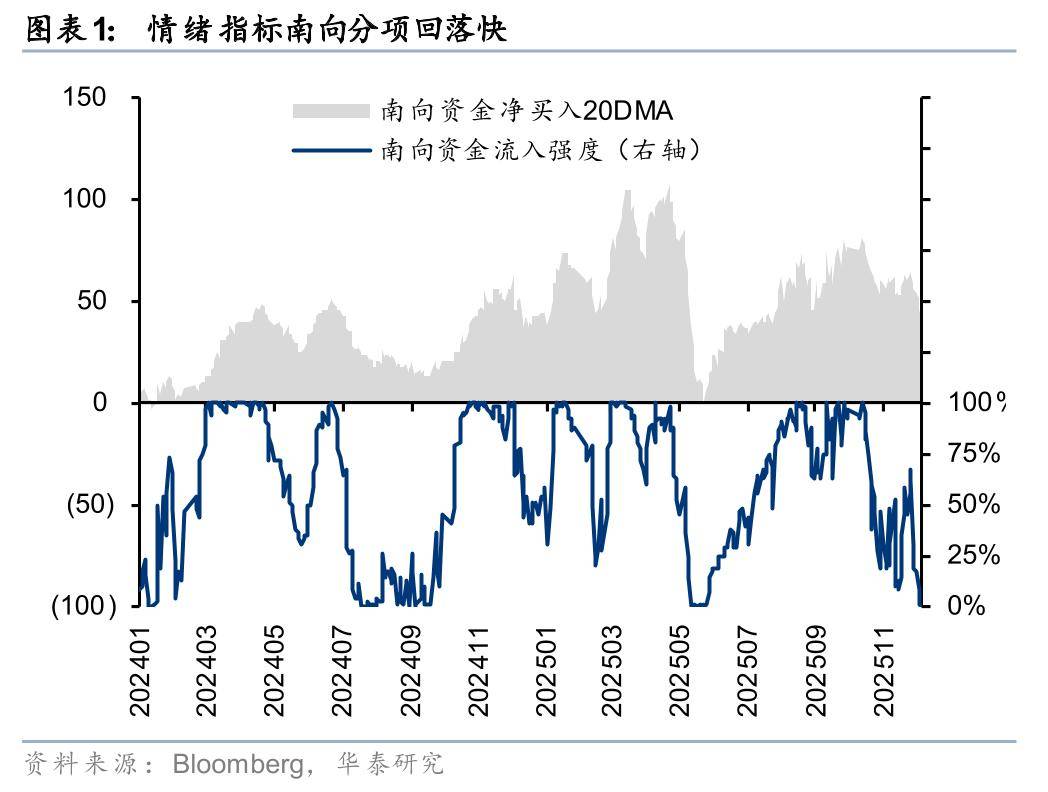
来源:华泰睿思 近期人民币汇率加速升值是国内经济金融数据中的一抹亮色。我们认为汇率升值对出口企业股价造成压力的"常识"并不受数据支持,反而适度升值在本轮 资本流动浪潮、人民币实际有效汇率较低和中外通胀差的存在下有利于企业表现。10月以来市场偏弱的资金面因素主因南向而非外资,港股情绪指标分 项、人民币汇率和EPFR数据均可得到交叉验证。目前我们构建的情绪指标仍在悲观区间摆动,重申港股处在布局区,短期建议关注流动性拐点和此前调 整较多且负面压力逐渐出清的科技和医药,左侧关注大众消费品的α机会,中期(二季度左右)依然维持成长与顺周期的均衡配置观点。 核心观点 汇率升值中出口企业股价承压的"常识"或并非"事实" 我们进一步剥离行业属性来聚焦海外收入差异,发现即便同一行业中,海外收入占比不同企业的表现与汇率走势也无显著相关关系。我们选取了2024年报 中国上市公司中海外收入占比最高的前10大细分行业(包括服饰鞋帽零售、电子、计算机、家电等)共400余样本,按海外收入占比高低将同行业内公司 分成等数量两组样本,并以市值加权形成两个指数。自2015年以来,高海外收入指数跑赢低海外收入指数229%,高低海外收入指数的相对表现 ...


喜娜AI速递:昨夜今晨财经热点要闻|2025年12月8日
Sou Hu Cai Jing· 2025-12-07 22:18
来源:喜娜AI 中信证券研报指出,超预期内需变化出现前,市场震荡和结构性机会轮动是常态。去年"9.24行情"以 来,两轮市场水位抬升均伴随融资规模大增,但剔除这两段,市场多横盘震荡。震荡期上涨板块有限, 债市调整影响股债平衡策略。未来人民币升值压力或带来货币宽松打破震荡。配置上建议关注资源/传 统制造业定价权重估和企业出海方向。详情>> 两部门加强医保支付范围管理,新版药品目录即将执行 12月7日,国家医保局、人力资源社会保障部印发2025年版《国家基本医疗保险、生育保险和工伤保险 药品目录》及《商业健康保险创新药品目录》。要求加强医保支付范围管理,严格落实相关要求,规范 药品使用与支付。新版目录自2026年1月1日起执行,将新增药品纳入,调出药品删除,调整支付范围。 还为未续约药品设6个月过渡期,积极推进新增药品进院和商保目录纳入保障范围。详情>> 美联储议息会议临近,或宣布购债计划 随着12月10日美联储议息会议临近,市场聚焦降息及资产负债表政策。前纽约联储专家Mark Cabana预 测,除降息25个基点外,美联储将宣布每月购买450亿美元国库券计划,至少持续6个月,以填补流动性 缺口。瑞银交易部门也有 ...
把握政策窗口期的投资机会
AVIC Securities· 2025-12-07 13:35
Market Overview - The A-share market is currently in an N-shaped consolidation phase with relatively low trading volume, indicating a wait-and-see approach ahead of policy announcements for the coming year[3] - The China Securities Regulatory Commission has released a draft regulation to enhance market value management, cash dividends, and share buybacks, aiming to improve investment value and investor returns[3] Currency Trends - Since November, the RMB has appreciated against the USD, driven by a stable Sino-US economic environment and year-end settlement demand, with the exchange rate reaching approximately 7.0583[3][10] - The RMB's rapid appreciation may slow down in the short term, but the long-term upward trend remains intact, supported by internal economic adjustments and external monetary policy shifts[10][11] Investment Opportunities - The recent adjustment of risk factors for insurance companies is expected to introduce over 100 billion RMB in potential insurance capital into the market, supporting technology innovation[3] - The report suggests focusing on sectors with marginal catalysts, such as commercial aerospace and robotics, while maintaining a dividend-based investment strategy[4] Foreign Investment Insights - In Q3 2025, the top five sectors favored by northbound capital were power equipment, electronics, pharmaceuticals, banking, and food and beverage, indicating a strong preference for technology sectors[5] - Historical data shows that during the last six rounds of RMB appreciation, the stock market generally performed well, with A-shares and Hong Kong stocks showing significant gains[5][17] Economic Outlook - The upcoming Federal Reserve meeting and China's Central Economic Work Conference are critical events that may influence market sentiment and policy direction[4] - The report highlights that the CDS spread for Chinese sovereign bonds has decreased significantly, reflecting improved perceptions of credit risk and increasing foreign interest in Chinese assets[15]

基金发行回暖,但离“疯牛”还远!人民币狂飙下,聪明钱布局2026
Sou Hu Cai Jing· 2025-12-07 10:21
Group 1 - The market is experiencing a warming trend in fund issuance, indicating a recovery in investor sentiment [1][3] - Compared to previous "bull market" conditions, the current market remains rational, with investors cautiously positioning themselves for more certain opportunities, particularly looking ahead to 2026 [2][10] - The number and scale of newly issued funds have increased significantly in the first 11 months of 2024, with stock funds surpassing bond funds for the first time, reflecting a shift in investor preference towards equities [3][7] Group 2 - Historical patterns suggest that extreme fund issuance can signal market tops, as seen in 2007, 2015, and early 2021, indicating that current fund issuance levels are still far from a frenzy [5][7] - The appreciation of the Renminbi is attracting overseas capital into the Chinese market, benefiting both A-shares and Hong Kong stocks, as it makes local assets more appealing [8][10] - Expectations of further interest rate cuts by the Federal Reserve and potential easing measures from the People's Bank of China could ignite market activity, with a possibility of transitioning from a structural market to a broader bull market by 2026 [10][12] Group 3 - The upcoming year-end period is traditionally a time for increased lending and investment, suggesting that sectors like technology, new energy, and leading consumer stocks may present good opportunities for early positioning [12][13] - The current market phase is characterized as neither a peak of exuberance nor a bottom of despair, but rather a critical moment that tests investor patience and strategy [13]

中信证券:人民币的升值压力可能会带来超预期的货币宽松,这可能是超预期变化的来源
Xin Lang Cai Jing· 2025-12-07 05:40
Core Viewpoint - The continuous improvement of China's manufacturing industry's global pricing power and economic profit share is expected to lead to a sustained appreciation of the Renminbi, with predictions of reaching 6.8 against the US dollar by 2026. To mitigate the potential negative impact of rapid Renminbi appreciation on export-oriented manufacturing, proactive monetary easing is deemed necessary [1]. Group 1: Economic Outlook - The anticipated monetary easing may lower real interest rates and stimulate domestic demand, which is essential for breaking the current market stagnation and achieving further growth by 2026 [1]. - Prior to this, market fluctuations and structural opportunities are expected to be the norm in the A-share market, with a focus on sectors that have global exposure and profit growth potential [1]. Group 2: Sector Recommendations - In the resources and traditional manufacturing sectors, there is optimism for leading companies in industries where China holds a competitive advantage, particularly in non-ferrous metals, chemicals, and new energy, emphasizing the narrative of "supply internalization and external demand for profit" [1]. - Companies expanding overseas remain a crucial avenue for profit and market capitalization growth, as A-shares transition from a domestic emerging market focus to a global mature market perspective, despite the increased resonance with overseas risk assets and economic environments [1]. - From a high-to-low perspective, less crowded sectors such as cinema, securities, aviation, liquor, and hotels, along with direct increment stocks like banks, thermal power, and oil & petrochemicals, are also viable options [1]. - Close attention is advised for policy changes during the upcoming Political Bureau meeting and economic work conference at the end of the year [1].

人民币升值进入加速期:多重逻辑支撑下的资产配置新机遇
Sou Hu Cai Jing· 2025-12-06 09:20
Core Viewpoint - The recent strong performance of the Renminbi (RMB) in the trading market indicates an accelerated appreciation trend, supported by multiple core logics as it progresses through a critical phase of its historical cycle [1]. Group 1: Exchange Rate Trends - The RMB began its accumulation process following the reduction of US-China tariffs in May, entering an appreciation channel with a 2.8% increase against a basket of currencies and a significant 9.4% appreciation against the Japanese Yen [3]. - Despite the recent rebound of the US dollar index from 96.6 to 100.2, the RMB has remained stable, with the offshore RMB showing stronger performance and the gap with the central parity continuing to narrow, signaling a potential acceleration in appreciation [3]. Group 2: Internal Support Factors - From April 2022 to June 2023, the RMB's real effective exchange rate has declined by 19%, and the nominal effective exchange rate has decreased by 7.7%, while China's export share and trade surplus have been rising, indicating a strong demand for valuation recovery [4]. - Since the second quarter, there has been an expansion in the surplus of bank customer foreign exchange settlements, with continuous inflows of northbound capital, and a significant amount of over 500 billion USD in export income remains unconverted, suggesting substantial potential for capital repatriation once exchange rate expectations stabilize [4]. Group 3: Implications for Investors - According to Goldman Sachs, a 1% appreciation of the RMB could enhance returns in the Chinese stock market by approximately 3%, particularly benefiting sectors such as materials, technology, and non-essential consumer goods in H-shares [6]. - The scale of foreign investment in Chinese government bonds has surpassed 3.2 trillion RMB, and the appreciation of the RMB will further increase the attractiveness of RMB-denominated assets [6]. - Investors are advised to focus on industries and assets that benefit from foreign capital inflows and reduced import costs, while also considering hedging strategies for export companies to mitigate exchange rate risks [6].
人民币强势升值,会破7吗?
Sou Hu Cai Jing· 2025-12-06 04:37
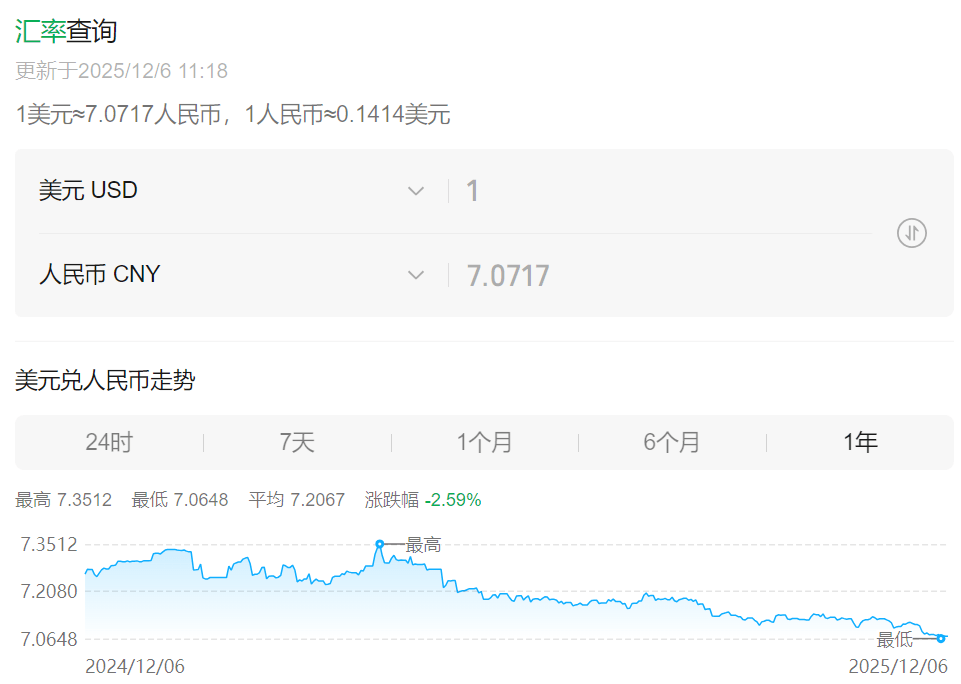
点击【樱桃大房子】关注并 人民币"硬气"了! 今天(12月6日),美元兑人民币汇率报7.0717。近日,在岸和离岸人民币兑美元报价均升破关键点位,尽管短期走势有所波动,但整体趋势显著走强。 人民币这波升值,背后藏着2025年全球经济的大棋局。 今天,我们就来扒一扒,这波升值潮到底意味着什么? 先聊聊人民币为什么强势升值? 从外部因素来讲,美联储主席即将换人+12月降息预期的升温,是推动本轮人民币升值的关键因素。 美国进入降息周期,美元指数持续回落,中美利差持续扩大(下图红色箭头可见),人民币对美元贬值的压力瞬间小了一大截,为人民币对美元升值创造 了空间。 另一方面,美国经济增长放缓和政策上的反复无常,也加速了全球"去美元化"。 巴西、沙特、俄罗斯等资源大国,纷纷开始减少对美元的依赖,增加使用本币或人民币进行贸易结算。人民币在这场货币多元化的浪潮中,正成为重要选 项之一。 最主要的原因肯定还是我国自身,央行在引导人民币升值。 通过观察中间价与市场价的差异可以发现,过去一个多月人民币的中间价一直在即期价下方。这就差直接说:"人民币可以升一升了!" 虽然近日二价合一,央行态度转为中性,但政策导向早已经为升值创造了条 ...
【环球财经】华侨银行:2026年上半年美元料温和走软 人民币有望延续有序升值
Xin Hua Cai Jing· 2025-12-06 04:13
美联储或于2026年一季度重启扩表 新华财经新加坡12月6日电(记者刘春涛) 华侨银行(OCBC)全球市场研究团队近日发布2026年上半 年外汇与利率展望报告。报告指出,随着美联储宽松周期逐步削弱美元的利差优势,预计美元在2026年 将呈现温和走软的态势。同时,预计人民币将在政策引导下继续保持有序升值的步伐。 报告分析了这一政策转变背后的驱动因素:首先,随着中国经济增长模式向内需和服务业倾斜,更强的 人民币有助于支撑购买力;其次,人民币国际化进程需要一个币值稳定且具有信誉的货币;最后,坚挺 的人民币汇率有助于维护金融稳定。 展望2026年,华侨银行预计人民币将继续以温和、受政策引导的方式升值。在利率债方面,报告预计中 国国债(CGB)收益率曲线在2026年上半年大部分时间将保持相对稳定。 看好马币表现新元维持中性偏强 在亚洲货币(除日本外)中,华侨银行表示相对看好马币(MYR)和人民币的表现。报告指出,得益 于国内基本面改善、持续的财政整顿以及人民币走强的锚定效应,马币有望保持坚挺。 对于新元(SGD),报告持"中性至温和走强"的观点。华侨银行认为,未来新元的走势将更多受美元和 人民币动态的影响,而非新加坡金 ...
人民币大涨!人民币升值会让财富大洗牌吗?对普通人有啥影响?
Sou Hu Cai Jing· 2025-12-05 20:32
Core Viewpoint - The recent surge in the offshore RMB against the USD has raised questions about its implications for wealth and purchasing power, with mixed reactions from different sectors of society [1][3]. Group 1: Economic Context - The RMB's rise is attributed to the weakening of the USD as the Federal Reserve has begun to lower interest rates due to economic pressures, leading to a shift in capital towards more attractive assets [3][4]. - China's economic resilience, particularly in manufacturing upgrades and high-value exports like electric vehicles and biomedicine, has strengthened the RMB's position in international markets [4][6]. Group 2: Market Reactions - The appreciation of the RMB has created winners and losers; those holding quality RMB assets, such as real estate and blue-chip stocks, are seeing their wealth increase, while low-end exporters are struggling with reduced profit margins due to the stronger currency [8][10]. - Import businesses benefit from the stronger RMB, allowing them to lower prices or increase inventory without raising costs significantly, thus enhancing profit margins [10]. Group 3: Investment Strategies - Investors are advised to avoid blindly converting to USD, as the RMB's strength may be a long-term trend, making RMB-denominated assets a safer choice [12][14]. - There is a growing interest in domestic investments, particularly in sectors benefiting from the RMB's appreciation, such as aviation and consumer goods, as well as in RMB-denominated bonds [14]. Group 4: Societal Impact - The RMB's rise has improved purchasing power for individuals studying abroad or engaging in international purchases, effectively increasing their disposable income [8][10]. - Conversely, overseas workers earning in USD are feeling the pinch as their remittances convert to less RMB, prompting some to hold onto their foreign currency in hopes of future rate adjustments [12]. Group 5: Long-term Outlook - The appreciation of the RMB signifies a shift away from China's "cheap factory" image towards becoming a global market leader, reflecting the country's growing economic strength [18]. - The stability of the RMB is seen as a positive indicator for the overall economic health of China, suggesting that ordinary citizens' wealth is becoming more robust in the international arena [18].

德意志银行:预计2026年人民币升向6.7-6.8区间
Sou Hu Cai Jing· 2025-12-05 06:29
本文由 AI 算法生成,仅作参考,不涉投资建议,使用风险自担 【12月5日,德意志银行称中国明年或允许人民币兑美元进一步升值】德银报告指出,汇率走强对出口 的影响预计有限。 其预计2026年人民币将升向1美元兑6.7至6.8区间,主要驱动因素有政策推动国际化 进程、贸易结算规模扩大、资本账户逆差收窄及中美利差缩小。 ...