人民币汇率

Search documents
人民币汇率:升破“7”或难持久,2026年底预估7.03
Sou Hu Cai Jing· 2025-12-22 07:40
个问,局盈匹期将末米12个月美元兄人民巾汇举日 标上修至6.85。他的预测也和部分中国学家及前央 行官员呼吁"人民币应走强"立场对比鲜明。 Schenker表示,维持汇率强势会对中国出口商及整 体稳定性产生连锁冲击,因会推高中国商品对外价 格,上月一项关键民间制造业指标大幅下滑已显现 压力。 【12月22日顶尖汇率预测人士:人民币升破"1美元兑7元"涨势难持久】顶尖汇率预测人士指出,人民币 若升破"1美元兑7元"关键关卡,涨势或难持久,原因包括中国制造商承压、外资流入疲弱。Prestige Economics总裁Jason Schenker称,未来约六个月内,人民币有机会短暂跨越该门槛,之后将回吐部分升 幅,预计至2026年底汇价约为1美元兑7.03元。Schenker在今年第三季彭博在岸美元兑人民币汇率分析师 评比中排第一。Schenker已将11月预估的明年底美元兑人民币汇率7.05下修。他还指出,人民币走强对 化解中国贸易紧张局势战略价值有限。Schenker看法与多家全球投资银行偏多预测不同,高盛近期将未 来12个月美元兑人民币汇率目标上修至6.85。他的预测也和部分中国学家及前央行官员呼吁"人民币应 ...

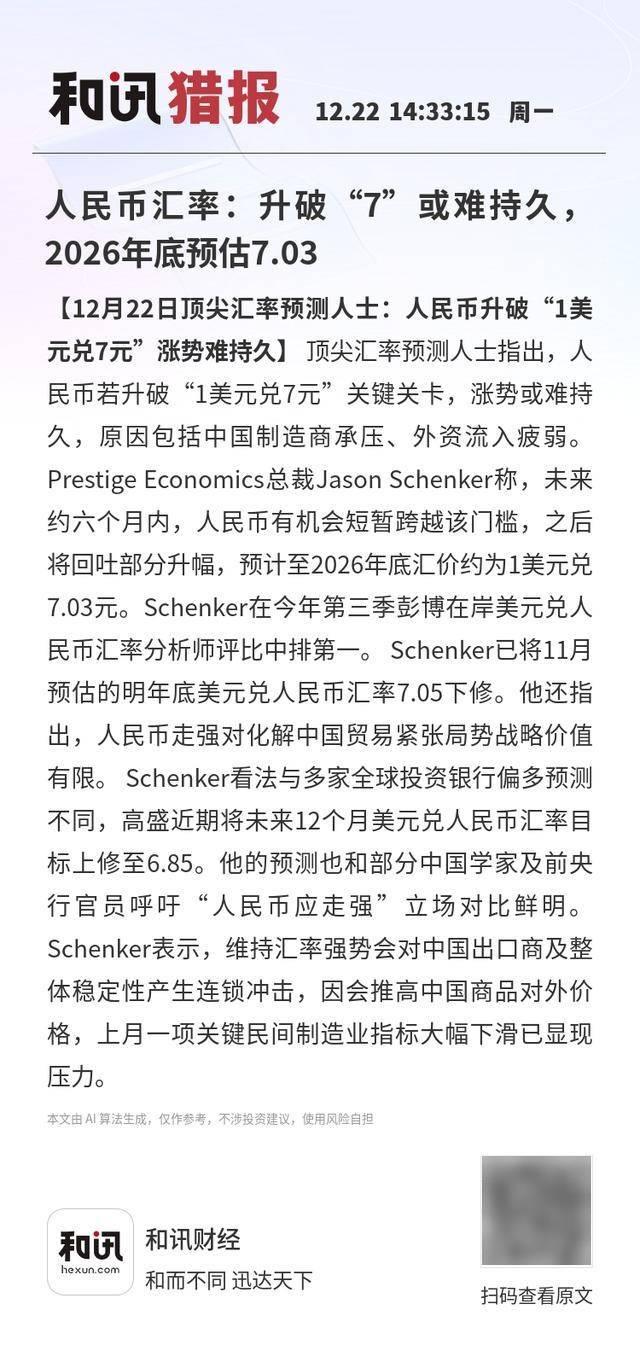
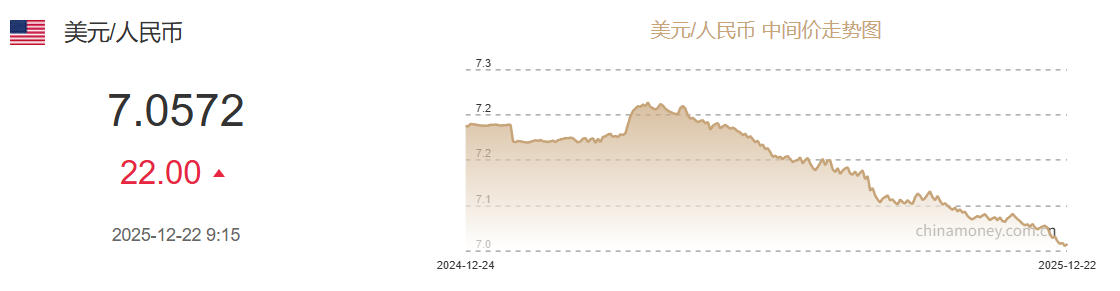
人民币对美元中间价报7.0572 下调22个基点
Zhong Guo Jing Ji Wang· 2025-12-22 02:49
(责任编辑:马欣) 中国经济网北京12月22日讯 来自中国外汇交易中心的数据显示,今日人民币对美元汇率中间价报 7.0572,较前一交易日下调22个基点。 中国人民银行授权中国外汇交易中心公布,2025年12月22日银行间外汇市场人民币汇率中间价为:1美 元对人民币7.0572元,1欧元对人民币8.2531元,100日元对人民币4.4699元,1港元对人民币0.90699元, 1英镑对人民币9.4289元,1澳大利亚元对人民币4.6576元,1新西兰元对人民币4.0553元,1新加坡元对 人民币5.4511元,1瑞士法郎对人民币8.8599元,1加拿大元对人民币5.1071元,人民币1元对1.1356澳门 元,人民币1元对0.57845马来西亚林吉特,人民币1元对11.4240俄罗斯卢布,人民币1元对2.3788南非兰 特,人民币1元对209.77韩元,人民币1元对0.52139阿联酋迪拉姆,人民币1元对0.53246沙特里亚尔,人 民币1元对46.8593匈牙利福林,人民币1元对0.50953波兰兹罗提,人民币1元对0.9052丹麦克朗,人民币 1元对1.3155瑞典克朗,人民币1元对1.4385挪威克朗, ...
12月22日人民币对美元中间价报7.0572 下调22个基点
Zhong Guo Xin Wen Wang· 2025-12-22 02:05
图源:中国外汇交易中心网站截图 本文为转载内容,授权事宜请联系原著作权人 来源:中国新闻网 编辑:郭晋嘉 12月22日人民币对美元中间价报7.0572 下调22个基点 广告等商务合作,请点击这里 中新网12月22日电 据中国外汇交易中心网站消息,中国人民银行授权中国外汇交易中心公布,2025年12月22日银行间外汇市场人民币汇率中间价为:1美元 对人民币7.0572元,下调22个基点。 中新经纬版权所有,未经书面授权,任何单位及个人不得转载、摘编或以其它方式使用。 关注中新经纬微信公众号(微信搜索"中新经纬"或"jwview"),看更多精彩财经资讯。 ...
人民币市场汇价(12月22日)
Xin Hua Wang· 2025-12-22 01:49
新华社北京12月22日电 中国外汇交易中心12月22日受权公布人民币对美元、欧元、日元、港元、英 镑、澳元、新西兰元、新加坡元、瑞士法郎、加元、澳门元、林吉特、卢布、兰特、韩元、迪拉姆、里 亚尔、福林、兹罗提、丹麦克朗、瑞典克朗、挪威克朗、里拉、墨西哥比索及泰铢的市场汇价。 100美元 705.72人民币 100欧元 825.31人民币 100日元 4.4699人民币 100港元 90.699人民币 100英镑 942.89人民币 100澳元 465.76人民币 100新西兰元 405.53人民币 100新加坡元 545.11人民币 100瑞士法郎 885.99人民币 100加元 510.71人民币 100人民币113.56澳门元 100人民币57.845马来西亚林吉特 100人民币1142.4俄罗斯卢布 100人民币237.88南非兰特 100人民币20977韩元 100人民币52.139阿联酋迪拉姆 100人民币53.246沙特里亚尔 100人民币4685.93匈牙利福林 100人民币50.953波兰兹罗提 100人民币90.52丹麦克朗 100人民币131.55瑞典克朗 100人民币143.85挪威克朗 ...
人民币快涨到7了!
Sou Hu Cai Jing· 2025-12-21 23:57
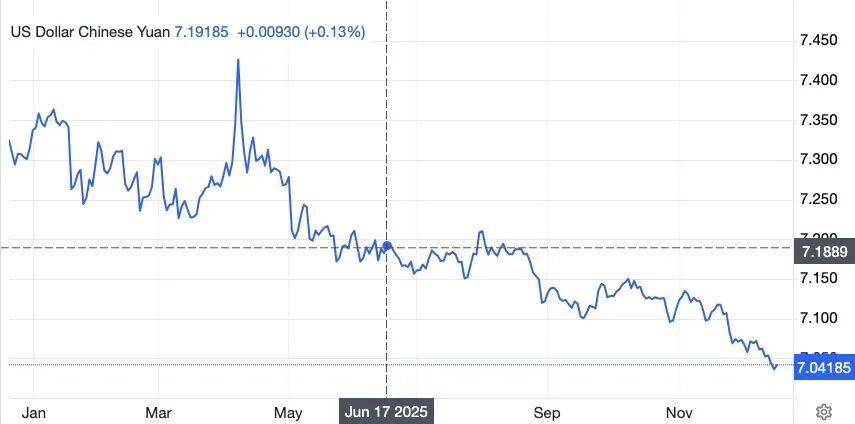
站在今年年底回头看,人民币这一年的走势让很多人没想到——它不但没跌,反而涨了不少。 年初贸易摩擦刚开始时,人民币一度贬到7.4。当时很多人还照着2018年贸易冲突的老经验推测,以为人民币会继续贬 值,甚至可能破8。 (人民币年内走势图) 照大多数人的直观想法,国内经济有压力,外部贸易摩擦又比2018年更激烈,人民币应该像当年那样承受很大贬值压力 才对,怎么还升值了呢? 但实际情况恰恰相反,人民币从4月份的低点7.4开始一路走高,到现在已经升值了4%,离7这个关口只差一口气。 在我看来,主要有两个原因: 第一,美元今年比较弱,贡献了大约三成的原因; 第二,政策起了支撑作用,贡献了七成。 说美元弱贡献了三成,主要是因为美元跌的时候,人民币并没有跟着大幅升值;而下半年人民币走强的节奏,更是光靠 美元走弱解释不通的。 看看下面这张图: 这是美元指数今年的走势。能明显看出,美元上半年就跌了差不多10%,下半年基本在98附近震荡。 而这期间: 上半年,日元、韩元分别升值9%和8%,人民币只升了2%; 全年来看,日元、韩元还略微贬值(-1%和-0.4%),人民币却整体升值了4%。 所以我觉得, 美元走弱确实在上半年带动了非 ...
东方财富:春季行情演化论与内需机会探讨
智通财经网· 2025-12-21 22:50
Core Viewpoint - The report from the Chen Guo team at Dongfang Caifu indicates that while there are signs of rising US Treasury yields and an imminent interest rate hike by the Bank of Japan, there is a strong willingness among investors to capitalize on the spring market rally, particularly in the domestic demand sector, especially non-durable consumer goods [1] Group 1: Market Dynamics - The spring market has evolved through three distinct phases: the calendar effect phase (before 2017), the preemptive speculation phase (2018-2023), and the reflexive phase expected in 2024-2025 [2] - The current market is characterized by a high level of financing and a tendency for institutional investors to engage in preemptive buying, indicating a strong market sentiment [3] Group 2: Investment Opportunities - Key sectors to focus on include insurance, brokerage, non-ferrous metals, AI computing/semiconductors, retail/personal care/social services/dairy products, aviation, new energy, and innovative pharmaceuticals, as these sectors show sufficient attractiveness and increasing win rates [1] - The domestic policies aimed at expanding domestic demand and reducing internal competition provide a favorable environment for these sectors, with expectations of a stronger RMB exchange rate [3][4] Group 3: Long-term Outlook - Historical data suggests that sectors with lower performance in the previous year may experience a rebound, driven by policy expectations and the end of annual performance assessments for institutions [4] - The gradual appreciation of the RMB and supportive policies from the Central Economic Work Conference are expected to play a significant role in restoring domestic demand and improving economic structure in the medium to long term [4]

人民币汇率持续走强,美元存款不降利率,海外资金流向有变
Sou Hu Cai Jing· 2025-12-21 16:24
Core Viewpoint - The article discusses the implications of interest rate changes by central banks and the Federal Reserve, emphasizing that banks must prioritize their balance sheets and risk management over macroeconomic trends [1][10]. Group 1: Currency and Interest Rate Dynamics - The Chinese yuan has appreciated against the US dollar by 3.4% this year, with a near 2% increase over the past six months and close to 1% in the last month, which affects net returns for investors [3]. - The Federal Reserve's policy has shifted since 2014, with expectations of a 75 basis point rate cut by 2025, creating uncertainty that complicates pricing and returns for institutions [3][10]. - Domestic interest rates for RMB deposits are on a downward trajectory, and the Fed's rate cuts may influence the flow of funds, with potential shifts towards high-yield USD products [5]. Group 2: Banking Strategies and Market Behavior - Foreign banks are leveraging high-yield deposit products during the interest rate cut window, supported by holding high-yield bonds, managing quotas, and the relative attractiveness of USD assets [5][10]. - The marketing of high-yield products by banks is seen as a strategy to attract customers while managing risks, with the potential for short-term gains but uncertain long-term sustainability [7][10]. - Investors are advised to be cautious, especially those holding RMB-denominated assets, as high interest rates may be offset by currency depreciation, leading to negligible or negative net returns [7][9]. Group 3: Recommendations for Investors - Institutions recommend strategies such as short-duration investments, phased currency exchanges, and using hedging instruments, though these may be complex and costly for average investors [9]. - It is suggested that individuals should diversify their investments, limiting USD asset allocation to 10%-15%, prioritizing short-duration and high liquidity options [10]. - The article concludes with a reminder that both interest rates and exchange rates must be considered together to assess true investment returns, urging caution against being blinded by high rates [12][13].

“十五五”首席观察:中国经济韧性当先
Bei Jing Shang Bao· 2025-12-21 15:55
Group 1: Economic Outlook and Policy Framework - In 2025, China’s economy is at a historical juncture, balancing short-term recovery and long-term transformation under the "14th Five-Year Plan" and the upcoming "15th Five-Year Plan" [1] - The central economic work conference has set the tone for 2026 as "seeking progress while maintaining stability, improving quality and efficiency" [1] - Key challenges include achieving sustainable consumption growth and coordinating the dual strategies of "internal circulation" and "high-level opening up" [1] Group 2: Monetary Policy Insights - There is still room for monetary policy adjustments, including potential interest rate cuts and reserve requirement ratio reductions to support economic recovery [3][4] - Structural tools will be expanded to focus on key national strategies and weak links, such as increasing support for technological innovation [4] - The need for a coordinated approach to counter-cyclical and cross-cyclical adjustments in monetary policy is emphasized to create a stable financial environment [4][5] Group 3: Currency and Exchange Rate Dynamics - The Chinese yuan has strengthened against a backdrop of complex external conditions, driven by domestic economic resilience and improved macro narratives [7] - The central economic work conference emphasizes maintaining the stability of the yuan, focusing on preventing excessive fluctuations [8] - The outlook for the yuan remains uncertain, with potential challenges from trade balance shifts and international economic conditions [9] Group 4: Gold Market Trends - Gold prices have reached new highs, driven by heightened global risk aversion and skepticism towards the US dollar credit system [11] - The forecast for gold prices suggests a potential rise to the range of $4,500 to $5,000 per ounce, influenced by ongoing geopolitical risks and central bank purchasing trends [12] Group 5: Aging Population and Insurance Sector - The aging population necessitates reforms in commercial insurance to address long-term care and wealth transfer needs [14] - The insurance sector is positioned to play a crucial role in providing comprehensive solutions for retirement security and risk management [15][16] Group 6: Internal and External Economic Circulation - The restructuring of global trade and external policy spillover effects are critical external variables for China's economic development [18] - The emphasis is on promoting the deep integration of internal and external circulation through policy guidance and market mechanisms [19] Group 7: Bond Market and Interest Rate Projections - The People's Bank of China is expected to implement a more proactive monetary policy, focusing on structural optimization rather than just total easing [22] - Long-term bond rates are anticipated to experience a phase of decline, influenced by fiscal expansion and ongoing economic recovery [23]

人民币悄然走强背后:三大市场推力与你的钱袋子
Sou Hu Cai Jing· 2025-12-21 11:42
Group 1 - The core point of the article is that the recent strengthening of the Chinese yuan is driven by solid economic fundamentals, changes in international trade dynamics, and the ongoing internationalization of the yuan [1][3][5] Group 2 - China's economic fundamentals provide a stabilizing effect for the yuan, with a complete industrial chain and a large domestic market supporting its strength [1] - The resilience of Chinese exports has increased foreign exchange earnings, leading to a favorable supply-demand relationship for the yuan [3] - The divergence in global monetary policy, particularly the Federal Reserve's aggressive rate hikes followed by signals of a slowdown, has eased the pressure on the yuan against the dollar [3] - The internationalization of the yuan is progressing, with more countries willing to use it for trade settlements and central banks incorporating it into their foreign exchange reserves, challenging the dominance of the dollar [5] - The strengthening of the yuan has mixed effects on ordinary people, benefiting imports and overseas spending while potentially pressuring export businesses [5] - Future expectations suggest that the yuan will likely experience two-way fluctuations, with a focus on stability rather than aggressive strengthening [7] - The strengthening of the yuan reflects market confidence in the long-term prospects of the Chinese economy, driven by productive factories and innovative enterprises [7]

金融大家评 | 人民币为何走强?明年能否破“7”?
清华金融评论· 2025-12-20 09:14
Core Viewpoint - The article discusses the recent appreciation of the RMB against the USD, highlighting the factors driving this trend and the outlook for the currency in 2026, emphasizing the importance of external and internal economic conditions [2][3][7]. Group 1: Reasons for RMB Appreciation - The appreciation of the RMB is primarily driven by two forces: the weakening of USD credit and the Federal Reserve's easing policies [3]. - A significant factor supporting the RMB's appreciation is the shift in foreign trade enterprises' willingness to convert their earnings, reversing a three-year trend of reluctance to do so [3]. - The recent capital inflow, particularly after the Fed announced a new easing cycle, has been largely attributed to foreign trade enterprises' increased currency conversion activities [3]. Group 2: Central Bank's Management of Cross-Border Liquidity - The central bank has effectively managed cross-border liquidity by lowering swap market premiums to control the pace of foreign capital inflow and guiding domestic expectations through the midpoint rate [4]. - The goal is to align domestic and foreign pricing with the central bank's expectations, achieving a "three-price unification" [4]. Group 3: Changes in RMB Exchange Rate Dynamics - Since April, the negative spread between the RMB midpoint and spot exchange rates has been notable, indicating that the midpoint has been guiding the appreciation of the spot rate [5]. - Seasonal factors, such as increased currency conversion by foreign trade enterprises and overseas workers sending money home before the Lunar New Year, are expected to support the RMB's strength [5]. - The recent shift from a negative to a positive spread between the midpoint and spot rates may reflect adjustments in the central bank's stance [6]. Group 4: Outlook for RMB Exchange Rate in 2026 - The RMB is expected to appreciate gradually in 2026, influenced by the restructuring of the international monetary system and the U.S. government's preference for a weaker dollar [8]. - The narrowing of interest rate differentials between China and the U.S. is likely to support the RMB, as the Fed continues its easing cycle [8]. - Increased internationalization of the RMB, supported by China's competitive manufacturing sector, is anticipated to enhance the currency's attractiveness and stability [8]. Group 5: External Factors and Uncertainties - The impact of U.S.-China tariffs on the RMB is expected to diminish as both economies show resilience under trade pressures [9]. - However, uncertainties remain, including domestic economic stability and external trade relations, which could affect the RMB's performance [12]. - The potential for further depreciation of the USD, driven by the Fed's policies and economic conditions, may also influence the RMB's trajectory [11].