
云计算

Search documents
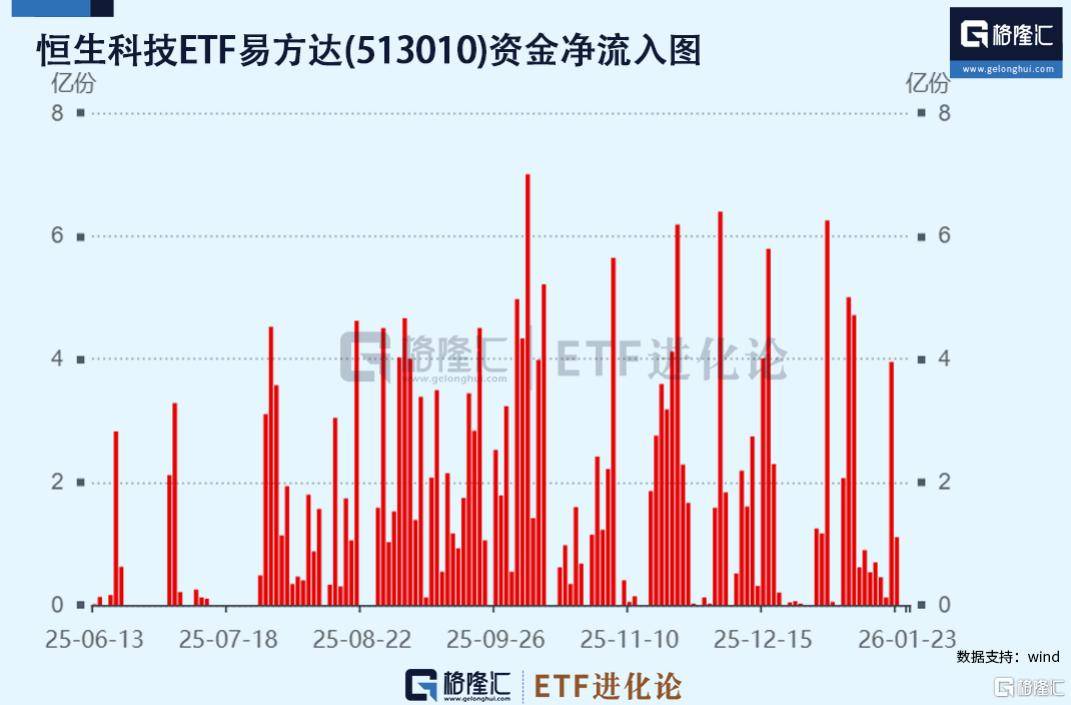
低估值+AI产业双重驱动下,十大核心ETF·恒生科技ETF易方达(513010)去年6月以来获资金“只进不出”,合计净流入超180亿
Sou Hu Cai Jing· 2026-01-26 07:16
Core Viewpoint - The Hong Kong stock market has experienced fluctuations, with the E Fund Hang Seng Technology ETF (513010) recording a 3.58% increase since the beginning of the year, highlighting its role as a key vehicle for investors to tap into the growth of China's technology sector [1]. Group 1: Market Performance and Fund Inflows - As of last Wednesday, foreign net inflows into Hong Kong stocks reached $1.95 billion, down from $2.82 billion the previous week, with active foreign inflows maintaining a net inflow of $240 million, setting a new weekly high [1]. - The southbound net inflow into Hong Kong stocks was HKD 23.5 billion, an increase from HKD 10 billion the previous week, with the electronics, media, and non-bank financial sectors leading in net inflows [1]. Group 2: ETF Characteristics and Advantages - The E Fund Hang Seng Technology ETF (513010) tracks the Hang Seng Technology Index, which encompasses all quality technology companies on the Hong Kong main board, providing a comprehensive view of the sector [3]. - The ETF includes 30 leading technology stocks, with significant representation from internet platforms, semiconductors, and new energy vehicles, and over 60% of its holdings are in AI-related companies [3]. - The ETF's management fee is only 0.2%, and the total fee is among the lowest in its category, enhancing its cost-effectiveness for investors [5]. Group 3: Index Composition and Rebalancing - The Hang Seng Technology Index is designed to avoid concentration risk by limiting the weight of any single industry to 15% and individual stocks to 8%, ensuring balanced exposure across 16 sub-sectors [3]. - The quarterly rebalancing mechanism of the index allows for timely inclusion of emerging leaders in sectors like new energy and semiconductors, aligning with the evolution of the technology industry [4]. Group 4: Market Outlook and Economic Indicators - The latest valuation of the Hang Seng Technology Index is at a relatively low historical level, with a P/E ratio of 23.84, indicating potential for valuation recovery amid structural opportunities in AI, cloud computing, and semiconductors [5]. - Despite a significant net sell-off of HKD 75.8 billion in the fourth quarter by active equity funds, there is potential for increased allocations as the market stabilizes [7]. - A rebound in domestic corporate loan demand may signal a recovery in the macroeconomic environment, which could positively influence investor sentiment and bring additional capital into the Hong Kong stock market [8].

AI投资进入“交卷期”,微软(MSFT.US)变现执行力将决定科技股下半场定价
Zhi Tong Cai Jing· 2026-01-26 07:10
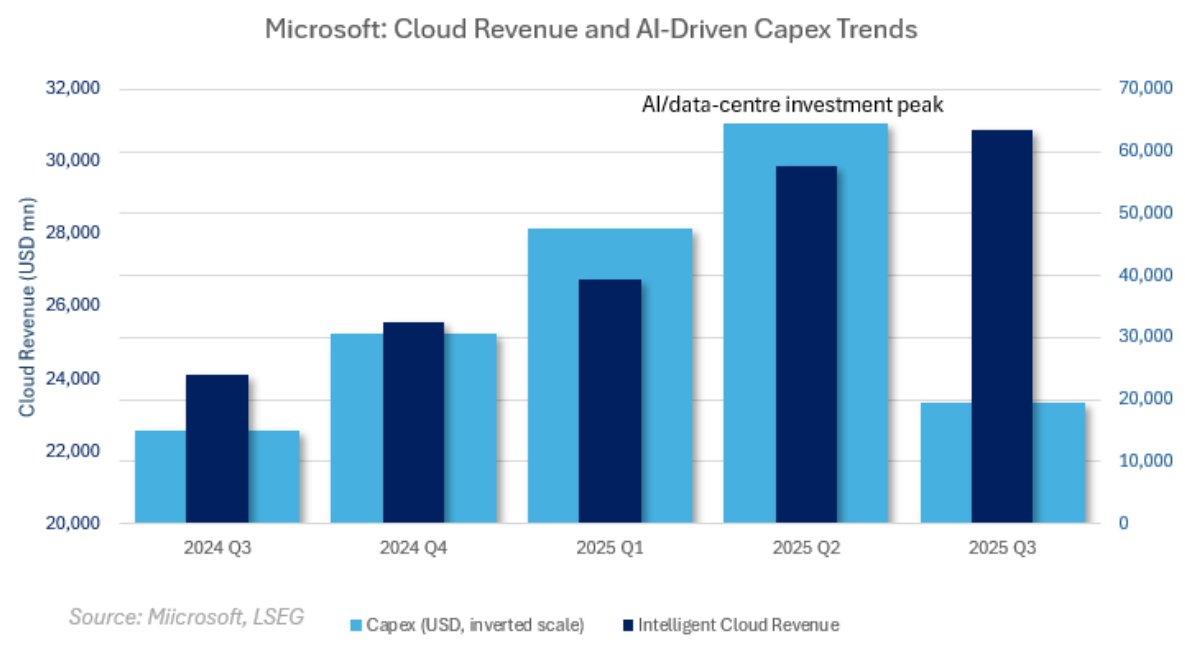
Core Viewpoint - Microsoft is set to report its Q2 FY2026 earnings on January 28, with expected revenue of $80.23 billion, reflecting a 15.2% growth, and an anticipated EPS of $3.88, representing a 20.1% year-over-year increase. The market's focus is shifting from overall performance to the execution in cloud business growth, AI monetization, and profit margins [1][2]. Revenue Growth - Cloud Computing as Core Driver - Azure remains the central driver of the earnings narrative, with market concerns focusing on whether cloud growth has stabilized or is re-accelerating compared to the previous quarter. Key indicators such as commercial bookings and remaining performance obligations (RPO) will be closely monitored [3]. AI Monetization - Evidence vs. Narrative - AI is crucial to Microsoft's valuation, but the market is seeking tangible evidence of revenue generation from AI. Attention will be on the adoption rates of Copilot in both enterprise and consumer sectors, whether this adoption is through paid or bundled models, and if AI workloads are reflected in Azure billing [6]. Profit Margins - Cloud Efficiency and Rising Costs - Profit margins are a critical sensitivity point as Microsoft increases investments in AI and data centers. The market will compare operating margins with the previous quarter to assess whether cloud computing efficiencies can offset rising costs in computing power, energy, and infrastructure [7][8]. Productivity and Personal Computing - Beyond cloud and AI, Microsoft's productivity and PC segments may signal potential demand. Pricing power in Office and Microsoft 365 will be viewed as indicators of enterprise resilience, while Windows OEM demand may suggest stabilization in the PC cycle [9]. True Catalyst - Guidance and Outlook - Guidance is likely to drive post-earnings reactions, with the market focusing on the tone for Q1 and the full year, particularly regarding cloud demand and spending trends. Investors will look for clear responses from management on Azure's growth outlook and whether AI revenue expectations are quantified or remain qualitative [11]. Capital Expenditures and Investment Spending - As Microsoft continues to expand AI and data center investments, capital expenditure guidance will be scrutinized. The market remains sensitive to narratives of "spending first, profiting later," especially in a high-interest-rate environment. Indications that high capital expenditure intensity will persist longer than expected could pressure market sentiment [12].

百度:2025 年第四季度前瞻:核心业务符合预期,价值释放为关注重点
2026-01-26 02:50
Summary of Baidu, Inc. 4Q25 Preview and Key Insights Company Overview - **Company**: Baidu, Inc. - **Industry**: Internet Services - **Market Cap**: US$51.5 billion - **12-Month Rating**: Buy - **Price Target**: US$180.00 Core Business Performance - **Core Ads Revenue**: Expected to narrow its year-over-year decline to 6.2% in 4Q25, recovering sequentially due to AI search transformation and growth in AI-native marketing services [2][4] - **Cloud Segment**: Anticipated growth to decelerate to low-teens percentage, with AI Cloud Infrastructure projected to deliver over 30% revenue growth in 2025 [2] - **Total Core Revenue**: Forecasted to recover sequentially in 4Q25, with a year-over-year decline narrowing [2] Financial Estimates - **Core Non-GAAP Operating Profit**: Revised down by 6.7% to Rmb2.7 billion for 4Q25 due to operating deleverage, implying a recovery in operating margin to 10.5% [4][10] - **Revenue Estimates**: Total net revenue for 4Q25 estimated at Rmb32.5 billion, reflecting a 4.8% year-over-year decline [10] - **Earnings Per Share (EPS)**: Expected diluted EPS for 4Q25 is Rmb53.21, a slight decrease from previous estimates [8] Strategic Developments - **Kunlunxin Chip**: Seen as a key growth driver, with potential upside not fully priced in, attributed to its performance advantages in the domestic AI chip market [2] - **Apollo Go**: Expected to sustain strong growth in rides and expand internationally, with recent developments including a full driverless testing permit in Dubai and commercial operations in Abu Dhabi [3] Shareholder Returns - **Share Buybacks**: Management committed to clearer communication regarding share buyback plans and execution progress, considering alternatives to enhance shareholder returns [3] Valuation Insights - **Price Target Methodology**: SOTP-based valuation assumes a 5x PE for Core ads, 3x P/S for Cloud, and specific valuations for Apollo Go and Kunlunxin [5][11] - **Valuation Breakdown**: Total valuation estimated at US$61.4 billion, translating to a price per share of US$180 [11] Risks and Challenges - **Competitive Landscape**: Evolving competition and execution risks in new business areas [15] - **Regulatory Environment**: Potential regulatory challenges impacting operations and growth [15] Market Performance - **Stock Performance**: Baidu's share price increased by 14% year-to-date, outperforming the KWEB index [2] - **Trading Metrics**: Average daily volume of 3.46 million shares, with a free float of 72% [7] Conclusion Baidu, Inc. is positioned for a recovery in its core advertising revenue and continued growth in its cloud segment, driven by AI initiatives. The company is actively pursuing international expansion in autonomous driving and is committed to enhancing shareholder returns through strategic buybacks. However, it faces risks from competition and regulatory pressures that could impact its future performance.
芯原股份20260123
2026-01-26 02:49
Summary of the Conference Call for XinYuan Co., Ltd. Company Overview - XinYuan Co., Ltd. reported a revenue of 3.153 billion yuan in 2025, representing a year-on-year growth of 35.81% [2][5] - The company focuses on semiconductor IP licensing and ASIC custom chip services, with IP licensing accounting for approximately one-third of total revenue [3][5] - The company employs over 2,000 staff, with 89% in R&D, and has established 9 R&D centers and 11 sales offices globally [3] Financial Performance - Revenue growth was driven by a 73.98% increase in volume business and over 95% growth in the data processing sector, which accounted for about 34% of total revenue [2][5] - New orders totaled 5.961 billion yuan in 2025, a 103.41% increase year-on-year, with a backlog of 5.075 billion yuan at year-end, expected to convert over 80% within a year [2][6] - Despite a loss of 449 million yuan in 2025, the loss narrowed by over 25% compared to the previous year, indicating potential for improved profitability due to scale effects [2][7] Business Strategy and Market Position - The company maintains a leading position in the semiconductor IP field, competing with firms like ARM, but offers a diverse range of products with unique advantages [2][13] - XinYuan is actively expanding its cloud computing market presence and increasing R&D investment in end-device technologies, particularly for smartphones and tablets [2][14] - The company emphasizes business growth and market share over short-term profitability, focusing on long-term strategies [2][11][12] Product Development and Innovation - Smart glasses and AR technology are key future development areas, with sales reaching 1.78 million units in the first three quarters of the year [2][15] - The company has developed advanced process technologies, with nearly 70% of production using processes of 7nm or more, including successful development of a 5nm automotive chip [2][4][28] Challenges and Opportunities - The smart glasses market faces challenges such as technology uncertainty, design, and user experience, but also presents significant opportunities for growth if these issues are addressed [2][17] - Collaboration with Google on open-source projects is expected to accelerate technological innovation and industry development [2][18][19] Future Outlook - The founder anticipates stable revenue growth in 2026 and 2027, supported by a strong order backlog [2][8] - The company is exploring new market opportunities while ensuring existing product production progresses [2][24] - Long-term investments in emerging markets like AR glasses and phones are expected to drive future growth and profitability [2][30][31] Conclusion - XinYuan Co., Ltd. is positioned for significant growth in the semiconductor industry, with a strong focus on R&D, innovative product development, and strategic market expansion, despite current financial losses. The company's long-term vision and commitment to technology leadership are expected to yield positive results in the coming years.

算力即国力-当前时点如何看待CPU涨价带来的投资机会
2026-01-26 02:49
Summary of Key Points from the Conference Call Industry Overview - The conference call discusses the CPU industry, focusing on the price increases of consumer and server CPUs, driven by supply-demand imbalances and the surge in AI-related demand [1][3][5]. Core Insights and Arguments - **Price Increases**: Consumer CPUs from Intel and AMD are set to increase by over 10% in Q4 2025, while server CPUs are expected to rise by 10% to 15% in Q1 2026, with high-end CPUs seeing increases of over 20% [1][3]. - **Supply-Demand Imbalance**: The price hikes are attributed to a supply-side shortage of chips, increased complexity in high-end manufacturing processes, and rising costs in wafer foundry services. Additionally, storage manufacturers expanding production are squeezing CPU capacity [5][9]. - **AI Demand Surge**: The demand for AI servers is significantly increasing, contributing to the growth of general-purpose servers, which are currently in a replacement cycle. This trend is expected to continue, driven by applications like Jatic AI and AI agents [1][4][7][8]. - **Domestic Leaders**: In the domestic market, Haiguang Information is highlighted as a leading company with the largest revenue scale. Longxin Zhongke and Feiteng Information are also expected to see significant revenue growth, with Feiteng projected to reach approximately 2.5 billion in revenue by 2025, a year-on-year growth of about 25% [6][1]. Additional Important Content - **Future Price Trends**: If upstream price pressures persist, including rising costs from storage and wafer foundries, CPU prices are likely to continue increasing. Strong downstream demand, such as Intel's recent large order from the U.S. Department of Defense and potential orders for AMD from overseas cloud providers, may further widen the supply-demand gap [9][12]. - **Cloud Computing Price Pressure**: The cloud computing sector is also facing price pressures due to rising costs of storage and CPUs. Major companies are implementing price increases by reducing discounts, although the apparent price changes may not be significant [13]. - **Technological Upgrades**: The overseas market is seeing significant upgrades in CPU technology, exemplified by NVIDIA's Ruby architecture, which upgraded from 72 cores to 88 cores, reflecting a global trend towards higher performance and greater usage [11]. This summary encapsulates the critical insights and trends discussed in the conference call, providing a comprehensive overview of the current state and future outlook of the CPU industry.
2026年中国通讯服务器构配件行业产业链、发展现状、竞争格局及发展趋势研判:服务器市场的快速发展,为通讯服务器构配件行业带来广阔的发展空间[图]
Chan Ye Xin Xi Wang· 2026-01-26 01:14
Core Insights - The development of the communication server components industry is closely linked to advancements in information technology, with significant market demand driven by cloud computing, big data, IoT, and 5G technologies [1][8] - The Chinese communication server components market is projected to reach 14.1 billion yuan by 2025, reflecting a year-on-year increase of 13.3% [8] - The global communication server components market is expected to grow to 9.12 billion USD by 2025, with an annual growth rate of 8.2% [7][8] Industry Overview - Communication servers are high-performance computers that provide computing or application services to client devices, featuring complex internal structures and various components such as CPUs, hard drives, and memory [4] - Communication server components include structural fasteners and assembly parts, which are crucial for the assembly of servers [4] Industry Chain - The upstream of the communication server components industry includes raw materials like stainless steel, copper, and aluminum, while the midstream consists of the components industry itself, and the downstream pertains to the application fields within communication servers [5] Market Size and Growth - The Chinese server industry market size was 165.2 billion yuan in 2022 and is expected to grow to 282.35 billion yuan by 2025, with a compound annual growth rate (CAGR) of 19.6% [7] - The growth of the server market is anticipated to drive demand for communication server components [7] Competitive Landscape - Key players in the communication server components industry include Inspur Information, ZTE Corporation, and Xiamen Meikang Security Technology, among others [9] - Server manufacturers often have in-house design capabilities for core structural components, ensuring supply chain stability [9] Development Trends 1. **Product Design Upgrades**: Focus on high-density integration and multi-scenario adaptability to meet the deployment needs of new data centers and communication networks [11] 2. **Smart and Precise Manufacturing**: Adoption of automated production lines and digital management systems to enhance product precision and consistency [12] 3. **Industry Chain Collaboration**: The competitive landscape is shifting towards deeper integration within the industry chain, with leading companies forming strategic partnerships with suppliers and manufacturers [13]







1月26日早餐 | 腾讯、百度打响春节AI红包大战
Xuan Gu Bao· 2026-01-26 00:00
Core Viewpoint - The overall sentiment in the market remains optimistic, with a focus on performance and thematic investments, indicating a potential continuation of a "slow bull" market trend [3][4][5]. Market Strategy - Various brokerage strategies suggest that the market is seeing structural changes, with increased capital inflow into sectors like real estate, resource products, and price increase chains [3]. - The focus for the upcoming period includes commercial aerospace and AI applications, as well as sectors with high profit elasticity [3]. - The market is supported by a relatively stable RMB exchange rate and a loose liquidity environment, which is expected to sustain high-elasticity assets [3]. Long-term Outlook - A long-term perspective indicates that the current market is still in the mid-stage of a bull market, with ample room for growth compared to previous bull market peaks [4]. - The risk premium for the CSI 300 index is currently at 5.27%, suggesting that there is still significant investment opportunity [4]. Cloud Computing - Amazon Web Services (AWS) has raised its EC2 machine learning capacity block prices by approximately 15%, breaking a long-standing trend of declining cloud service prices [6]. - This price increase is expected to benefit cloud computing and related service providers, indicating a potential valuation restructuring in the sector [6]. Semiconductor Industry - Samsung Electronics has raised NAND flash memory prices by over 100% in Q1 2023, highlighting severe supply-demand imbalances in the semiconductor market [8]. - This price increase is part of a broader trend of rising prices in the storage industry, driven by structural shortages and increased demand from AI technologies [8]. Gene Sequencing and Health - The Nipah virus outbreak in India has prompted health screenings at international airports in Thailand, indicating a heightened focus on health monitoring and potential impacts on the healthcare sector [9]. New Stock Offerings - North Star Life Sciences is set to launch an IPO on the Sci-Tech Innovation Board at a price of 17.52 yuan per share, with a subscription threshold of 90,000 yuan [11]. Company Announcements - Hunan Gold expects a net profit of 1.27 billion to 1.608 billion yuan for 2025, driven by rising sales prices of gold, antimony, and tungsten products [12]. - YJ New Materials plans to acquire 100% of Aokening Qinhuangdao and 95% of Aokening Kunshan, focusing on aluminum plate production [12]. - Xian Dao Intelligent anticipates a net profit of 1.5 billion to 1.8 billion yuan for 2025, reflecting a significant increase in orders due to rising production rates among major battery companies [13]. - Zhongwei Company expects a net profit of 2.08 billion to 2.18 billion yuan for 2025, indicating a growth of approximately 28.74% to 34.93% [14].

嘉兴本土信创品牌实现全国市场突破
Xin Lang Cai Jing· 2026-01-25 23:27
Core Insights - JiaShu Company has successfully entered the national government procurement system with its self-branded XinChuang computers, marking a significant milestone for a local brand in the government sector [1] - The Central Government's procurement project is known for its high entry barriers and strict technical standards, highlighting JiaShu's product performance and alignment with national needs [1] - The company has received procurement orders from a central government agency, further enhancing its credibility and influence in the industry [1] Company Development - JiaShu Company aims to create a leading digital city laboratory by integrating cutting-edge technologies such as AI, big data, IoT, and cloud computing into a digital service system [2] - The company has established the first national postdoctoral workstation in the municipal state-owned assets system, emphasizing its commitment to talent and research investment [2] - JiaShu has applied for 44 patents, with 12 granted invention patents and 5 utility model patents, showcasing its focus on innovation and technology [2] Market Positioning - The company has developed various big data solutions, including the Xinghai Big Data Platform and Edge Computing Platform, and has achieved DCMM Level 3 certification for data management capabilities [2] - As the first public data authorized operation unit in Jiaxing, JiaShu leads the Jiaxing Data Asset Service Alliance, contributing to regional digital economic development [2] - The company is actively expanding its market coverage and building a collaborative ecosystem through its three business segments: integration, government-enterprise, and operation [2] Future Outlook - JiaShu Company plans to continue driving innovation and optimizing its product and service ecosystem to provide high-quality solutions for government agencies and enterprises [3] - The company aims to contribute to the prosperity of the national XinChuang industry and inject new momentum into technological independence and digital construction [3]
浙江民营企业发展稳健向好 在册总量超370万户
Xin Lang Cai Jing· 2026-01-25 19:17
Group 1 - The overall development of private enterprises in Zhejiang Province is stable and positive, with a total of 3.7689 million registered private enterprises by the end of 2025, accounting for 91.9% of all enterprises in the province, representing a year-on-year growth of 7.52% [1] - The distribution of private enterprises is concentrated in four cities: Hangzhou, Jinhua, Ningbo, and Wenzhou, which together account for about 70% of the total number of private enterprises in the province [1] - Hangzhou leads with 1.0096 million registered private enterprises, making up 26.8% of the total, followed by Jinhua, Ningbo, and Wenzhou with 623.8 thousand, 569.1 thousand, and 442.1 thousand respectively [1] Group 2 - The industrial structure of private enterprises in Zhejiang shows a significant focus on the tertiary sector, with 74.84% of private enterprises engaged in this sector by the end of 2025 [2] - The top three industries for private enterprises are wholesale and retail, manufacturing, and leasing and business services, with registered numbers of 1.2629 million, 686.4 thousand, and 448.5 thousand respectively [2] - There is notable growth in innovative sectors, with private enterprises in scientific research and technical services reaching 395.7 thousand, a year-on-year increase of 13.51%, and those in information transmission, software, and IT services reaching 261.3 thousand, up by 12.53% [2] Group 3 - Hangzhou maintains its position as the "Digital Economy Capital" of China, with private tech enterprises thriving in AI, big data, and cloud computing, leading to the emergence of internationally influential innovative companies [3] - Jinhua is leveraging the Yiwu International Trade Comprehensive Reform to accelerate the transition from traditional commerce to digital trade, with an expected import and export total exceeding 1 trillion yuan by 2025 [3] - Ningbo is a key production base for small household appliances, with over 2,000 complete appliance enterprises and more than 300 large-scale enterprises in this sector, covering various product categories [3]
欧盟委员会力推《数字网络法案》
Xin Lang Cai Jing· 2026-01-25 19:17
Core Viewpoint - The European Commission has proposed the Digital Networks Act to simplify and unify rules for connecting networks, facilitating investment in advanced fiber and mobile networks to support the application of innovative technologies like AI and cloud computing [1] Group 1: Legislative Proposal - The proposal aims to strengthen the single market in the connectivity sector by establishing unified rules and facilitating cross-border operations, encouraging operators to scale up, develop, and innovate [1] - Companies will only need to register in one member state to provide services across the EU [1] Group 2: Spectrum Authorization Framework - The EU plans to create an EU-level spectrum authorization framework to promote pan-European satellite communication services [1] - The proposal seeks to enhance consistency in spectrum authorization among member states, granting operators longer-term spectrum licenses and making licenses automatically renewable [1] Group 3: Next Steps - The legislative proposal will be submitted for review by the European Parliament and the EU Council [1]