社会融资规模

Search documents
锌:震荡下行
Guo Tai Jun An Qi Huo· 2025-08-04 02:04
Group 1: Report Industry Investment Rating - The investment rating for the zinc industry is "Oscillating Downward" [1] Group 2: Core View of the Report - The report presents the latest data on zinc's fundamentals, including prices, trading volumes, open interests, premiums, and inventories, and indicates a downward trend for zinc [1] Group 3: Summary Based on Related Content 1. Zinc Market Data - **Prices**: The closing price of SHFE zinc main contract was 22,320 yuan/ton, down 0.11%; the closing price of LME zinc 3M electronic trading was 2,729.5 dollars/ton, down 1.18% [1] - **Trading Volumes**: The trading volume of SHFE zinc main contract was 105,121 lots, a decrease of 77,539 lots; the trading volume of LME zinc was 14,107 lots, an increase of 2,308 lots [1] - **Open Interests**: The open interest of SHFE zinc main contract was 108,084 lots, a decrease of 2,397 lots; the open interest of LME zinc was 189,343 lots, a decrease of 568 lots [1] - **Premiums and Discounts**: Shanghai 0 zinc premium was 0 yuan/ton, unchanged; LME CASH - 3M premium was -6 dollars/ton, a decrease of 4.2 dollars/ton [1] - **Inventories**: SHFE zinc futures inventory was 14,982 tons, a decrease of 76 tons; LME zinc inventory was 100,825 tons, a decrease of 3,975 tons [1] 2. News - People's Bank of China Deputy Governor Zou Lan stated that from the first - half financial data, the effect of monetary policy in supporting the real economy was relatively obvious. At the end of June, the year - on - year growth rate of the stock of social financing scale was 8.9%, M2 increased by 8.3% year - on - year, and RMB loans increased by 7.1% year - on - year [2] 3. Trend Intensity - The trend intensity of zinc is -1, indicating a relatively bearish outlook [2][3]
上半年陕西省信贷运行平稳 重点领域信贷支持稳固有力
Sou Hu Cai Jing· 2025-08-02 00:18
Core Viewpoint - The People's Bank of China, Shaanxi Branch, has implemented a moderately loose monetary policy since 2025, focusing on key areas and increasing credit support to the real economy, resulting in a steady growth of financing and a favorable monetary environment for economic recovery [1] Group 1: Loan Growth - As of the end of June, the total balance of RMB loans in Shaanxi reached 61,173.27 billion yuan, with a year-on-year growth of 7.93%, surpassing the national average by 0.83 percentage points [2] - In the first half of the year, new loans amounted to 3,169.07 billion yuan, an increase of 210.51 billion yuan compared to the previous year, achieving 74% of last year's total [2] - Corporate loans were the main driver of credit growth, with new loans to enterprises totaling 2,547.44 billion yuan, accounting for 80.38% of the total loan increase [2] Group 2: Sectoral Loan Distribution - The manufacturing sector saw a significant increase in medium and long-term loans, with a balance of 4,690.34 billion yuan, growing by 17.73% year-on-year [3] - Loans to the leasing and business services, manufacturing, and construction industries increased by 1,042.76 billion yuan, 362.87 billion yuan, and 350.01 billion yuan respectively, together accounting for 68% of the sectoral loan increase [2][3] Group 3: Deposit Growth - The total balance of RMB deposits in Shaanxi reached 74,896.67 billion yuan, with a year-on-year growth of 8.29%, slightly above the national level [4] - Household deposits maintained a double-digit growth, reaching 46,424.36 billion yuan, with an increase of 2,810.01 billion yuan in the first half of the year [4] - Government bond issuance accelerated, contributing to a significant increase in fiscal deposits, which grew by 18.43% year-on-year, reaching a balance of 1,201.98 billion yuan [4]
上半年我省社会融资规模增加2793亿元
Liao Ning Ri Bao· 2025-08-02 00:12
Group 1 - The total social financing scale in Liaoning Province increased by 279.3 billion RMB in the first half of the year, marking the highest increase for the same period in nearly a decade [1] - Loans to the real economy amounted to 182.8 billion RMB, providing strong financial support for the comprehensive revitalization of Liaoning [1] - By the end of June, the balance of RMB loans in Liaoning's financial institutions reached 5.36 trillion RMB, an increase of 167.3 billion RMB from the beginning of the year, with a year-on-year increase of 130.1 billion RMB [1] Group 2 - The balance of technology loans in the province reached 821.78 billion RMB, with an increase of 65.27 billion RMB [2] - Green loans amounted to 666.98 billion RMB, accounting for 12.4% of total loans [2] - The balance of inclusive micro loans reached 473.1 billion RMB, a year-on-year increase of 21.5%, with new inclusive micro loans of 56.8 billion RMB in the first half of the year [2]
上半年天津存贷款增速加快 主要产业贷款快速增长
Xin Hua Cai Jing· 2025-07-30 13:39
上半年,天津社会融资规模累计增加3058亿元,同比多708亿元,社会融资规模结构呈现三个"多增"。 一是企业债券融资多增。上半年全市企业债券净融资165亿元,同比多增402亿元。二是政府债券融资多 增。上半年全市地方政府债券净融资1080亿元,同比多增453亿元。三是信托贷款多增。上半年全市信 托贷款增加420亿元,同比多增156亿元。 (文章来源:新华财经) 其中,主要产业贷款快速增长。6月末,全市工业中长期贷款同比增长6.3%,电力、热力、燃气及水生 产和供应业贷款同比增长13.1%,建筑业贷款同比增长13.0%,住宿和餐饮业贷款同比增长66.9%,信息 传输、软件和信息技术服务业贷款同比增长40.8%,均高于各项贷款平均增速。 另外,重点领域贷款保持较快增长。6月末,全市科技贷款余额同比增长10.5%,绿色贷款比年初增长 15.9%,普惠小微企业贷款同比增长15.7%,农林牧渔业贷款同比增长10.5%,均显著高于各项贷款增 速。 新华财经天津7月30日电(记者李亭)记者从人民银行天津市分行获悉,2025年上半年,天津市存款、 贷款增速加快,社会融资规模同比多增,有力支持实体经济回升向好和高质量发展。 存 ...
上半年辽宁省社会融资规模累计增加2793亿元
Xin Hua Cai Jing· 2025-07-29 13:46
Core Insights - The social financing scale in Liaoning Province increased by 279.3 billion yuan in the first half of 2025, marking the highest level for the same period in the past decade [1] - The total RMB loan balance of financial institutions in Liaoning reached 5.36 trillion yuan by the end of June 2025, with an increase of 167.3 billion yuan since the beginning of the year, and a year-on-year increase of 130.1 billion yuan [1] Loan Structure - State-owned banks maintained a high growth rate in lending [1] - Inclusive small and micro loans grew by over 20%, with a balance of 473.1 billion yuan at the end of June, reflecting a year-on-year growth of 21.5%, which is 7.1 percentage points higher than the previous quarter [1] - Loans for scientific research and technical services increased significantly, with a balance of 32.4 billion yuan, showing a year-on-year growth of 65.01% [1] - Manufacturing loans also saw a year-on-year increase, with a balance of 698.8 billion yuan at the end of June, an increase of 43.5 billion yuan since the beginning of the year, and a year-on-year increase of 40.8 billion yuan [1] Deposits Overview - The total RMB deposit balance of financial institutions in Liaoning reached 8.54 trillion yuan, reflecting a year-on-year growth of 4% [1] - Household deposits and non-financial enterprise deposits stood at 6.48 trillion yuan and 1.01 trillion yuan, respectively [1]
上半年上海个人房货需求回升,信贷结构持续优化
Guo Ji Jin Rong Bao· 2025-07-24 12:02
Core Insights - The People's Bank of Shanghai reported a stable growth in credit and financing costs, contributing to the high-quality economic development of Shanghai in the first half of 2025 [1][3] Group 1: Credit and Financing - As of June, the total balance of loans in Shanghai reached 12.85 trillion yuan, with a year-on-year growth of 8.4%, which is 1.6 percentage points higher than the national average [1] - Household loans increased by 13.7% year-on-year, with a notable recovery in personal housing loan demand since October of the previous year [1] - Non-financial enterprise loans grew by 5.5% year-on-year, with these loans accounting for 55.2% of all new loans in the first half of the year [1] Group 2: Loan Structure and Costs - The loan structure has been optimized, with significant increases in loans to the technology and inclusive finance sectors, showing year-on-year growth of 28.9% for information technology, 19.7% for research services, and 14.9% for inclusive small and micro loans [2] - The weighted average interest rate for newly issued corporate loans in June was 2.74%, down 49 basis points from the previous year, marking a historical low [2] - The weighted average interest rate for small and micro enterprise loans was 3%, a decrease of 56 basis points year-on-year [2] Group 3: Social Financing and Direct Financing - The social financing scale in Shanghai increased by 841.8 billion yuan in the first half of the year, which is 324 billion yuan more than the previous year, effectively meeting the financing needs of the real economy [3] - RMB loans to the real economy increased by 510.8 billion yuan, accounting for 60% of the total social financing increment [3] - Direct financing saw significant growth, with net financing from corporate bonds at 102.6 billion yuan, net financing from non-financial enterprise stocks at 14.2 billion yuan, and net financing from government bonds at 144.4 billion yuan, with the latter showing a year-on-year increase of 2.036 billion yuan [3]
央行上海总部:上海个人房贷需求回升,融资成本稳中有降
news flash· 2025-07-24 06:50
Core Insights - The People's Bank of China Shanghai Headquarters reported a rebound in personal housing loan demand in Shanghai, with financing costs stabilizing and showing a slight decline [1] Financial Overview - As of the end of June, the total loan balance in Shanghai reached 12.85 trillion yuan, reflecting a year-on-year growth of 8.4%, which is 1.6 percentage points higher than the national average [1] - The social financing scale in Shanghai increased year-on-year, with stable growth in total credit and a continuous optimization of the credit structure [1] Loan Growth - Household loan balances grew by 13.7% year-on-year, which is an increase of 8.1 percentage points compared to the same period last year [1] - The demand for personal housing loans has been on the rise since turning positive in October of the previous year [1] - Non-financial enterprise loan balances increased by 5.5% year-on-year [1]
21社论丨货币政策有效支撑实体经济,稳物价需重点发力
21世纪经济报道· 2025-07-22 00:06
Core Viewpoint - The People's Bank of China maintains the Loan Prime Rate (LPR) at 3.0% for 1-year and 3.5% for over 5 years, indicating a stable monetary policy amid economic recovery efforts [1] Monetary Policy and Economic Indicators - The monetary policy is characterized by moderate easing, effectively supporting macroeconomic stability [1] - M2 growth reached 330.29 trillion yuan, up 8.3% year-on-year, marking the highest level since March 2024 [2] - M1 increased by 4.6% year-on-year, the highest since May 2025, indicating a recovery in demand for current deposits [2] - The gap between M2 and M1 growth rates narrowed to 3.7%, the lowest since 2022, suggesting a rebound in investment and consumption [2] - Consumer Price Index (CPI) remains low at 0.1%, and Producer Price Index (PPI) at -3.6%, reflecting cautious expectations among economic entities [2] Social Financing and Government Bonds - Social financing stock grew by 8.9% year-on-year, indicating an improving financing environment for the real economy [3] - Government bonds are the main contributor to the increase in social financing, with a 21.3% year-on-year growth [3] - In June, social financing increased by 900.8 billion yuan year-on-year, exceeding market expectations [3] Loan Structure and Consumer Behavior - Residents show caution in short-term loans, reflecting weak consumer confidence, while long-term loans are supported by policy and real estate market recovery [5] - Corporate loans increased, indicating a willingness to invest in production expansion and technological upgrades [5] - The stability of LPR rates suggests no significant changes in influencing factors, with banks facing high interest margin pressures [5] Future Monetary Policy Directions - The monetary policy should remain moderately loose, with potential for further rate cuts depending on inflation trends [6] - Structural monetary policy tools will be optimized to support key sectors like small enterprises and green development [6] - Coordination between monetary and fiscal policies is essential to create a synergistic effect [7] - Enhanced management of monetary policy expectations and risk monitoring in key areas like real estate and local government debt is necessary [7]


21社论丨货币政策有效支撑实体经济,稳物价需重点发力
2 1 Shi Ji Jing Ji Bao Dao· 2025-07-21 22:35
Core Viewpoint - The People's Bank of China (PBOC) has maintained the Loan Prime Rate (LPR) at 3.0% for 1-year and 3.5% for over 5 years, aligning with market expectations, while the monetary policy remains moderately accommodative to support macroeconomic stability [1] Monetary Policy and Economic Indicators - The monetary policy is effectively supporting macroeconomic stability through a combination of total control and structural tools, with a focus on enhancing corporate investment and consumer confidence [1] - Broad money supply (M2) grew by 8.3% year-on-year to 330.29 trillion yuan by the end of June, marking the highest growth since March 2024 [2] - Narrow money supply (M1) increased by 4.6% year-on-year, indicating a recovery in both corporate and household demand for current deposits [2] - The gap between M2 and M1 growth rates narrowed to 3.7%, the lowest since 2022, suggesting a rebound in investment and consumption willingness [2] Social Financing and Loan Structure - The total social financing stock grew by 8.9% year-on-year by the end of June, indicating an improving financing environment for the real economy [3] - Government bonds are the main contributor to the increase in social financing, with a 21.3% year-on-year growth, while loans to the real economy grew by 7% [3] - In the household sector, short-term loans remain weak, reflecting cautious consumer sentiment, while long-term loans are supported by policy measures and a recovering real estate market [3] Corporate Loan Trends - Both short-term and long-term loans for enterprises have increased, indicating a growing willingness to invest in production expansion and technological upgrades [4] - The stability of the LPR in July suggests that there have been no significant changes affecting the pricing factors, despite high pressure on bank interest margins [4] Future Monetary Policy Directions - The monetary policy is expected to remain moderately accommodative, with potential for further reductions in reserve requirements and interest rates in the second half of the year, depending on price index changes [5] - There is a focus on optimizing structural monetary policy tools to support key sectors such as small and micro enterprises, technological innovation, and green development [5] - Coordination between monetary and fiscal policies is emphasized to create a synergistic effect, while monitoring risks in real estate, local government debt, and external market fluctuations [5]
金融数据超预期修复——6月金融数据点评
Sou Hu Cai Jing· 2025-07-19 03:06
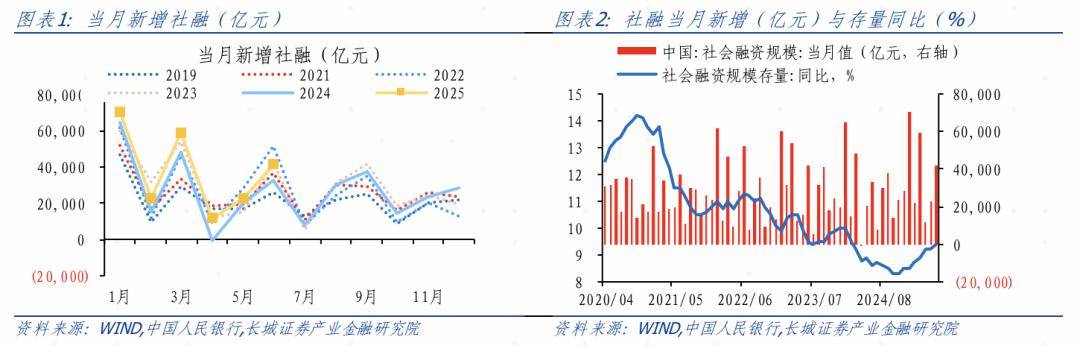
Core Viewpoint - The financial data for June indicates a significant increase in M1 and M2 growth rates, reflecting heightened liquidity and economic activity, primarily driven by government financing and seasonal factors, while consumer confidence remains cautious [1][2][3]. Group 1: Monetary Data - In June, the new social financing scale reached 4.2 trillion yuan, an increase of 900 billion yuan year-on-year, with a year-on-year growth rate of 8.9% for the social financing stock, up from 8.7% [1][2]. - M1 growth accelerated from 2.3% in May to 4.6% in June, while M2 increased from 7.9% to 8.3%, indicating improved liquidity and economic activity [1][3]. - The M2-M1 gap narrowed to 3.7% from 5.6% in the previous month, suggesting a more optimistic market outlook and enhanced production and consumption investment intentions [1][3]. Group 2: Financing Data - Government bond issuance remains robust, with net financing of 1.3548 trillion yuan in June, a year-on-year increase of 507.2 billion yuan, contributing to a total issuance of 7.66 trillion yuan in the first half of the year, which is 65% of the annual target [2][4]. - Corporate loan demand showed signs of recovery, with new corporate loans in June totaling 1.77 trillion yuan, an increase of 140 billion yuan year-on-year, indicating a strong seasonal performance [4][5]. - Resident loans increased moderately, with short-term loans rising due to seasonal consumption patterns, but overall performance remains weak compared to historical averages [5].