红利资产

Search documents
红利资产仍具备较强吸引力 业内认为其可作为底仓配置
Shen Zhen Shang Bao· 2025-07-07 22:47
Group 1 - The core viewpoint is that dividend assets remain attractive for investors in the current market environment, particularly those with high dividend levels, stable ROE capabilities, and shock-absorbing properties [1] - Historical experience indicates that A-shares typically enter a dividend peak period from May to July, making high-dividend sectors the focus of capital allocation [1] - The A-share dividend index and low-volatility index hit year-to-date lows on April 7, 2023, but have since rebounded significantly, with increases of 8.27% and 12.18% respectively from April 8 to July 7 [1] Group 2 - From April 8, 2023, several A-share dividend-related stocks have seen significant gains, with some stocks like Gongchuang Lawn and Limin Co. rising over 110% [2] - In the Hong Kong market, high-dividend stocks have also performed well, with many stocks rising over 50% from April 10 to July 7, including Hai Feng International and China Hongqiao [2] - Analysts suggest that the previous broad logic of dividend investment needs to be reassessed, recommending a focus on "pro-cyclical" sectors that benefit from the current economic recovery, particularly in the consumer sector [2]
股市特别报道·财经聚焦 丨红利主题基金强势吸金 ,机构称其在波动环境中更具“确定性”
Shen Zhen Shang Bao· 2025-07-07 15:01
Core Viewpoint - The recent performance of dividend-themed funds has been strong, driven by stable cash dividends and market fluctuations, leading to potential dual returns for investors [1][3]. Group 1: Fund Performance - Since April 10, several dividend-themed funds have seen significant net value increases, with 27 products rising over 20% and more than 70 funds increasing over 10% [1]. - Notable inflows into dividend-themed ETFs include nearly 2.7 billion yuan into the Southern S&P China A-share Large Cap Dividend Low Volatility ETF and over 2.5 billion yuan into the Huatai-PB Dividend Low Volatility ETF [1]. Group 2: Investment Strategy - Dividend index funds are evolving from traditional income tools to core components of asset allocation, addressing sustainability issues of high dividend companies through quantitative rules and periodic rebalancing [2]. - Investors can diversify their portfolios using dividend index funds, focusing on different cash flow schedules or reinvesting annual dividends for long-term growth [2]. Group 3: Market Conditions - In a volatile market, dividend assets provide high safety margins and stable cash flows, making them a more certain investment choice [3]. - The current valuation and dividend yield of dividend assets are attractive, with strong expectations for future capital inflows due to ongoing policy support for long-term investments [3]. Group 4: Hong Kong Market Insights - In the short term, Hong Kong dividend stocks exhibit advantages in dividends and valuations, supported by a favorable market environment [4]. - The mid-term outlook suggests continued value in Hong Kong dividends due to regulatory support for dividends and increased long-term capital inflows in a low-interest-rate environment [4].
股市特别报道·财经聚焦| 红利资产近来持续发力, 业内认为其依然可作为底仓配置
Shen Zhen Shang Bao· 2025-07-07 12:21
Core Viewpoint - The A-share dividend index and Hong Kong dividend assets have shown strong performance since April, indicating that high dividend levels, stable ROE capabilities, and defensive attributes remain attractive to investors in the current market environment [1] Group 1: Market Performance - A-share dividend indices hit year-to-date lows on April 7, with the CSI Dividend Index at 5040.64 points and the CSI Low Volatility Dividend Index at 10348.71 points, followed by a rebound with gains of 8.27% and 12.18% respectively from April 8 to July 7 [1] - The Hong Kong Dividend Index also reached a new low on April 9, but subsequently rose, achieving a historical high on May 23, with a cumulative increase of 19.77% from April 10 to July 7 [1] Group 2: Stock Performance - In the A-share market, several dividend-related stocks have seen significant gains since April 8, with companies like Gongchuang Turf and Limin Co. rising over 110%, and others like Chao Hong Ji and Giant Network increasing by 94% [2] - In the Hong Kong market, high dividend stocks such as Hai Feng International and China Hongqiao have risen over 50% from April 10 to July 7 [2] Group 3: Future Outlook on Dividend Assets - Analysts suggest that the attractiveness of equity markets is gradually surpassing that of bond markets, and the value of dividend assets as a core allocation remains [3] - Dividend assets can be categorized into three types: resource-based, utility-based, and growth-oriented, with a recommendation to focus on cyclical sectors that benefit from economic recovery [3][4] - The banking sector is highlighted as a potential beneficiary of long-term improvements in bad debt cycles, with a recovery in valuations expected due to a decline in non-performing loan rates [3] Group 4: Investment Strategy - The classification of "pan-dividend" assets into resource-type, bond-type, and growth-type is emphasized, with different types performing best during various economic cycles [4] - Growth-type dividends are expected to perform well during the "market bottom to profit bottom" phase, driven by active expansion of interest margins, while resource-type and bond-type dividends excel during initial slowdowns [4]
招商证券:交运基础设施板块基本面稳健 关注港股红利标的配置价值
智通财经网· 2025-07-07 08:14
智通财经APP获悉,招商证券发布研报称,基础设施板块业绩较为稳定、派息能力强,依然是优质的红 利标的,从估值优势上看,建议关注港股基础设施红利资产的配置价值。该行认为头部高速今年业绩稳 健、派息预期稳定,经过近期股价调整后股息率逐渐回归至4%左右,进入可配置区间。港口方面,看 好头部港口板块,中长期看分红有提升空间。综上,降息周期下红利资产仍有配置价值,当前基础设施 板块头部标的H股相较A股估值差仍存,未来有收敛空间,建议关注港股红利资产估值提升空间。 招商证券主要观点如下: 2025年上半年,市场风险偏好提升、偏防御风格的基础设施板块跑输wind全A指数 从交运各子板块涨跌幅来看,2025/1/2-2025/6/30申万高速公路指数下跌2.5%、申万港口指数下跌 1.2%、申万铁路指数下跌3.1%,wind全A指数上涨8.7%。公路、铁路、港口均跑输指数,主要原因是连 续3年上涨导致板块估值已基本修复至合理位置,且今年以来市场风险偏好提升、防御型板块关注度下 降。 25年上半年交运基础设施板块基本面表现符合预期,预计下半年高速公路维持稳健,铁路客运持续增 长、货运量有提升空间,港口集装箱吞吐持续好于散杂货 ...

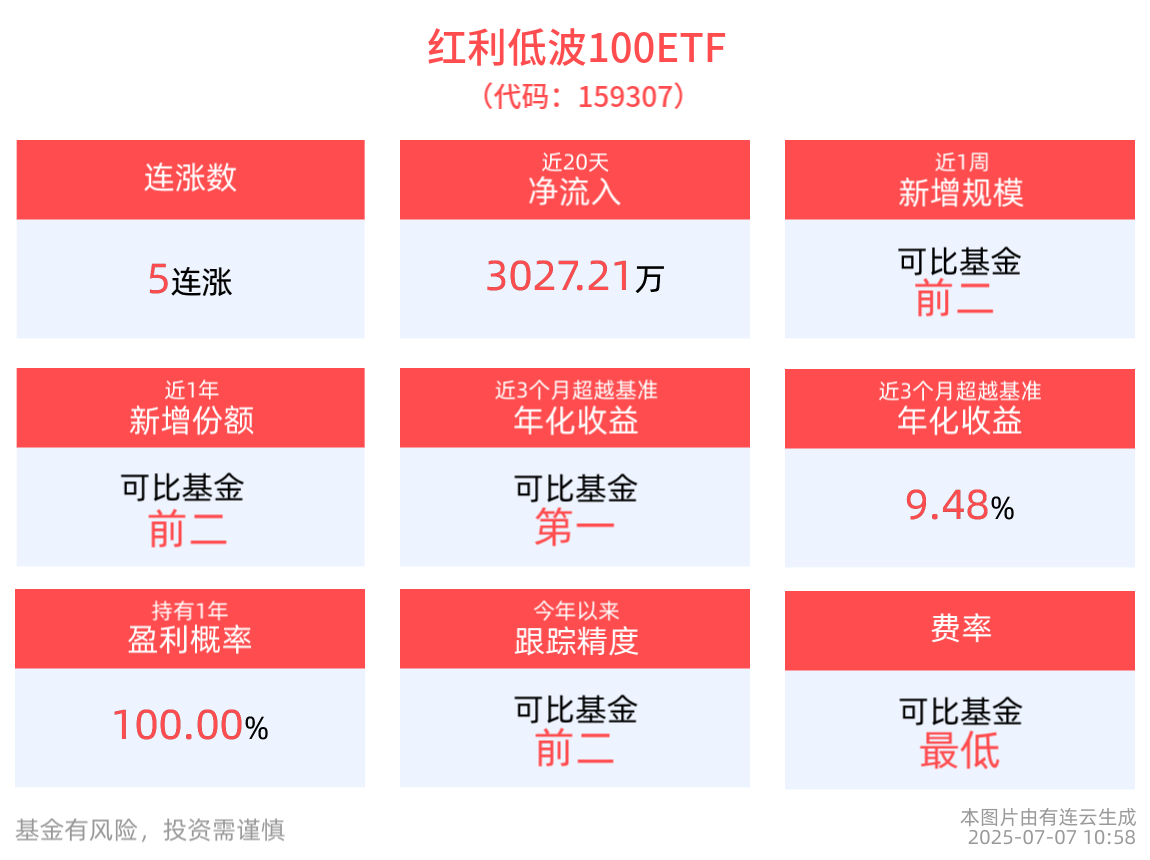
红利低波100ETF(159307)冲击5连涨,近1年净值涨幅排名可比基金第一,红利资产稳定性助力投资者锚定确定收益
Xin Lang Cai Jing· 2025-07-07 03:18
Core Viewpoint - The A-share market is experiencing a "dividend wave," with over 300 companies distributing more than 200 billion yuan in dividends, indicating a growing awareness of shareholder returns and improved regulatory mechanisms [2][3]. Group 1: Market Performance - As of July 4, 2025, the Dividend Low Volatility 100 ETF (159307) has seen a net value increase of 15.42% over the past year, ranking first among comparable funds [4]. - The ETF has achieved a maximum monthly return of 15.11% since its inception, with an average monthly return of 3.47% during the months it has risen [4]. - The ETF's year-to-date maximum drawdown is 6.18%, indicating lower drawdown risk compared to its benchmark [4]. Group 2: Fund Flows and Liquidity - The Dividend Low Volatility 100 ETF has experienced a significant increase in scale, with a growth of 545.32 million yuan over the past week, ranking second among comparable funds [3]. - The ETF has seen a net inflow of 3,027.21 million yuan over the last 20 trading days, with an average daily net inflow of 151.36 million yuan [3]. - The ETF's latest financing buy-in amount is 197.30 million yuan, with a financing balance of 1,466.43 million yuan [3]. Group 3: Index Composition - The Dividend Low Volatility 100 Index (930955) selects 100 stocks with good liquidity, continuous dividends, high dividend yields, and low volatility, reflecting the overall performance of such securities [5]. - As of June 30, 2025, the top ten weighted stocks in the index account for 20.14% of the total index weight [6].

2025年中期大类资产配置报告:红利资产从共识到分化的再审视
Guohai Securities· 2025-07-06 09:32
Macroeconomic Overview - China's macroeconomic situation shows structural recovery, with retail sales growing by 6.4% year-on-year in May, supported by policies like trade-in programs[8] - Industrial production remains stable, with a 5.8% year-on-year increase in May, although PPI fell by 3.3% year-on-year, indicating weak demand in the industrial sector[8][14] Asset Allocation Strategy - The attractiveness of equity markets is gradually surpassing that of bond markets, with a recommendation to focus on "pro-cyclical" sectors benefiting from economic recovery, particularly in consumer goods[9][28] - A quantitative model for asset allocation suggests a risk budget weight of 40% for equities, 15% for government bonds, 35% for commodities, and 25% for gold, with specific recommended allocations of 13.95% in stocks and 57.93% in bonds[9][57] Dividend Assets Analysis - Dividend assets are categorized into three types: defensive assets (utilities), pro-PPI cyclical assets (coal and oil), and pro-CPI cyclical assets (consumer sectors), with a shift in investment logic required for the current market[40][44] - The valuation of dividend assets has been rising since 2023, with the PE and PB ratios of the CSI Dividend Index at 68% and 39.53%, respectively, indicating room for valuation improvement compared to major indices[33][56] Banking Sector Insights - The non-performing loan (NPL) rate in Chinese banks peaked in 2020 and has been declining, suggesting a potential for valuation recovery in the banking sector, which is supported by long-term capital inflows from insurance companies[45][53] - Insurance capital has significantly increased its holdings in bank stocks, with 19 instances of stake increases in 2025 alone, indicating strong institutional confidence in the banking sector[55][56]
东方证券:重点关注盈利稳定、高分红的电解铝板块投资机会 建议关注中国宏桥
Zhi Tong Cai Jing· 2025-07-04 03:32
Group 1 - The core viewpoint is that with the continuous destocking of aluminum chain and aluminum processing products, primary aluminum prices are expected to maintain an upward trend, and leading companies may exhibit higher profit elasticity [1] - In the short term, there is no favorable demand side, while in the medium term, investment should focus more on supply-side logic [1] - The current overall dividend yield of the sector remains attractive compared to other dividend assets, suggesting a focus on China Hongqiao (01378) [1] Group 2 - Long-term stable low-cost electricity supply is a hard constraint for the domestic and international electrolytic aluminum industry [2] - Although overseas energy costs have been at a low level in recent years, there may be significant upward risks in the future [2] - The electrolytic aluminum industry is expected to maintain a good supply-demand pattern in the medium term [2] Group 3 - The stability of the supply-demand pattern is expected to enhance the stability of future industry profits [3] - Continuous decline in capital expenditure within the electrolytic aluminum industry is likely to lead to sustained improvements in the balance sheets of listed companies, ultimately reflecting in increased dividends and buybacks [3] - Major listed companies in the electrolytic aluminum sector are projected to have dividend yields close to 6% [3]

有色钢铁行业周观点(2025年第26周):重点关注盈利稳定、高分红的电解铝板块投资机会-20250703
Orient Securities· 2025-07-03 10:15
Investment Rating - The report maintains a "Positive" investment rating for the non-ferrous and steel industries [5] Core Viewpoints - The focus is on investment opportunities in the stable and high-dividend electro-aluminum sector [2][9] - Short-term demand concerns are alleviated, with a greater emphasis on supply-side logic for mid-term investments [8][13] - Long-term stable and low-cost electricity supply is a critical constraint for the electro-aluminum industry [14] - The supply-demand balance is expected to ensure stable profitability and dividends, making the electro-aluminum sector a true dividend asset [14] Summary by Sections Electro-Aluminum Sector - Concerns about downstream demand affecting short-term profitability are noted, but the report argues that short-term demand is not a worry [8][13] - Inventory levels in the electro-aluminum sector are decreasing, indicating a healthy supply-demand balance [8][13] - The report emphasizes the importance of stable, low-cost electricity supply as a hard constraint for the electro-aluminum industry [14] - Future profitability is expected to be stable, with major companies potentially achieving a dividend yield close to 6% [14] Steel Sector - The steel industry is entering a demand lull, with a focus on monitoring production reduction policies [15] - Rebar production has increased significantly, with a slight rise in consumption [15][16] - Total steel inventory has seen a slight increase week-on-week but a significant decrease year-on-year [22] - Steel prices have shown a slight decline, with the overall price index down by 0.49% [35][36] New Energy Metals - Lithium production in May 2025 saw a significant year-on-year increase of 31.37% [39] - The production of new energy vehicles in China has also risen sharply, with a 33.02% increase in production [43] - Prices for lithium and nickel have shown an upward trend, indicating a robust market [48][49]


私募上半年成绩单出炉事件应对成致胜关键
Zhong Guo Zheng Quan Bao· 2025-07-02 20:16
Group 1 - The A-share market in the first half of 2025 experienced significant volatility, leading to a stark performance divergence among private equity firms, with some capitalizing on new trends while others faced losses [1] - Notable private equity firms like Tongben Investment achieved substantial positive returns due to the rise of the new consumption sector, shifting their focus from "big consumption" to "new consumption" since November 2024 [1][2] - The emergence of new consumption is fundamentally a supply-side transformation, driven by factors such as high demand in niche markets and a generational shift towards younger consumers who prioritize emotional value in products [2] Group 2 - The first half of 2025 was characterized by wide fluctuations and structural opportunities in the stock market, with many investors struggling to navigate the volatility and identify long-term trends [2][3] - Key time points included the "DeepSeek moment" before the Spring Festival and overseas disturbances in early April, which influenced the technology sector's revaluation [3] - Some private equity firms reflected on their low allocation to the banking and insurance sectors, which performed well in June, indicating a need for increased research focus on these areas [3] Group 3 - Looking ahead, private equity firms remain optimistic about the second half of the year, focusing on sectors such as artificial intelligence, new consumption, innovative pharmaceuticals, and dividend assets [3][4] - Long-term funds are expected to anchor on fundamentals while speculative funds will seek out previously stagnant sectors for quick rotations, suggesting a complementary market dynamic rather than a zero-sum game [4] - Specific investment directions include a continued emphasis on "technology + consumption," with an increased focus on leading companies in the new consumption space and a broader definition of the technology sector [4]
中国资产这半年
Shang Hai Zheng Quan Bao· 2025-07-02 18:29
Group 1: Brokerage Performance - In the first half of the year, 27 out of 34 brokerage firms' stock selection portfolios reported positive returns, accounting for nearly 80% [2][4] - Huaxin Securities and Dongxing Securities led with returns exceeding 30%, at 35.59% and 34.72% respectively [3][4] - The top-performing stocks in June included Giant Network, which saw a monthly increase of 63.09%, and Shenghong Technology, with gains over 50% [4][5] Group 2: Fund Performance - Active equity funds achieved an average return of 6.78% in the first half of the year, with over 80% reporting positive returns [9][10] - Notably, 347 funds had returns exceeding 20%, and 50 funds surpassed 40%, with 11 funds achieving over 60% [9][10] - The top-performing fund was the CITIC Construction North Exchange Selected Mixed Fund, with a return of 82.45% [10] Group 3: Investment Outlook - Brokerages expect the A-share market to trend upwards in the second half, focusing on emerging technology sectors and maintaining dividend assets as core holdings [7][8] - Key sectors for investment include AI, defense, and high-tech manufacturing, with a shift towards core asset trends anticipated [8] - Fund managers are optimistic about opportunities in AI, pharmaceuticals, and consumer sectors, suggesting a proactive investment strategy [11][12] Group 4: Macro Economic Insights - External factors have shown that Chinese assets are increasingly attractive, with resilience being a key characteristic of the macro economy [13][14] - Consumer performance has exceeded expectations, supported by policies like the trade-in subsidy, while exports have also remained strong [14] - The influx of southbound capital into Hong Kong stocks has been significant, with net inflows reaching 731.19 billion HKD, indicating robust market interest [17]