
储能

Search documents
锂电反转,天赐材料打响年报第一枪
Shang Hai Zheng Quan Bao· 2026-01-05 01:29
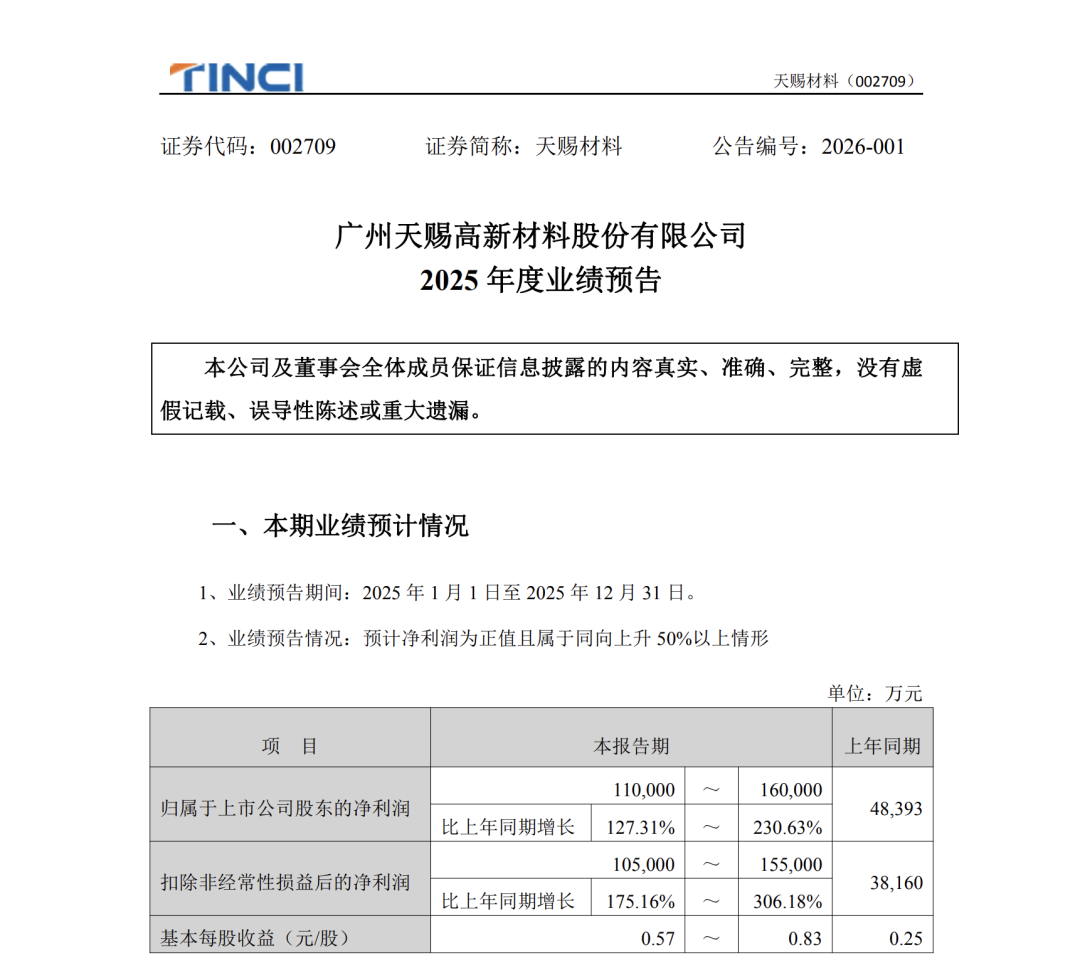
Core Viewpoint - Tianqi Materials (002709) expects a significant increase in net profit for 2025, projecting a range of 1.1 billion to 1.6 billion yuan, representing a growth of 127.31% to 230.63% compared to 2024 [1][3]. Financial Performance - The net profit attributable to shareholders is forecasted to be between 1.1 billion and 1.6 billion yuan, with a year-on-year growth of 127.31% to 230.63% [1][3]. - The net profit after deducting non-recurring gains and losses is expected to be between 1.05 billion and 1.55 billion yuan, reflecting a growth of 175.16% to 306.18% compared to the previous year [3]. - Basic earnings per share are projected to be 0.57 yuan to 0.83 yuan, up from 0.25 yuan in the previous year [3]. Market Position and Product Demand - The company has maintained a leading position in the global sales of lithium-ion battery electrolytes, increasing its market share from 28.8% in 2021 to 36.4% in 2023, with a production volume exceeding 390,000 tons in 2023 [4]. - The demand for lithium-ion battery materials has surged due to the growth in the new energy vehicle market and the rapid expansion of the energy storage market [1][4]. Production Capacity and Sales Forecast - Tianqi Materials currently has an electrolyte production capacity of approximately 850,000 tons and a lithium hexafluorophosphate production capacity of about 110,000 tons, with core products reaching near full production capacity [5]. - The company anticipates selling 720,000 tons of electrolytes in 2025, exceeding its initial target of 700,000 tons for the year [5]. Recent Developments and Contracts - In the second half of 2025, Tianqi Materials secured significant contracts for electrolyte procurement with major players in the energy storage battery sector, totaling nearly 3 million tons [4].


十大券商策略:看好“有新高”组合!
天天基金网· 2026-01-05 01:05
上天天基金APP搜索777注册即可领500元券包,优选基金10元起投!限量发放!先到先得! 中信证券:人心思涨,预计开年市场震荡向上 从机构的赚钱效应来看,2025年在过去10年里能排到第三,过去20年里排到第六。在一个回头来看巨大 的结构性牛市当中,实际上市场既享受了预期差带来的"估值的钱",也挣到了"业绩的钱",预期差来自于 对中国自主科技能力的重估以及中美关系,而结构性的超预期业绩来自复杂贸易环境下外需的韧性以及AI 推理需求爆发,这些因素站在2025年初来看并不是那么理所应当会发生。增量流动性只是预期差和业绩 兑现过程中的结果,或者是用于后验的解释牛市形成的理由,投资者过于高估了增量资金对市场的影响。 增量资金入市不会是2026年市场上一个新台阶的主要因素。2026年最大的预期差来自于外需与内需的平 衡,对外"征税"、补贴内需应是大势所趋,今年是个重要的开端。站在开年,考虑到去年末的资金热度并 不算高,人心思涨的环境下开年后市场震荡向上的概率更高。 国泰海通:一年之计在于春 在市场持续反弹之际,中国股市有望跨越与站稳重要关口。海外流动性的宽松,叠加春节前结汇,有望推 动人民币的稳定与升值。以A500E ...




AI注能变革,内外需求共振
Zhong Guo Neng Yuan Wang· 2026-01-05 00:55
Core Viewpoint - The report from Guojin Securities indicates that the domestic power grid equipment market is expected to exceed 2 trillion yuan by 2026, with a year-on-year growth of 15%, driven by significant changes in industry dynamics, particularly in domestic and international markets [1][2]. Market Size and Growth - The estimated total market size for domestic power grid equipment enterprises in 2026 is over 2 trillion yuan, with a year-on-year increase of 15% [2]. - Breakdown of market segments includes: - Domestic grid (approximately 823 billion yuan, yoy +9%) [2]. - External grid (approximately 580 billion yuan, yoy +19%) [2]. - International market (approximately 665 billion yuan, yoy +20%) [2]. Industry Dynamics - The industry is entering a new phase characterized by stable growth and structural differentiation, with a focus on international expansion and main grid development as key drivers [2]. - The report highlights ten segments to track and assess market conditions, indicating a global upcycle in power equipment [2]. Segment Analysis - Main grid (high growth maintained): In 2026, the bidding for transmission and transformation equipment is expected to reach 91.9 billion yuan, a year-on-year increase of 26% [3]. - Ultra-high voltage (bottoming out): Approval for new projects is expected to accelerate post-Q4 2025, with five new direct current lines anticipated in 2026 [3]. - Distribution network (upward turning point): Material bidding from January to November showed a year-on-year decrease of 4%, but prices for the second batch of regional joint procurement equipment have increased by 10% to 30% [3]. - Smart meters (downward trend slowing): Bidding for smart meters in 2025 is approximately 15 billion yuan, a year-on-year decrease of 40%, but new standards in 2026 are expected to lead to price increases [3]. - Digitalization of the grid (bottoming out): Bidding for digital equipment in 2025 is expected to reach 4.2 billion yuan, a year-on-year increase of 70% [3]. - Export opportunities for transformers and switchgear remain strong, with significant year-on-year growth in exports [3]. Investment Recommendations - Focus on the transformer segment, which is expected to benefit from technological innovation and increased demand [4]. - Solid-state transformers (SST) are highlighted as a disruptive technology with significant commercial potential, expected to see validation in 2026 and commercialization in 2027 [5]. - Attention is drawn to the anticipated recovery in domestic investments under the "14th Five-Year Plan," particularly in ultra-high voltage policies and new smart meter standards [5].
天赐材料2025年业绩预喜最高赚16亿 电解液销量超预期锁定近300万吨长单
Chang Jiang Shang Bao· 2026-01-05 00:20
长江商报消息 ●长江商报记者 潘瑞冬 锂离子电池材料生产商天赐材料(002709.SZ)业绩大涨。 12月30日晚间,天赐材料发布2025年度业绩预告,预计归母净利润为11亿元至16亿元,同比增长 127.31%至230.63%;扣非净利润为10.5亿元至15.5亿元,同比增长175.16%至306.18%。 天赐材料表示,新能源车市场需求持续增长以及储能市场需求快速增长,公司锂离子电池材料销量同比 大幅增长。同时因公司核心原材料的产能爬坡与生产环节的成本管控,整体盈利能力提升。 长江商报记者注意到,2025年全年天赐材料电解液销量预计达72万吨,超额完成年初制定的70万吨目 标,目标完成率达约103%。 第四季度归母净利最高预增7倍 其中四季度涨势尤为迅猛,9月末价格仅6.1万元/吨,12月已飙升至18万元/吨,涨幅高达195%。此轮涨 价由供需失衡驱动,储能与新能源汽车需求爆发,而行业有效产能收缩、库存低位,形成供需紧平衡。 2025年电解液销量超额完成目标 价格上涨已传导至产业链,天赐材料满产运行。 11月下旬,天赐材料在投资者活动中表示,公司当前电解液产能达85万吨,六氟磷酸锂产能约11万吨, 受益于 ...
周期论剑|新年周期打头阵-思路详解
2026-01-04 15:35
Summary of Key Points from Conference Call Industry Overview - **A-Share Market Performance**: The Shanghai Composite Index rose by 18.41% in 2025, indicating a positive market outlook for 2026, driven by expectations of U.S. interest rate cuts and increased liquidity in overseas markets [2][3]. - **Chemical Industry**: The chemical sector showed strong performance in 2025, with expectations of continued growth into 2026, as supply pressures ease and some products see price increases [10][11]. - **Aviation Industry**: The aviation sector experienced a 13% increase in passenger traffic during the New Year period, with ticket prices rising over 10% year-on-year. Future growth is anticipated due to low supply growth and recovering demand [6]. - **Oil Shipping Industry**: The oil shipping sector is at a four-year high, driven by increased oil production. The next five years are expected to see continued demand growth [8][9]. Core Insights and Arguments - **Market Trends**: The A-share market is expected to benefit from several factors, including anticipated U.S. interest rate cuts, a stable and appreciating RMB, and supportive policies for investment and real estate [2][3]. - **Price Increase Logic**: Price increases are emerging in sectors like chemicals and new energy materials due to improved demand and constrained supply. The TMT supply chain is also experiencing price hikes due to demand expansion [4]. - **Investment Recommendations**: - **Technology Growth**: Positive outlook for technology sectors, including internet, electronics, and power equipment [5]. - **Non-Banking Financials**: Favorable conditions for insurance and brokerage firms [5]. - **Cyclical Sectors**: Sectors benefiting from domestic demand and stable real estate policies, such as tourism and consumer goods, are recommended [5]. Additional Important Insights - **Industrial Metals**: The industrial metals market is optimistic for 2026, with supply disruptions and increased demand from AI and traditional sectors driving growth [15]. - **Chemical Sector Recommendations**: Key companies to watch include Hualu Hengsheng in coal chemicals and leading firms in the refrigerant and new materials sectors [11]. - **Coal Market Outlook**: The coal market is expected to stabilize, with prices projected to rise in the latter half of 2026 after a period of decline [22][24]. - **Real Estate Sector**: The real estate sector is receiving renewed attention from policymakers, indicating potential recovery and investment opportunities in leading companies [25]. This summary encapsulates the key points discussed in the conference call, highlighting the performance and outlook of various industries, along with strategic investment recommendations.
【十大券商一周策略】看多马年春节,短线两手准备!看好“有新高”组合
券商中国· 2026-01-04 14:57
Group 1 - The core viewpoint is that the market is expected to experience a震荡向上 (upward fluctuation) at the beginning of the year, driven by a combination of structural bull market factors and improved investor sentiment [2][4][5] - The anticipated balance between external and internal demand will be a significant factor in 2026, with policies aimed at boosting domestic demand becoming increasingly important [2][3] - The spring market is likely to continue its upward trend, supported by improving economic data, ample liquidity, and positive policy signals [4][8] Group 2 - The A-share market is expected to see a "开门红" (opening red) at the start of the year, with significant inflows of institutional funds and a favorable liquidity environment [6][10] - The 2026 bull market is characterized by a combination of basic cyclical improvements, new technological trends, and increased asset allocation towards equities [5][8] - Investment strategies should focus on sectors benefiting from new growth themes, such as AI, renewable energy, and industrial automation, while also considering cyclical recovery opportunities [9][11]

国泰海通 · 晨报260105|元旦“微度假”热度高
国泰海通证券研究· 2026-01-04 13:14
Macro Insights - The New Year's holiday saw a significant increase in travel, with inter-regional mobility growing by 19.5% year-on-year, reaching a recent high. Short-distance "micro-vacations" have become mainstream, with strong performance in service consumption, particularly in entertainment. However, product consumption has declined due to the waning effects of year-end sales [4]. - Real estate sales are showing marginal declines, although the easing of purchase restrictions in first-tier cities has released some demand. Infrastructure and construction are still constrained by insufficient new projects [4]. - The port operations remain stable, but there is a divergence in domestic import freight rates and the Baltic Dry Index (BDI). Most industries are experiencing a decline in operating rates, with petrochemicals and automotive sectors showing weak performance due to rising costs and falling demand, while emerging sectors like lithium batteries and photovoltaics are performing well [4]. - The Producer Price Index (PPI) is generally rising, while the Consumer Price Index (CPI) shows mixed results. The RMB exchange rate has surpassed 7.0, with funding rates and government bond yields trending upward [4]. Strategy Insights - The A-share market is expected to see a "spring opening red" as it closed at 3968.84 points in 2025, marking an 18.41% annual increase. The market sentiment has shifted towards optimism, with expectations of a potential interest rate cut in the U.S. in 2026 [8]. - The influx of incremental capital, particularly through A500 ETF and insurance funds, is expected to solidify liquidity. The government has emphasized the need to stabilize and improve real estate market expectations, indicating a proactive approach to boosting growth [8][9]. - The central bank's fourth-quarter meeting highlighted the importance of price signals for promoting stable economic growth and reasonable price recovery, with a gradual emergence of price increases in certain sectors due to improved demand and supply constraints [10]. Industry Comparisons - The technology sector, particularly in AI and emerging industrialization trends, is expected to see strong growth. The domestic chip technology breakthroughs and storage price increases are anticipated to continue, with a focus on companies with global competitive advantages [11]. - Non-bank financial institutions are likely to benefit from increased demand for wealth management and the migration of household deposits, with recommendations for insurance and brokerage firms [11]. - The cyclical sectors are showing signs of improvement, with low valuations and positioning, benefiting from policies aimed at expanding domestic demand and stabilizing the real estate market. Recommendations include tourism services, hotels, and consumer goods [11]. - Specific themes to watch include AI applications, robotics, commercial aerospace, and domestic consumption, with a focus on new consumption patterns and service sectors [11].

投资策略周报:春季躁动提前启动,牛市格局依旧未改-20260104
HUAXI Securities· 2026-01-04 13:00
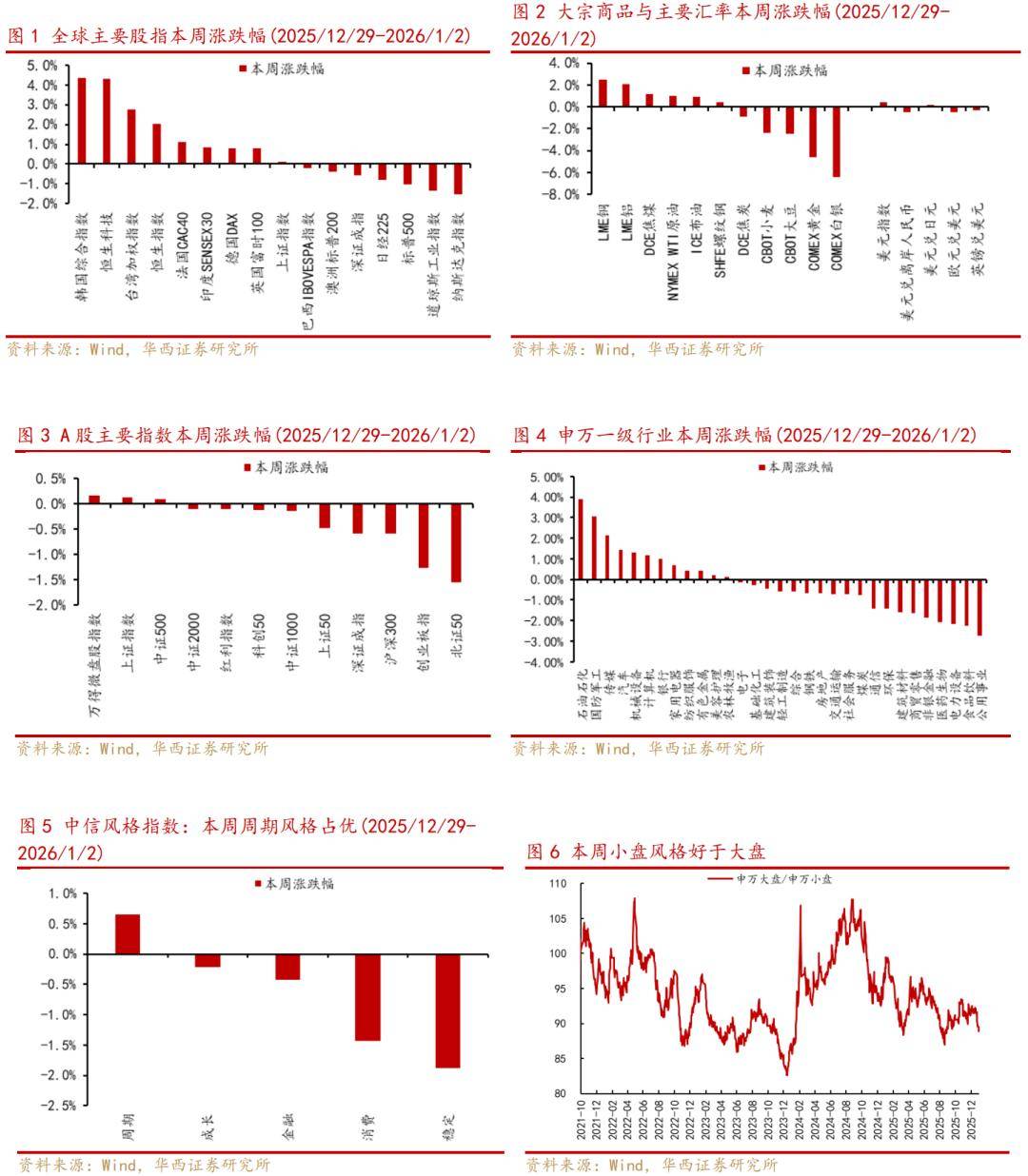
Market Review - The South Korean Composite Index, Hong Kong's Hang Seng Tech Index, and Taiwan Weighted Index led global gains, while US stock indices declined during the week of December 29, 2025, to January 2, 2026. In the A-share market, cyclical and growth sectors performed well, with oil, military, and media industries leading, while utilities faced the largest declines [1] - On January 2, the first trading day after New Year's, the Hong Kong stock market experienced a "good start," with the Hang Seng Tech Index surging 4% in a single day, particularly in semiconductor, AI computing, and internet giants, indicating a recovery in market risk appetite [1] Market Outlook - The year 2026 is anticipated to be a "big year" with multiple positive factors converging, maintaining a solid bull market foundation. The spring rally has started early due to several reasons: 1. Macro policy cycle indicates that 2026, as the first year of the 14th Five-Year Plan, will see multiple departments intensifying the rollout of supporting industrial policies and investment plans, creating a favorable liquidity environment through coordinated fiscal and monetary policies [2] 2. In December, institutional funds, represented by stock ETFs, showed significant inflows, with insurance funds expected to contribute to the market's upward trend due to favorable exchange rate movements [2] 3. With the narrowing decline in PPI, corporate earnings are expected to enter a mild recovery phase in 2026, making the bet on earnings inflection points a crucial support for the market [2] Key Focus Areas - The new chairperson of the Federal Reserve is a focal point this month, with the December meeting minutes indicating a majority support for further rate cuts, although there are significant policy path divergences among officials. The probability of a rate cut in January is currently low at 17% [2] - The manufacturing PMI for December 2025 returned to the expansion zone at 50.1%, with production and new orders indices at 51.7% and 50.8%, respectively, indicating improvements in both supply and demand [3] - The non-manufacturing PMI also rose to 50.2%, with the construction sector PMI at 52.8%, reflecting the effectiveness of policy-driven financial tools [3] Policy Measures - The National Development and Reform Commission has issued a list of early construction projects and a central budget investment plan totaling approximately 295 billion yuan for 2026 [4] - The "two new" policies for 2026 will continue and be optimized, with the first batch of 62.5 billion yuan in subsidy funds being released early [4] - New local government bond limits will also be issued ahead of schedule, alongside measures in the real estate sector to reduce transaction costs for residents [4] Institutional Investment Trends - Since December, there has been a significant net inflow of institutional funds, particularly into A500-related ETFs, indicating a proactive approach to the spring rally [5] - The beginning of the year typically sees aggressive credit issuance from banks, which is expected to improve the liquidity outlook for the real economy and enterprises [5] - Recommended sectors for investment include emerging growth themes supported by industrial policies, such as AI computing, robotics, and domestic substitution, as well as sectors benefiting from "anti-involution" and price increases, such as chemicals and new energy [5]
李立峰、张海燕:春季躁动提前启动,牛市格局依旧未改
Sou Hu Cai Jing· 2026-01-04 12:53
Market Review - The South Korean Composite Index, Hong Kong's Hang Seng Tech Index, and Taiwan Weighted Index led global gains, while US stock indices declined during the week of December 29, 2025, to January 2, 2026. In the A-share market, cyclical and growth sectors performed well, with oil and petrochemicals, military industry, and media leading gains, while utilities lagged behind. On January 2, 2026, the Hong Kong stock market opened strong, with the Hang Seng Tech Index surging 4%, particularly in semiconductor, AI computing, and internet giants, indicating a recovery in market risk appetite. In commodities, base metals and crude oil rose, while precious metals fell, with COMEX silver and gold down 6.39% and 4.63%, respectively. The offshore RMB strengthened against the US dollar, surpassing 6.97 on Friday [1][2][3]. Market Outlook - The market is expected to maintain a bullish trend into 2026, driven by several positive factors. The macro policy cycle is favorable, with multiple departments rolling out supportive industrial policies and investment plans as 2026 marks the start of the 14th Five-Year Plan. Coordinated fiscal and monetary policies are creating a friendly liquidity environment. Institutional funds, particularly in stock ETFs, have shown significant inflows, indicating a strong willingness to invest as foreign capital returns due to currency appreciation. The narrowing decline in PPI suggests a mild recovery in corporate profits, which will support market sentiment [2][4][5]. Key Focus Areas 1. **Overseas Developments**: The selection of a new Federal Reserve Chair is a key focus, with the December meeting minutes indicating a majority support for further rate cuts, though there are significant policy path divergences. The probability of a rate cut in January is low at 17%, with potential candidates like Hassett and Waller advocating for further easing [2][3]. 2. **PMI Data**: Both manufacturing and non-manufacturing PMIs returned to expansion territory in December 2025, with manufacturing PMI at 50.1% and non-manufacturing PMI at 50.2%. This improvement in production and new orders supports the spring market rally [3][4]. 3. **Policy Measures**: The government has implemented a series of targeted policies to boost market confidence, including a 295 billion yuan investment plan and early release of subsidies and local debt limits. The real estate sector is also seeing policy adjustments to lower transaction costs, which may stabilize market expectations [4][5]. 4. **Institutional Investment Trends**: There has been a notable net inflow of institutional funds into stock ETFs, particularly those related to the A500 index, indicating a proactive approach to the upcoming spring market rally. The favorable policy outlook and stable currency are expected to attract further foreign investment [5]. Industry Focus - The focus for industry investment should be on emerging growth sectors supported by policy, such as AI computing, robotics, and energy storage, as well as sectors benefiting from price increases and "anti-involution" trends, including chemicals and non-ferrous metals [5].
别卷峰谷价差了!储能“新路子”席卷!下一轮赢家是它?
Xin Lang Cai Jing· 2026-01-04 11:30
Core Insights - The Guangdong electricity spot market has welcomed the first five power generation virtual power plant trading units, with a total capacity of approximately 33 million kilowatts, marking a significant step towards fair market entry for distributed renewable energy resources [1][10] - The virtual power plants, formed by aggregating distributed photovoltaic, user-side energy storage, and charging piles, allow for active market participation, transforming previously passive grid resources into responsive market entities [1][10] - The Jiangsu province has also accelerated its virtual power plant development, aiming for a regulation capacity of over 5 million kilowatts by 2030, with an initial investment of approximately 10.39 million yuan for 100 projects [1][10] Group 1: Market Dynamics - The traditional peak-valley arbitrage model for commercial energy storage is losing its certainty due to changes in market conditions, with the installed capacity of renewable energy expected to exceed 1.2 billion kilowatts by 2025 [3][12] - The price of electricity during peak hours has risen, while daytime prices have dropped below 0.2 yuan per kilowatt-hour, making it challenging for energy storage to maintain profitability [3][12] - Policy adjustments have further weakened the economic viability of projects relying solely on peak-valley price differences, as new regulations remove the safety net of government-mandated time-of-use pricing [4][13] Group 2: Virtual Power Plant Benefits - Virtual power plants are redefining energy storage revenue models by combining aggregation of distributed resources with intelligent scheduling, leading to a composite revenue model that includes basic arbitrage and various ancillary services [5][14] - The accuracy of power forecasting for aggregated resources has reached over 92%, with deviation assessment costs reduced by 67% [5][14] - The revenue sources for virtual power plants include dynamic basic arbitrage, peak shaving services, frequency regulation, and demand response, showcasing a shift from single arbitrage tools to flexible adjustment assets [7][16] Group 3: Industry Transformation - Leading companies in the energy storage sector are transitioning from equipment manufacturing to service-oriented business models, enhancing their capabilities across the entire value chain [8][18] - Major players like Envision and Huawei are integrating hardware, software, and operational services to maximize the lifecycle value of energy storage systems [8][18] - Cross-industry players, including state-owned enterprises, are leveraging their resources to establish a comprehensive advantage in the virtual power plant market [8][19] Group 4: Policy and Technological Drivers - National policies have set ambitious targets for virtual power plant regulation capacity, aiming for 20 million kilowatts by 2027 and over 50 million kilowatts by 2030 [9][19] - Local governments are exploring differentiated policies, such as Guangdong's open load-type virtual power plant trading and Jiangsu's focus on cultivating demonstration projects [9][19] - The future of energy storage is seen as promising, with virtual power plants enabling scale effects and transitioning from single arbitrage to diversified revenue streams, supported by ongoing technological advancements and policy improvements [9][19]