自由现金流

Search documents
现金流ETF南方(159232)红盘上扬,活跃5连涨,A股再迎分红潮,红利资产或迎较好布局时点
Xin Lang Cai Jing· 2025-06-26 03:24
Group 1 - The cash flow ETF from Southern (159232) has risen by 0.29%, marking its fifth consecutive increase, with a turnover of 6.76% and a transaction volume of 38.3043 million yuan [1] - The index it tracks, the CSI All Share Free Cash Flow Index, increased by 0.21%, with notable gains from constituent stocks such as Yiming Pharmaceutical (up 3.42%), Bohai Ferry (up 2.95%), and Western Mining (up 2.77%) [1] - The fund aims to reflect the overall performance of listed companies with strong cash flow generation capabilities by focusing on the key financial indicator of free cash flow [1] Group 2 - Approximately 350 A-share companies are set to implement annual report dividend distributions this week, with a total dividend amount exceeding 200 billion yuan [1] - CITIC Securities suggests that after June, dividend assets may present a favorable timing for investment, recommending investors to maintain focus on dividend and new sectors [2] - The top ten weighted stocks in the CSI All Share Free Cash Flow Index include Midea Group, China Shenhua, and China National Offshore Oil Corporation, indicating a concentration in high cash flow generating companies [2]
顺丰控股(002352):解码顺丰系列研究(20):自由现金流视角看顺丰:利润表外的精彩
Huachuang Securities· 2025-06-23 14:05
Investment Rating - The report maintains a strong buy rating for SF Holding (002352) [1] Core Views - The report emphasizes the sustainable optimization of free cash flow as a reflection of the company's evolving business and operational models [1][10] - Key drivers identified include the upward trend in EBIT and the stabilization of capital expenditures leading to steady depreciation and amortization [12][35] Summary by Sections Revenue Growth - The company has implemented a comprehensive organizational restructuring to activate operations, aiming to unleash employee potential while maintaining the advantages of a direct sales model [2] - Initial results show that from March 2025, the volume growth rate has surpassed the industry average, with growth rates of 25.4%, 30.0%, and 31.8% in March to May respectively [2][53] - The structure of time-sensitive packages is shifting from business packages to consumer and industrial manufacturing sectors, becoming a major growth driver [2][67] - The number of monthly settled customers reached 2.3 million by the end of 2024, an 18% year-on-year increase, while individual users grew to 730 million, a 10% increase [2][67] Cost Management - The company is pursuing a large operational model transformation to support ongoing cost reductions, with a focus on four major areas, ten links, and twenty-one measures [2] - The introduction of "cages" is seen as a key tool for transforming the last-mile delivery process [2] Future Business Volume - The report raises questions about the sustainability of accelerated business volume growth, particularly regarding the impact of "unmanned vehicles + cages + flexible urban capacity" [3][11] - The use of unmanned vehicles and cages is projected to significantly reduce costs in the last-mile delivery segment, with estimated savings of 2,200 yuan per month per route [3][11] Capital Expenditure and Depreciation - The peak of capital expenditure has passed, with total capital expenditures decreasing from 289 billion yuan in 2021 to an estimated 107 billion yuan in 2024, leading to a stabilization in depreciation and amortization [12][43] - The effective tax rate has been declining, contributing to improved cash flow [46] Profitability Forecast - The report adjusts profit forecasts for 2025-2027, projecting net profits of 12.09 billion, 13.99 billion, and 15.91 billion yuan respectively, with corresponding EPS of 2.42, 2.80, and 3.19 yuan [13] - The target price for the stock is set at 62.7 yuan, reflecting a 24% upside from the current market value [14]

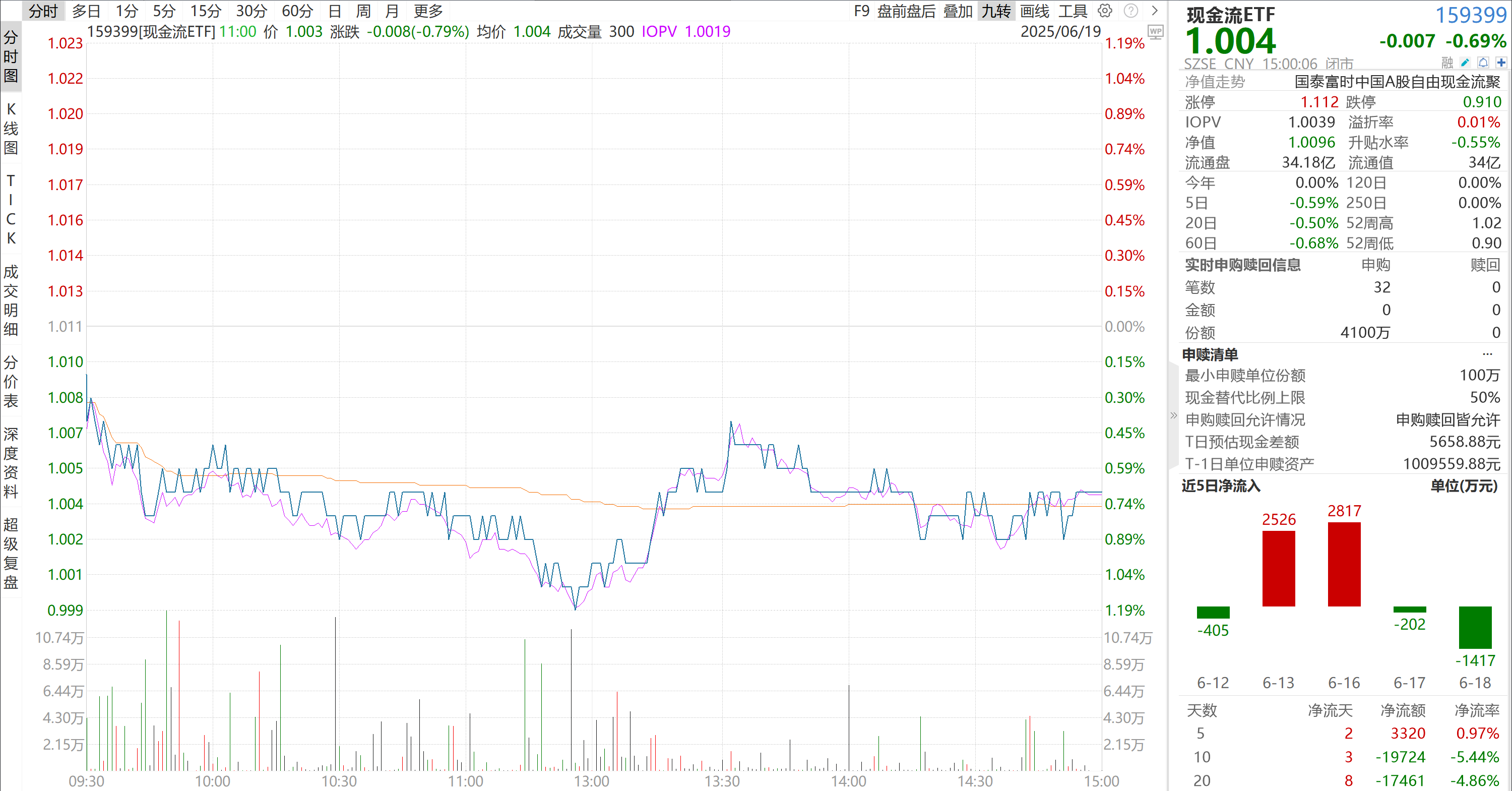
市场回调,红利资产再受青睐 现金流ETF(159399)盘中净流入超4000万元
Mei Ri Jing Ji Xin Wen· 2025-06-19 07:58
Market Overview - The market experienced a broad decline, with sectors such as textiles, beauty, non-ferrous metals, and pharmaceuticals leading the losses, while the oil sector saw an increase. The Shanghai Composite Index fell by 0.79%, and the Shenzhen Component Index dropped by 1.21% [1] - Dividend assets showed resilience during the market pullback, with the Cash Flow ETF (159399) and Dividend State-Owned Enterprise ETF (510720) both declining by less than 0.8%. Notably, the Cash Flow ETF (159399) saw a net inflow of 41 million yuan today [1] Geopolitical and Economic Context - The escalation of the Israel-Palestine conflict may lead to a broader regional crisis, impacting global shipping and economic conditions. The Chinese government is actively organizing the evacuation of its citizens from Iran and Israel, while the U.S. has begun withdrawing military personnel from the Middle East [3] - Although the current tariff situation has improved significantly since April's "reciprocal tariffs," uncertainties remain high. The recovery of global economic momentum may be hindered by the impact of tariffs on exports and growth in non-U.S. regions. While major equity markets have largely recovered from the declines following the imposition of tariffs, the pressure on corporate earnings may persist due to delayed effects on costs and consumer spending [3] Domestic Economic Data - Recent economic data from the National Bureau of Statistics indicates weak demand, with industrial value-added growth at 5.8% and fixed asset investment growth at 2.9%, both lower than previous values. This suggests a marginal decline in investment willingness among manufacturing enterprises [6] Investment Insights - As economic growth slows, the marginal returns on corporate investments are also decreasing. Companies unable to achieve excess returns through increased capital expenditure may continue to favor returning dividends to investors. In the context of ongoing tariff uncertainties, slowing overseas economic growth, and geopolitical tensions, dividend cash flow assets are likely to stabilize portfolio volatility [8] - The Cash Flow ETF (159399) focuses on large and mid-cap stocks, with a higher proportion of central state-owned enterprises compared to similar cash flow indices, providing a higher margin of safety and warranting investor attention [8]

Meta CFO Susan Li:生于成都、长于美国,从“华尔街神童”到“大厂CFO”
Hua Er Jie Jian Wen· 2025-06-19 07:16
Core Insights - Meta's CFO Susan Li shared her career journey and insights on Meta's talent development, corporate culture, and AI strategy during an interview with Stripe's John Collison [1][4][10]. Group 1: Career Journey and Development - Susan Li joined Meta in 2008 and became one of the youngest CFOs in a Fortune 100 company in 2022 [1][21]. - Meta has a strong internal succession planning culture that identifies talented individuals early in their careers and develops long-term growth plans for them [4][8]. - Li emphasized the importance of receiving feedback and mentorship throughout her career, which significantly boosted her confidence [9][12]. Group 2: Corporate Culture and Leadership - Mark Zuckerberg's feedback style is described as world-class—direct, respectful, and never harsh, ensuring clarity in communication [4][12]. - Meta's leadership is characterized by patience and a commitment to nurturing talent within the organization [7][10]. Group 3: Financial Strategy and Metrics - For Meta, free cash flow and capital expenditures are more critical financial metrics than EBITDA [4][30]. - The company believes that not every investment needs to succeed, as some will yield significant returns that justify the overall strategy [4][20]. - Li highlighted the importance of understanding the financial outlook and the need for continuous performance delivery to retain investor confidence [18][27]. Group 4: AI Strategy and Future Outlook - There is a "window period" before AI fully replaces human labor, allowing for increased productivity and the feasibility of previously unviable projects [4][43]. - Meta is focused on building the next large-scale platform while ensuring that investors have reasons to hold their stock until that vision materializes [18][27]. - The company is investing in AI and infrastructure to enhance user experiences and operational efficiency, while also considering the long-term implications of these investments [33][39].

首批自由现金流 ETF 上市四月记:从投资新物种到资金 “吸铁石”,发生了什么?
Morningstar晨星· 2025-06-18 09:40
Core Viewpoint - The emergence of Free Cash Flow ETFs has disrupted traditional investment strategies, attracting significant capital and reshaping market dynamics since their launch in February 2025 [1][2]. Group 1: Core Advantages of Free Cash Flow ETFs - Free Cash Flow serves as a critical indicator of a company's operational quality, revealing its ability to generate cash after covering operating costs and capital expenditures [2]. - Unlike traditional dividend or low-valuation strategies, Free Cash Flow ETFs focus on companies that can produce substantial cash flow after necessary expenses, thus avoiding high-leverage financial risks [2][3]. - The dynamic mechanism of excluding unstable cash flow companies enhances the resilience of holdings during economic cycles, providing a safety margin based on real cash flow [3][4]. Group 2: Phenomenal Growth in Four Months - The initial trading day saw over 1 billion CNY in transaction volume for Free Cash Flow ETFs, with significant growth from 694 million CNY to 3.7 billion CNY in assets under management [6][7]. - As of now, there are 23 Free Cash Flow ETF products tracking five indices, with the CSI All Share Free Cash Flow Index being the most popular among fund companies [6]. - The 10-year government bond yield falling below 2% has created a significant yield advantage for Free Cash Flow indices, appealing to institutional investors seeking stable returns [7][8]. Group 3: Multi-Dimensional Drivers of Capital Influx - Competitive pricing strategies have emerged, with some fund management fees reduced to 0.15%, significantly enhancing investor returns over the long term [11][12]. - Policy support, such as the new "National Nine Articles," emphasizes dividend distribution and market capitalization management, favoring companies with strong cash flow [14]. - The shift in investor sentiment towards risk-adjusted returns positions Free Cash Flow ETFs as a balanced investment option amid economic uncertainty [9][10]. Group 4: Future Outlook and Challenges - The market for Free Cash Flow ETFs presents both opportunities and challenges, with individual investors likely to become a new source of capital as they shift from reliance on guaranteed returns to risk-adjusted strategies [15]. - The ability to maintain liquidity and manage large-scale inflows will be crucial for fund managers, requiring effective stock selection and dynamic cash flow management [15][16]. - The sustainability of cash flow generation, disciplined execution of fund strategies, and the market's appeal to long-term capital will determine the success of Free Cash Flow ETFs in navigating economic cycles [16].

同类规模最大的自由现金流ETF(159201)盘中小幅下行,打开布局窗口
Mei Ri Jing Ji Xin Wen· 2025-06-16 05:09
Core Viewpoint - The A-share market is experiencing mixed performance, with the National Index of Free Cash Flow showing a decline of approximately 0.3%, while certain stocks lead gains and others face losses. The largest free cash flow ETF is actively traded and has reached a scale of 3.704 billion yuan, indicating strong investor interest [1]. Group 1: Market Performance - On June 16, major A-share indices showed a divergence in performance, with the National Index of Free Cash Flow experiencing fluctuations and a decline of about 0.3% [1]. - Leading stocks included Zhao Xun Media, Hai Lu Heavy Industry, and China Power, while Spring Wind Power, Ya Xiang Integration, and Xiamen Xiangyu faced declines [1]. Group 2: ETF Insights - The largest free cash flow ETF (159201) is actively traded, with a transaction volume nearing 120 million yuan, and it has reached a scale of 3.704 billion yuan, leading its category [1]. - The ETF closely tracks the National Index of Free Cash Flow, selecting stocks with positive and high free cash flow after liquidity, industry, and ROE stability screening, indicating high quality and strong risk resistance suitable for long-term investment [1]. Group 3: Economic Outlook - Short-term market trends are expected to remain volatile, with a focus on structural opportunities. Long-term external uncertainties pose challenges, but domestic economic resilience is anticipated due to ongoing policy support [1]. - The trend of reallocating household wealth towards financial assets is becoming increasingly evident, with future attention on the recovery pace of market sentiment [1].
油价飙升助推西方石油(OXY.US)股价反弹 巴菲特“失手股”或迎翻身契机
Zhi Tong Cai Jing· 2025-06-13 23:10
Group 1 - The stock price of Occidental Petroleum (OXY.US) has rebounded due to rising global oil prices, following a period of underperformance [1] - The recent escalation of tensions in the Middle East, particularly due to Israeli airstrikes on Iran, has led to significant fluctuations in international oil prices, benefiting the energy sector [1] - Occidental Petroleum's stock rose nearly 3.8% to $46.45 per share, providing a positive signal for investors after a year of approximately 23% decline in stock price due to low energy prices and high debt levels [1] Group 2 - The company's high debt levels are attributed to its aggressive acquisition strategy, including a $50 billion acquisition of Anadarko Petroleum in 2019, which involved issuing $8.5 billion in preferred stock to Berkshire Hathaway [1] - In August 2023, Occidental Petroleum further increased its debt by acquiring CrownRock Resources for $12 billion, leading to downgrades from several brokerages and a decline in market confidence [1] - Despite challenges, some analysts believe Occidental Petroleum is gradually improving its financial situation, having reduced debt by $2.4 billion in the current year and a total of $6.8 billion since Q3 2024 [2] Group 3 - The company's current debt target is $15 billion, with expectations to achieve this by 2027, while generating approximately $4 billion in free cash flow annually over the next two years [2] - Analysts predict that if oil prices remain high or increase further, the likelihood of achieving the debt reduction target will significantly improve [2] - Raymond James analyst John Freeman has rated the stock as "outperform" with a target price of $51, indicating a positive outlook for the company's financial strategy focusing on debt repayment and free cash flow growth [2]

自由现金流是分红的必要条件,低费率的自由现金流ETF(159201)逆势飘红
Mei Ri Jing Ji Xin Wen· 2025-06-13 02:33
Group 1 - The A-share market opened lower on June 13, with the Shanghai Composite Index down 0.15%, the Shenzhen Component Index down 0.39%, and the ChiNext Index down 0.59% [1] - The Guozheng Free Cash Flow Index rose slightly by approximately 0.15%, with component stocks showing mixed performance, including leading gains from Yaxiang Integration and China National Offshore Oil Corporation, while City Media and Baorui Technology faced declines [1] - The low-fee Free Cash Flow ETF (159201) followed the index upward, showing active trading and leading in scale and share among similar products [1] Group 2 - Guojin Securities stated that free cash flow is a necessary condition for dividends, as companies can only pay dividends when they have sufficient free cash flow available after meeting operational and development needs [1] - The Free Cash Flow ETF (159201) closely tracks the Guozheng Free Cash Flow Index, addressing the shortcomings of traditional dividend strategies in industry coverage and future performance predictions, focusing on internal growth capability and emphasizing financial health and sustainability [1] - The fund management fee is set at an annual rate of 0.15%, and the custody fee at 0.05%, both representing the lowest fee levels in the market, maximizing benefits for investors [1]
红利+:红利价值和自由现金流因何更优
2025-06-12 15:07
Summary of Key Points from the Conference Call Industry and Company Overview - The discussion revolves around the **Huafu Xinhua CSI Dividend Value Index** and the **Huafu CSI All-Share Free Cash Flow ETF**, both designed to meet investor demand for dividend assets in a low-interest-rate environment [1][2][4]. Core Insights and Arguments - **Investment Strategy**: The Huafu Xinhua CSI Dividend Value Index employs a multi-factor model focusing on defensive characteristics, aiming to provide higher returns than traditional dividend indices by reflecting the fundamentals of listed companies more timely and avoiding valuation traps [1][2][5]. - **Free Cash Flow Focus**: The Huafu CSI All-Share Free Cash Flow ETF tracks free cash flow metrics, ensuring that portfolio companies exhibit strong financial health, which helps maintain stability during market adjustments and offers sustained growth potential [2][3]. - **Market Demand**: There is a strong demand for dividend assets due to the low-interest-rate environment, with the market size for dividend ETFs growing from approximately **70 billion RMB** in September 2024 to over **120 billion RMB** by March 2025, indicating persistent demand even with rising risk appetite [4]. - **Performance Metrics**: Since 2013, the Huafu Xinhua CSI Dividend Value Index has achieved an annualized excess return of about **5%** compared to traditional indices, demonstrating its effectiveness in enhancing portfolio quality [1][5]. Additional Important Insights - **Sample Selection Criteria**: The index requires that total cash dividends exceed total refinancing amounts and that the dividend payout ratio is greater than **20%**, ensuring companies have a strong willingness and ability to return capital to shareholders [7]. - **Defensive Characteristics**: The index's defensive nature is attributed to its inclusion of market indicators and low volatility factors, allowing for timely adjustments to avoid significant price fluctuations during market downturns [12][14]. - **Industry Distribution**: The index maintains a more diversified industry distribution, with a cap of **30%** on any single industry, which contrasts with traditional indices that may have higher concentrations in specific sectors [13]. - **Comparison with Traditional Indices**: While the Huafu Xinhua CSI Dividend Value Index may underperform in bull markets, it excels in bear markets, making it a suitable long-term investment tool for risk-averse investors [11][14]. - **Free Cash Flow vs. Dividend Yield**: Free cash flow is viewed as a more comprehensive indicator of a company's financial health compared to traditional dividend yield metrics, as it reflects a company's ability to generate cash for dividends and reinvestment [15][16][17]. Conclusion - The Huafu Xinhua CSI Dividend Value Index and the Huafu CSI All-Share Free Cash Flow ETF represent innovative approaches to dividend investing, focusing on defensive strategies and financial health, which are increasingly relevant in today's low-interest-rate environment. Investors are encouraged to understand the unique characteristics of these products to optimize their investment strategies for stable and substantial returns [27].
Gold Royalty (GROY) 2025 Investor Day Transcript
2025-06-12 14:00
Summary of Gold Royalty (GROY) 2025 Investor Day Company Overview - Gold Royalty (GROY) is a royalty company focused on gold assets, with a portfolio of 248 royalties, positioning it among the top tier of listed royalty companies [doc id='46'] - The company is approaching free cash flow generation for the first time since its IPO in March 2021, with significant growth expected over the next five years [doc id='3'][doc id='79'] Industry Insights - Gold prices are nearing all-time highs, currently around $3,400 per ounce, making gold one of the best-performing asset classes [doc id='2'] - The gold market is characterized by a lack of supply response to price increases, with mining companies unable to significantly increase production due to capital intensity and long investment horizons [doc id='21'][doc id='30] - Central bank buying, particularly from Asia, has been a significant driver of gold prices, although this has not translated into a corresponding increase in gold equity prices [doc id='23'][doc id='24'] Financial Performance and Projections - The company expects a 16% growth in attributable production in 2025, with a projected 360% increase over the next five years, translating to a compounded annual growth rate of 36% [doc id='32'] - By the end of the decade, GROY anticipates reaching approximately 30,000 ounces of attributable production, potentially generating around $90 million in revenue at current gold prices [doc id='35'] - General and administrative (G&A) costs have decreased by 40% in 2023 due to post-merger integration, allowing for more revenue to flow to the bottom line [doc id='36] Growth Strategy - The company is focused on a disciplined capital allocation strategy, prioritizing debt reduction and potential shareholder returns over new acquisitions due to current market conditions [doc id='37'][doc id='41'] - GROY has a unique business model with four pillars of growth: traditional royalty financing, organic royalty generation, corporate M&A, and cash flowing assets [doc id='58][doc id='61'] - The company has been patient in its acquisition strategy, having looked at over 400 opportunities but only executing 10 transactions, emphasizing the importance of value accretion [doc id='50][doc id='52] Market Dynamics - The royalty and streaming sector is increasingly competitive, with over 40 companies vying for similar opportunities, making it challenging to deploy capital effectively [doc id='50] - The overall market capitalization of listed royalty companies is around $100 billion, with M&A activity averaging $3.5 billion annually, indicating limited growth from acquisitions [doc id='52] - GROY's current market multiple is approximately 0.8 times NAV, which is below the market average, limiting its ability to engage in significant M&A [doc id='49] Conclusion - Gold Royalty is well-positioned for growth with a strong portfolio and a disciplined approach to capital allocation, focusing on generating free cash flow and enhancing shareholder value in the coming years [doc id='79]