通用人工智能(AGI)

Search documents
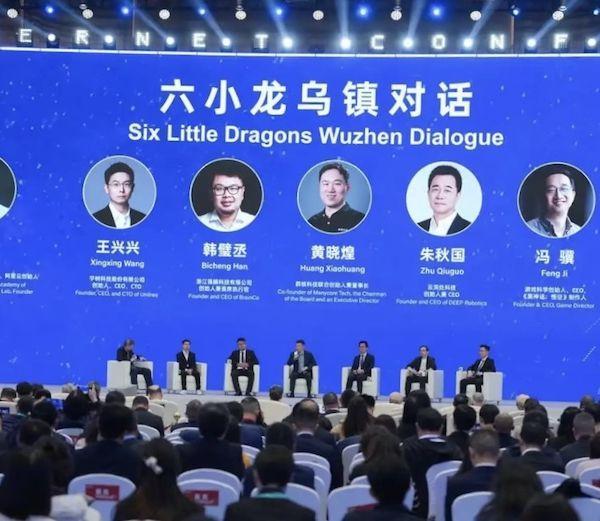
“六小龙”乌镇共探AI发展,为构建网络空间命运共同体注入中国科创动能
Hua Xia Shi Bao· 2025-11-09 04:55
Core Insights - The World Internet Conference in Wuzhen emphasizes the theme of building a shared future in cyberspace, highlighting the importance of open cooperation and security in the digital age [1][4]. Group 1: Event Overview - The conference attracted over 1,600 guests from more than 130 countries and regions, showcasing China's innovative capabilities in technology through the "Six Little Dragons" [4]. - The event featured discussions on artificial intelligence (AI) and global challenges, with a focus on collaborative innovation [4][5]. Group 2: AI Development and Open Collaboration - Open collaboration is identified as a key driver for rapid AI development, with companies like DeepSeek advocating for open-source technology to democratize AI access [5]. - DeepSeek's upcoming products, DeepSeek-V3 and DeepSeek-R1, aim to provide high-performance AI solutions at lower costs, enabling broader participation in AI innovation [5]. - Group Core Technology has successfully launched open-source datasets that have gained recognition in the global AI community, facilitating advancements in spatial intelligence [6]. Group 3: Robotics and AI Integration - Robotics development is significantly influenced by open technology and collaboration, as highlighted by Yushutech's CEO, who noted the importance of shared development in the robotics sector [8]. - The "Internet Light" expo showcased 670 companies from 54 countries, demonstrating AI's integration across various industries, with a focus on smart manufacturing [8]. Group 4: Challenges in AI and AGI - The transition from specialized AI to Artificial General Intelligence (AGI) presents multiple challenges, including the need for stable, generalizable learning algorithms [9]. - Current AI systems face limitations in adaptability and learning, which are essential for achieving AGI capabilities [9][10]. Group 5: Ethical Considerations and Social Impact - The principle of "technology for good" is emphasized as a guiding value for Chinese tech companies, focusing on serving humanity through innovation [11]. - The potential societal impact of AI, including job displacement, is acknowledged, with a consensus on the need for AI to enhance human creativity rather than replace it [12].

高盛交易员:每年这个时候的波动是“正常现象”,没什么“异常”
Hua Er Jie Jian Wen· 2025-11-09 03:46
Core Viewpoint - Goldman Sachs believes that the recent 5% pullback in the US stock market is a typical year-end seasonal fluctuation within the AI cycle, rather than an unusual signal indicating the end of the upward trend [1] Group 1: Market Outlook - Despite the market pullback, there remains potential for further gains before year-end, supported by seasonal factors, the early stage of the AI investment cycle, and relatively light institutional positioning [1][2] - Kapa anticipates a 5-10% increase in the market by year-end, driven by favorable seasonal factors and broad market participation [1][2] - Current cautious sentiment among institutional investors, who believe the market has peaked, may create opportunities for significant upward movement in the remaining trading days of the year [1][2] Group 2: AI Investment and Economic Impact - The core logic supporting continued market growth is based on the belief that the AI revolution is still in its early stages, with institutional investors yet to fully allocate to AI themes [2] - AI investments, while substantial in nominal terms, represent less than 1% of GDP, indicating a more moderate impact compared to historical infrastructure investment peaks [5] Group 3: Valuation and Positioning - Current market valuations and investor positioning are still below historical highs, providing potential support for future market performance [6] - The Nasdaq 100 index is trading at a 46% discount compared to the internet bubble period, suggesting that earnings are supporting valuations [6] - Investor positioning has shifted to a "light" state, indicating that there is significant capital waiting to enter the market once sentiment turns positive [6]

2025乌镇互联网峰会:蚂蚁集团已部署万卡规模国产算力群
Huan Qiu Wang· 2025-11-08 11:03
Core Insights - Ant Group has deployed a domestic computing power cluster at a scale of tens of thousands of cards, achieving over 98% stability in training tasks and performance comparable to international computing clusters [1][2] - The rapid development of Artificial General Intelligence (AGI) is driven by the "Scaling Law," with flagship language models now exceeding 20 terabytes of training data and entering the trillion-parameter era [1][2] Group 1: Technological Innovations - Ant Group is exploring a series of technological innovations to enhance intelligent experiences, focusing on optimizing model parameter efficiency, data application efficiency, and computational efficiency [2] - The Ant Bailing model has established a comprehensive open-source model system covering language, reasoning, and multimodal capabilities, with the recent launch of the world's first open-source trillion-parameter model, Ring-1T, showcasing advanced logical reasoning and coding abilities [2] Group 2: Efficiency Improvements - The training efficiency of the Ring-1T model has been nearly doubled through innovative training methods, stabilizing both training and reasoning lengths [2] - Ant Group has made significant breakthroughs in controlling the number of tokens generated during reasoning, achieving a "Pareto optimal" balance between task effectiveness and computational costs [2] Group 3: Future Vision - The company emphasizes that the ideal future is not about AI replacing humans but rather about AI enhancing human capabilities, promoting a high degree of human-AI collaboration [2]
OpenAI 终于意识到,单靠微软,实现不了AGI
AI前线· 2025-11-08 05:33
撰稿 | 李文朋 编辑 | 王一鹏 奥特曼和纳德拉为期 5 年的蜜月期,终于出现了结束的征兆。 11 月 3 日消息,OpenAI 与亚马逊云科技(AWS)正式公布一项价值约 380 亿美元的多年战略合作 协议。根据协议,OpenAI 将通过 AWS 获取大规模计算资源,包括数十万块 NVIDIA 图形处理器, 以及可扩展至数百万 CPU 的计算容量,该部署计划将于 2026 年底全面完成。 这一事件发生在"2025 年 10 月 28 日微软与 OpenAI 签订新协议"之后,与 OpenAI"重组"几乎同期进 行。 所谓"新协议",指的是 2025 年 10 月 28 日,微软与 OpenAI 签署的临时"最终框架协议",撤销微软 对 OpenAI 享有的"优先购买权",微软持股比例降低至 27%。 这一步骤标志着 OpenAI 从依赖微软开始走向"自主多元"。 据 OpenAI 透露,预计未来需投资 1.4 万亿美元用于构建计算基础设施,以支持 AGI 的实现。奥特 曼强调,实现 AGI 这一目标的实现需要海量计算能力作为保障。 一直以来,OpenAI 经营模式受非营利框架限制,在利润和股权分配上存在约 ...



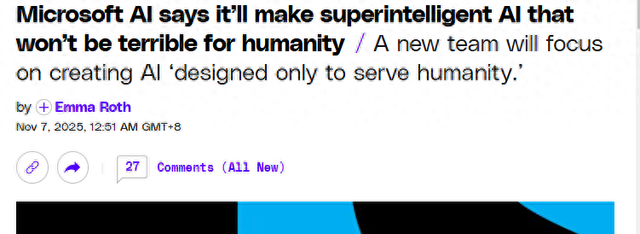
外媒:微软成立新团队开发“只为服务人类”的人工智能
Huan Qiu Wang· 2025-11-08 05:05
Core Insights - Microsoft has established a new team focused on developing artificial intelligence that is "only for the service of humanity" [1][3] - Mustafa Suleyman, head of Microsoft's AI division, emphasized that this "human-centered superintelligence" is not "unrestricted and highly autonomous," but rather "carefully calibrated, contextualized, and limited" [3] - Microsoft aims to avoid participating in the race for Artificial General Intelligence (AGI), while competition with OpenAI is expected to intensify [3] Applications of Human-Centered Superintelligence - The new AI will serve as a partner to help individuals "learn, act, enhance productivity, and receive support" [3] - It will provide assistance in the healthcare sector [3] - The AI aims to create "new scientific breakthroughs" in the clean energy field [3]
乌镇峰会剧透AI未来 互联网进入智联模式,空间智能将站上C位
2 1 Shi Ji Jing Ji Bao Dao· 2025-11-08 04:28
Core Insights - The 2025 World Internet Conference in Wuzhen focuses on building a community in cyberspace, emphasizing digital economy and cultural heritage protection [1] - The conference features over 24 sub-forums and attracts more than 1,600 guests from over 130 countries and regions [1] - The rise of artificial intelligence (AI) is highlighted, with discussions on the transition from "connected" to "intelligent" internet [1] Group 1: Digital Economy and AI Development - AI and robotics are becoming central to China's digital economy, with companies like JD.com leading the charge in smart logistics [2] - JD's founder predicts that social logistics costs in China could drop to below 10% of GDP within the next five years, surpassing progress made in the last 10 to 15 years [2] - The conference showcases the shift towards embodied intelligence and spatial intelligence in AI, moving from virtual to physical applications [2][3] Group 2: AI Infrastructure and AGI - Major Chinese internet companies are investing in large-scale AI infrastructure, with Alibaba focusing on building a super AI cloud [4] - The development of AI is seen as progressing through three stages: emergence of intelligence, general artificial intelligence (AGI), and super artificial intelligence (ASI) [4] - AGI is characterized as a digital entity capable of perception, reasoning, decision-making, and collaboration [4] Group 3: Challenges and Future Directions - Current AI lacks the stability of human intelligence, performing well in complex tasks but poorly in simpler ones due to fixed parameters post-training [5] - The industry views humanoid robots as ideal carriers for AGI, providing the best interface for interaction with the physical world [5] - The conference serves as a critical observation point for the evolution of China's internet ecosystem, highlighting the integration of technology with industry [5]


AI六巨头同台:AGI,不再是“未来”的事了
3 6 Ke· 2025-11-08 01:43
Core Insights - The roundtable discussion among AI pioneers indicates that General Artificial Intelligence (AGI) is no longer a distant goal but is beginning to manifest in real-world applications [1] - The conversation highlights a paradigm shift in AI development, with varying perspectives on the timeline and nature of AGI [21][32] Group 1: Evolution of AGI - The emergence of AGI is a result of 40 years of gradual evolution rather than a sudden breakthrough [2] - Key figures in AI, such as Geoffrey Hinton and Yoshua Bengio, shared their pivotal moments that led them to pursue AI research, emphasizing the foundational work that has shaped today's AI landscape [3][4][10][14] - The collective contributions of these pioneers have created a historical framework for understanding AI's development, with each playing a unique role in advancing the field [20] Group 2: Perspectives on AGI's Timeline - Different experts provided varied timelines regarding the realization of human-level intelligence, reflecting their distinct understandings of intelligence itself [21][34] - Yann LeCun suggested that AGI will evolve gradually over the next five to ten years, rather than appearing as a singular event [23] - Fei-Fei Li pointed out that certain AI capabilities have already surpassed human abilities in specific areas, indicating that some aspects of AGI are already present [25] - Huang Renxun emphasized that AGI-level intelligence is already being applied in practical scenarios today [28] - Geoffrey Hinton predicted that machines will outperform humans in debates within the next 20 years, signaling a significant advancement in AI capabilities [29] - Yoshua Bengio noted the exponential growth in AI's planning abilities over the past six years, suggesting that AI could reach engineer-level capabilities within five years, though he cautioned against making definitive predictions [31] Group 3: Transition from Language to Action - The discussion highlighted a shift from AI's focus on language capabilities to the need for action-oriented intelligence [35] - Fei-Fei Li stressed the importance of spatial intelligence and the ability to perform tasks, which current AI models struggle with [37] - LeCun argued that existing large language models are far from achieving true intelligence and emphasized the need for self-organizing learning methods [39][41] - Huang Renxun described AI's evolution from a tool to a production system, capable of executing tasks in real-time, thus marking a significant paradigm shift in AI's role [43][44] Conclusion - The dialogue concluded that AGI is not a product that will launch on a specific date but is already permeating various sectors and processes [48] - The rapid advancements in AI suggest that the landscape will continue to evolve, potentially leading to a different world in the near future [49][50]
乌镇峰会剧透AI未来
2 1 Shi Ji Jing Ji Bao Dao· 2025-11-08 00:37
Group 1: Internet and Digital Economy - The 2025 World Internet Conference in Wuzhen focuses on building a community in cyberspace, emphasizing digital economy and cultural heritage digitization [1] - Over 1,600 guests from more than 130 countries and regions attended the conference, highlighting its global significance [1] - The conference showcases the transition from "interconnected" to "intelligent" internet, reflecting deep integration of industrial chains and comprehensive upgrades of digital infrastructure [1] Group 2: Artificial Intelligence and Robotics - AI is becoming a core trend in China's digital economy, with companies like JD.com accelerating the intelligent upgrade of supply chains and logistics [2] - JD.com aims to reduce social logistics costs to below 10% of GDP within the next five years, indicating a significant advancement in logistics efficiency [2] - The emergence of "embodied intelligence" and "spatial intelligence" marks a shift in AI from virtual to physical realms, enhancing robots' spatial understanding and collaborative capabilities [2][3] Group 3: AGI Development - Domestic internet giants are investing in large-scale AI infrastructure, moving towards Artificial General Intelligence (AGI) [5] - Alibaba is building a super AI cloud to provide leading AI services globally, indicating a competitive landscape in AI development [5] - The development of AGI is seen as a three-stage process, with the current phase being the beginning of AGI, which will enable machines to perceive, reason, and innovate [5] Group 4: Challenges and Future Directions - Current AI lacks the stable intelligence of humans, performing well in complex tasks but poorly in simpler ones, necessitating advancements in learning algorithms [6] - Humanoid robots are viewed as ideal carriers for AGI, providing the best interface for interaction with the physical world [6] - The Wuzhen Summit serves as a critical observation point for the evolution of China's internet ecosystem, which is increasingly integrating with industries and taking on a leading role in the global AI landscape [6]
美国10月裁员飙升183%,阿里在建超大规模AI设施 | 财经日日评
吴晓波频道· 2025-11-08 00:29
Trade Data - In October, China's exports decreased by 1.1% year-on-year in USD terms, while imports increased by 1% [2] - ASEAN remains China's largest trading partner, with a trade value of 6.18 trillion yuan, up 9.1% [2] - The trade value with the EU was 4.88 trillion yuan, up 4.9%, while trade with the US fell by 15.9% to 3.38 trillion yuan [2] Economic Outlook - Recent US-China trade negotiations have led to the temporary cancellation of some tariffs, which may boost Chinese exports [3] - Domestic demand recovery is slow, putting pressure on economic growth in Q4, with more focus on the declining import side [3] US Employment Trends - In October, US companies announced 153,000 layoffs, a 183% increase month-on-month, marking the highest monthly figure since 2003 [7] - The technology sector saw significant layoffs, with 33,300 job cuts, nearly six times that of September [7] - The overall job market in the US is cooling, with rising layoffs and stagnant hiring demand [8] AI Infrastructure Development - Alibaba is building a large-scale AI infrastructure, aiming to provide leading AI services globally [9] - The development of AI is expected to progress through three stages, with the current focus on achieving AGI (Artificial General Intelligence) [9][10] Robotics Innovations - XPeng Motors plans to mass-produce humanoid robots by the end of 2026, targeting a market projected to be worth $20 trillion [11] - The humanoid robot, IRON, is designed for various applications, including service roles [12] Tesla's Compensation Plan - Tesla's CEO Elon Musk's compensation plan, valued at approximately $1.03 trillion, was approved by 75% of shareholders [13] - The plan includes ambitious targets such as achieving a market cap of $8.5 trillion and delivering 20 million vehicles [13][14] Market Performance - On November 7, the Chinese stock market experienced a slight decline, with the Shanghai Composite Index down 0.25% [17] - The market is currently characterized by a lack of clear leadership, with various sectors experiencing mixed performance [18]

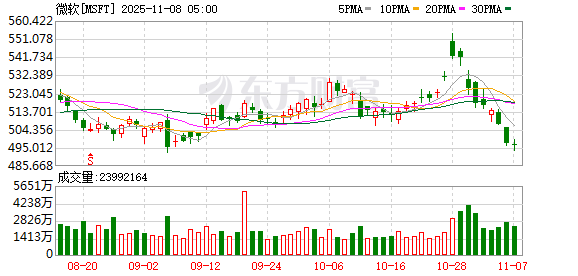
纳指创4月来最大单周跌幅 微软连跌8天 创14年来最长连跌纪录
2 1 Shi Ji Jing Ji Bao Dao· 2025-11-08 00:09
Market Performance - On November 7, the U.S. stock market experienced a "V-shaped reversal," with the Dow Jones Industrial Average rising by 0.16% and the S&P 500 increasing by 0.13%, while the Nasdaq fell by 0.21% [2] - For the week, the Dow dropped by 1.21%, the S&P 500 fell by 1.63%, and the Nasdaq saw a decline of 3.04%, marking the largest weekly drop for the Nasdaq since early April [4] Sector Performance - Large tech stocks showed mixed results, with the Wande American Technology Index down by 0.56%. Notable individual performances included Tesla down over 3%, Google down over 2%, and Amazon up by 0.56% [5] - Energy stocks collectively rose, with Exxon Mobil increasing by over 2% and Chevron by more than 1% [5] - Airline stocks mostly increased, with American Airlines up over 3% and Southwest Airlines up by 3% [6] - Semiconductor stocks generally declined, with the Philadelphia Semiconductor Index down by 1.01% [7] - Chinese concept stocks mostly fell, with the Nasdaq Golden Dragon China Index down by 0.95% [8] Commodity Performance - In precious metals, spot gold rose by 0.58% to $4000.29 per ounce, while COMEX gold futures increased by 0.42% to $4007.8 per ounce [8] Economic Context - There is a growing consensus in the U.S. capital markets regarding risks, particularly concerning the AI narrative, which is facing uncertainty due to the high costs and unclear pathways to achieving General Artificial Intelligence (AGI) [8] - The U.S. federal government has been in a "shutdown" for 37 days, causing significant disruptions, including the delay of the October non-farm payroll report [9]