
避险需求

Search documents
地缘风险推高贵金属价格 纽约金价17日收涨 银价再创新高
Xin Hua Cai Jing· 2025-12-18 00:53
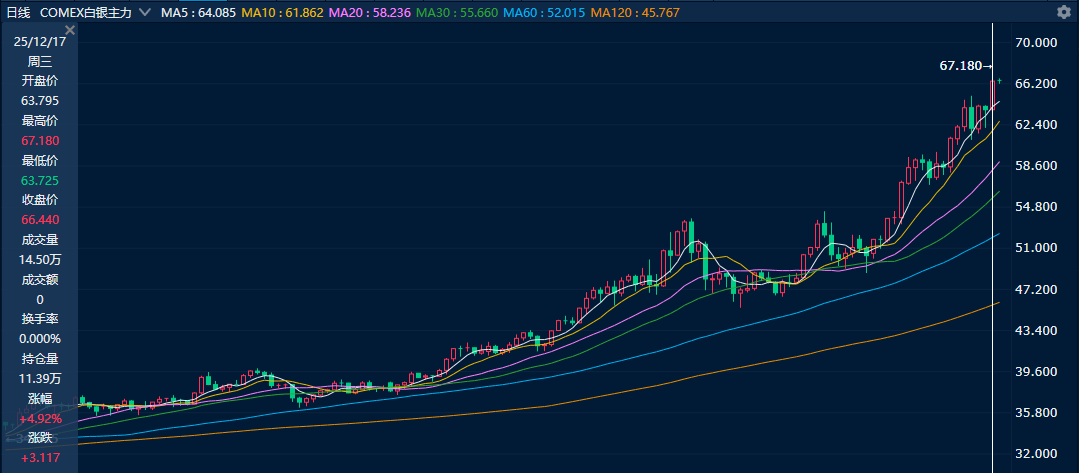
受避险需求和技术性买盘拉动,黄金价格当日小幅上涨,白银价格则大幅攀升再创新高,盘中交易一度达到每盎司67.18美元。 纽约商品交易所黄金期货市场交投最活跃的2026年2月黄金期价17日上涨0.90%,收于每盎司4371.40美元;当天3月交割的白银期货价格上涨4.92%,收于 每盎司66.44美元。 今年黄金和白银价格表现惊人,分别上涨超过65%和100%。加拿大蒙特利尔银行预计,贵金属价格在2026年仍有上涨空间。 资讯编辑:王芳琴 021-66896877 资讯监督:乐卫扬 021-26093827 资讯投诉:陈跃进 021-26093100 免责声明:Mysteel发布的原创及转载内容,仅供客户参考,不作为决策建议。原创内容版权归Mysteel所有,转载需取得Mysteel书面授权,且Mysteel保留对任何侵权行为和有悖原创内容原意的引用行为进 行追究的权利。转载内容来源于网络,目的在于传递更多信息,方便学习与交流,并不代表Mysteel赞同其观点及对其真实性、完整性负责。 来源:新华财经专业终端 今年以来,白银价格上涨约130%,是同期黄金期货涨幅的2倍。部分原因是白银库存趋紧以及零售和工业需求强劲 ...

【环球财经】地缘风险推高贵金属价格 纽约金价17日收涨 银价再创新高
Xin Hua Cai Jing· 2025-12-18 00:46
Group 1 - The core viewpoint of the articles highlights the significant increase in precious metal prices, particularly silver, which has risen approximately 130% this year, double the increase of gold prices [2] - Gold futures for February 2026 rose by 0.90% to $4,371.40 per ounce, while silver futures for March delivery increased by 4.92% to $66.44 per ounce, with silver reaching an intraday high of $67.18 [1] - The rise in precious metal prices is attributed to heightened demand for safe-haven assets due to geopolitical tensions, particularly the U.S. threats against Venezuela, and strong retail and industrial demand for silver driven by sectors like solar energy and electric vehicles [2] Group 2 - The tightening of silver inventories and robust demand from various industries have contributed to the surge in silver prices [2] - The price of crude oil also saw an increase, rising by 2.92% to $56.74 per barrel, following the U.S. blockade of oil tankers entering Venezuela [2] - Both gold and silver have shown remarkable performance this year, with increases exceeding 65% and 100% respectively, and there is an expectation for further price increases in precious metals through 2026 according to the Bank of Montreal [2]
白银,杀疯了!
Sou Hu Cai Jing· 2025-12-17 06:27
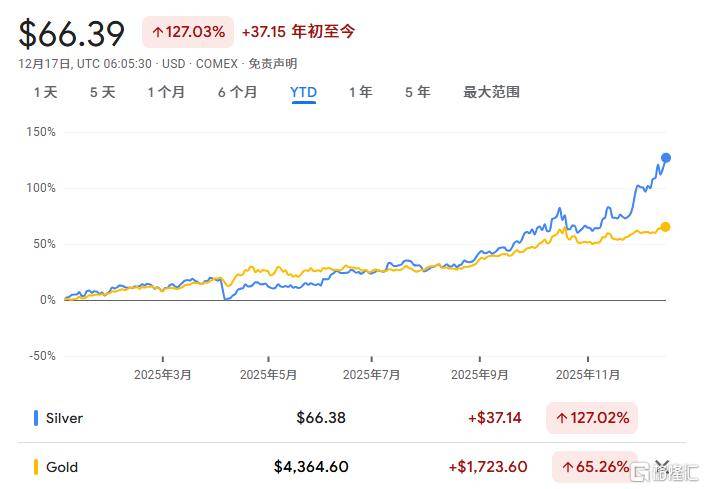
Core Viewpoint - Silver has surged significantly, reaching a historical high of over $66 per ounce, driven by strong industrial demand and increased investment interest due to economic uncertainties and Federal Reserve rate cut expectations [2][9]. Group 1: Market Performance - On Wednesday, silver prices broke through $66 per ounce, with spot silver rising over 4% and COMEX silver futures increasing by more than 5% to a peak of $66.5 per ounce [2]. - Year-to-date, silver has outperformed other assets with a remarkable increase of approximately 127%, while gold has risen by 65% [2]. Group 2: Economic Factors - Weak U.S. economic data has led to a surge in demand for safe-haven assets like precious metals [5]. - The U.S. unemployment rate unexpectedly rose to 4.6% in November, the highest level since September 2021, while non-farm payrolls increased by 64,000, exceeding expectations [6][7]. - Retail sales remained flat in October, contrary to expectations of a 0.1% increase, and the S&P Global PMI dropped significantly [8]. Group 3: Supply and Demand Dynamics - Industrial demand for silver has remained around 50%, making it a key driver of the current bull market [11]. - The World Silver Association projects a supply shortage of 4,633 tons in 2024, marking the fourth consecutive year of supply deficits [12]. - The solar energy sector, electric vehicles, and data centers are identified as major growth areas for silver demand, with compound annual growth rates of 17% and 13% respectively [12]. Group 4: Future Outlook - Analysts suggest that silver's investment demand may continue to dominate, with potential for prices to reach $70 due to low inventory levels and significant short squeezes in the market [13]. - However, there are contrasting views, with some analysts warning that the current bull market may be nearing its end, potentially leading to a prolonged bear market starting around 2026 [14][15][16].
俄乌冲突未消避险升温 国际黄金V形反转稳4300
Jin Tou Wang· 2025-12-17 03:12
Core Viewpoint - International gold prices are experiencing a slight increase, currently trading around $4324.62 per ounce, with a daily rise of 0.52% and a trading range of approximately $26, indicating a stable upward trend in the short term [1][3]. Group 1: Market Dynamics - The recent geopolitical tensions, particularly the ongoing Russia-Ukraine conflict, are providing significant support for gold as a safe-haven asset. Despite a temporary decline in gold prices due to rumors of peace talks, prices rebounded quickly [1][2]. - The U.S. and Europe are discussing security guarantees for Ukraine post-ceasefire, with Germany's Chancellor suggesting that peacekeeping forces could engage Russian troops if necessary. This indicates a persistent geopolitical risk that could drive up gold demand [2]. Group 2: Technical Analysis - Gold prices have shown resilience, bouncing back from a low of $4271, demonstrating strong support levels. The market is currently in a bullish trend, with key technical indicators suggesting further upward movement towards a target of $4350 [3]. - The market sentiment remains positive, with the price maintaining above $4300, and any pullbacks are viewed as buying opportunities. The support zone between $4266 and $4275 has effectively halted downward movements, confirming its strength [3].
宝城期货贵金属有色早报(2025年12月17日)-20251217
Bao Cheng Qi Huo· 2025-12-17 01:51
1. Report Industry Investment Ratings - No industry investment ratings are provided in the report. 2. Core Views of the Report - Gold is expected to be strong in the short - term and may maintain a strong run due to increased market risk - aversion as the macro - environment weakens. In the medium - term, it will be in a volatile state, and in the long - term, it has shown a high - level volatile trend since late October. [1][3] - Copper is expected to be strong in the long - term. Although it is under pressure in the short - term due to decreased market risk preference and liquidity, it is supported by downstream replenishment demand and low LME inventories. [1][4] 3. Summary by Related Catalogs Gold - **Short - term**: The short - term view is bullish. After the macro - environment took a turn for the worse since last Friday, overseas stocks and commodities generally declined, and the short - term liquidity of gold decreased significantly. The impact of the interest - rate meeting has been fully digested, and the market's risk - aversion demand has risen rapidly, so the price of gold may maintain a strong run. [1][3] - **Medium - term**: The medium - term view is volatile. Since late October when Sino - US relations eased, the price of gold has been in a high - level volatile state, and attention can be paid to the technical pressure at the $4400 mark. [3] - **Intraday**: The intraday view is volatile and bullish. Yesterday, the price of gold in the Asian session fluctuated downward and then rose and fell back at night. The US non - farm payroll data last night was mixed, and the short - term fluctuation of gold was not obvious. [3] Copper - **Short - term**: The short - term view is volatile. Yesterday, the price of copper in the Asian session decreased with reduced positions, dropping nearly 2000 yuan/ton from the high. The market risk preference and liquidity decreased, putting pressure on the copper price. However, it is relatively resistant in the non - ferrous sector due to its strong financial attributes. [1][4] - **Medium - term**: The medium - term view is bullish. As the copper price drops, the downstream replenishment willingness in the industry increases, and the low LME inventories strongly support the copper price. [1][4] - **Intraday**: The intraday view is volatile and bullish. The long - short game has intensified, and the copper price shows a pattern of being strong overseas and weak in China. Attention can be paid to the support of the 10 - day moving average. [4]
这一板块,年内涨幅超73%
Di Yi Cai Jing· 2025-12-16 13:51
Core Insights - The non-ferrous metals sector in A-shares has experienced a remarkable rally in 2025, with an annual increase of 73.67%, surpassing the communication sector's 72.97% and ranking first in the market [3][4]. - Notable individual stocks in the non-ferrous metals sector have shown impressive performances, with Srei New Materials (688102.SH) leading with a 340.01% increase, and 26 stocks doubling in value throughout the year [3][5]. - Historically, the non-ferrous metals sector has never topped the annual performance rankings, achieving second place twice but failing to maintain consecutive years in the top five [7][8]. Market Performance - The rally in 2025 encompasses a broad spectrum from precious metals to industrial metals, marking a rare comprehensive explosion in the sector over the past fifteen years [5]. - Precious metals, particularly gold and silver, have been significant drivers, with gold prices rising due to central bank purchases and geopolitical tensions, while silver has seen a surge exceeding 100% due to supply-demand dynamics [5][10]. - Industrial metals are experiencing increased demand driven by sectors such as new energy vehicles and renewable energy investments, indicating a long-term growth narrative for metals like copper and aluminum [5][6]. Historical Context - The non-ferrous metals sector is characterized by its cyclical nature, often linked to commodity supercycles and global monetary easing [7][8]. - Historical data shows that the sector has never achieved consecutive years in the top five for annual performance, with significant downturns following previous peaks [7][8]. - The sector's high valuation levels as of December 16, 2025, pose a challenge for continued growth, with the index reaching 7499.07 points, approximately 17% below its historical peak [8][9]. Future Outlook - The outlook for 2026 remains uncertain, with questions about whether the sector will follow historical patterns of correction or break the "champion curse" [4][8]. - Key factors influencing the valuation of the non-ferrous metals sector in 2026 include price trends and demand dynamics, with various sub-sectors expected to follow distinct drivers [9][10]. - Analysts suggest that gold will be influenced by credit and safe-haven demand, silver by industrial needs, and copper by supply constraints and new energy demands [10].

宝城期货贵金属有色早报(2025年12月16日)-20251216
Bao Cheng Qi Huo· 2025-12-16 01:50
Group 1: Report Investment Ratings - There is no information about the report industry investment rating in the provided content Group 2: Core Viewpoints - Gold is expected to be strong in the short - term, with a core logic of a weakening macro atmosphere and rising risk - aversion demand [1][3] - Copper is expected to be strong in the long - term, due to a macro - easing environment, mine - end production cuts, and the implementation of interest rate cuts [1][4] Group 3: Summary by Variety Gold (AU) - Short - term view: Strong; Medium - term view: Oscillating; Intraday view: Oscillating and tending to be strong; Overall reference view: Strong in the short - line. The price has been rising since last week, reaching near the $4400 mark on Monday night. After a dovish Fed meeting, the short - term market risk preference and liquidity increased, but on Friday night, the macro atmosphere worsened. The short - term impact of the meeting has been digested, and risk - aversion demand has risen rapidly, so the price may remain strong. Tonight's US non - farm data may affect short - term trends, and the $4400 mark is a technical resistance in the medium - to - long - term [1][3] Copper (CU) - Short - term view: Oscillating; Medium - term view: Strong; Intraday view: Oscillating and tending to be strong; Overall reference view: Strong in the long - line. After the Asian session yesterday, LME copper soared close to $11,900, and SHFE copper opened higher at night, approaching the 94,000 yuan mark. Then the price fell back, and the long - position closing intention was strong. The non - ferrous sector declined, but copper was resilient due to its strong financial properties. The sharp drop last Friday stimulated downstream replenishment demand, and the spot premium in Guangdong increased, indicating actual demand resilience. The short - term price volatility is large, and both sides tend to close positions. Tonight's US non - farm employment data may affect short - term trends, and the 5 - day moving average can be monitored [1][4]
金丰来:金价上行逻辑解析
Xin Lang Cai Jing· 2025-12-15 10:52
Core Viewpoint - Recent rise in gold prices reflects market repricing of interest rate environment and risk sentiment [1][3] - Current increase in gold prices is driven by multiple expectations rather than a single factor [1][3] Macroeconomic Factors - The core impact of interest rate cut expectations is the change in holding costs [1][3] - As interest rate cut expectations strengthen, funds are more likely to flow into inflation-resistant and value-preserving assets [1][3] - Periodic safety events amplify market uncertainty, increasing demand for safe-haven assets, providing additional support for gold prices [1][3] Short-term Influences - Short-term disturbances exist, with some officials signaling tighter policies, leading to a temporary strengthening of the dollar, which suppresses gold prices [1][3] - These signals reflect policy divergence rather than a trend reversal, with the market expected to reassess based on employment and inflation data [1][3] Data Considerations - Upcoming employment report is a key variable influencing short-term trends [4] - A slowdown in the labor market could further solidify easing expectations; conversely, strong data may trigger a technical pullback in gold prices, but not necessarily alter the mid-term structure [4] Technical Structure - Gold prices are currently in a relatively favorable position, remaining above key moving averages with strong momentum indicators, indicating that the bullish trend is not broken [4] - If the key resistance zone is effectively breached, sentiment and funds may resonate, driving prices further upward [4] Long-term Outlook - In the context of interest rate cycles, risk preferences, and technical patterns, gold retains medium to long-term investment appeal [2][4] - Short-term fluctuations are seen as rhythm adjustments, with a focus on the overall trend rather than individual events causing emotional swings [2][4]

特朗普倡1%利率黄金T+D稳于974
Jin Tou Wang· 2025-12-15 03:14
Group 1 - The Shanghai gold T+D opened at 976.00 yuan/gram and reached a high of 979.32 yuan/gram, closing at 974.12 yuan/gram with an increase of 1.29% [1] - The technical analysis indicates that Shanghai gold T+D has successfully broken through the key resistance level of 950 yuan/gram, maintaining an upward channel on the daily chart [2] - The market sentiment is bullish, with a moderate increase in trading volume, but caution is advised regarding potential profit-taking risks and fluctuating expectations of Federal Reserve policies [2] Group 2 - President Trump expressed a strong desire for interest rates to drop to 1% or lower within a year, significantly below the current Federal Reserve policy rate range [1] - Trump attributed the current high inflation to the previous administration and predicted that the price situation in the U.S. will improve as the election approaches [1] - The midterm elections are approaching, and Trump remains cautious about whether current economic policies will help the Republican Party win [1]
美乌和平谈判推进沪金强势上攻
Jin Tou Wang· 2025-12-15 03:03
Group 1 - Gold futures are currently trading around 979.30 yuan per gram, with a rise of 1.52%, reaching a high of 985.78 yuan and a low of 963.50 yuan, indicating a short-term bullish trend [1] - The main contract for Shanghai gold continues to show strength, maintaining a key support level at 950 yuan per gram, with short-term moving averages in a bullish arrangement and MACD indicators showing a golden cross, suggesting an upward channel [4] - Market sentiment is leaning towards bullish, with moderate volume increase, but caution is advised regarding potential fluctuations in Federal Reserve policy expectations and short-term profit-taking risks [4] Group 2 - The ongoing discussions between Ukraine and the U.S. representatives in Berlin regarding a "peace plan" to end the Russia-Ukraine conflict lasted over five hours and are set to continue [3] - Key participants in the talks include U.S. Special Envoy Wittekov and Jared Kushner, along with Ukrainian President Zelensky and other high-ranking officials [3]