动量因子

Search documents
高盛:资⾦流向分析
Goldman Sachs· 2025-06-06 02:37
Investment Rating - The report gives a "green light" for the short-term outlook of US equities, indicating a positive investment sentiment [2]. Core Insights - The market is experiencing upward momentum until summer technicals and economic data come into play, with investors likely to be halted before any significant drawdown occurs [3]. - Retail investors are actively buying dips in US equities, while institutional activity remains muted [2]. - Robust liquidity is noted, with top of book liquidity at $11.08 million, above the one-year average of $10.65 million, supporting healthy trading in the near term [7][8]. Summary by Sections Market Setup - The report highlights a preference for specific trades, including SPX call spreads and hedging strategies for long positions [5]. - The liquidity environment is described as supportive for trading, although it may lose momentum as summer approaches [8]. Trading Activity - US equities have seen net buying for six consecutive sessions, with a notable increase in long buys, indicating strong market interest [27]. - The overall gross leverage has increased to 289.2%, placing it in the 95th percentile for the past year, driven by short leverage [28][29]. Seasonal Trends - The report notes that early to mid-June typically sees moderate market increases, providing a favorable trading environment, especially for bearish long-term views [64]. ETF Flows - Significant inflows into factor ETFs were observed, with May being the best month for inflows since the election, indicating strong investor interest in momentum strategies [43][50]. - The report also mentions a growing interest from global investors in emerging market equities due to USD weakness and US growth uncertainty [54].
风格制胜3:风格因子体系的构建及应用
Bank of China Securities· 2025-06-06 01:14
Core Insights - The report explores the construction and application of a style factor system for A-shares, focusing on four dimensions: market capitalization, valuation, profitability, and momentum [2][9][12] - A-shares have exhibited different dominant factors over various periods, with profitability leading from 2013 to 2014, small-cap factors from 2015 to 2016, valuation from 2016 to 2018, and a return to profitability dominance from 2019 to early 2021 [2][24][27] - The report predicts a resurgence of high valuation factors starting in 2025, driven by expectations of weak profit recovery and strong policy support [2][27] Style Factor Construction and Performance - The style factor system is constructed using a bottom-up approach, assigning style labels to each stock based on their factor indicators [9][12] - The performance of the style factors shows that small-cap stocks have generally outperformed large-cap stocks since 2010, with a notable fivefold return from small-cap strategies [12][17] - Valuation factors indicate that low valuation styles have been particularly strong, especially during specific periods such as 2017-2018 and 2022-2024 [14][15] Influencing Factors of Style Factors - Profitability factors are highly correlated with economic cycles, showing better performance during economic upturns [45][46] - Valuation factors are closely linked to market sentiment, with high valuation stocks performing better during periods of positive sentiment [49][50] - Market capitalization factors are significantly influenced by remaining liquidity, with small-cap factors performing strongly in liquidity-rich environments [53][54] Application of Style Factor System - The report establishes an A-share style investment system based on the identified style factors, suggesting that the current dominant styles are high profitability, high valuation, and small-cap [2][27] - The analysis indicates that the A-share market has not fully priced in the expected profit recovery, suggesting potential upside for high profitability and high valuation factors [2][27] - Different asset types exhibit varying dominant style factors, with emerging growth assets showing significant small-cap advantages and dividend assets reflecting low valuation strengths [29][33]
小市值风格占优,私募调研跟踪策略超额明显——量化组合跟踪周报 20250524
EBSCN· 2025-05-24 07:20
- The PB-ROE-50 portfolio achieved an excess return of 1.15% in the CSI 500 stock pool, 0.29% in the CSI 800 stock pool, and -0.30% in the entire market stock pool[23][24] - The public research stock selection strategy achieved an excess return of 0.54% relative to the CSI 800, while the private research tracking strategy achieved an excess return of 2.61% relative to the CSI 800[25][26] - The block trading portfolio achieved an excess return of -0.61% relative to the CSI All Share Index[29][30] - The directed issuance portfolio achieved an excess return of 0.12% relative to the CSI All Share Index[35][36] - The momentum factor and growth factor achieved positive returns of 0.12% and 0.04% respectively, while the liquidity factor, beta factor, and size factor achieved significant negative returns of -0.56%, -0.52%, and -0.40% respectively[18][20] - In the CSI 500 stock pool, the best-performing factors this week were gross profit margin TTM (1.65%), single-quarter ROA (1.40%), and single-quarter total asset gross profit margin (1.26%)[14][15] - In the liquidity 1500 stock pool, the best-performing factors this week were 5-day average turnover rate (0.45%), 5-minute return skewness (0.36%), and downside volatility ratio (0.33%)[16][17] - In the CSI 500 stock pool, the worst-performing factors this week were single-quarter net profit year-on-year growth rate (-0.42%), 5-day reversal (-0.49%), and post-morning return factor (-0.64%)[14][15] - In the liquidity 1500 stock pool, the worst-performing factors this week were momentum spring factor (-1.07%), 5-day reversal (-1.11%), and single-quarter net profit year-on-year growth rate (-1.19%)[16][17] - In the CSI 300 stock pool, the best-performing factors this week were net profit gap (1.30%), 5-day exponential moving average of trading volume (1.15%), and total asset gross profit margin TTM (1.02%)[12][13] - In the CSI 300 stock pool, the worst-performing factors this week were logarithmic market value factor (-1.02%), momentum spring factor (-1.12%), and post-morning return factor (-1.29%)[12][13] - The net asset growth rate factor performed well in the comprehensive industry, and the net profit growth rate factor performed well in the steel industry[21][22] - The BP factor performed well in the beauty and personal care industry, and the EP factor performed well in the coal industry[21][22]
美银:市场人气改善,标普500指数或很快重返历史高点
Jin Shi Shu Ju· 2025-05-20 14:16
截至周一收盘,标普500指数较6144.15点的历史收盘高点仅低3%。诚然,引领市场反弹逼近历史高点 的大盘科技股近期可能失去动能。 DataTrek Research联合创始人杰西卡・拉贝(Jessica Rabe)指出,iShares MSCI美国动量因子ETF (MTUM)今年以来表现超过标普500指数10个百分点。从历史来看,在经历如此强劲的上涨后,动量 因子通常会跑输大盘指数。 美国银行指出,其全球股票风险偏好指标已从4月初的"深度恐慌"反弹至中性水平。 该行策略师里特什・萨马迪亚(Ritesh Samadhiya)指出,这一指标在过去38年中已32次从恐慌转向中 性。他补充称,在这些案例中,只有四次市场情绪回落至恐慌水平,"而在所有其他情况下,情绪进一 步上升至乐观水平"。 萨马迪亚表示:"在货币宽松背景下,恐慌情绪彻底宣泄后市场广度显著改善,这在历史上通常与新一 轮牛市的延续或形成相关。尽管历史并非完美的指引,但大量证据表明市场可能继续攀升。" 目前来看,美股似乎势不可挡。标普500指数周一小幅收涨,逆转了穆迪下调美债评级引发的跌势,将 连胜纪录延长至六个交易日。这一涨势进一步巩固了该基准指数自 ...
金融工程市场跟踪周报:市场波动温和提升,杠铃组合或占优-20250428
EBSCN· 2025-04-28 03:43
- The report discusses the "Momentum Factor" as a key quantitative factor that performed well in the market during the week of April 21-25, 2025. The factor's construction is based on identifying stocks with strong recent performance, which are expected to continue outperforming in the short term[12][24][26] - The "Momentum Sentiment Indicator" is calculated by measuring the proportion of stocks within the CSI 300 Index that have achieved positive returns over a specified period (N days). The formula is: $ \text{CSI 300 Index N-day Upward Stock Proportion} = \frac{\text{Number of CSI 300 stocks with positive returns in the past N days}}{\text{Total number of CSI 300 stocks}} $ This indicator captures market sentiment and is used to identify potential market bottoms or overheating phases. It is noted that the indicator can quickly capture upward opportunities but may fail to avoid risks during market downturns[26][27][29] - The "Momentum Sentiment Indicator Timing Strategy" applies two smoothing windows (N1 and N2, where N1 > N2) to the indicator. When the short-term smoothed line (fast line) exceeds the long-term smoothed line (slow line), it signals a bullish market sentiment. Conversely, when the fast line is below the slow line, it indicates a neutral or bearish sentiment. As of April 25, 2025, the fast line was below the slow line, suggesting a cautious market outlook[27][29][33] - The "Moving Average Sentiment Indicator" uses eight moving averages (8, 13, 21, 34, 55, 89, 144, 233) of the CSI 300 Index closing prices. The indicator assigns values based on the position of the current price relative to these averages. If the current price exceeds the values of more than five moving averages, it signals a bullish sentiment. As of April 25, 2025, the CSI 300 Index was in a non-optimistic sentiment zone[33][37] - The report highlights "Cross-sectional Volatility" as a measure of short-term alpha opportunities. It notes that the cross-sectional volatility of CSI 300, CSI 500, and CSI 1000 Index components increased week-over-week, indicating improved alpha conditions. Over the past quarter, the cross-sectional volatility of CSI 300 and CSI 1000 was in the upper-middle range of the past six months, while CSI 500 was in the middle range[38][41] - "Time-series Volatility" is another alpha-related metric discussed. The time-series volatility of CSI 300, CSI 500, and CSI 1000 Index components rose week-over-week, signaling better alpha conditions. Over the past quarter, the time-series volatility of these indices was in the upper-middle range of the past six months[41][43] - The report evaluates the "Fund Concentration Degree Indicator," which measures the standard deviation of cross-sectional returns of concentrated fund portfolios. A lower standard deviation indicates higher fund concentration, while a higher standard deviation suggests fund dispersion. As of April 25, 2025, the fund concentration degree slightly increased, and the excess returns of concentrated funds and stocks declined week-over-week[85][88][90]





商品量化CTA周度跟踪-2025-03-25
Guo Tou Qi Huo· 2025-03-25 11:05
Report Title - The report is titled "Commodity Quantitative CTA Weekly Tracking" by Guotou Futures Research Institute's Financial Engineering Group, dated March 25, 2025 [1][2] Report Industry Investment Rating - No industry investment rating is provided in the report Core Viewpoints - The commodity sector cross - section has switched, with internal differentiation in the energy and chemical sector, a decline in the agricultural products sector, and the precious metals and non - ferrous sectors remaining relatively strong in the cross - section. Specific sectors show different trends in momentum,持仓量, and term structure [3] Summary by Commodity Categories Overall Commodity Sector - The non - ferrous sector shows upward momentum, while the energy and chemical sector has internal differentiation, the agricultural products sector is down, and the precious metals and non - ferrous sectors are relatively strong. Different sectors have different changes in momentum,持仓量, and term structure indicators [3] Methanol - Strategy net value: The demand factor decreased by 0.23%, the inventory factor decreased by 0.19%, and the synthetic factor weakened by 0.15%. The comprehensive signal this week is neutral. Fundamental factors: The methanol arrival volume gives a long signal, domestic capacity utilization gives a short signal (supply is neutral); methanol - to - olefin plant capacity utilization decreased, acetic acid operating rate increased (demand is neutral); port inventory continued to decrease, and the short - side strength of the inventory factor weakened significantly to neutral; the Inner Mongolia - Shandong regional spread factor gives a long signal, and the spread factor is slightly long [5] Glass - Strategy net value: Last week, the supply factor weakened by 0.20%, the demand factor decreased by 0.19%, the inventory factor decreased by 1.15%, and the synthetic factor weakened by 0.91%. The comprehensive signal this week is short. Fundamental factors: The float glass capacity utilization rate was flat month - on - month (supply is neutral); second - tier city commercial housing transaction data gives a short signal (demand is short); float glass enterprise inventory is relatively high year - on - year (inventory remains short); the domestic float glass market price gives a long signal, but the overall long - side contribution is not high (spread is slightly long) [9] Iron Ore - Strategy net value: The inventory factor weakened by 1.09%, the spread factor remained unchanged, and the synthetic factor weakened by 0.34%. The comprehensive signal this week remains long. Fundamental factors: The iron ore arrival volume at Qingdao Port continued to decline compared with the previous week (supply signal turns neutral); the blast furnace operating rate of 247 steel enterprises increased compared with the previous week (demand signal remains neutral); the inventory of Brazilian iron ore in 31 ports continued to rise (inventory remains long); the spot sales price of Rio Tinto's PB powder at Rizhao Port increased (spread signal remains neutral) [12] Aluminum - Strategy net value: Last week, the supply factor weakened by 0.11%, the demand factor weakened by 0.68%, the inventory factor weakened by 0.12%, the spread factor remained unchanged, and the synthetic factor weakened by 0.20%. The comprehensive signal this week remains long. Fundamental factors: The SMM domestic lead concentrate price continued to rise (supply signal remains long); China's lead alloy exports in March decreased compared with February (demand signal turns short); LME lead registered warrants decreased (inventory turns short); SMM concentrate import profit increased (spread signal is long) [12]
先锋标普500 ETF稳居第一大ETF位置——海外创新产品周报20250324
申万宏源金工· 2025-03-25 06:51
Group 1 - The core viewpoint of the article highlights the recent developments in the U.S. ETF market, particularly the introduction of innovative products such as the Solana futures ETF and the significant inflow of funds into domestic equity products [1][2][3]. Group 2 - The U.S. ETF market saw a total of 10 new products launched last week, with a notable issuance of a municipal bond index product by BlackRock, reflecting strong demand for tax-exempt municipal bonds [1]. - Individual leveraged products have gained popularity, with Defiance and Leverage Shares issuing four 2x leveraged products linked to companies like Robinhood, Palo Alto Networks, and Adobe [1]. - Fortuna launched a Bitcoin strategy product that primarily invests in Bitcoin futures and employs options strategies, including Covered Calls, to provide a safety net [1]. - MarketDesk introduced a high-concentration momentum product that selects stocks based on quality and momentum factors, emphasizing strong performance over the past six months [1]. - Invesco launched a futures strategy product that invests in various futures, including stock index, bond, and foreign exchange futures, with a relatively pessimistic outlook on U.S. stocks [1]. Group 3 - The inflow into U.S. domestic equity products exceeded $60 billion last week, indicating a stabilization in overall U.S. stock performance [3]. - There were significant differences in fund flows among the three major S&P 500 ETFs, with State Street's SPDR S&P 500 ETF experiencing outflows, while Vanguard and BlackRock's products saw substantial inflows [5][8]. - The top inflow products included iShares Core S&P 500 ETF (IVV) with $173.38 million and Vanguard S&P 500 ETF (VOO) with $163.53 million, while SPDR S&P 500 ETF Trust (SPY) faced outflows of $222.23 million [6]. Group 4 - The performance of U.S. ETFs has shifted, with low volatility factors emerging as the strongest performers this year, while growth and quality styles have seen significant pullbacks [9]. - Despite the strong performance of low volatility factors, there has been no significant inflow into these products, whereas dividend products have seen more pronounced inflows [9].

测试结果看看吧—一个年薪40w员工三天工作量
小熊跑的快· 2025-03-07 02:13
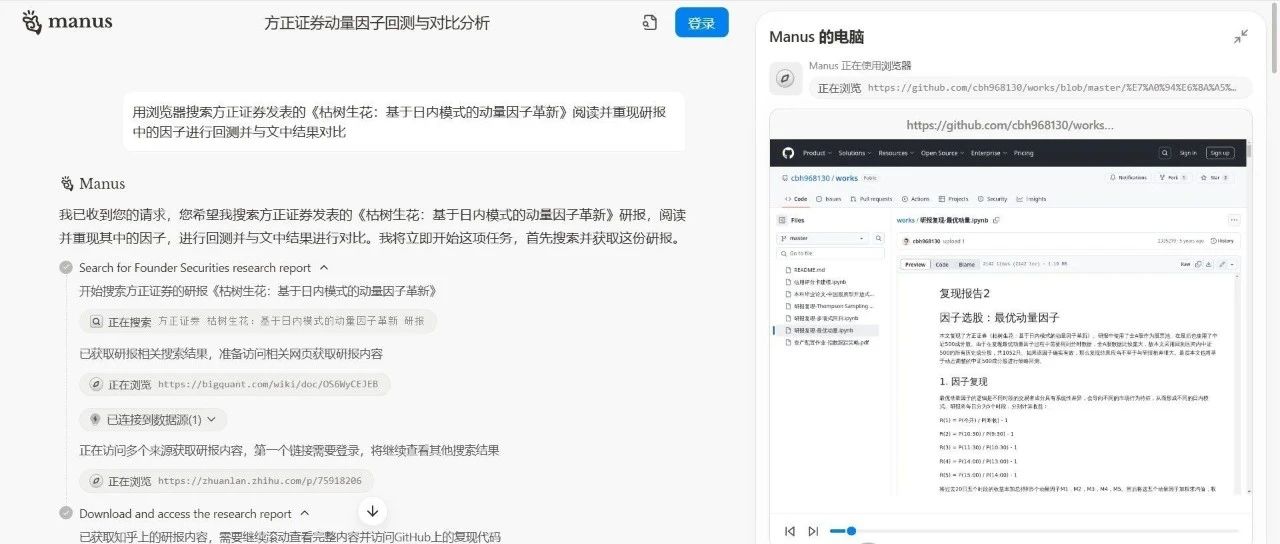
Core Viewpoint - The article discusses the replication and backtesting of a momentum factor based on a report published by Founder Securities, highlighting the efficiency and accuracy of the process in comparison to traditional methods [1][2][3]. Group 1: Data Collection and Challenges - The process involved collecting necessary data for factor calculation, but faced issues with API responses, particularly with Yahoo Finance's support for the Chinese A-share market [2]. - Alternative solutions included creating a simulated dataset and utilizing code found on GitHub to implement factor calculations and backtesting [2]. Group 2: Factor Calculation and Backtesting - The implementation of precise factor calculation code was completed, using simulated data to replace actual data due to difficulties in obtaining historical intraday data for the Chinese A-share market [2]. - A comprehensive quantitative backtesting was conducted to analyze the performance differences between traditional momentum factors and optimal momentum factors [2]. Group 3: Results and Efficiency - The entire replication process was completed successfully, with all conclusions aligning with the original report, taking only 40 minutes under crowded website conditions [3]. - In contrast, a typical employee would require approximately 3 days to complete the same task, while someone unfamiliar with the process might take up to 6 days [3].
盘点SmartBeta指数(策略指数)常用的八大策略因子
雪球· 2025-03-04 09:08
Core Viewpoint - The article emphasizes the importance of investment factors in selecting stocks and constructing investment strategies, highlighting that understanding these factors can lead to better investment decisions and potential returns [2][20]. Investment Factors Overview - The article introduces eight commonly used investment factors, each with distinct principles, applicable market conditions, and associated risks, which can help investors optimize their investment strategies [4][16]. Factor Summaries 1. Market Capitalization Factor - Focuses on the impact of stock size on returns, with large-cap stocks generally being more stable but less elastic, while small-cap stocks offer higher growth potential but come with increased risk [5][6]. 2. Value Factor - Concentrates on the discrepancy between a company's intrinsic value and market price, aiming to identify undervalued stocks for potential gains when market sentiment improves [8]. 3. Growth Factor - Evaluates a company's earnings growth and future potential, typically performing well in favorable economic conditions but facing higher risks during downturns [9]. 4. Low Volatility Factor - Selects stocks with stable prices and low volatility, providing better risk-adjusted returns, especially during market downturns [11]. 5. Dividend Factor - Targets stocks with stable dividends and high yield, offering defensive characteristics in volatile markets but may lag in strong bull markets [12]. 6. Quality Factor - Based on financial and operational metrics to identify high-quality companies, which may face valuation risks during periods of high market risk appetite [13]. 7. Momentum Factor - Utilizes the trend-following theory, capitalizing on stocks that have shown strong past performance, though it may struggle in volatile markets [14]. 8. Reversal Factor - Exploits price reversal opportunities, performing well in choppy or bearish markets but underperforming in strong trends [15]. Factor Usage Considerations - Investors should choose factors that align with their risk tolerance and investment goals, combining multiple factors to enhance returns while being mindful of market conditions [17][18][19].

高盛交易员:当下市场,我最关注这张图
华尔街见闻· 2025-03-02 12:40
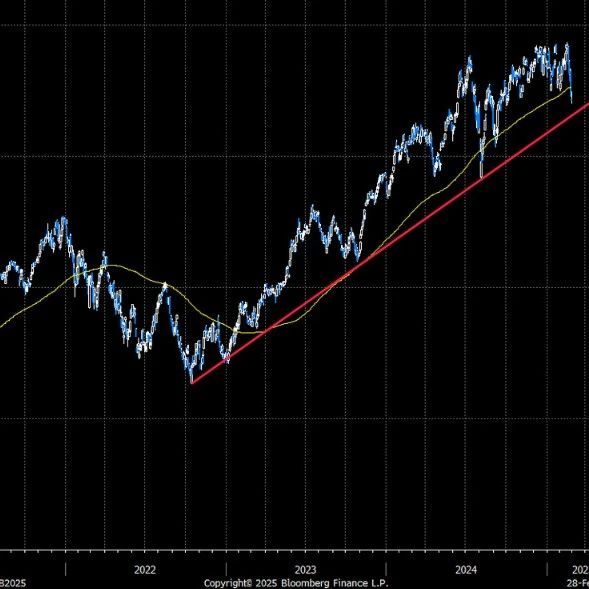
Core Viewpoint - The global market has become increasingly complex, with significant challenges arising from weak tech stocks, fluctuating consumer sentiment, and policy uncertainties impacting investor decisions [1][4]. Group 1: Market Dynamics - The "Magnificent 7" tech giants have seen an 8% decline this year, contrasting with a 4% increase in the remaining 493 companies in the S&P 500, highlighting a shift in market dynamics [5]. - Recent weeks have shown a significant rise in market difficulty, with hedge funds experiencing their second-worst five-day performance in nearly two years [6]. - The "momentum" factor has recently contributed significantly to hedge fund returns, but has shown volatility since the U.S. elections, indicating a shift towards new sectors and industries [7]. Group 2: Economic Indicators - U.S. GDP growth rate estimates have dropped from slightly above 3% to below 2% in the past month, reflecting economic uncertainty [9]. - Investor sentiment data from the American Association of Individual Investors (AAII) is nearing historical highs, indicating a rapid shift in investor mood [10]. Group 3: Sector Analysis - The technology sector ETF (XLK) has recently fallen below its 200-day moving average but remains above the upward trend line established since Q4 2022, indicating potential for further movement [14]. - Xiaomi's recent launch of an electric vehicle, with the first batch of 10,000 units selling out in 10 minutes, demonstrates the resurgence of innovation among Chinese private enterprises [16].