
太空算力

Search documents
东方国信(300166.SZ):目前公司业务暂未涉及“太空计算”或“太空算力”相关的技术研发、商业化应用或项目布局
Ge Long Hui· 2026-02-10 12:52
格隆汇2月10日丨东方国信(300166.SZ)在投资者互动平台表示,目前公司业务暂未涉及"太空计算"或"太 空算力"相关的技术研发、商业化应用或项目布局。在算力领域,公司的核心资源与能力均投入于建设 高效、绿色的地面智算基础设施(如内蒙古智算中心)与普惠算力服务平台。 ...

东方国信:目前公司业务暂未涉及“太空计算”或“太空算力”相关的技术研发、商业化应用或项目布局
Ge Long Hui· 2026-02-10 12:51
格隆汇2月10日丨东方国信(300166.SZ)在投资者互动平台表示,目前公司业务暂未涉及"太空计算"或"太 空算力"相关的技术研发、商业化应用或项目布局。在算力领域,公司的核心资源与能力均投入于建设 高效、绿色的地面智算基础设施(如内蒙古智算中心)与普惠算力服务平台。 ...
马斯克念念不忘的“火星梦”,为什么突然转向月球了?
3 6 Ke· 2026-02-10 11:37
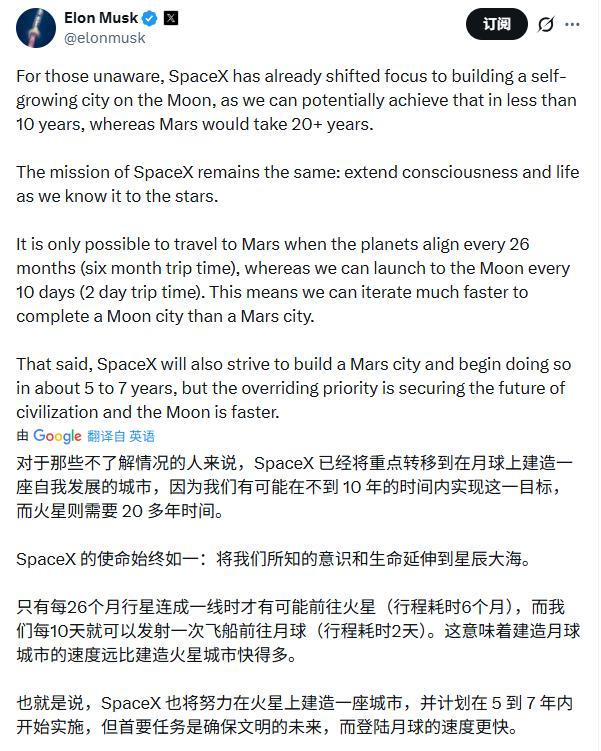
2月9日到2月10日,埃隆·马斯克(Elon Musk)在社交媒体平台X上连续发帖,扔出了一个重磅消息:他 旗下的太空探索技术公司SpaceX,要调整战略重心了。 那个被他反复提及十余年的"火星殖民"愿景,正阶段性让位于一个更近、更具紧迫性的目标,在月球上 建造一座城市。 马斯克在社交媒体发帖解释道:"对于不了解最新进展的人来说,SpaceX的重点已经转向月球,并计划 在那里建设一座可自我发展的城市。我们有可能在不到10年内实现这一目标,而真正实现火星殖民,则 仍需要更多的时间"。 随后他继续发帖,进一步道出这一战略转向背后的深层忧虑:"之所以改变优先事项,是因为我担心自 然灾害或人为灾难可能切断来自地球的补给,从而导致殖民地走向灭亡"。 那个曾断言"月球只是干扰"、主张"直奔火星"的马斯克,为何突然将目光重新投向月球?这座设想中的 月球城市将如何建成?它真的可能在十年内从愿景走向现实吗? 01 星际梦想绕道:"火星先让路月球" 马斯克的这个决定,并非一时兴起,而是基于一套冷酷的现实计算。用他自己的话说,核心原因就两个 字:速度。 去火星,太难也太慢。由于行星运行轨道的关系,从地球发射飞船前往火星的最佳窗口期 ...

马斯克的万亿豪赌:把AI数据中心送上天,是天才构想还是科幻泡沫?
Hua Er Jie Jian Wen· 2026-02-10 07:54
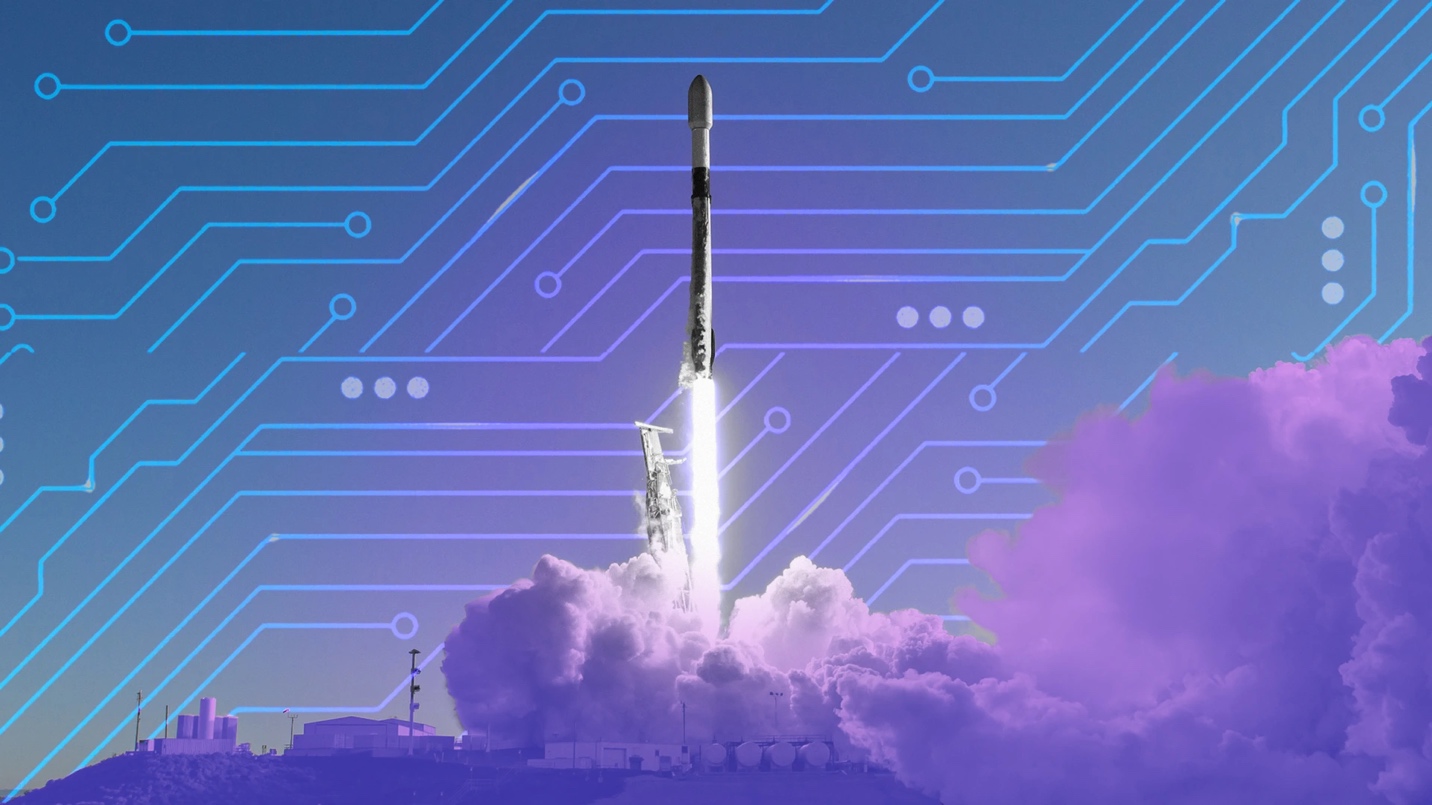
Core Viewpoint - Elon Musk is planning a $1.25 trillion venture to merge SpaceX with his AI startup xAI, betting on the future of AI in space rather than on Earth [1] Group 1: Industry Trends - Major tech giants are also exploring space-based AI capabilities, with Jeff Bezos working on Project Prometheus and Google planning the Suncatcher project in collaboration with Planet [1] - Aetherflux's founder highlights that the AI boom has created a "once-in-a-century energy usage inflection point," suggesting that space offers theoretically "unlimited energy" [2] Group 2: Economic Viability - Deutsche Bank reports that deploying a 1 GW capacity data center in space currently costs seven times more than on Earth, but predicts this cost gap will close rapidly by 2032 [3][4] - The cost of launching payloads must drop significantly, from approximately $1,600 per kilogram to $67 per kilogram, and satellite costs must be optimized to below $2 million each for space data centers to become economically viable [3][4] Group 3: Technical Challenges - Engineers warn of significant physical challenges, including heat dissipation issues in the vacuum of space, which could require extensive and fragile cooling structures [5][6] - Space is filled with radiation and debris, necessitating expensive protective measures for electronic equipment, which could further complicate the feasibility of space-based data centers [6] Group 4: Geopolitical Concerns - There are concerns about who will control space-based infrastructure, with warnings that if U.S. companies dominate, it could pose risks for global service availability [7] - The potential for monopolistic control over space-based resources raises alarms about regulatory challenges and competition in the tech industry [7] Group 5: Investment Considerations - The race for space-based computing has begun, but the economic rationale is heavily dependent on extreme assumptions about launch costs [8] - Investors are advised to consider more efficient energy solutions on Earth, such as nuclear or geothermal data centers, rather than investing in costly space infrastructure [8]
钧达股份20260209
2026-02-10 03:24
Summary of Conference Call Company and Industry Overview - **Company Involved**: XunTian QianHe Space Technology Co., Ltd. (寻天千禾) - **Parent Company**: JunDa Co., Ltd. (君达股份) has become the major shareholder with a 60% stake in XunTian QianHe, indicating a strategic partnership aimed at enhancing the commercial satellite sector in China [1][16]. Core Insights and Arguments XunTian QianHe's Position and Strategy - **Leadership in Commercial Space**: XunTian QianHe positions itself as a leader in China's commercial space sector, focusing on high-value commercial satellites. The team has experience in the development and launch of nearly 100 satellites [2][6]. - **Self-Developed Products**: Approximately 70% of the satellite platform products are self-developed, showcasing a strong vertical integration within the industry [2][7]. - **Policy Support**: The company benefits from recent government policies aimed at accelerating the development of commercial space, including the establishment of a dedicated Commercial Space Administration [3][4]. Market Dynamics - **Competitive Landscape**: The near-Earth orbit resources are highly competitive, with a "first come, first served" principle for frequency resources. China aims to catch up with the U.S., which has a significant lead in satellite launches [3][5]. - **Launch Goals**: XunTian QianHe aims to complete the launch of 1,300 satellites by 2029 and 15,000 satellites by 2030, indicating a robust growth trajectory in satellite deployment [5][14]. Technological Capabilities - **Satellite Types**: The company focuses on various satellite types, including communication, remote sensing, navigation, and computing satellites, with a strong emphasis on integrating advanced technologies [10][12]. - **Innovative Solutions**: XunTian QianHe is developing cutting-edge technologies, such as AI-enabled satellites for on-orbit target extraction and advanced meteorological payloads [12][13]. JunDa's Strategic Vision - **Investment in XunTian QianHe**: JunDa's investment is aimed at leveraging XunTian QianHe’s technological strengths and market position to become one of the top three commercial satellite companies in China [16][18]. - **Market Opportunities**: JunDa identifies significant market opportunities in remote sensing, communication, and computing satellites, particularly as launch costs decrease and demand for satellite services increases [19][21][22]. Additional Important Insights - **Collaboration and Partnerships**: JunDa plans to collaborate with various stakeholders, including government entities and major corporations, to enhance the operational capabilities and market reach of XunTian QianHe [24][25]. - **Global Market Expansion**: There is a strategic focus on expanding into overseas markets, particularly in regions like the Middle East and Southeast Asia, to establish a localized service system [25][26]. - **Technological Leadership**: JunDa emphasizes its technological leadership in space energy solutions, particularly in solar power technologies for satellites, which could become a standard solution in the industry [27][28]. Conclusion The conference highlighted the strategic partnership between JunDa and XunTian QianHe, focusing on leveraging technological capabilities and market opportunities in the rapidly evolving commercial satellite industry in China. The emphasis on self-developed products, government support, and ambitious launch goals positions both companies for significant growth in the coming years.
和众汇富研究手记:太空AI与债务挑战
Cai Fu Zai Xian· 2026-02-10 03:06
Core Viewpoint - Elon Musk's recent comments on artificial intelligence, space computing, and U.S. debt have garnered significant attention, suggesting that space may become the most economically viable location for deploying AI computing within the next three years, with implications for macroeconomic operations and industrial structures [1][4]. Group 1: AI and Space Computing - Current AI models are evolving towards larger scales and higher complexities, with computing power and energy becoming core bottlenecks [3]. - Musk's proposal to deploy AI in space represents a reconfiguration of the "energy-computing-cost" relationship, leveraging stable and efficient solar energy in space as a critical support for large-scale computing operations [3]. - The traditional ground-based data centers face increasing constraints in power, cooling, and land, making the search for new computing capacity solutions a long-term issue for the tech industry [3]. Group 2: Digital Human Simulation - Musk predicts that the number of "simulated digital humans" will far exceed real humans, indicating a shift in AI from a tool to a "factor of production" [3]. - If AI achieves comprehensive digital simulation of human capabilities in cognition, judgment, and execution, it could reshape labor division and value creation methods, impacting sectors like finance, manufacturing, healthcare, and education [3]. Group 3: AI Governance and Economic Implications - Musk emphasizes the importance of aligning AI values with human civilization goals, highlighting that technology governance is a core issue in tech development [4]. - The integration of AI and robotics with the U.S. debt issue has sparked discussions, with Musk warning that without productivity gains from AI and automation, the U.S. may face fiscal imbalance or bankruptcy [4]. - The rising U.S. debt and interest payments are pressing fiscal constraints, particularly in a high-interest environment, necessitating a focus on enhancing potential growth rates [4]. Group 4: Historical Context and Future Outlook - Historical technological revolutions have significantly raised overall societal productivity, providing space for debt management and economic expansion [5]. - Musk's views on AI and robotics are based on the premise that technological advancements can expand the economic "pie," thereby improving the capacity to manage high debt levels [5]. - The construction cycle, commercialization path, and safety issues of space AI infrastructure present uncertainties, while AI's impact on employment and income distribution may exacerbate social tensions in the short term [6]. - The discussions around AI computing, automation, and productivity enhancement are expected to intensify, with significant implications for the long-term global economic landscape [6].

未知机构:广发机械燃机再推荐Musk访谈中被忽视的方向燃机及涡轮叶片-20260210
未知机构· 2026-02-10 02:15
Summary of Key Points from Conference Call Industry Overview - The focus is on the gas turbine and turbine blade sectors, which are currently underappreciated despite their critical role in power generation [1] - The industry is characterized by high technical barriers, significant capital expenditures, and long development cycles, leading to a stable and concentrated market structure [2] Core Companies Mentioned - **Howmet and PCC**: Global leaders in turbine blade manufacturing [2] - **Domestic Key Players**: - **应流股份 (Yingliu)**: Leading in turbine blades, has established relationships with major clients like Baker Hughes, Siemens, GE Aviation, and Ansaldo [2] - **万泽股份 (Wanze)**: Emerging as a secondary supplier for turbine blades, has made breakthroughs with overseas clients and is a core supplier for domestic turbine blades [2] - **航亚科技 (Hangya)**: Leading in compressor blades, holds significant shares with GE Aviation and Safran [2] Market Dynamics - The gas turbine industry is entering a decade-long super cycle, presenting opportunities for various stakeholders: - **杰瑞股份 (Jereh)**: Targeted by manufacturers [2] - **东方电气 (Dongfang Electric)** and **海联讯 (Hailianxun)**: Focused on main engine manufacturing [2] - **鹰普精密 (Eagle Precision)** and **联德股份 (Liande)**: Concentrated on component manufacturing [2] Key Insights from Musk's Interview - Elon Musk highlighted the overlooked bottleneck in power generation related to turbine blades, emphasizing that the demand for power generation exceeds simple calculations based on GPU power and PUE [1] - Musk suggested that SpaceX and Tesla may need to manufacture their own turbine blades due to a 12-18 month delivery delay caused by limited production capacity from only three global foundries [1] Additional Considerations - The turbine blade sector is noted for its high value and technological complexity, which may lead to investment opportunities as the industry stabilizes and matures [2] - There is a systemic research focus on North American AIDC power generation, with additional opportunities identified in internal combustion engines, modified aviation turbines, and solid oxide fuel cells (SOFC) [2]


【公告全知道】光模块+商业航天+光伏+太空算力+人形机器人!公司持续推进与国际龙头客户在商业卫星和太空算力领域的相关项目稳步落地
财联社· 2026-02-09 14:56
前言 《公告全知道》每周日至每周四推送明日股市重大公告!内容包含"停复牌、增减持、投资中标、收 购、业绩、解禁、高送转"等一系列个股利好利空公告,其中重要公告均以红色标注,帮助投资者提前 寻找到投资热点,防范各类黑天鹅事件,并且有充足的时间进行分辨和寻找合适的上市公司。 ①光模块+商业航天+光伏+太空算力+人形机器人!这家公司持续推进与国际龙头客户在商业卫星和太空 算力领域的相关项目稳步落地;②光模块+国产芯片+数据中心!这家公司拟12.51亿投建光芯片器件项 目;③AI应用+ AI大模型+云计算+卫星互联网+机器人!公司发布基于DeepSeek的可控大模型服务。 ...

马斯克突然喊话“重返月球”!SpaceX要搞什么大事?
Xin Lang Cai Jing· 2026-02-09 11:06
(来源:VCA创投社) 过去十几年,马斯克逢人就喊"移民火星",甚至把特斯拉跑车送上太空。但这次他突然改口:"月球才是人类迈向星辰大海的第一站。" 这个转变 背后藏着三个关键原因。首先是时间成本——去火星要等26个月才有一次发射窗口,单程耗时6个月;而登月发射周期缩短到每10天一次,3天就 能到达。其次是政策压力,美国特朗普政府要求2028年前让宇航员重返月球,SpaceX作为NASA的核心承包商,必须先完成这份价值数十亿美元 的合同。最后是商业现实,火星任务烧钱太快,而月球能更快赚钱:既能承接NASA的工程款,又能开采氦-3这种未来核聚变燃料,甚至出租月 球"黄金地段"给商业公司建酒店、实验室。 你以为SpaceX只是造火箭?这次他们要玩把大的!公司计划在月球上搞一场"基建狂魔"行动:用AI卫星组成"太空监控网",实时监测地球环境、 交通、灾害,甚至帮农民预测收成;在月球表面建工厂,用月壤3D打印建筑材料,再通过电磁轨道炮把"积木"发射到太空组装;就连星舰火箭也 被改造成了"太空酒店",燃料箱变卧室,外壳装太阳能板。更疯狂的是,SpaceX已向美国联邦通信委员会申请部署100万颗卫星,这些太阳能驱动 的"太 ...
马斯克称10年内先在月球建造城市
Xin Lang Cai Jing· 2026-02-09 11:00
当地时间2月8日,埃隆·马斯克发文称,SpaceX已将重心转向在月球建设一座可自我扩张的城市,"因为 我们有望在不到10年内实现这一目标,而火星则需要20年以上"。 据马斯克所述,火星每26个月才会出现一次适合出发的行星交汇窗口期(单程需6个月),而前往月球 每10天即可发射(单程仅需2天)。这意味着,建设月球城市的迭代速度会远快于火星城市。 但他强调,SpaceX仍会致力于建设火星城市,并计划在约5至7年内启动相关工作,且首要任务是"保障 人类文明的未来",而月球项目的推进速度更快。 这一调整打破了马斯克多年来坚守的火星优先战略。作为SpaceX的长期核心愿景,"火星殖民计划"被马 斯克反复强调,其曾多次提出要在2026年底前实现火星无人探测,甚至乐观预测2030年前完成载人登 陆。 战略转向背后,或是技术与商业逻辑的双重考量。从技术层面看,月球任务的复杂度显著低于火星,且 月球距离地球更近,应急救援更可控,成为验证星舰回收、自主着陆等关键技术的"中级考场"。马斯克 此前也承认,2026年执行火星任务"技术可行但成功率极低"。 从商业角度看,SpaceX与NASA签订的阿尔忒弥斯登月合同金额达40亿美元,要 ...