稳中求进

Search documents
2025年中央经济工作会议与去年相比有这些新动向
Bei Ke Cai Jing· 2025-12-11 15:11
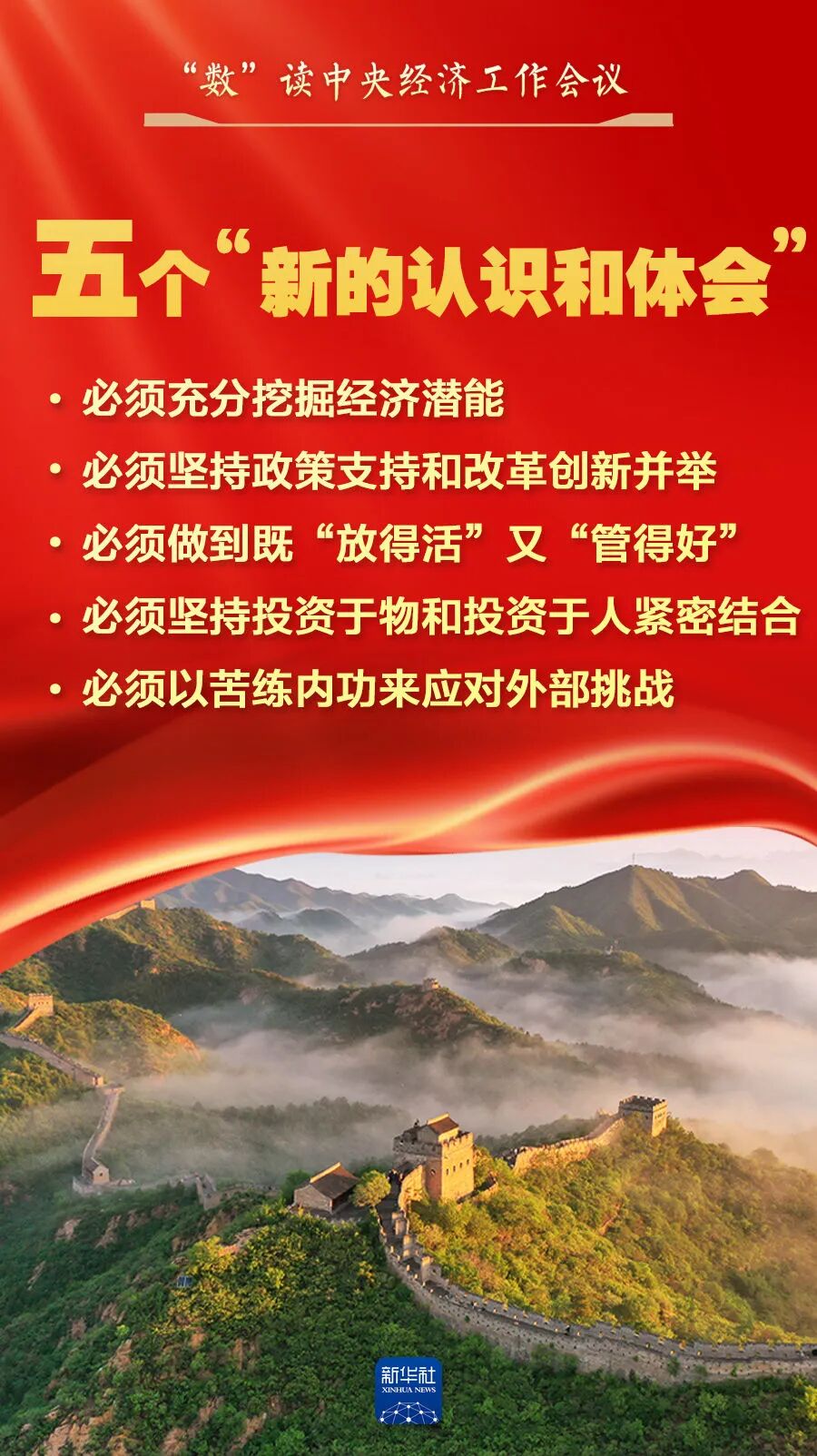
中央经济工作会议12月10日至11日在北京举行。会议指出,我国经济发展中老问题、新挑战仍然不少,外部环境变化影响加深,国内供强需弱矛盾突出,重 点领域风险隐患较多。这些大多是发展中、转型中的问题,经过努力是可以解决的,我国经济长期向好的支撑条件和基本趋势没有改变。要坚定信心、用好 优势、应对挑战,不断巩固拓展经济稳中向好势头。 新京报贝壳财经记者对比往年内容发现,本次会议在政策取向上突出"稳中求进、提质增效",并提出"发挥存量政策和增量政策集成效应"。会议强调,要着 力稳就业、稳企业、稳市场、稳预期,传递出明年经济工作将更注重结构优化、风险化解与民生实质改善的新信号。 2025年中央经济工作会议多项提法更新升级,释放明年经济工作稳中求进、提质增效新信号。 推动标志性改革举措落地见效。 高质量完成国有企业改革深化提 升行动,出台民营经济促进法。 开展规范涉企执法专项行动。制 定全国统一大市场建设指引。加 强监管,促进平台经济健康发 展。 开展"人工智能+"行动,培育 人工智能 未来产业。加强国家战略科技力 量建设。 促进居民收入增长和经济增长同 步。实施提振消费专项行动,推 动中低收入群体增收减负。 高质量完成 ...


权威解读!中央经济工作会议这些提法,很新!
Shang Hai Zheng Quan Bao· 2025-12-11 14:51
Core Insights - The Central Economic Work Conference held on December 10-11, 2025, outlined key economic tasks for 2026, emphasizing the importance of domestic demand and market stability [1][2][10]. Group 1: Economic Policy Direction - The conference established a policy tone of "seeking progress while maintaining stability" and "improving quality and efficiency," highlighting a higher demand for economic quality and effectiveness [3][4]. - It was noted that macroeconomic policies will focus on both short-term and long-term adjustments, enhancing the effectiveness of governance [4]. Group 2: Fiscal Policy - A more proactive fiscal policy will be implemented, with a projected deficit rate of no less than 4% and an increase in new debt scale [5][6]. - The fiscal spending structure will shift towards supporting consumption and improving residents' welfare, including increased childcare subsidies and pension benefits [5][6]. Group 3: Monetary Policy - The conference reiterated the commitment to a moderately loose monetary policy, emphasizing the flexible use of various policy tools such as interest rate cuts and reserve requirement ratio adjustments [7][9]. - The aim is to enhance liquidity and promote economic stability through effective monetary policy coordination [7][9]. Group 4: Domestic Demand and Consumption - The primary task for 2026 is to "maintain domestic demand as the main driver and build a strong domestic market," with a focus on boosting consumption and investment [10][11]. - Specific measures to stimulate consumption include increasing fiscal support and expanding the range of supported consumer goods [11]. Group 5: Innovation and New Growth Drivers - The conference highlighted the importance of "innovation-driven development" as a key task, aiming to create a comprehensive innovation ecosystem [12][13]. - Initiatives include establishing international technology innovation centers and enhancing intellectual property protection in emerging fields [12][13]. Group 6: Capital Market Reforms - Continuous deepening of capital market reforms was emphasized, focusing on improving the investment and financing functions of the capital market [16][17]. - Future measures may include optimizing capital market infrastructure and enhancing investor protection [17]. Group 7: Real Estate Market Stability - The conference stressed the need to stabilize the real estate market through targeted policies, including inventory reduction and promoting affordable housing [25]. - Measures may involve using special bond funds to acquire existing housing for public welfare and implementing tax incentives for home purchases [25]. Group 8: Energy Strategy - The conference called for the formulation of a national energy strategy, focusing on building a new energy system and expanding green electricity applications [22][23]. - This marks a significant shift in energy development strategy, aiming to replace traditional fossil fuels with clean energy sources [22][23]. Group 9: Local Government Debt Management - The conference addressed the need to manage local government debt risks proactively, encouraging compliance and restructuring of existing debts [27][28]. - Strategies include replacing high-cost debts with lower-interest bonds and utilizing asset management techniques to mitigate risks [27][28].
中央经济工作会议解读:壮大新动能,深入“反内卷”
Guoxin Securities· 2025-12-11 14:11
Economic Outlook - The central economic work conference emphasized the importance of "high-quality development" over "steady progress," indicating a shift in priorities for 2026[4] - The growth target for 2026 is likely set around "around 5%," with internal control targets between 4.8% and 5.0%[5] Policy Focus - Expanding domestic demand remains the top priority, with a balanced emphasis on both consumption and investment[5] - The fiscal policy will maintain necessary deficits and debt levels, with a projected deficit rate of 4.0% for 2026 and an increase in special government bonds to approximately 1.5 trillion yuan[9][8] Monetary Policy - The monetary policy will adopt a "moderately loose" stance, with flexibility in implementing rate cuts and reserve requirement ratio adjustments[11] - Expected interest rate cuts in 2026 are projected to be in the range of 10-20 basis points, with a reserve requirement ratio reduction of 50 basis points[11] Structural Reforms - The conference highlighted the need to address "involution" in competition, with plans to establish a unified national market and regulate tax incentives and subsidies[4][15] - Emphasis on innovation and technology, including the establishment of three major international innovation centers and a focus on service industry enhancements[15] Risk Management - The priority for risk management has shifted, with a decreased focus on the real estate sector, indicating a more stable approach to market stabilization[22] - Local government debt management remains a high priority, reflecting ongoing concerns about financial stability[22]
锚定国策践初心 精耕实干促发展
Xin Lang Cai Jing· 2025-12-11 13:53
文:中泰期货股份有限公司党委书记、董事长 吕祥友 2025年中央经济工作会议明确"稳中求进、提质增效"工作总基调,围绕内需主导、创新驱动、改革攻 坚、对外开放、协调发展、"双碳"引领、民生为大、守牢底线八大重点任务作出部署,为"十五五"规划 开局定向。作为国有控股期货公司,中泰期货将深刻把握会议确定的工作总基调,立足期货和衍生品专 业优势,将政策导向转化为"服务实体、创新发展、守牢底线"的务实行动,以金融力量助力经济高质量 发展。 践行初心使命,筑牢服务实体"压舱石"。中泰期货将紧扣会议"建设强大国内市场"部署,锚定公司"把 牢一个方向,抓实一个方法"经营发展思路,持续提升服务实体经济能力。聚焦作用发挥,充分发挥期 货市场发现价格、管理风险、配置资源功能,加大产业客户与机构投资者服务开发力度;深化战略协 同,积极融入母公司发展战略,锻造证期协同新优势,在功能性发挥中提升价值创造力;紧跟国家战 略,丰富绿色低碳转型产品和服务供给,持续加大沿黄地区服务力度,深化"保险+期货"模式创新,助 力乡村全面振兴,彰显国有期货公司的责任与担当。 坚持创新发展,激活提质增效"强引擎"。围绕会议"加紧培育壮大新动能"要求,中泰 ...

2026经济工作怎么干?专家解读中央经济工作会议
Yang Shi Wang· 2025-12-11 13:42
Core Viewpoint - The central economic work conference emphasizes the policy orientation of "seeking progress while maintaining stability and improving quality and efficiency," highlighting the dialectical relationship between stability and progress, as well as quality and efficiency [4][6]. Group 1: Economic Growth and Stability - By 2025, China's economy is expected to reach approximately 140 trillion yuan, necessitating a reasonable growth rate to ensure long-term stability [4]. - China's current economic growth rate is among the top in major economies, reflecting the country's commitment to high-quality development and the balance between qualitative improvement and reasonable quantitative growth [4]. Group 2: Quality and Efficiency - The relationship between quality and efficiency is crucial, focusing on the development of new and superior production capabilities, successful industrial transformation, and a positive trend in green and low-carbon transitions [6]. - The effectiveness of macroeconomic policies must be emphasized, ensuring that policies are forward-looking, targeted, and effective through detailed implementation [6][7]. Group 3: Policy Consistency - Consistency in policy orientation is essential, including the alignment of economic and non-economic policies, as well as stock and incremental policies, to create a stronger policy synergy [9]. - Adhering to the principles of seeking progress while maintaining stability and improving quality and efficiency will facilitate a smooth start to economic work in 2026 [9].
2025年中央经济工作会议学习体会:稳妥做增量,务实推存量
ZHONGTAI SECURITIES· 2025-12-11 12:48
Group 1: Economic Policy Framework - The central economic work meeting emphasizes the principle of "seeking progress while maintaining stability," focusing on stabilizing employment, enterprises, markets, and expectations to ensure smooth economic operation[2] - The meeting suggests a combination of "mandatory options + optional options" in macroeconomic policy, indicating a relatively stable approach to mandatory macro policies while allowing for counter-cyclical adjustments as needed[3] - The integration of stock and incremental policies is highlighted, with a commitment to continue implementing a more proactive fiscal policy while maintaining necessary fiscal deficits and total debt levels[3] Group 2: Consumer and Market Dynamics - Consumption is prioritized over investment in policy discussions, with specific measures to enhance consumer capacity, including the implementation of urban and rural resident income increase plans[4] - The meeting calls for the expansion of quality goods and services supply and the removal of unreasonable restrictions in the consumption sector to unleash service consumption potential[4] - The focus on addressing "involution" competition indicates a recognition of deeper structural issues, requiring comprehensive solutions rather than superficial capacity clearing[4] Group 3: Taxation and Industry Support - The meeting proposes to improve the local tax system, addressing the decline in local tax revenue share in fiscal income and expenditure, with potential adjustments to shared tax ratios to stabilize local government finances[5] - Specific industries are identified for targeted support, including artificial intelligence, digital trade, and green trade, aiming to create a favorable policy environment for development[5] - Employment remains a top priority in social policy, with a focus on stabilizing job opportunities for key groups such as college graduates and migrant workers[5] Group 4: Risk Management - The meeting emphasizes risk prevention, particularly in the real estate sector and local government debt, encouraging the acquisition of existing residential properties for affordable housing[6] - The report highlights potential risks including policy changes, unexpected economic fluctuations, and delays in updating research information[6]
“阶梯式递进、不断发展进步的历史过程”
Ren Min Ri Bao· 2025-12-09 22:32
时间观,贯穿理想、信念与奋斗。 "十四五"收官在即,"十五五"即将开启。基本实现社会主义现代化这场接力跑,即将进入"夯实基础、 全面发力的关键时期"。 "实现社会主义现代化是一个阶梯式递进、不断发展进步的历史过程,需要不懈努力、接续奋斗。"习近 平总书记的这一重要论述,道出了中国共产党人深邃的时间观。 时间观,贯通过去、现在和未来。 "看清楚过去我们为什么能够成功、弄明白未来我们怎样才能继续成功"。 "中国式现代化是干出来的,伟大事业都成于实干!" 从第一个五年计划到第十四个五年规划,一以贯之的主题是把我国建设成为社会主义现代化国家。几多 艰辛,几多不易,几多辉煌,"阶梯式递进、不断发展进步"正是其生动写照。 从2025到2035,尽管我们可能随时会面对风高浪急甚至惊涛骇浪的重大考验,但"阶梯式递进、不断发 展进步"的大势不会变,规律不会变。 下一个5年,用好我们的优势,直面风险挑战,坚定不移办好自己的事,确保基本实现社会主义现代化 取得决定性进展——我们的信心,不会变。 (一) "阶梯式递进、不断发展进步的历史过程",体现的是一种战略定力。 习近平总书记深刻指出:"按照经济社会发展规律确定奋斗目标,一以贯之 ...
在决胜“十四五”谋划“十五五”中深刻感悟——“阶梯式递进、不断发展进步的历史过程”
Ren Min Ri Bao· 2025-12-09 22:18
"十四五"收官在即,"十五五"即将开启。基本实现社会主义现代化这场接力跑,即将进入"夯实基础、 全面发力的关键时期"。 "实现社会主义现代化是一个阶梯式递进、不断发展进步的历史过程,需要不懈努力、接续奋斗。"习近 平总书记的这一重要论述,道出了中国共产党人深邃的时间观。 时间观,贯通过去、现在和未来。 "看清楚过去我们为什么能够成功、弄明白未来我们怎样才能继续成功"。 时间观,贯穿理想、信念与奋斗。 "中国式现代化是干出来的,伟大事业都成于实干!" 从第一个五年计划到第十四个五年规划,一以贯之的主题是把我国建设成为社会主义现代化国家。几多 艰辛,几多不易,几多辉煌,"阶梯式递进、不断发展进步"正是其生动写照。 从2025到2035,尽管我们可能随时会面对风高浪急甚至惊涛骇浪的重大考验,但"阶梯式递进、不断发 展进步"的大势不会变,规律不会变。 下一个5年,用好我们的优势,直面风险挑战,坚定不移办好自己的事,确保基本实现社会主义现代化 取得决定性进展——我们的信心,不会变。 (一) "阶梯式递进、不断发展进步的历史过程",体现的是一种战略定力。 习近平总书记深刻指出:"按照经济社会发展规律确定奋斗目标,一以贯之 ...
重磅定调!最新解读
Zhong Guo Ji Jin Bao· 2025-12-09 11:58
中国银河(601881)宏观认为,从总的政策基调来看,本次政治局会议强调要坚持"稳中求进、提质增 效",明年是"十五五"规划开局之年,聚焦国内"提质增效",有利于赢得"十五五"规划良好开局。当前 百年变局加速演进,面对外部不确定性,宏观政策要以"我"为主,把握好"逆周期""跨周期"力度,推动 经济实现质的有效提升和量的合理增长,以确定性应对不确定性。 【导读】明年经济工作坚持"稳中求进、提质增效"总基调,为"十五五"规划开局注入强劲动力 中共中央政治局12月8日召开会议,分析研究2026年经济工作。 受访专家表示,会议强调明年经济工作坚持"稳中求进、提质增效"总基调,兼顾了短期稳增长与中长期 高质量发展。同时,宏观政策、扩大内需、创新驱动等多方面协同发力,将为"十五五"规划开局筑牢根 基,更好推动我国经济高质量发展。 亮点1:紧扣"稳中求进、提质增效"总基调 为"十五五"规划开局夯实基础 会议强调明年经济工作要坚持"稳中求进、提质增效"的总基调,"实施更加积极有为的宏观政策""持续 扩大内需、优化供给",并将"内需主导,建设强大国内市场"放在八大任务首位。 上海金融与发展实验室首席专家、主任曾刚表示,此次宏观 ...
重磅定调!最新解读
中国基金报· 2025-12-09 11:54
Core Viewpoint - The article emphasizes that China's economic work in 2026 will adhere to the principle of "seeking progress while maintaining stability and improving quality and efficiency," which will lay a strong foundation for the "14th Five-Year Plan" [1][3]. Group 1: Economic Policy Framework - The meeting highlighted the importance of implementing a more proactive fiscal policy and maintaining a moderately loose monetary policy for 2026 [5][6]. - The fiscal policy is expected to maintain the same deficit ratio as this year, while the scale of special bonds and quasi-fiscal policy tools will increase [5]. - Monetary policy will focus on two main areas: total policy adjustments, including potential interest rate cuts, and structural policies aimed at supporting key sectors such as technology innovation and small enterprises [5][6]. Group 2: Domestic Demand Expansion - The meeting placed a strong emphasis on expanding domestic demand, stating that it should be the primary driver of economic growth [7][8]. - Strategies include boosting consumption through policy reforms and avoiding a dichotomy between investment and consumption [8]. - The development of a unified national market is seen as crucial for enhancing competition and matching supply with demand effectively [8]. Group 3: Innovation-Driven Growth - Innovation is identified as a key focus, with the goal of fostering new growth drivers [9][10]. - The establishment of a modern industrial system and the promotion of high-level technological self-reliance are highlighted as essential tasks [11]. - The article suggests that innovation should be integrated with industry, emphasizing the need for technological upgrades in traditional sectors and the development of emerging industries [12]. Group 4: Risk Management - The meeting addressed the need to "safeguard the bottom line and actively and prudently mitigate risks in key areas," particularly in real estate and local government debt [13][14]. - It is noted that stabilizing the real estate market is critical to preventing systemic risks and maintaining market confidence [14][15]. - Recommendations for risk mitigation include implementing systematic policy measures, restructuring small financial institutions, and establishing a long-term mechanism for government debt management [15].