
L3级自动驾驶

Search documents
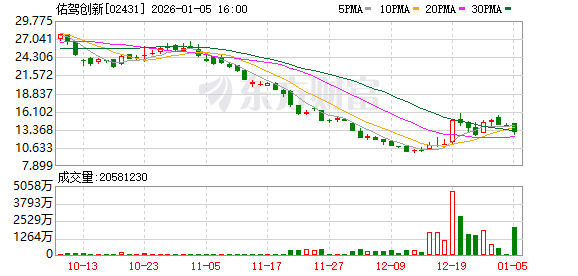
佑驾创新:多名股东自愿延长限售期 董事长刘国清个人增持5万股
Zheng Quan Shi Bao Wang· 2026-01-05 15:30
Core Viewpoint - Youjia Innovation (02431.HK) demonstrates strong confidence in its business prospects through voluntary extension of share lock-up periods by major shareholders and the chairman's share purchase, signaling positive market sentiment and shareholder protection [2] Group 1: Shareholder Actions - Major shareholders, including executive directors Liu Guoqing, Yang Guang, Zhou Xiang, Wang Qicheng, and individual shareholders Yan Shengye and Wu Jianxin, voluntarily extended their share lock-up periods, with four executive directors holding a total of 18.42% of shares extending their lock-up until December 27, 2026 [2] - Chairman Liu Guoqing purchased a total of 50,000 H-shares at an average price of approximately HKD 12.60 per share on January 5, 2026 [2] Group 2: Business Performance - Youjia Innovation has achieved a compound annual growth rate of over 50% in revenue, indicating a strong business momentum and deepening competitive moat [2] - The company has successfully delivered mass production to 42 automotive manufacturers, expanding its customer base across leading domestic and luxury brands, and is accelerating its international expansion [3] Group 3: Future Prospects - The company has entered the commercialization phase for its L4 autonomous driving business, with its unmanned buses operating in multiple cities and securing significant orders in the logistics market [3] - Youjia Innovation's comprehensive technology layout from L1 to L4, along with its strong engineering and mass production capabilities, positions it well to benefit from the accelerating industry upgrades and market opportunities [4] - The recent inclusion in the Hang Seng Stock Connect Electronic Theme Index reflects the capital market's recognition of the company's industry position and growth potential [4]

全球车企市值“大洗牌”
财联社· 2026-01-05 14:08
汽车产业深度变革背景下,全球车企市值排名的更新既是中国、外资车企行业地位与竞争格局的直观体现,亦为市场对汽车企业全产业链价值的综 合判断。 "一家企业的市值表现与很多因素有关,如盈利与现金流能力、成长潜力与战略布局以及企业抗风险能力等。"有业内人士分析称,小米的市 值排在比亚迪之前,本质是估值逻辑的胜利,两家企业在资本眼中的定位差异十分明显。"尽管小米在过去一年经历了诸多风波,但其'生态 溢价'能力依旧十分可观,尤其是相对于偏向传统制造的比亚迪而言。" 与华为深度绑定的赛力斯,是除小米、比亚迪外排名第三的中国车企,反超上汽集团的同时整体排名上升一位,至第18位。业界普遍认为, 爆款车型终端热度不减、登陆港股两地上市等因素,是其被市场认可的主要原因。 | | | | 2025年中国上市车企市值排名(截至2025年12月31日) | | | | | --- | --- | --- | --- | --- | --- | --- | | 2025排名 | 较2024排名 | 公司 | 2025年市值 | 2024年市值 | 市值变化 | 色注 | | | | | (亿美元) | (亿美元) | (亿,美元) | | ...


智驾商业化新阶段!深蓝汽车L3级自动驾驶车辆大规模上路
Zhong Guo Zheng Quan Bao· 2026-01-05 03:39
2025年12月26日,重庆街头出现一道标志性的智能出行风景线——46辆搭载我国首批L3级自动驾驶专 用正式号牌的深蓝汽车平稳驶入城市道路。 作为长安汽车旗下核心智能电动品牌,深蓝汽车凭借此次先发优势,叠加61.22亿元增资扩股的资本助 力、33.3万辆的2025年销量佳绩,以及累计超70万辆的全球交付基础,正以"技术+资本+市场"的三重合 力,重塑中国智能汽车产业的竞争格局,为全球自动驾驶商业化提供"中国方案"。 "L2到L3是一个巨大的跨越,这个跨越的背后是责任主体的判断,对于安全的要求完全不一样。"深蓝 汽车董事长邓承浩在接受中国证券报记者采访时直言,这一突破不仅是技术的胜利,更是产业生态走向 成熟的标志。 技术合规双轮驱动 长安科技人工智能基础与应用副总经理梁锋华称,L3级自动驾驶的安全性要求达到人类驾驶的几十 倍,需通过传感、系统等多重冗余设计,确保单点失效时仍能无缝切换,同时预留充足接管时间,并设 置最小风险兜底策略。 此次上路的46辆深蓝汽车,获准在重庆内环快速路等指定路段的拥堵环境下,以最高时速50公里进行自 动驾驶。"之所以做这一限定,主要是为了积累拥堵场景下的驾驶数据,通过不同场景示范带动 ...

港股异动 | 智驾概念股多数走高 黑芝麻智能(02533)涨超7% 浙江世宝(01057)涨超6%
智通财经网· 2026-01-05 02:33
Core Viewpoint - The smart driving concept stocks have shown significant gains, driven by advancements in autonomous driving technology and positive market sentiment towards the industry [1] Group 1: Stock Performance - Black Sesame Intelligence (02533) increased by 7.32%, reaching HKD 20.96 [1] - Zhejiang Shibao (01057) rose by 6.26%, reaching HKD 5.26 [1] - Pony.ai-W (02026) saw a rise of 6.29%, reaching HKD 123.4 [1] - WeRide-W (00800) increased by 4.54%, reaching HKD 24.42 [1] Group 2: Technological Advancements - A Model 3 equipped with FSD v14 successfully completed a cross-country trip from Los Angeles to South Carolina, covering 2732 miles in 2 days and 20 hours, entirely relying on FSD without any human intervention [1] - The journey included various driving conditions such as highways, city roads, nighttime driving, and multiple entries and exits at supercharging stations [1] Group 3: Industry Outlook - Dongwu Securities maintains a positive outlook on the L4 RoboX mainline for 2026 [1] - Orient Securities anticipates that with regulatory support and increasing market demand, the progress of L3 autonomous driving industrialization is expected to accelerate by 2026, benefiting related smart driving hardware and software suppliers [1]

智驾概念股多数走高 黑芝麻智能涨超7% 浙江世宝涨超6%
Zhi Tong Cai Jing· 2026-01-05 02:29
Core Viewpoint - The smart driving concept stocks have shown significant gains, driven by advancements in autonomous driving technology and positive market sentiment towards related companies [1] Group 1: Stock Performance - Major smart driving stocks have risen, with Hezhima (000716) up 7.32% to HKD 20.96, Zhejiang Shibao (002703) up 6.26% to HKD 5.26, Pony.ai-W (02026) up 6.29% to HKD 123.4, and WeRide-W (00800) up 4.54% to HKD 24.42 [1] Group 2: Technological Advancements - A Model 3 equipped with FSD v14 successfully completed a cross-country trip from Los Angeles to South Carolina, covering 2732 miles in 2 days and 20 hours, entirely relying on FSD without any human intervention [1] Group 3: Industry Outlook - Dongwu Securities maintains a positive outlook on the L4 RoboX mainline by 2026, while Dongfang Securities anticipates accelerated progress in L3 autonomous driving commercialization by 2026, driven by regulatory support and increasing market demand, benefiting related smart driving hardware and software suppliers [1]

信达国际:维持禾赛-W“买入”评级 目标价200港元
Zhi Tong Cai Jing· 2026-01-05 01:51
Core Viewpoint - The report from Cinda International highlights that Hesai Technology (02525) demonstrates superior profitability and cash flow compared to its peers, justifying a valuation premium with a maintained "Buy" rating and a target price of HKD 200 [1] Group 1: Financial Performance - The company is projected to achieve a compound annual growth rate (CAGR) of 41% in revenue and 321% in adjusted earnings from fiscal years 2024 to 2027 [1] - In Q3, the company reported a net income of RMB 795 million, a year-on-year increase of 47.5%, with a net profit of RMB 256 million, marking a record high compared to a loss of RMB 70.4 million in the same period last year [2] - Cumulative net profit for the first three quarters reached RMB 283 million, exceeding the annual profit target of RMB 200 million to RMB 350 million, leading to an upward revision of the full-year profit guidance to RMB 350 million to RMB 450 million [2] Group 2: Market Position and Product Development - Hesai is the global leader in the lidar market, with significant growth in shipments of advanced driver-assistance systems (ADAS) and robotic lidar, increasing by 190% and 131% year-on-year, respectively [2] - The company has secured over 120 mass production contracts for various vehicle models and has maintained a leading market share of 46% in the automotive lidar sector for seven consecutive months [4] - New products targeting L3-level autonomous driving are expected to be delivered in large quantities between 2025 and 2027, enhancing the company's competitive edge [4] Group 3: Industry Trends - The approval of the first batch of L3-level conditional autonomous driving models in mainland China indicates a clearer regulatory environment, which could boost the valuation of the autonomous driving industry [3] - The expected increase in the number of lidar devices per L3 vehicle (3-6 units) compared to L2 vehicles (1-2 units) suggests a growing demand for lidar technology [4] - The company's JT series lidar products are experiencing strong overseas demand, with total shipments expected to exceed 200,000 units for the year [5]
长安汽车2025年销量超291万辆 四大维度齐创历史新高
Zheng Quan Ri Bao Wang· 2026-01-04 14:47
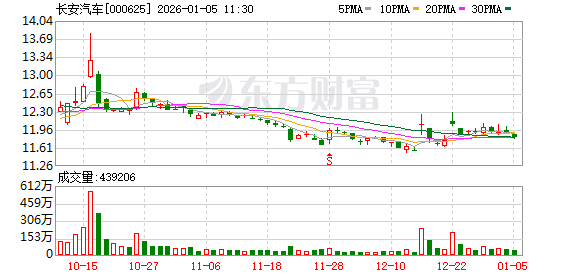
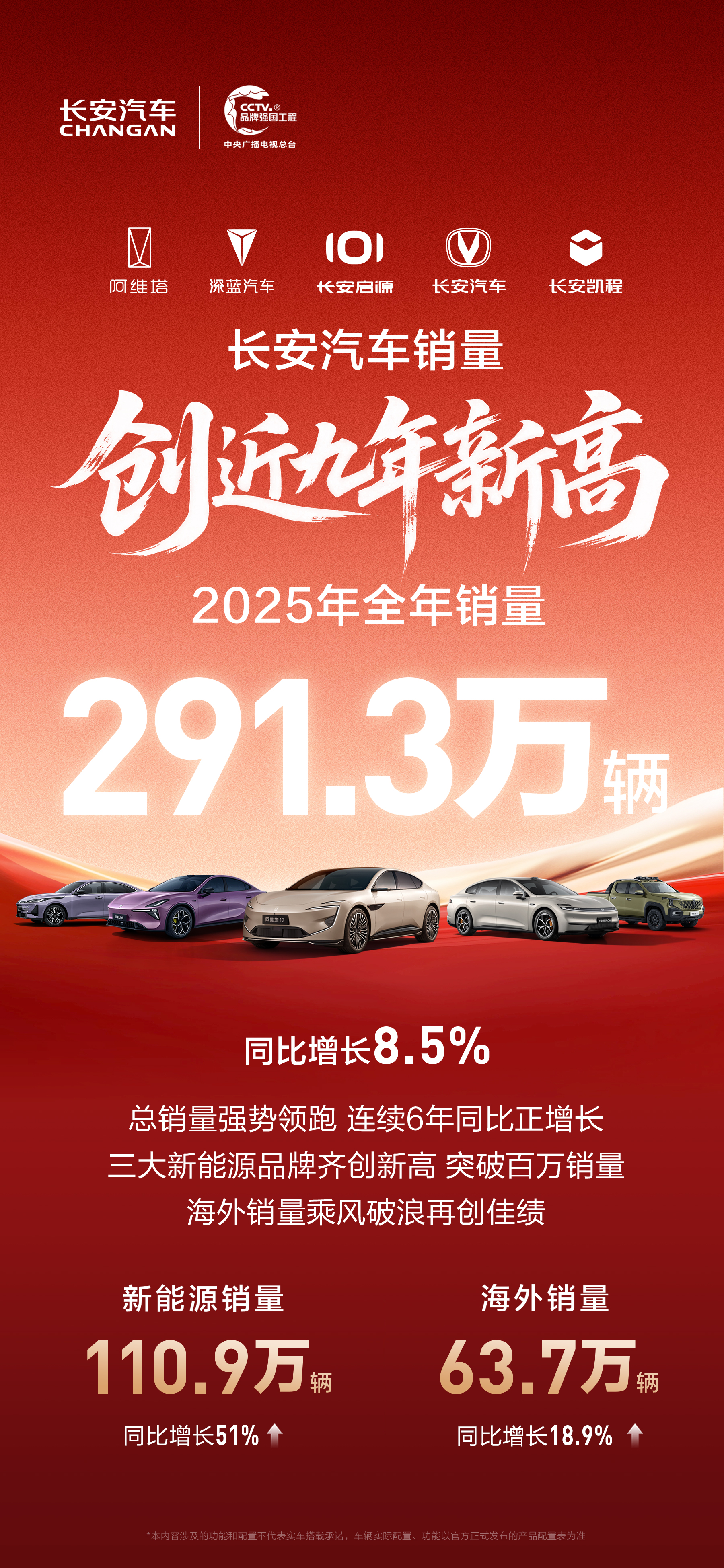
Core Viewpoint - In a highly competitive automotive market in 2025, Changan Automobile (000625) has demonstrated robust performance with record-breaking achievements, showcasing strong momentum in high-quality development and strategic resilience [1]. Sales Performance - Changan Automobile achieved total sales of 2.913 million units in 2025, marking an 8.5% year-on-year increase and reaching the highest sales level in nearly nine years, with six consecutive years of positive growth [8][10]. - The company celebrated the milestone of producing its 30 millionth vehicle, achieving this in just 4.5 years from the 20 million mark, highlighting the "Changan speed" [8]. New Energy Vehicle (NEV) Growth - The NEV segment surpassed 1.1 million units sold in 2025, representing a 51% year-on-year increase, placing Changan among the top players in the "million sales club" for NEVs [10]. - The three NEV brands—Avita, Deep Blue, and Changan Qiyuan—contributed significantly to this growth, with Avita achieving sales of over 120,000 units, Deep Blue reaching 333,000 units, and Changan Qiyuan selling 411,000 units [10][11][12]. Global Market Expansion - Changan's overseas sales reached 637,000 units in 2025, an 18.9% increase year-on-year, establishing a new historical high and demonstrating strong global competitiveness [12]. - The company has made significant strides in its global strategy, including the establishment of nine overseas factories and plans for 20 more in countries like Brazil and Indonesia, enhancing its global footprint [12][13]. Strategic Initiatives - The establishment of the new central enterprise on July 29 has empowered Changan to accelerate its three major plans: "Shangri-La" for NEVs, "Beidou Tianshu" for smart technology, and "Haina Baichuan" for globalization, creating a solid foundation for steady sales growth [8][9]. - Changan is committed to technological innovation, with advancements in battery technology and smart driving systems, positioning itself as a leader in the L3 autonomous driving segment [9][11]. Future Outlook - Looking ahead, Changan aims to strengthen its core technological capabilities, deepen the development of its five-brand matrix, and expand its global presence, targeting a production and sales goal of 5 million units by 2030 [13].
L3试点破冰之后:2026年自动驾驶的机遇与闯关
Zhong Guo Qi Che Bao Wang· 2026-01-04 09:08
法规与标准层面的滞后性同样制约着行业发展。尽管京渝等地已出台地方性法规,明确L3级系统 激活期间由车企承担主要责任,驾驶员未及时接管则需自行担责,但全国性的事故认定标准仍未统一。 跨城市行驶时,不同地区对数据存证、责任划分的要求差异较大,给车企规模化推广带来合规挑战。数 据治理方面,自动驾驶系统每秒产生的海量数据涉及隐私保护与跨境存储,目前缺乏全国性统一规范, 既影响数据共享效率,也增加了企业合规成本。保险机制衔接也存在空白,尽管北京要求车企购买每车 不低于500万元的交通事故责任险,但针对L3级的专属保险产品仍处于探索阶段,EDR数据追溯机制与 理赔流程的衔接也仍需完善。 生态协同与用户认知的偏差则构成了落地的第三重障碍。L3 级自动驾驶的商业化绝非单一企业能 单打独斗完成,需要车企、通信企业、基建运营商、保险机构等多方协同。但目前路侧单元与车联网基 础设施存在区域割裂,跨区域路侧感知网络建设投入巨大,商业模式尚不清晰,导致车企配合度不足。 用户层面,认知偏差可能引发安全风险与信任危机。部分消费者对L3级"系统主导、按需接管"的规则存 在误读,过度追求"脱手脱眼"的使用体验,忽视了驾驶员的接管义务。 面对机 ...
车企2026谁家强?我们列出了13家看好与“欠佳”
虎嗅APP· 2026-01-03 03:13
Core Viewpoint - The Chinese automotive industry has shifted from a phase of rapid expansion driven by investment and storytelling to a focus on efficiency and realization, emphasizing cash flow, profitability models, technology compliance, and global operational capabilities [2][3]. Group 1: Market Volume - The key question for 2026 is whether the new energy vehicle (NEV) market can surpass the 20 million unit threshold, with growth driven by factors such as trade-in programs, lower-tier markets, and improved charging experiences [4][5]. - The Chinese government has introduced a new trade-in subsidy policy for 2026, which is expected to stimulate demand in the automotive sector [6][7]. - Predictions for 2026 NEV sales vary, with estimates ranging from a 10% growth (14.14 million units) to a more optimistic 28.4% growth (16.5 million units), particularly in the 150,000 to 200,000 yuan price range [8][10]. Group 2: Profit Expectations - The industry is transitioning from a focus on scale to profitability, with competition intensifying in the 200,000 to 400,000 yuan price range [9][22]. - Companies like Geely are expected to see profit growth from multiple sources, while others like GAC face significant challenges [31][32]. Group 3: L3 and Intelligent Driving - The introduction of L3 autonomous driving is expected to shift responsibility from drivers to manufacturers, leading to systemic changes in the automotive ecosystem [38][40]. - The L3 era will likely drive the standardization of L2 features across all vehicles, increasing competition in the intelligent driving space [42][43]. Group 4: Luxury Narrative - The luxury narrative in the NEV sector is becoming increasingly complex, with a need for brands to establish genuine value propositions beyond just high-end features [50][51]. - The market for luxury vehicles priced above 300,000 yuan is growing slowly, while more affordable segments are seeing significant growth [57][60]. Group 5: Overseas Expansion - Chinese automotive exports are projected to exceed 8 million units in 2025, with significant growth in markets like Mexico and the UAE [67][68]. - The establishment of overseas production facilities is crucial for meeting demand and avoiding trade barriers, with many companies rapidly expanding their international manufacturing capabilities [72][73]. Group 6: AI Cross-Industry Moves - The focus for 2026 will likely shift away from ambitious cross-industry ventures towards enhancing core automotive services through AI, as companies learn from past experiences [78][81].

从 “脱手” 到 “担责” L3智能驾驶迈入商业化新纪元
Xin Lang Cai Jing· 2026-01-02 20:34
Core Insights - The issuance of the first official license plates for L3 autonomous vehicles in China marks a significant breakthrough in the smart connected vehicle industry, transitioning from testing to commercial application [1][3] - The year 2025 is identified as a pivotal year for the global autonomous driving industry, with L3 technology moving from validation to commercialization [2] - The development of L3 autonomous driving is supported by advancements in multi-sensor fusion technology and the clarification of liability regulations [2][6] Group 1: Industry Developments - The first batch of L3 autonomous vehicles, including the BAIC Arcfox Alpha S, has received official license plates, allowing them to operate on designated roads in Beijing and Chongqing [1][3] - The vehicles can perform dynamic driving tasks under specific conditions, such as maintaining a maximum speed of 80 km/h on certain highways, while still requiring a driver to be present for emergency control [3][6] - The government is implementing a dual-track mechanism for product approval and road access, ensuring a clear safety baseline while allowing for innovation [4][5] Group 2: Technological and Regulatory Framework - L3 autonomous driving is seen as a critical transition from assisted driving to fully autonomous driving, with the system capable of handling all dynamic driving tasks under designated conditions [6][7] - The responsibility for accidents is divided based on the operational conditions of the vehicle, with manufacturers liable for faults within designated areas and drivers responsible outside those conditions [7][8] - The successful implementation of L3 technology requires comprehensive upgrades across vehicles, components, software, and infrastructure, emphasizing the need for vehicle-road collaboration [8][9] Group 3: Market Potential and Future Outlook - The penetration rate of L3 autonomous driving is projected to reach 55% by 2028, with the domestic market expected to exceed 1.2 trillion yuan by 2030, indicating a significant growth opportunity [8] - Companies are encouraged to take proactive measures in safety, data governance, and exploring sustainable business models to support the commercialization of smart connected vehicles [9]