价格战

Search documents
人民日报评论:新能源汽车决不能打价格战兴奋剂
news flash· 2025-06-01 01:36
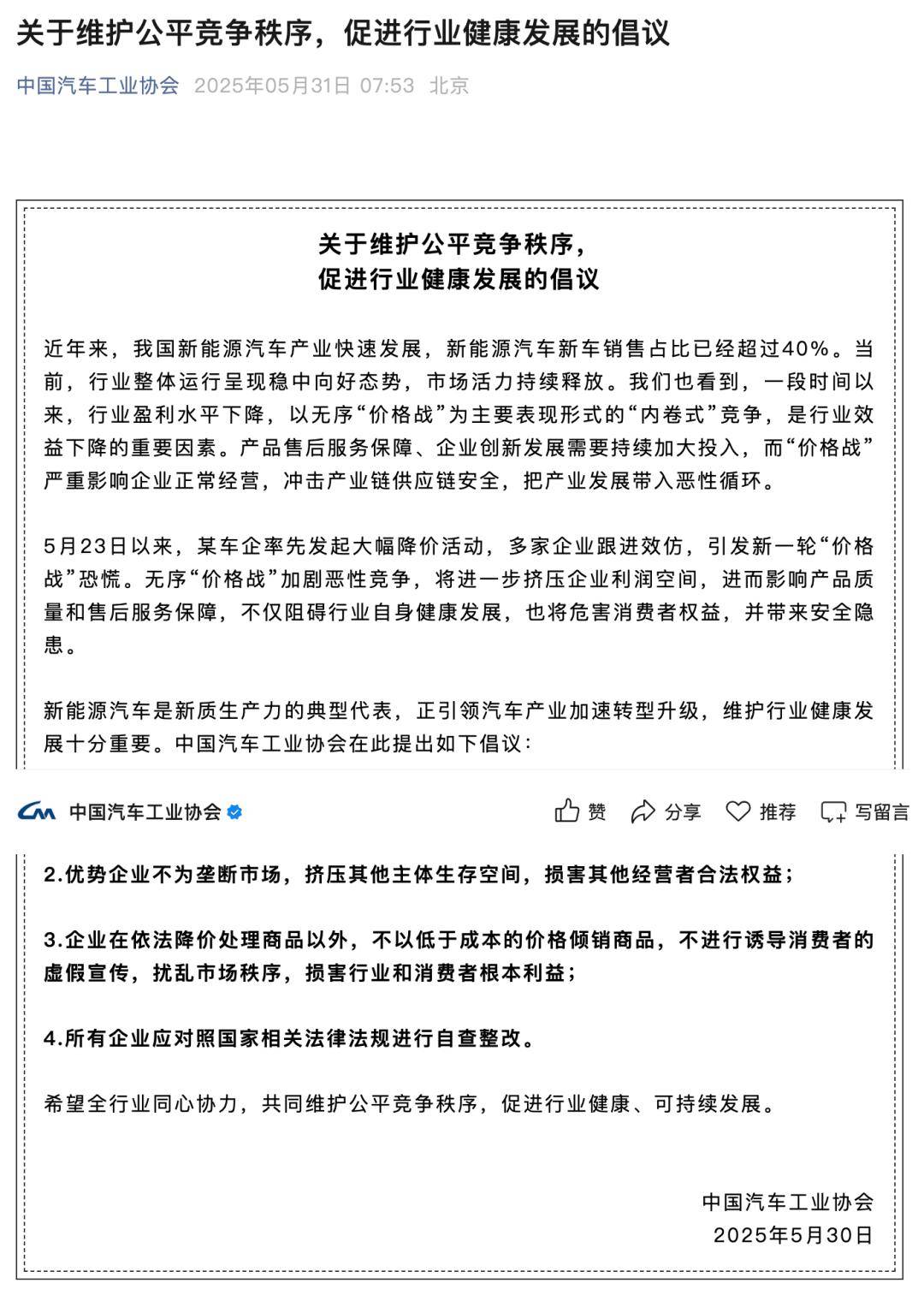
针对近日车企掀起新一轮"价格战",中国汽车工业协会发布《关于维护公平竞争秩序,促进行业健康发 展的倡议》,明确表示反对。工信部亦表态支持倡议,强调"'价格战'没有赢家,更没有未来"。明确的 信号、坚决的态度,给无序"价格战"踩下刹车,可谓及时。中国制造在许多领域之所以能从跟跑实现领 跑,最主要靠的不是低价,而是创新。曾经,不到10万的国产油车无人问津;如今,20多万的国产新能 源车"一车难求"……蜕变背后,在于有智能驾驶、先进电池、智能座舱等技术创新的支撑。今天的中国 制造,正处于从"价格导向"到"价值导向"跃升的关键阶段。眼下,新能源汽车产业发展一日千里,各国 车企也在加大投入研发新技术新产品,中国车企尽管颇有优势,但远没有到大幅领先、高枕无忧的境 地。车企须坚守长期主义发展理念,通过技术创新、管理创新降低生产成本,给广大消费者带来更优 质、更具性价比的产品。莫要在资本裹挟下扭曲商业逻辑,只会用价格战来追求短期市值和股价。否 则,等资本套现离场后,产业就只剩"赔本赚吆喝"的空壳,出海进程也将被迟滞。(人民日报) ...
反对价格战!汽车行业大整顿
Sou Hu Cai Jing· 2025-06-01 01:35
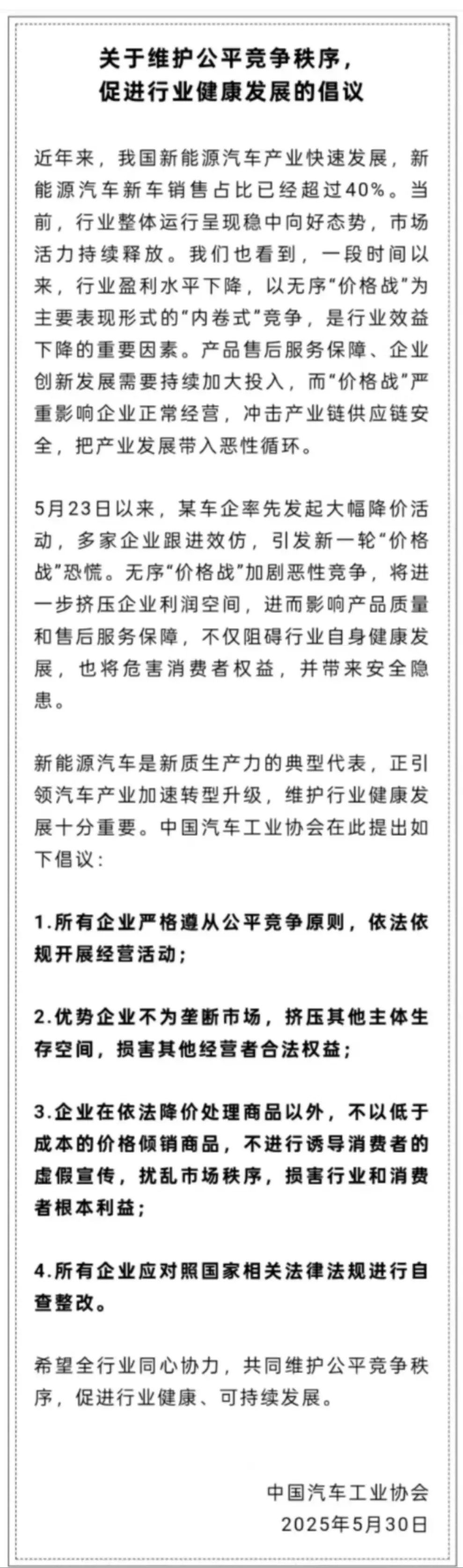
5月31日早间,中国汽车工业协会(下称"中汽协")发布《关于维护公平竞争秩序,促进行业健康发展的倡议》,其中提到:优势企业不为垄断市场,挤 压其他主体生存空间,损害其他经营者合法权益;企业在依法降价处理商品以外,不以低于成本的价格倾销商品,不进行诱导消费者的虚假宣传,扰乱市 场秩序,损害行业和消费者根本利益。 关于维护公平竞争秩序,促进行业健康发展的倡议 中国汽车工业协会 2025年05月31日 07:53 北京 关于维护公平竞争秩序, 促进行业健康发展的倡议 近年来,我国新能源汽车产业快速发展,新能源汽车新车销售占比已经超过40%。当 前,行业整体运行呈现稳中向好态势,市场活力持续释放。我们也看到,一段时间以 来,行业盈利水平下降,以无序"价格战"为主要表现形式的"内卷式"竞争,是行业效 益下降的重要因素。产品售后服务保障、企业创新发展需要持续加大投入,而"价格战" 严重影响企业正常经营,冲击产业链供应链安全,把产业发展带入恶性循环。 5月23日以来,某车企率先发起大幅降价活动,多家企业跟进效仿,引发新一轮"价格 战"恐慌。无序"价格战"加剧恶性竞争,将进一步挤压企业利润空间,进而影响产品质 量和售后服务保 ...


筋斗云:新能源汽车,“价格战”兴奋剂决不能打
Ren Min Ri Bao· 2025-06-01 01:12
针对近日车企掀起新一轮"价格战",中国汽车工业协会发布《关于维护公平竞争秩序,促进行业健康发展的倡议》,明确表示反对。工信部 亦表态支持倡议,强调"'价格战'没有赢家,更没有未来"。明确的信号、坚决的态度,给无序"价格战"踩下刹车,可谓及时。 这两年,一些车企口口声声反对"内卷式"竞争,却又不断扣动"价格战"扳机,严重影响行业生态与市场秩序,冲击产业链供应链安全。数据 显示,2024年汽车行业利润率仅为4.3%,低于整个下游工业利润率及2023年水平;今年一季度,利润率进一步下降到3.9%。一边是屡创新高 的产销量和良好口碑,另一边却是"越造越赔""增收不赠利"的困境。这样的背离意味着行业处于亚健康状态,不可能持久。 "价格战"硝烟弥漫,深层次的隐患重重。供应商的利润空间与应收账款、生产工人的薪酬待遇、产品的质量与安全、售后服务等消费者合法 权益,才是最终的伤害承受者。低价低质产品还会大幅消耗"中国制造"好不容易积攒的国际形象与口碑。殷鉴不远。在上世纪90年代末,国 产摩托车凭借物美价廉,畅销东南亚市场。但好景不长,价格战最终导致产品力下滑,不仅失去了市场份额,更让中国制造的口碑急转直 下。今天,我们决不能让 ...
百度起诉小米,6月13日开庭;乐高中国已终止与涉事博主合作;余承东:华为将只有五个“界”;客服回应微信朋友圈可以折叠丨邦早报
创业邦· 2025-06-01 00:45
Legal Disputes - Baidu has filed a lawsuit against Xiaomi and Shanghai Yiyi Information Technology Co., Ltd. for unfair competition, with the court hearing scheduled for June 13, 2025, at the Shanghai Qingpu District People's Court [3][5]. Automotive Industry Insights - Huawei's executive Yu Chengdong announced that the company will focus on five key areas in the automotive sector, emphasizing the importance of collaboration among top manufacturers [5]. - The automotive industry is witnessing a significant number of price cuts, with over 200 models having reduced prices last year and more than 60 in the first quarter of this year. Industry leaders are advocating for a shift from price wars to technological advancements and quality improvements [9][12]. - Lantu Motors CEO Lu Fang stated that the company firmly opposes price wars and believes in enhancing manufacturing efficiency through technological innovation rather than cost-cutting measures [12]. Corporate Developments - Lego China has terminated its partnership with a third-party company following negative comments made by a blogger about singer A-Shin, reaffirming its support for A-Shin's fans [7]. - Xiaomi Automotive has expanded its presence with 298 stores across 82 cities as of May, with plans to open 37 more stores in June [9]. Financing Activities - Beijing Shunjing Biopharmaceutical Technology Co., Ltd. has completed a Series A financing round of 300 million yuan, which will be used for clinical trials of its acute myocardial infarction antibody drug SGC001 [11]. - The pre-made food brand Lianjie Workshop has announced a Series B financing round of 300 million yuan to support its expansion and development [11]. - UnixAI, a developer of embodied intelligent robots, has successfully completed an angel+ financing round, with funds aimed at advancing its research and development [11]. Entertainment Industry Performance - The total box office for new films during the Dragon Boat Festival in 2025 has surpassed 200 million yuan, with "Mission: Impossible 8" leading the box office [16].
美将提高进口钢铝关税,欧盟准备反制;印度首次承认战机被击落;俄一桥梁被引爆坍塌,致数十人伤亡;工信部、中汽协:反对车企“价格战”丨每经早参
Mei Ri Jing Ji Xin Wen· 2025-05-31 22:51
每经编辑|胡玲 5月31日消息,国家互联网信息办公室近日就《网信部门行政处罚裁量权基准适用规定(征求意见稿)》向社会公开征求意见。征求意见稿提出,对当事人 的同一个违法行为,不得给予两次以上罚款的行政处罚。另外,征求意见稿提出,同一个违法行为违反多个法律规范应当给予罚款处罚的,按照罚款数额高 的规定处罚。有两个以上应当给予行政处罚违法行为的,应当分别裁量,合并处罚。(央视新闻) 4 香港《稳定币条例》正式成为法例 香港特别行政区政府于5月30日在宪报刊登《稳定币条例》,这意味着《稳定币条例》正式成为法例。此前,香港立法会已经在5月21日正式通过该条例草 案,用以在香港设立"法币稳定币"(挂钩法定货币的稳定币)发行人的发牌制度。该法例旨在推动金融创新的同时保持金融稳定,并标志着香港在数字资产 领域迈出了重要的一步。(证券时报) 5 药企涉嫌贿赂百名医务人员,四川卫健委通报:违规费用已全部清缴 5月31日,根据健康四川官微消息,近期,四川省卫健委收到"某药企涉嫌向医生输送商业贿赂"举报信,成立调查组会同相关部门开展调查核实工作。举报 信涉及医疗机构人员125人,其中6人信息重复,1人信息不实,核实为118人,分布 ...

今日新闻丨中汽协:反对价格战、内卷式竞争!2025粤港澳大湾区车展开幕!
电动车公社· 2025-05-31 17:49
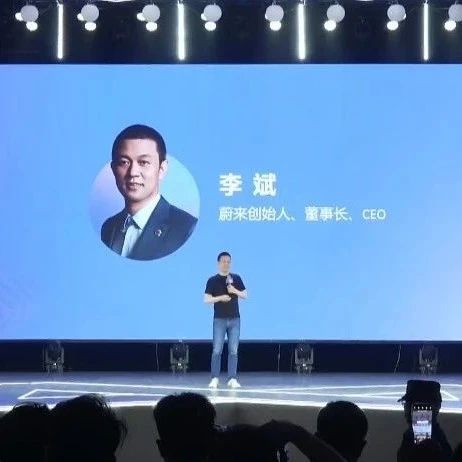
关注 「电动车公社」 和我们一起重新思考汽车 《今日新闻》将会每天给大家带来几条当日重磅新闻,并附上社长的简单评论。关注「电动车公社」,新 能源圈大事小事 看我们就够啦~ 今日新闻要点: 1、 中汽协发布红头文件 近日,中国汽车工业协会发布红头文件《关于维护公平竞争秩序,促进行业健康发展的倡议》,文中重点 提及价格战、内卷式竞争对于行业的危害,提倡车企有序竞争。 前年,中汽协也曾与车企签署"反内卷"倡议,不过后来并未阻止行业进一步降价内卷。这次中汽协再次提 出倡议,说明目前汽车行业整体利润率已经低到了"非健康"水平,这种状况不可持续。希望这一轮,车企 们能够平衡好利润与市场竞争的关系,切记量力而行。 2、 2025粤港澳大湾区车展开幕 5月31日,2025粤港澳大湾区车展和第三届未来汽车先行者大会开幕。大会上演讲环节,邀请到了包括蔚 来李斌、小鹏何小鹏、鸿蒙智行靳玉志、地平线余凯等业界大佬,重点就未来汽车AI智能化等方面进行了 讨论。 值得一提的是,这次大会上业界大佬们对于目前汽车行业价格战愈演愈烈,基本上给出 了"卷技术、卷 AI、卷品质而不是卷价格"这一观点。但说是一回事, 做是另一回事。下半年的汽车行业 ...

“多10%”策略下 别克昂科威启动新营销周期
Jing Ji Guan Cha Wang· 2025-05-31 14:12
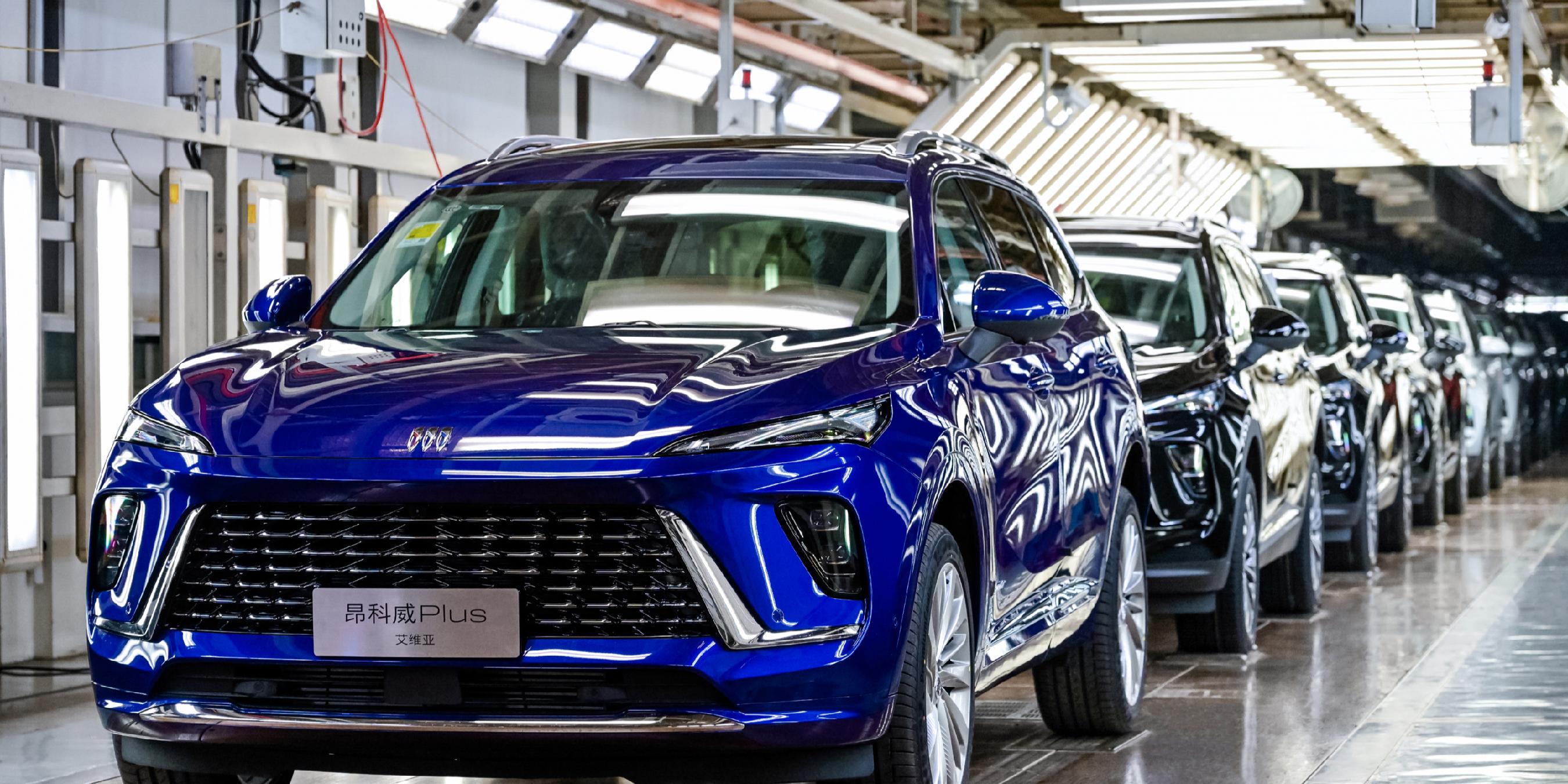
Core Insights - The article highlights the launch of a marketing campaign by SAIC-GM, coinciding with the production of the 1.8 millionth Envision model, which includes various limited-time purchase incentives [2][3] - The Envision and GL8 are identified as core models for the Buick brand, representing American SUVs specifically designed for the Chinese market [2] - The article discusses the strategic repositioning of Buick's pricing and product offerings to enhance market competitiveness, with the Envision being a key product in this strategy [3][4] Group 1: Product and Market Strategy - The Envision has undergone three generations of product innovation since its initial launch in 2014, with the latest model, Envision Plus, being produced at the award-winning East Yue base [2] - Buick's strategy involves offering luxury features at mid-range prices, effectively targeting price-sensitive consumers [3] - The Envision has become a significant contributor to SAIC-GM's sales, achieving a cumulative sales figure of 1.7 million units by November 2024, and reaching 1.8 million units in just six months [3] Group 2: Competitive Landscape - The East Yue base is responsible for approximately 74% of SAIC-GM's total vehicle exports, but the impact of U.S. tariffs on exports has prompted a focus on increasing domestic market share [3] - The recent launch of limited-time offers aims to boost sales and market share in the face of rising competition from domestic brands [3][4] - The Envision's new pricing strategy and product differentiation are crucial for maintaining market share amid a new wave of price competition in the domestic automotive market [4]
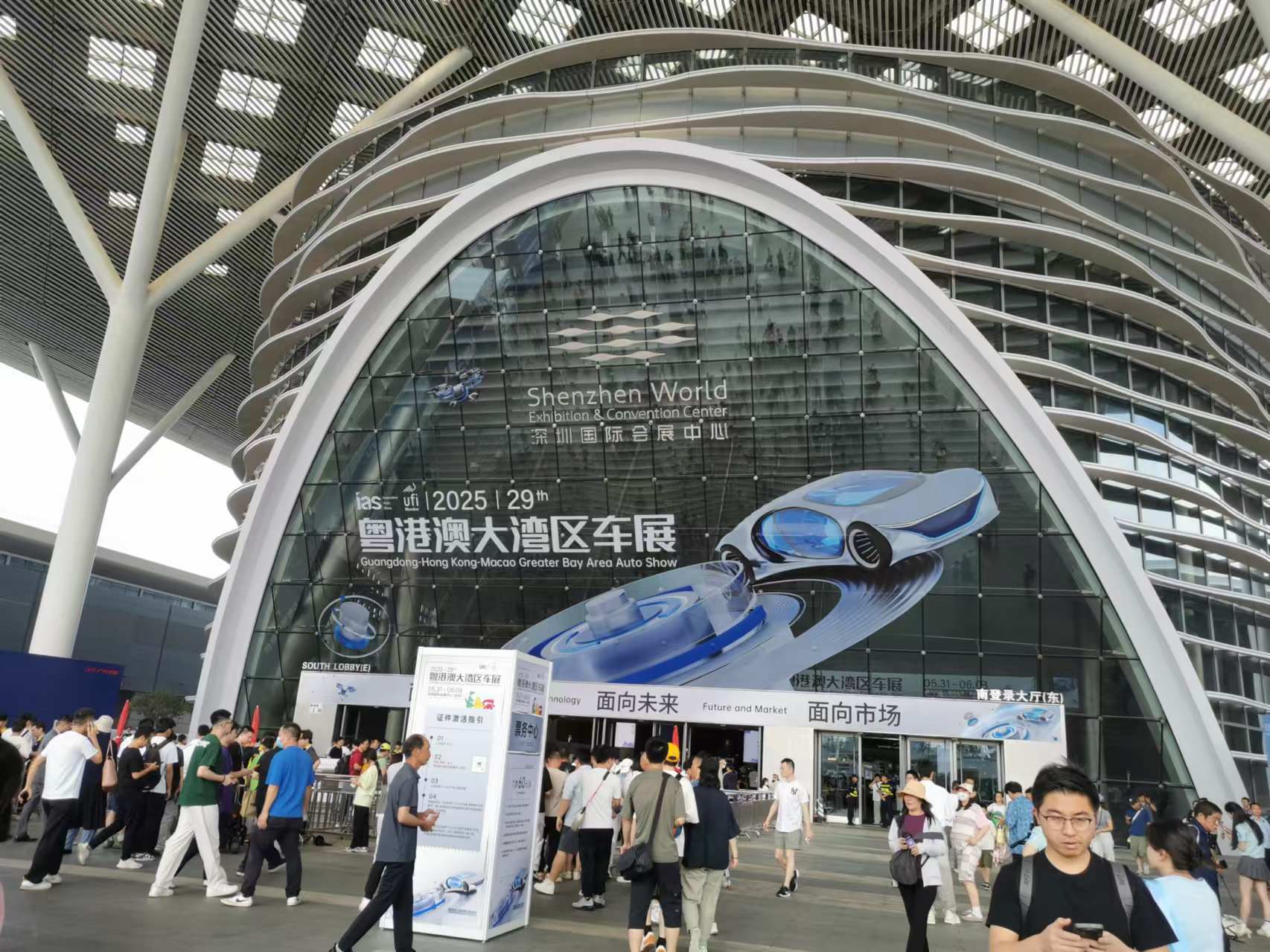
直击2025粤港澳大湾区车展:千余款车型亮相,自主豪车风头无两,车企大佬热议“价格战”
Mei Ri Jing Ji Xin Wen· 2025-05-31 13:23
Core Viewpoint - The 2025 Guangdong-Hong Kong-Macao Greater Bay Area Auto Show showcases over 1000 models, emphasizing technological advancements in the automotive industry, particularly in electric and intelligent vehicles [1][2]. Group 1: Event Overview - The auto show spans over 260,000 square meters, featuring more than 80,000 square meters dedicated to outdoor activities and test drives [1]. - Nearly 100 global brands are participating, presenting a wide array of vehicles including concept cars and premieres [1]. Group 2: Technological Innovations - BYD and Huawei have established dedicated pavilions, highlighting their latest technologies and products, including the launch of the "Megawatt Flash Charging" initiative [4][5]. - BYD plans to build over 10,000 "Megawatt Flash Charging" stations in collaboration with partners [4]. - Huawei's pavilion showcases its digital solutions integrated into vehicles, with over 20 brands adapting its QianKun ADS 4 driving system [7]. Group 3: Foreign Brands Collaboration - Foreign brands are increasingly collaborating with local tech companies to accelerate their transition to electric and intelligent vehicles, exemplified by Audi's partnership with Huawei [8][11]. - The Audi Q6L e-tron family, featuring an 800V battery with a maximum range of 765 km, is a key product of this collaboration [11]. Group 4: Domestic Luxury Brands - Domestic luxury brands are gaining prominence, with models like the Zun Jie S800 and the Yang Wang U8L priced over 1 million yuan [16][19]. - The Mengshi M817, developed in partnership with Huawei, is highlighted as a new flagship model featuring advanced driving technologies [17]. Group 5: Industry Discussions on Pricing - The China Automobile Industry Association has issued an initiative against "price wars," advocating for fair competition and product quality [20]. - Industry leaders emphasize the importance of innovation and maintaining product value over engaging in price reductions [21].
反对无序“价格战”,车企高层在粤港澳大湾区车展大会上表态
Bei Ke Cai Jing· 2025-05-31 13:22
Core Viewpoint - The automotive industry is facing challenges due to chaotic "price wars," which are leading to decreased profitability and potential risks to product quality and consumer rights [1][2]. Group 1: Industry Concerns - The China Association of Automobile Manufacturers (CAAM) has issued a statement indicating that disordered "price wars" exacerbate unhealthy competition, squeezing profit margins and affecting product quality and after-sales service [1][2]. - The Ministry of Industry and Information Technology (MIIT) has echoed these concerns, stating that such price wars hinder sustainable R&D investment, impacting product quality and safety, and ultimately harming consumer rights [1][2]. Group 2: Impact on Profitability - The CAAM highlighted a decline in industry profitability, attributing it to "involutionary" competition primarily manifested through price wars, which disrupt normal business operations and threaten supply chain security [2]. - In the previous year, over 200 models were sold at reduced prices, with more than 60 models experiencing price cuts in the first quarter of this year, indicating a trend where increased sales do not correlate with improved profits [2]. Group 3: Call for Innovation and Value - Industry leaders, including NIO's CEO Li Bin, have advocated for a focus on technology and service rather than price competition, emphasizing the need for innovation and quality [2][3]. - GAC Group's Vice President He Xianqing expressed the importance of "value wars" over price wars, suggesting that price reflects value in a competitive market [2]. - The MIIT has encouraged companies to prioritize innovation and quality, aiming to enhance product standards and service quality while fulfilling social responsibilities [2].
车圈大佬,回应“价格战”!
凤凰网财经· 2025-05-31 12:01
Core Viewpoint - The automotive industry is currently facing a heated debate over "price wars," with industry leaders advocating for a shift towards "technology competition" and "value competition" instead of price reductions [1][3][11]. Group 1: Industry Perspectives on Competition - NIO's CEO, Li Bin, emphasized the need to focus on "technology" rather than engaging in price wars, indicating a desire for sustainable competition [1]. - Changan Automobile's CEO, Deng Chenghao, stated that the future of the automotive industry will revolve around "technology" and "user experience," distancing from low-price strategies [1][11]. - The China Association of Automobile Manufacturers highlighted that chaotic price wars are detrimental to industry profitability and urged companies to adhere to fair competition principles [1]. Group 2: Internal Reforms and Performance - NIO is undergoing significant internal restructuring, particularly within its second brand, with a reported 40% reduction in frontline staff while aiming for a 40% increase in delivery volume in May [3]. - Xiaopeng Motors' CEO, He Xiaopeng, expressed confidence in achieving or exceeding profitability targets by Q4 2025, focusing on internal management and technological advancements [5][7]. Group 3: Technological Advancements and Value Proposition - Deep Blue Automotive aims to enhance its competitiveness through superior products, technology, and user experience, distancing itself from low-cost strategies [9][11]. - GAC Group's Vice President, He Xianqing, emphasized a "value war" approach, providing customers with value beyond just price, supported by significant R&D investments exceeding 55 billion yuan [13][17].