
电动化转型

Search documents
宝马集团一季度净利润同比下降26.4%,在华销量同比下降17.2%
Jin Rong Jie· 2025-05-12 03:32
Group 1 - BMW Group reported total revenue of €33.758 billion for Q1 2025, a decrease of 7.8% compared to €36.614 billion in Q1 2024, with a core automotive segment revenue of €29.211 billion, down 5.6% year-on-year [1] - The company's pre-tax profit (EBT) fell by 25.2% to €3.113 billion, with a pre-tax profit margin narrowing from 11.4% in the same period last year to 9.2% [1] - Net profit for the group was €2.173 billion, a decline of 26.4%, marking the largest quarterly drop since Q2 2021 [1] Group 2 - BMW's global vehicle deliveries in Q1 totaled 586,117 units, a year-on-year decrease of 1.4%, with electric models accounting for 26.9% of total sales and pure electric vehicle sales increasing by 32.4% to 109,513 units [3] - The significant decline in deliveries was particularly pronounced in the Chinese market, which saw a 17.2% drop to 155,200 units, the largest decline among major markets [3] - In contrast, the European market saw a slight increase of 0.3%, while the U.S. market experienced a decline of 5.6% [3] Group 3 - BMW plans to launch over 10 new models in the Chinese market by 2025, including the new long-wheelbase 5 Series and the iX5 hydrogen fuel cell vehicle [4] - Starting in 2026, the company will introduce pure electric models based on a "new generation" platform, with initial products expected to include mid-size sedans and sports utility vehicles [4] - Analysts note that BMW is at a critical juncture in its product renewal cycle and electrification transition, with the success of its new battery technology being crucial for future competitiveness [4] Group 4 - Morgan Stanley reports that luxury brands, including BMW, face dual challenges of increased R&D investment and declining traditional business revenues during the electrification transition [4] - BMW's R&D expenses as a percentage of revenue have risen from 5.7% in 2020 to 6.1% in 2024, with expectations of maintaining high investment levels in 2025 [4]

宝马集团2025年第一季度财报:电动化转型加速,中国市场销量下滑
Xin Lang Cai Jing· 2025-05-11 08:03
Core Insights - BMW Group reported a slight decline in global vehicle deliveries in Q1 2025, but significant progress in electrification was noted [1][3] - The Chinese market experienced the largest decline in sales for BMW, raising concerns in the market [1][3] Financial Performance - In Q1 2025, BMW Group delivered 586,117 vehicles globally, a year-on-year decrease of 1.4%, with electric vehicles accounting for 26.9% of total sales [3] - Sales of pure electric vehicles surged by 32.4% year-on-year, reaching 109,513 units, indicating strong market acceptance of electric models [3] - Total revenue for Q1 2025 was €33.758 billion, down 7.8% compared to the same period in 2024, with automotive business revenue at €29.211 billion, a decline of 5.6% [3] - Pre-tax profit (EBT) fell by 25.2% to €3.113 billion, with a pre-tax profit margin of 9.2%, down from 11.4% in 2024 [3] - EBIT (earnings before interest and taxes) for the automotive segment was €2.024 billion, a decrease of 25.3%, but above market expectations of €1.85 billion [4] - The EBIT margin was 6.9%, within the annual target range of 5% to 7% [4] - Free cash flow for the automotive segment was €413 million, significantly down from €1.283 billion in 2024 [4] Market Challenges - BMW's sales in China dropped by 17.2% year-on-year, significantly higher than the global average decline, reflecting intense competition and changing consumer demand [3] - The company maintains its financial outlook for 2025, anticipating a decrease in certain import tariffs starting in July, but warns of potential risks from tariff increases and supply chain bottlenecks [4][5] - Overall, while BMW has made positive strides in electrification, the decline in sales and financial metrics highlights the challenges it faces [5]
上汽集团2024年净利现历史最大降幅 一季度单车售价再降13%去库存仍在延续
Xin Lang Zheng Quan· 2025-05-09 10:00
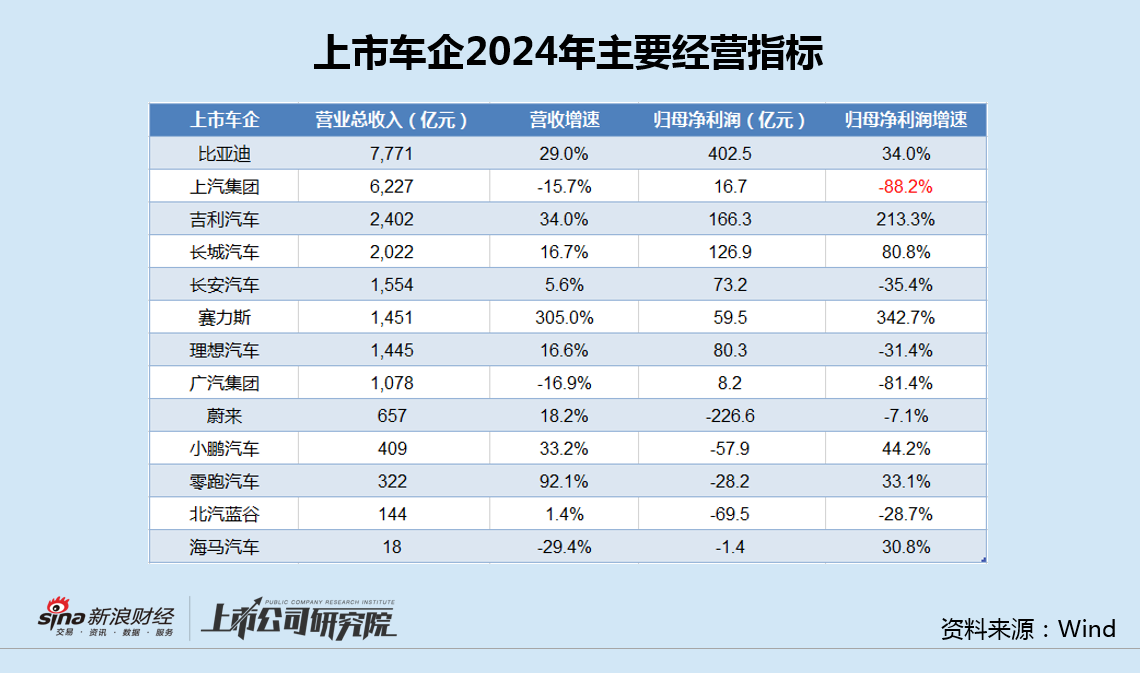
Core Viewpoint - The financial performance of listed automotive companies in May shows a divergence, with 7 out of 13 companies reporting positive net profit growth, while 6 experienced declines or increased losses. The standout performer is Seres, with a net profit increase of 342.7%, while SAIC Group faced a significant decline of 88.2% in net profit, marking its largest annual drop since its listing in 1997 [1][2]. Group 1: Financial Performance - Among the 13 listed automotive companies, BYD reported a total revenue of 77.71 billion yuan, with a revenue growth rate of 29.0% and a net profit of 4.025 billion yuan, reflecting a 34.0% increase [2]. - SAIC Group's total revenue was 62.27 billion yuan, down 15.7%, with a net profit of 0.167 billion yuan, a staggering decline of 88.2% [2][4]. - Geely Automobile achieved a revenue of 24.02 billion yuan, with a growth rate of 34.0%, and a net profit of 1.663 billion yuan, marking a significant increase of 213.3% [2]. Group 2: SAIC Group's Challenges - SAIC Group's net profit decline of 88.19% in 2024 is the largest annual drop in its 27-year history, with a non-recurring net profit of -5.409 billion yuan, also a historical record for losses [4][3]. - The poor performance is attributed to a significant drop in sales across both its independent and joint venture segments, with total vehicle wholesale sales down 20.1% to 4.013 million units [7][8]. - SAIC General's new car sales plummeted by 56.54% to 435,000 units, heavily impacting the overall performance of SAIC Group [7]. Group 3: Market Dynamics - In the first quarter of 2024, SAIC Group's net profit showed a slight recovery to 3.023 billion yuan, a year-on-year increase of 11.4%, but revenue continued to decline [9]. - The average selling price per vehicle dropped by 13%, indicating pressure from industry price wars, while the gross margin fell to 9.38%, down 0.81 percentage points year-on-year [9]. - The sales of SAIC's new energy vehicles grew by only 9.9%, significantly below the industry average growth rate of 40.2% [9][10].

重大事项点评启动极氪私有化,打造“一个吉利”
Huachuang Securities· 2025-05-08 13:30
Investment Rating - The report maintains a "Strong Buy" rating for Geely Automobile, expecting it to outperform the benchmark index by over 20% in the next six months [5][18]. Core Views - Geely Automobile has initiated a non-binding privatization offer for Zeekr at a premium of 13.6% over the last closing price, aiming to consolidate its high-end electric vehicle assets and enhance operational efficiency [2][8]. - The privatization is expected to significantly increase Geely's profits and long-term shareholder value, with projections indicating a 34.3% increase in net profit from the acquisition [8][9]. - The company is on track for a successful electric transformation starting in 2024, with further acceleration anticipated in 2025, supported by strategic brand integration [8][9]. Financial Summary - **Revenue Projections**: - 2024A: 240,194 million CNY - 2025E: 336,392 million CNY (34.03% YoY growth) - 2026E: 441,972 million CNY (40.05% YoY growth) - 2027E: 514,187 million CNY (31.39% YoY growth) [4][9] - **Net Profit Projections**: - 2024: 16,632 million CNY - 2025: 14,788 million CNY (-11.09% YoY) - 2026: 20,800 million CNY (40.66% YoY) - 2027: 25,699 million CNY (23.55% YoY) [4][9] - **Earnings Per Share (EPS)**: - 2024: 1.65 CNY - 2025: 1.47 CNY - 2026: 2.06 CNY - 2027: 2.55 CNY [4][9] - **Valuation Ratios**: - Price-to-Earnings (P/E) ratio for 2025: 10.6x - Price-to-Book (P/B) ratio for 2025: 1.6x [4][9] Target Price - The target price range for Geely Automobile is set between 23.69 and 28.43 CNY, representing a potential upside of 42% to 70% from the current price of 16.78 CNY [5][8].

吉利汽车(00175):重大事项点评:启动极氪私有化,打造“一个吉利”
Huachuang Securities· 2025-05-08 08:11
证 券 研 究 报 告 吉利汽车(00175.HK)重大事项点评 强推(维持) 启动极氪私有化,打造"一个吉利" 事项: ❖ 吉利汽车发布公告,宣布向极氪提交非约束性私有化要约,拟以2.566美元/18.5 元或 1.23 股新发行的吉利汽车股份收购每股极氪股份(以上两种方案股东可 选择,后同),或以 25.66 美元/185 元或 12.3 股新发行的吉利汽车股份收购每 股极氪 ADS。该报价较极氪最后一个交易日收盘价溢价 13.6%,较过去 30 个 交易日成交量加权平均价溢价 20%。目前,吉利汽车持有极氪 65.7%股权,若 私有化建议落实及完成,极氪将成为吉利汽车全资子公司并从纽交所退市。 评论: [ReportFinancialIndex] 主要财务指标 | | 2024A | 2025E | 2026E | 2027E | | --- | --- | --- | --- | --- | | 主营收入(百万元) | 240,194 | 336,392 | 441,972 | 514,187 | | 同比增速(%) | 34.03% | 40.05% | 31.39% | 16.34% | | 归母 ...
肩负合资纯电反攻大任,广汽本田P7尚需补课智能化
2 1 Shi Ji Jing Ji Bao Dao· 2025-05-07 09:28
Group 1 - The fuel vehicle market is declining while the penetration rate of new energy vehicles is rapidly increasing, putting pressure on joint ventures that once dominated the Chinese market [1] - GAC Honda is facing challenges in its electrification transformation, struggling to scale its hybrid technology and receiving lukewarm responses to its early electric vehicle offerings [1] - GAC Honda has launched the P7, a new electric SUV priced at 199,900 yuan, marking a significant shift in its approach to the Chinese market [1] Group 2 - The P7 features advanced driving assistance systems, including Honda CoPilot Pro, but these features are not standard and require additional costs, limiting their current usability [2] - The success of the P7 as a key model in GAC Honda's electrification strategy remains to be seen, pending market validation [2]
德国汽车工业协会主席穆希雅: 欢迎中国车企来欧洲
Zhong Guo Qi Che Bao Wang· 2025-05-07 08:09
Core Insights - The interview with VDA President Muche highlights the importance of Sino-German cooperation in the automotive industry, particularly in the context of electric vehicle (EV) development and trade policies [2][3] Group 1: Market Dynamics - China is the world's largest new car market, significantly influencing the electric vehicle sector, and trade with China has created numerous job opportunities for Germany [3] - Over two-thirds of German automotive industry respondents plan to increase investments in China, particularly in R&D, production, and sales [4] - One-third of surveyed companies intend to expand production capacity in China, with 80% planning to maintain or increase their production scale in the long term [4] Group 2: Localization and Consumer Preferences - German automotive companies are adopting a "local for local" strategy, focusing on product localization to better meet the competitive environment in China [4] - There are notable differences in consumer preferences between Chinese and European markets, with Chinese consumers prioritizing vehicle space and digital features, while European consumers focus on safety and performance [4] Group 3: Trade Policies and Barriers - Muche expressed concerns about tariffs, particularly the impact of U.S. tariffs on German automotive exports and the uncertainty it brings to the global automotive supply chain [6] - The VDA opposes the EU's tariffs on Chinese electric vehicles and calls for collaborative efforts to eliminate trade barriers and promote market openness [6][7] - Muche emphasized the need for discussions to focus on removing trade barriers rather than creating new obstacles, advocating for solutions like minimum price standards and encouraging Chinese companies to establish factories in Europe [7] Group 4: Future Events and Collaboration - The upcoming Munich Motor Show is anticipated to provide a valuable platform for automotive companies and suppliers, with expectations for strong participation from Chinese enterprises [7]

通用汽车(GM.US)大幅下调全年盈利预期 净利润下修至82亿-101亿美元
智通财经网· 2025-05-01 14:08
财报显示,通用汽车Q1销售额为440亿美元,好于市场预期的432亿美元;营业利润为35亿美元,好于市 场预期的34亿美元;每股收益为2.78美元,好于市场预期的2.68美元。 总的来说,此次预期调整折射出汽车行业面临的双重压力:既要应对电动化转型的巨额投入,又需承受 全球贸易环境突变带来的成本冲击。在通用汽车大幅调低盈利目标后,行业分析师正重新评估关税政策 对北美汽车产业链的连锁反应,这或将引发新一轮行业盈利预期修正潮。 智通财经APP获悉,通用汽车(GM.US)在因关税不确定性撤回 2025 年财务展望几天后,于周四更新了 全年利润预期。这家底特律汽车巨头将调整后每股收益预期大幅下调至8.25-10.00美元区间,此前预期 为11.00-12.00美元,并显著低于华尔街10.99美元的共识预期。归属于股东的净利润预期区间同步下修 至82亿-101亿美元,此前为112亿-125亿美元。 公司管理层直言,最新预测已计入40亿-50亿美元的关税相关影响,这成为拖累盈利预期的核心因素。 此外,该公司全年汽车运营现金流预期也遭下调,最新指引为173亿-208亿美元。 值得注意的是,尽管下调盈利预期,通用汽车仍维持全年 ...

上海车展|未来三年在华推出超30款新车,大众聚焦新一代智能网联汽车
Guan Cha Zhe Wang· 2025-04-30 13:37
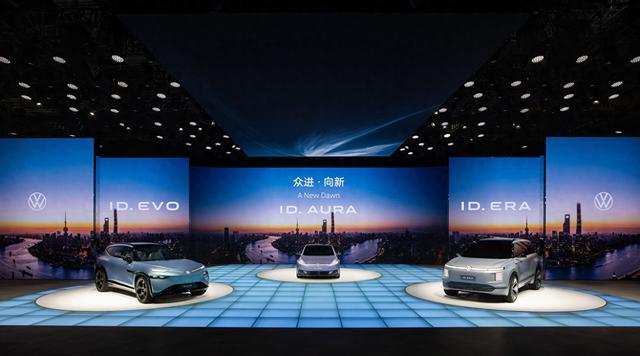
Core Insights - Volkswagen is focusing on its "In China, For China" strategy, showcasing its commitment to the Chinese market by launching over 30 competitive new models in the next three years, primarily in the electric vehicle segment [1][7] - The company presented three new concept cars at the Shanghai Auto Show, which are designed in collaboration with its local joint ventures, highlighting the brand's tailored approach to meet diverse consumer needs in China [3][4] Product Strategy - Volkswagen plans to introduce more than 20 advanced new energy vehicles, including pure electric, plug-in hybrid, and range-extended models starting in 2026, to cater to the diverse demands of Chinese consumers [7][8] - The ID. AURA concept car is the first pure electric sedan based on the CMP platform, featuring advanced driving assistance and AI virtual assistant capabilities [7][8] - The ID. ERA concept car targets the growing demand for range-extended vehicles, boasting a comprehensive range of over 1000 kilometers and advanced navigation and parking assistance technologies [8][11] - The ID. EVO concept car, a full-size electric SUV, offers a range of 700 kilometers and features a unique design with customizable LED lighting and a high-tech interior aimed at enhancing user experience [11][13] Technological Advancements - Volkswagen emphasizes the importance of local R&D capabilities through Volkswagen (China) Technology Co., Ltd. (VCTC) to better integrate into the local mobility ecosystem [13] - The new CMP platform and CEA architecture are designed to optimize costs by 40% and improve the speed from development to market by over 30%, with vehicles based on these platforms set to launch in 2026 [13]
车展对话|马勒董事会主席Arnd Franz:已调整产能布局,中国业务高度自主
2 1 Shi Ji Jing Ji Bao Dao· 2025-04-30 08:02
Core Insights - The automotive industry is undergoing significant changes due to electrification and geopolitical influences on supply chains, leading to layoffs among major Tier 1 suppliers like Mahle [1] - Mahle plans to restructure its operations by 2025, including layoffs in Slovenia and shifting production to Bosnia and Hungary, while also consolidating its divisions and management [1] Group 1: Company Strategy - Mahle invests 5.4% of its revenue annually in R&D, focusing on local R&D capabilities in China to adapt to market demands and technological advancements [2][4] - The company emphasizes close customer relationships and rapid technology iteration to maintain competitiveness in the fast-evolving Chinese market [2][3] Group 2: Market Challenges - Mahle addresses the high cost sensitivity of Chinese OEMs by leveraging supply chain advantages and integrating local and international resources to enhance cost efficiency [4] - The company has established a "war room" to analyze market conditions and continuously improve its operations in response to cost pressures [4] Group 3: Global Operations - Mahle has restructured its global production capacity, designating China as a fully autonomous region with independent project teams, while also implementing regional management in India [5] - The company supports free trade and advocates for the resolution of tariff negotiations to minimize economic harm and maintain production efficiency [5] Group 4: Technological Advancements - Mahle has been proactive in developing products for the emerging 800V high-voltage platform, including on-board chargers and DC converters, as part of its electrification strategy [6] - The company is also innovating in smart charging solutions and has developed wireless charging technology, positioning itself for future advancements in electric vehicle infrastructure [6]