能源转型

Search documents
利安隆董事长李海平:化学与生物技术双轮驱动公司高质量发展
Zheng Quan Ri Bao· 2026-01-08 16:45
Core Insights - The company emphasizes strategic stability during adversity, focusing on its core chemical business while also investing in biotechnology as a new growth engine [1] Group 1: Business Strategy - The company is a leader in the polymer materials anti-aging industry and has experienced rapid growth since its listing on the Shenzhen Stock Exchange in 2017 [2] - The company identifies three global trends: supply chain restructuring, energy transition, and the omnipresence of AI, which will guide its R&D and investment strategies [2] - The company is committed to technological innovation to upgrade its business, expanding from material anti-aging to human anti-aging products, with nine categories of traditional chemical sunscreen products already launched [2][3] Group 2: International Expansion - The company is actively pursuing international expansion, as evidenced by its recent announcement of capital increases to support the construction of a research and production base in Malaysia [2] - The company aims to establish a robust supply chain to support emerging industries such as new energy vehicles and flexible displays through acquisitions and new production bases [3] Group 3: Biotechnology Development - The company views biotechnology as a strategic new engine for growth, focusing on life sciences to create long-term value [3] - The company has invested in R&D for small nucleic acid drugs, biomanufacturing, and personal care, collaborating with institutions like Tianjin University [3] Group 4: Operational Efficiency - The company has implemented a ten-year strategic planning management model to ensure effective execution of its strategies [4] - The management team has maintained a zero voluntary turnover rate, indicating strong organizational cohesion [4] - The company has outlined three key areas for capital expenditure: differentiated domestic investments, a focus on biological innovation, and increased international presence [4]
中国攻克技术难关,可控核聚变成能源转型核心方向,这三大赛道有望迎来业绩爆发!
Jin Rong Jie· 2026-01-08 13:01
Core Insights - The recent announcement by the Hefei Institute of Physical Science confirms the existence of a density-free zone in the Tokamak, providing significant physical evidence for high-density operation in magnetic confinement fusion devices [1] - The controlled nuclear fusion industry is currently focusing on technological engineering and commercial feasibility breakthroughs, with substantial investment opportunities concentrated in the mid-to-upstream segments [1] - The global consensus on carbon neutrality is driving the urgent demand for stable, clean, and high-energy-density energy sources, positioning controlled nuclear fusion as a core direction for energy transition [1] Market Segments Overview Superconducting Materials and Magnet Systems - This sector directly benefits as Tokamak devices require strong magnetic fields to confine high-temperature plasma, with high-temperature superconducting materials being crucial [2] - The market for high-temperature superconducting materials is expected to grow rapidly due to increasing demand from fusion devices, with companies already leading in Nb3Sn and superconducting magnet design and manufacturing [2] Nuclear Equipment Manufacturing - The sector is poised for significant market opportunities as projects like BEST and CFETR advance, leading to explosive growth in the demand for core precision components [2] - Domestic leading companies possess comprehensive design and manufacturing capabilities, having successfully developed key equipment for ITER, which positions them to secure high-value orders in future fusion power plant constructions [2] Low-Temperature and Refrigeration Equipment - Magnetic confinement fusion devices require superconducting magnets to be cooled to near absolute zero, creating high demands for critical equipment like megawatt-level helium refrigerators [3] - Domestic companies are making technological breakthroughs in low-temperature refrigeration, which will provide robust equipment support for China's fusion reactor projects and create new growth points for performance [3]
5000万桶石油被抢?美逼委内瑞拉对华断联,中方早已留足后手
Sou Hu Cai Jing· 2026-01-08 11:51
美国抢钱抢人抢地盘,不仅绑走了委内瑞拉总统马杜罗,还要把该国石油收益直接揣进口袋,甚至逼着 新政府跟中俄等国"断交"。中国的能源安全,真的会被这招"釜底抽薪"撼动吗? 参考消息报道称,特朗普在掳走马杜罗夫妇后,又突然高调宣布,美委达成了重大协议:委内瑞拉将向 美国"移交"3000万到5000万桶原油,价值接近20亿美元。 他还说,这批油会"低价买入,高价卖出",中间赚的钱由他本人来控制,用来"造福美委两国人民"。 简单说,就是特朗普要用委内瑞拉的资源给自己赚钱。 历史经验告诉我们,跟特朗普政府谈生意,能全身而退的伙伴不多。 更何况,现在马杜罗还在美国手中,委内瑞拉看守政府处于巨大的压力之下,所谓的"利润造福两国人 民",就是一个无法验证的"承诺"。 别忘了,当年特朗普发动全球贸易摩擦时,也说增加的关税收入会直接惠及美国老百姓,这事儿后来有 多少人感受到了? 自从美国对委内瑞拉实施严厉制裁以来,其他国家都不敢明目张胆地买,导致他们的石油想卖出去难如 登天。结果就是委内瑞拉石油产量被迫削减,只能打折出售。 现在突然要挤出这么一大笔给美国,它从哪儿变出来?于是,问题就来了:这批油,很可能要动别人盘 子里的奶酪。 据 ...


铜:2026 年维持看涨基本面展望-Copper_ Maintain bullish fundamental outlook in 2026
2026-01-08 10:42
ab Global Research 5 January 2026 Copper Maintain bullish fundamental outlook in 2026 Remain bullish despite near-term disconnect between prices & physical signals LME copper prices are close to record highs at the start of 2026, consensus is bullish, net speculative positioning is elevated and copper equities have re-rated as equity investors position for tightness and further price upside…but most physical market signals are not yet reflecting the tightness the market is positioned for. Whilst the current ...
从燃气灶到发射场!商业航天特气“第一供应商”:九丰能源
市值风云· 2026-01-08 10:11
Core Viewpoint - The article highlights the transformation of Jiufeng Energy from a traditional energy service provider to a key supplier of aerospace fuels, driven by the booming demand in China's commercial space industry, which is entering a high-density launch phase with 23 missions planned by private rocket companies by 2025 [3][4]. Group 1: Company Performance - Jiufeng Energy reported a revenue of 15.608 billion yuan for the first three quarters of 2025, a decrease of 8.4% year-on-year, and a net profit of 1.241 billion yuan, down 19.1% year-on-year [4][6]. - The decline in performance is attributed to a high comparative base from the previous year and extreme weather events affecting operations, which resulted in a profit reduction of 97 million yuan [6]. - Despite short-term challenges, the company's LNG business showed resilience, with a gross margin of 10.4%, an increase of 1.05 percentage points compared to the full year of 2024 [6]. Group 2: Strategic Transformation - Jiufeng Energy is transitioning to a "gas source + distribution" model, with the operation of the Xinjiang Qianghua coal-to-natural gas project, which has an annual production capacity of 1.375 billion cubic meters [8]. - The company announced plans to invest in a second phase of the Xinjiang coal-to-gas project, aiming for an annual capacity of 4 billion cubic meters, which will enhance its self-supply ratio [8]. Group 3: Aerospace Fuel Business - Jiufeng Energy's entry into the aerospace fuel sector marks a significant milestone, having established a partnership with the Hainan Commercial Space Launch Site and invested 493 million yuan in the first phase of its special fuel project [9]. - The project aims to produce 333 tons of liquid hydrogen, 48,000 tons of liquid oxygen and nitrogen each, 384,000 cubic meters of helium, and 9,400 tons of high-purity liquid methane annually, set to be operational by 2025 [9][10]. - By September 2025, the Hainan special fuel project had supported eight commercial and national-level launches, successfully validating the quality of its products [10]. Group 4: Future Outlook - Jiufeng Energy signed an investment agreement for the second phase of the Hainan special fuel project, with an estimated total investment of about 300 million yuan, expanding production capabilities for various aerospace fuels [12]. - The company has also secured supply agreements with major launch sites across China and established long-term supply contracts with eight rocket companies, positioning itself as a leading supplier in the commercial aerospace fuel market [14][15]. - The demand for aerospace fuels is expected to surge, with projections indicating that by 2030, China could see 1500 to 2000 satellite launches annually, creating a significant market for special fuels [14].


深海之下,国运之上:解码巴西石油公司的崛起之路与南美能源新秩序
Sou Hu Cai Jing· 2026-01-08 09:26
Core Insights - The article emphasizes the transformative impact of Brazil's offshore oil discoveries on the country's energy independence and geopolitical standing, particularly through the advancements made by Petrobras in deepwater oil exploration and production [1][3]. Group 1: Petrobras' Strategic Developments - Petrobras has shifted its focus from merely upstream exploration to a comprehensive energy value chain, aiming to reduce reliance on primary resource exports and enhance the production of high-value products [3]. - The company plans to achieve near self-sufficiency in diesel by 2029, currently importing 20%-25% of its diesel, primarily from Russia [3]. - Key projects like the Abreu e Lima Refinery and the Boaventura Energy Complex are central to Petrobras' strategy to increase refining capacity by millions of barrels per day [3]. Group 2: Renewable Energy Initiatives - Petrobras is actively promoting energy transition by increasing its renewable energy share to 8%-11% by 2050, leveraging Brazil's strong hydropower, wind, and solar resources [4]. - The company is enhancing its biofuel production, with ethanol already comprising about 40% of transportation fuel in Brazil, and is integrating agricultural advantages into energy production [4]. Group 3: Financial Resilience - In a volatile global energy market, Petrobras demonstrated financial resilience with a net profit of $4.1 billion in Q2 2025, despite Brent crude prices dropping from $75.7 to $60.7 per barrel [5]. - The company reported a net income of $5.2 billion in Q3 2025, a 28% quarter-on-quarter increase, with operating cash flow reaching $9.9 billion [5]. - Petrobras maintains strict capital discipline, focusing 90% of capital expenditures on exploration and production, with a total debt ceiling of $75 billion to manage financial risks [5]. Group 4: Dual Strategy for Future Growth - Petrobras is pursuing a dual strategy of optimizing its core oil and gas business while aggressively entering the renewable energy sector [6]. - The company plans to invest over $110 billion from 2025 to 2029, primarily to strengthen its deepwater oil and gas position, with an expected increase of 3.2 million barrels of oil equivalent per day [7]. Group 5: Global Ambitions and Partnerships - Brazil's energy strategy aligns with Petrobras' global ambitions, as the country joins the OPEC+ cooperation mechanism and hosts COP30, signaling its intent to play a significant role in global energy governance [7]. - The establishment of the China-Brazil Technology Innovation Center highlights the collaborative efforts between Chinese and Brazilian entities in addressing global energy challenges [8]. Group 6: Market Entry Considerations for Chinese Enterprises - The rise of Petrobras offers valuable lessons for Chinese companies looking to expand globally, particularly in energy and technology sectors [8]. - Successful market entry in Brazil requires understanding local regulations, cultural nuances, and establishing strong relationships with Petrobras and its partners [9].


3月19-20日 常州 2026锂电关键材料及应用市场高峰论坛
鑫椤锂电· 2026-01-08 08:28
Core Viewpoint - The lithium battery industry is poised for a significant growth cycle in 2026, characterized by strong demand recovery, accelerated global expansion, and disruptive technological advancements, leading to a "spiral rise" in both volume and price [3]. Group 1: Market Outlook - Global lithium battery production is expected to reach 2250 GWh by 2025, with a growth rate of 30% in 2026, particularly in the energy storage sector, which may see a remarkable growth rate of 48.3% [5]. - The demand surge will significantly impact the supply of battery cells and four key upstream materials, highlighting a potential supply gap that needs to be addressed for stable and efficient supply chains [5]. Group 2: Conference Details - The 2026 Lithium Key Materials and Application Market Summit will be held on March 19-20, 2026, in Changzhou, Jiangsu, organized by Xinluo Information [4]. - The summit will focus on three core topics: in-depth discussions on cutting-edge technologies and market supply-demand dynamics, the release of the authoritative 2025 lithium battery brand rankings, and B2B procurement matchmaking [5][6][7]. Group 3: Key Topics and Speakers - The main forum will cover topics such as the outlook for lithium ore resource supply, operational strategies for lithium carbonate in the current market environment, and advancements in high-energy-density power battery technology [9]. - Sub-forums will address critical materials for power batteries and energy storage, including market trends, solid-state battery technology, and the impact of policies on energy storage projects [10][11]. Group 4: Participation and Costs - The participation fee for the conference is set at 2800 yuan per person, with a limited-time free attendance option available for the first 200 registrants [17].





国际观察|非洲2026:在世界变局中厚植“非洲定力”
Xin Hua She· 2026-01-08 08:18
Core Viewpoint - The article highlights the increasing awareness of sovereignty and the importance of regional stability in Africa amidst global uncertainties, emphasizing the continent's efforts towards self-reliance and economic transformation as it moves towards a peaceful and prosperous future [1][2]. Group 1: Sovereignty and Regional Stability - African nations are responding to external pressures by reinforcing their sovereignty, as seen in their reciprocal actions against U.S. travel restrictions on certain countries [2]. - The African Union has taken a strong stance on issues like Somaliland, emphasizing the importance of territorial integrity and opposing unilateral actions that threaten regional stability [4]. Group 2: Political and Economic Resilience - The year 2026 is expected to be a significant election year for Africa, with countries like Guinea and the Central African Republic demonstrating political resilience through stable elections [5]. - Upcoming elections in Uganda, Ethiopia, and Zambia are shifting voter focus from identity politics to governance issues, such as digital economy benefits and energy security [6]. Group 3: Economic Growth Projections - The World Bank and IMF predict that sub-Saharan Africa's economic growth will exceed 4% in 2026, driven by demographic advantages and ongoing economic reforms [7]. - The African Continental Free Trade Area is progressing, enhancing regional integration and economic dynamism [7]. Group 4: Energy Transition and Digital Economy - African nations are aiming to capitalize on global energy transitions and digital economy trends by moving from raw material exports to value-added processing [8]. - Investments in digital infrastructure, such as 5G and submarine cables, are crucial for supporting cross-border payments and reducing reliance on the U.S. dollar [8]. Group 5: China-Africa Cooperation - The year 2026 marks the 70th anniversary of diplomatic relations between China and Africa, with cooperation evolving towards more balanced and sustainable models [9]. - Key projects like the Mombasa-Nairobi railway and agricultural technology centers exemplify the mutual benefits of China-Africa collaboration [9][11]. - Cultural exchanges and people-to-people connections have strengthened ties, fostering trust and cooperation between China and African nations [11].
标普全球警告:AI竞赛与国防开支双重提速,全球铜资源或面临千万吨级缺口
智通财经网· 2026-01-08 06:49
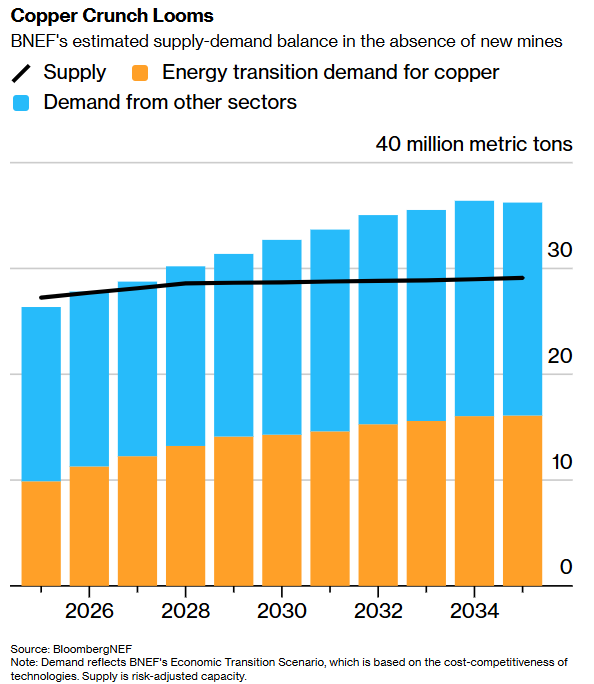
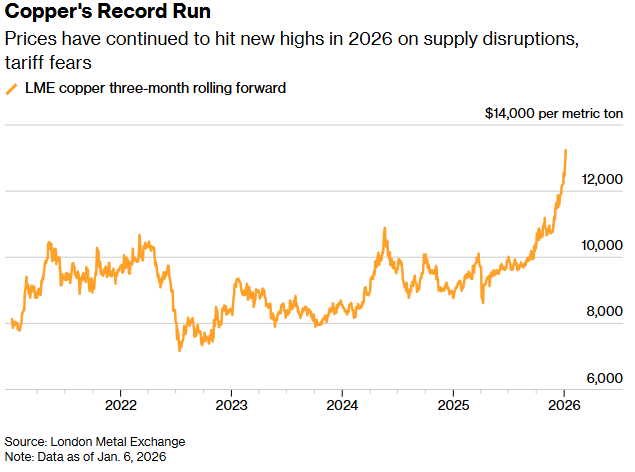
智通财经APP获悉,根据标普全球的一项最新研究,人工智能竞赛和激增的国防开支将加剧预期的铜短 缺,而生产商正难以扩大产能。 标普全球在周四发布的一份由矿业支持的报告中写道,需求增长正在加速,而矿山供应正面临结构性限 制,这增加了铜成为经济增长和技术扩张瓶颈的风险。 在伦敦交易所,由于一系列矿山停产以及贸易商在特朗普政府可能加征关税前于美国囤积金属,铜价已 飙升至每吨 13,000 美元以上的历史新高。虽然流入美国仓库的铜使价格超出了基础消费量所支撑的水 平,但新的需求领域预示着长期市场将更加紧张。 "三年前,人工智能和数据中心甚至都不在考虑范围内,"标普全球能源转型与关键金属咨询主管 Aurian De La Noue 在接受采访时表示。"这项研究表明,甚至在考虑这些新的增长向量之前,世界就已经在走 向供应赤字。" 铜价创纪录上涨 标普全球预计,到 2040 年,全球铜需求将从目前的水平增长 50%,达到 4200 万吨。虽然建筑、家 电、交通和发电等传统来源继续占据铜需求的大部分,但最大的增长份额来自能源转型用途,包括电动 汽车、可再生能源、电池和电网扩张。 新的需求来源也在扩大规模。随着全球已安装的数据中 ...
“铜荒”加剧:供应缺口或达1000万吨,AI与国防开支或引爆全球铜争夺战
Jin Shi Shu Ju· 2026-01-08 06:06
Core Insights - The competition in the artificial intelligence sector and rising defense spending are expected to exacerbate the already evident copper shortage, with producers struggling to expand capacity [1] - A report by S&P Global indicates that global copper demand is projected to increase by 50% by 2040, reaching 42 million tons, driven primarily by energy transition sectors such as electric vehicles and renewable energy [1][2] Group 1: Demand Drivers - The demand for copper from artificial intelligence, data centers, and global defense spending is expected to double, adding approximately 4 million tons of consumption by 2040 [2] - The installation capacity of global data centers is projected to grow nearly fourfold by 2040, significantly increasing copper consumption related to these infrastructures [2] - The potential demand from humanoid robots could reach about 1.6 million tons annually by 2040, accounting for approximately 6% of current consumption [2] Group 2: Supply Challenges - Global copper production is expected to peak at around 33 million tons by 2030, facing challenges such as declining ore grades and obstacles in permitting, financing, and construction of new projects [2] - Even with a significant increase in recycled copper, projected to more than double to 10 million tons, there will still be a supply gap of 10 million tons [2] - The longer development cycles, rising costs, and highly concentrated supply chains further exacerbate supply challenges, making the market increasingly vulnerable to disruptions as demand accelerates [5] Group 3: Market Dynamics - High copper prices are beneficial for the industry, but there is no guarantee that prices will remain at elevated levels [5] - The research received funding from major mining companies and traders, indicating strong industry interest in the findings [5]