
美元霸权

Search documents
美债危局与中国的"金盾"战略:从债务陷阱到货币突围
Sou Hu Cai Jing· 2025-06-08 15:47
当"借债成瘾"的邻居再次敲门时,中国这次选择了锁紧钱袋。这个将国债钟摆调至38万亿美元的庞然大物,正用美元霸权的手术刀划破全球信用体系。从 2008年金融危机到2025年债务上限谈判,华盛顿政客们在国会山上演全武行,两党为军费福利撕扯体面,最终以"给气球打气"的方式将债务上限提升至38万 亿美元。这种饮鸩止渴的玩法,让国际投资者用脚投票——美债收益率从3%飙升至4.5%,日元英镑连续12个月抛售美债,华尔街的债务游戏正在演变为全 球金融体系的慢性中毒。 面对这场精心编排的"狼来了"戏码,中国早已备好三道防火墙。第一道是黄金铸就的诺亚方舟:两年间日均增持3吨黄金,总储备突破7377万盎司,足以铺 满三个鸟巢体育场的金色盾牌,将外汇储备中黄金占比从3.19%提升至5.36%。第二道防线是人民币国际化闪电战:东南亚菜市场扫码支付、俄罗斯石油管 回望2008年的救援往事,中国曾以4万亿外汇储备换来的是贸易战清单和技术封锁黑名单。今天北京金融街上的决策者们深谙:国际金融体系从不庇护"善意 债权人",只有铸币权与黄金储备构筑的护城河才能赢得对等对话。当美联储印钞机轰鸣着收割全球铸币税,当华盛顿政客把国债当作政治筹码,中国 ...


中银证券首席经济学家徐高:国内政策加码守住底线,股债汇平稳运行可期
Bei Jing Shang Bao· 2025-06-08 09:25
北京商报讯(记者 岳品瑜 董晗萱)6月6日,在"2025中银全球走进昌平——融通世界·智启未来"活动上,中银证券首席 经济学家徐高阐述了其对于当前中国经济形势的观点及未来展望。 近期中美经贸高层互动释放积极信号,但贸易战的深层矛盾与影响仍在持续发酵。徐高指出,特朗普政府发起贸易战的 根本目标在于压缩美国巨额贸易逆差,其逻辑是将制造业岗位流失归咎于贸易伙伴。然而,历史数据揭示了一个关键矛 盾:美国的贸易赤字问题早在20世纪80年代就已凸显,远早于中国深度融入全球贸易体系,将赤字主因归于中国缺乏充 分依据。 值得注意的是,中国拥有显著的内部缓冲空间。徐高表示,近年来经济下行压力主要源于国内周期性因素,特别是房地 产市场的调整。目前,一系列稳地产政策已开始显现效果。只要房地产市场逐步企稳,国内巨大的内需潜力足以缓冲外 需走弱的影响。中国作为内需潜力远未充分释放的大型经济体,在政策刺激方面拥有广阔的回旋余地。 面对这场由美方挑起的贸易摩擦,中国需做好"持久战"的心理与战略准备。"中美之间正在进行'懦夫博弈',狭路相逢勇 者胜,'下策'绝不可能被接受。"徐高强调,基于过往交锋经验,对特朗普政府的极限施压策略采取退让姿态 ...


中国若不接盘美债,美国将面临信誉崩盘!
Sou Hu Cai Jing· 2025-06-07 23:41
先说个扎心的事实:美国现在每天光利息就得烧掉27亿美元,这还不算本金。你没听错,光是利息钱就能压垮华盛顿那帮人。去年日本还攥着1.1万亿美元 美债,结果上个月直接甩卖了500亿,搞得美债利率一晚上窜高20个点。连日本都开始跑路了,你觉得中国会傻到去接盘?这不是"农夫与蛇"的故事,是"东 郭先生救狼"的翻版。 美债曾经是全球金融市场的"定海神针",但现在呢?越来越多国家开始用自己的货币结算,东盟搞了本币结算圈,巴西卖大豆直接收人民币,俄罗斯更是把 存在美国的黄金全拉回国。美元的国际地位正在一步步被蚕食,这不是危言耸听,而是肉眼可见的趋势。 美债这事儿,最近又成了全球金融圈的头号瓜。6月份到期的6.5万亿美元美债,像一颗定时炸弹,正悬在华盛顿的头顶。而大家最关心的问题是:中国会不 会接盘?我的答案很简单——别开玩笑了,接盘就是给自己挖坑! 还有人提到比特币,说美国可能用比特币来化债。这更是个笑话。比特币是什么?它是个虚拟品,网络崩溃了它就归零。美国拿虚拟货币换中国的真金白 银,这不是明抢是什么?拿中国人当傻子吗? 美国的债务问题已经不是靠"化债"能解决的了,它的问题是系统性的。贪腐严重、贫富差距拉大、财政赤字失控 ...
美财政部放出数据,6月底有1.45万亿美元债到期,美债会暴雷吗?
Sou Hu Cai Jing· 2025-06-07 22:28
没有人会想到,美国作为世界第一大经济体,如今美国政府的债务却超过了36万亿美元。 现在每年光给国债持有人(包括外国政府和投资者)的利息,就得付8810亿美元!这就相当于每天睁开眼就要还24亿利息。债务到期了怎么办?美国政府的 办法是:绝大多数(99.5%)通过发行新国债来还旧债! 以前,靠着美元是世界头号硬通货(尤其是1974年和沙特等国协议保证石油用美元结算),全球赚了美元的国家(比如中国、日本)都乐意买美国国债保值 (石油美元→买美债),形成循环。 美国政府觉得欠债不怕:一来能印美元还钱(虽然会贬值),二来一直有人买新债接盘。 但风水轮流转!现在这模式不行了:2025年4月的一次美债拍卖(30年期国债),认购情况创四年最差,买家数量大幅减少。 最近网上疯传"美国6月有6.5万亿美元国债到期还不起",搞得人心惶惶。其实这数字大错特错!真实情况是这样的: 1. 实际到期没那么多:1.2万亿~1.45万亿美元。 中国有句老话说的好,冰冻三尺非一日之寒!美国政府之所以能欠下如此高的债务,也是通过经年累积而成。 美国政府开支如此巨大,很大一部分都用于了军费上。就说伊拉克和阿富汗那两场仗(2001-2021年),直接 ...
美债最大“接盘侠”诞生,疯狂买走1.5万亿,但不是英国、日本
Sou Hu Cai Jing· 2025-06-07 06:44
信息源:本文陈述所有内容皆为可靠信息来源赘述在文章结尾 就在大家盯着中国、日本抛售美债的时候,美国财政部竟凭空冒出个"超级接盘侠",一年狂扫1.5万亿 美债,比日本全年军费都多! 可这土豪既不是传统盟友英国,也不是中东金主,但背后牵扯着美国掏空全球钱包的新套路…… 美债困局 2025年4月特朗普宣布"对等关税"政策后,美国国债遭遇了自2001年以来最猛烈的抛售潮,长期国债收 益率连日飙升。 2025年5月,美国财政部资本流动报告显示,中国单月减持189亿美元美债,持仓降至7654亿美元——这 是二十年来首次被英国反超,滑落至美债海外持有国的第三位。 日本虽在2025年2月增持466亿美元,但其国内债务压力制约了持续接盘能力。 此刻,美国国债总额高悬于37万亿美元之巅,而年复一年"借新还旧"的戏码也导致各国央行对美债态度 发生了转变,石油国家转向黄金,欧洲基金缩紧钱袋,美联储自身深陷量化紧缩。 对于美国来说,急需解决的2025年到期债务规模如滚雪球般膨胀,但是特朗普却丝毫不慌,因为一个隐 形巨头已悄然崛起。 2024年全球稳定币转账量高达27.6万亿美元,比Visa和万事达交易量总和还多。进入2025年,其总市 ...
特朗普“致命药方”,恐将亲手埋葬美元霸权
凤凰网财经· 2025-06-06 13:01
Core Viewpoint - Former U.S. Treasury Secretary Lawrence Summers warns that the "Big and Beautiful" plan promoted by the Trump administration is pushing the U.S. towards a fiscal cliff, potentially undermining the dollar's dominance and reshaping the global economic order [1][2] Group 1: Fiscal Implications - The Congressional Budget Office (CBO) estimates that the plan will add $2.4 trillion to the deficit over the next decade, but Summers' dynamic modeling suggests the actual debt increase could exceed $4 trillion when accounting for temporary tax measure extensions and interest effects [1] - Annual fiscal deficit rates are projected to exceed 7% of GDP, surpassing the dangerous threshold of 6% observed in recent years [1] Group 2: Contributing Factors - The aging population is expected to increase welfare spending significantly, with Social Security funds projected to be depleted by 2029 [1] - Government healthcare spending is growing at twice the rate of economic growth, potentially reaching 20% of GDP by 2025 [1] - Rising interest rates, with 30-year U.S. Treasury yields exceeding 5%, have led to debt servicing costs surpassing military expenditures [1] Group 3: Global Economic Concerns - As the largest debtor nation, the U.S. faces a monetary dilemma of maintaining the dollar's reserve status while issuing massive amounts of debt to cover deficits [2] - If U.S. debt surpasses $40 trillion, international confidence in the dollar may falter, leading to rapid selling of U.S. bonds by central banks [2] - The Trump economic team believes a 3.5% GDP growth rate combined with 10% tariff revenue can resolve the debt crisis, but models indicate that tariffs could raise core PCE inflation by 1.2 percentage points [2] Group 4: Policy Recommendations - Summers supports the proposal to eliminate the debt ceiling but emphasizes that restoring fiscal discipline requires tax reform, including closing loopholes for multinational corporations and implementing a digital services tax [2] - The upcoming Senate vote on the plan has prompted global central banks to initiate emergency measures, indicating the high stakes involved in maintaining dollar supremacy [2]
欧洲用降息反击美国,美联储还是按兵不动,进一步冲击美元霸权
Sou Hu Cai Jing· 2025-06-06 10:12
Group 1: Economic Conditions in Europe - The European Central Bank (ECB) has lowered the deposit rate by 25 basis points to 2.0%, marking the eighth rate cut since June of the previous year, indicating that the rate cut cycle is nearing its end [1] - The Eurozone's GDP is projected to grow by 0.9% this year, with a stable job market and slight increases in household income supporting consumer spending [1] - The Eurozone's inflation rate fell to 1.9% in May, the first time it has dipped below the 2% target in 2025, with core inflation decreasing from 2.7% to 2.3% [1] Group 2: U.S. Economic Challenges - The Federal Reserve is facing significant challenges, with the dollar's share of global foreign exchange reserves dropping to 58%, the lowest since 1994, while the euro holds steady at 20% [4] - The U.S. has maintained interest rates between 4.25% and 4.5% despite rising inflation expectations at 2.8% and increasing recession risks, leading to a decline in consumer confidence to a five-year low [4] - The dollar index has fallen to 99.24, reflecting a broader trend of "de-dollarization" as countries increasingly prefer to settle transactions in their own currencies [4] Group 3: U.S. National Debt Concerns - The U.S. federal government debt has surpassed $36 trillion, equating to approximately $10.8 thousand per citizen, with the debt-to-GDP ratio rising from 98% in 2024 to 102% in 2025, and projected to reach 150% by 2028 [7] - The rapid growth of U.S. debt outpaces economic growth, indicating a reliance on borrowing rather than productivity to sustain fiscal operations [7] - The "Big and Beautiful" Act is expected to add $3.3 trillion in new debt over the next decade, with a projected deficit of $1.7 trillion for 2025, raising concerns about fiscal sustainability [9]

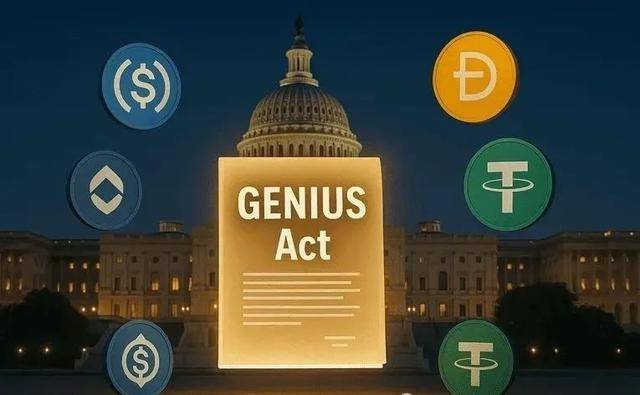
低调通过却暗藏杀机,“天才法案”是美元霸权的新密码
Sou Hu Cai Jing· 2025-06-06 07:44
Core Viewpoint - The introduction of the GENIUS Act by the U.S. Senate represents a strategic move to reinforce the dominance of the U.S. dollar in the global financial system under the guise of innovation and regulation, effectively turning stablecoins into tools of U.S. financial hegemony [1][9]. Group 1: Stablecoin Regulation - The GENIUS Act mandates that all stablecoins must be 100% backed by U.S. dollar cash or U.S. Treasury securities, restricting the asset base and effectively tying global stablecoin issuance to U.S. debt [3][4]. - This legislation aims to prevent any potential threats to the U.S. financial system by ensuring that stablecoins cannot operate independently of U.S. financial instruments [3][4]. Group 2: Global Financial Control - The act introduces a new dimension of sanctions, requiring both domestic and foreign stablecoin issuers to register with U.S. authorities and comply with stringent regulations, thereby extending U.S. regulatory reach globally [4][6]. - The GENIUS Act is seen as a step towards a "digital Bretton Woods" system, where the U.S. seeks to control the blockchain transaction ecosystem under its regulatory framework [4][7]. Group 3: Economic Implications - Analysts predict that if stablecoin market capitalization reaches $3.7 trillion by 2030, with half allocated to U.S. debt, the U.S. could gain $1.5 to $1.75 trillion in debt financing capacity, highlighting the financial leverage the U.S. aims to achieve through stablecoins [6]. - Currently, 99% of stablecoins are pegged to the U.S. dollar, and two-thirds of cryptocurrency transactions rely on stablecoins for settlement, indicating the potential for the U.S. to manipulate global capital flows through this legislation [6][9]. Group 4: International Response - Various regions, including Hong Kong, the EU, and Singapore, are exploring localized stablecoin regulations that prioritize technical safety and user protection, contrasting with the U.S. approach of regulatory dominance [9]. - Without a unified international effort to establish a fair and decentralized global stablecoin governance mechanism, the blockchain landscape may become increasingly unequal and controlled by U.S. interests [9].
美国欠的36万亿美元国债可能要炸了
Sou Hu Cai Jing· 2025-06-05 09:09
Group 1 - The U.S. national debt has reached $36 trillion, creating significant financial pressure, with monthly interest payments of $890 billion against a revenue of $389 billion [1] - The U.S. Treasury has approved a new debt issuance plan of $1.2 trillion for the last quarter, despite claims of strong creditworthiness [2] - Global central banks are increasingly wary of U.S. debt, with countries like Brazil and South Africa exploring alternative currencies and financial arrangements [2][3] Group 2 - China has strategically reduced its holdings of U.S. debt by $480 billion over the past 18 months and increased its gold reserves to 16% of its foreign exchange reserves [3] - The CIPS system in China is processing 4.8 trillion yuan in cross-border transactions daily, indicating a shift away from the SWIFT system [3] - The potential for a coordinated sell-off of U.S. debt by global markets poses a significant risk to the U.S. financial system, with fears of a debt crisis escalating [3]
“全球欧元时刻”正在加速到来?
Sou Hu Cai Jing· 2025-06-05 04:14
Group 1: Core Perspectives on Euro Internationalization - The Euro has not significantly increased its global role despite being the second-largest currency since its inception in 1999, with its share in international currency usage remaining around 19%, still far behind the US dollar [1][2][3] - The Euro was created primarily for European integration rather than to compete with the dollar, and its internationalization lacks sufficient "hard" support compared to the dollar's backing from the US's economic, political, and military strength [3][4] - The Eurozone's economic performance has lagged behind the US and emerging economies since the 2009 Eurozone crisis, with its share of global GDP declining from 20% to 15% by 2023, which limits the Euro's global influence [4][6] Group 2: Challenges and Opportunities for Euro - The Euro's potential rise is hindered by the need for enhanced military strength and strategic autonomy, as reliance on US military power undermines trust in the Euro as a global currency [7][12] - The current international monetary environment presents opportunities for the Euro, as the dollar's dominance is being challenged by US economic policies and a decline in global trust towards the dollar [9][10][11] - To capitalize on these opportunities, the Eurozone must improve its economic vitality, enhance capital market attractiveness, and achieve political consensus among member states to elevate the Euro's international status [10][12]