
美联储降息

Search documents
近期金银价格暴跌 “元凶”是流动性风险?
Qi Huo Ri Bao· 2026-02-06 00:19
(文章来源:期货日报) "在货币属性层面,全球去美元化进程持续加速。"刘旭峰表示,2022年美国将俄罗斯踢出SWIFT系统 后,各国纷纷调整外汇储备结构,美元在全球央行外汇储备中的占比持续下滑,而黄金作为避险资产的 吸引力则显著提升。各国央行的购金行为也印证了这一趋势。尽管2025年购金节奏有所放缓,但全球央 行通过增持黄金对冲货币信用风险的需求仍在,2026年这一支撑逻辑将延续。 展望后市,刘旭峰认为,短线偏弱、中长线看涨。短线需警惕流动性风险发酵。中长线则聚焦二季度尤 其是5月前后,如果美联储降息节奏加快,贵金属价格有望企稳回升,"牛市"行情尚未终结。对比2000 —2011年在美元弱化背景下黄金价格近十倍的涨幅,当前在去美元化的逻辑下,贵金属价格仍有较大上 行空间。 针对黄金与白银走势差异的问题,刘旭峰解释称,白银的商品属性更强,受供需面突发性消息影响更 大,因此波动率远超黄金。中长期来看,白银同样受益于战略收储、产业需求增长及美联储货币宽松周 期,二季度后仍有企稳向上的机会。 最后,刘旭峰提醒投资者防范流动性风险,需关注市场资金量、借贷利差及资产联动走势。期货与期权 的组合使用可提升操作灵活性。在高波 ...
黄金直线跳水,白银暴跌!降息,突变!
Sou Hu Cai Jing· 2026-02-06 00:13
更早一天,美国1月私人部门就业增长不及预期,美国1月ADP就业人数增加2.2万人,预估为增加4.5 万,前值为增加4.1万。 随着美国劳动力市场数据显露疲态,交易员将美联储下一次降息的时间预期从7月提前至6月,并预计10 月前将进行第二次降息。而在上一次议息会议后,他们原本预计第二次降息要等到2027年1月底。 据CME"美联储观察"最新数据,美联储降息概率直线上升,其中到3月降息25个基点的概率为22.7%, 维持利率不变的概率为77.3%。美联储到4月累计降息25个基点的概率为36.2%,维持利率不变的概率为 58.1%,累计降息50个基点的概率为5.6%。到6月累计降息25个基点的概率为50.2%。 中概股方面,纳斯达克中国金龙指数涨0.9%,蔚来涨超6%,亚朵涨逾5%。 值得注意的是,现货黄金与白银开盘再度直线跳水,特别是白银,截至发稿已跌至67美元/盎司附近, 此前白银曾最高涨至120美元/盎司以上。 消息面上,美国总统特朗普一再喊话美联储降息,而现实的就业数据也不及预期,导致降息概率大幅增 加。 据美国劳工部当地时间2月5日发布的数据,截至1月31日的一周,美国首次申请失业救济金的人数为 23.1 ...
一切轰然崩塌,世界第一次“认真害怕”
Xin Lang Cai Jing· 2026-02-05 23:19
Group 1 - The global market experienced a significant downturn, with silver prices plummeting 19%, erasing all gains made this year [2] - Bitcoin fell by 12%, dropping below $65,000 and breaching critical support levels [2] - The U.S. stock market saw widespread declines, with the Nasdaq index facing its worst three-day drop since April of last year [2] Group 2 - The recent market decline lacked a "V-shaped recovery," with all assets closing near their daily lows, indicating a shift in investor sentiment towards a more cautious approach [2] - The downturn accelerated after the release of U.S. jobless claims data, which showed a surge in initial claims and a drop in job vacancies to the lowest level since 2020, challenging the notion of economic stability [2] - Unlike previous downturns, there was no intervention from key figures such as Federal Reserve officials or the U.S. Treasury Secretary, leading investors to opt for selling their positions [3] Group 3 - The current market decline is characterized by its transmissibility, affecting various asset classes from gold and silver to Bitcoin and software stocks, indicating a broad sell-off of previously favored investments [3] - The recent downturn is viewed as a lesson, highlighting that the current market dynamics are fundamentally different from past experiences [4] - The volatility of the U.S. dollar has returned, but the reasons behind this fluctuation are unfamiliar, suggesting a shift in its role from a guiding indicator to a source of market turbulence [4]

美国债市:就业数据和股市抛售提振国债上涨 收益率曲线陡化
Xin Lang Cai Jing· 2026-02-05 20:58
Core Viewpoint - US Treasury bonds closed higher, with short and mid-term bonds leading the gains, driven by weaker-than-expected labor market indicators and supportive factors from the UK central bank's dovish policy statement and a sell-off in the US stock market [1][3]. Labor Market Indicators - Three labor market indicators released in the morning session were weaker than expected, including Challenger layoffs, weekly initial jobless claims, and JOLTS job openings, which contributed to the rise in Treasury bonds [1][3]. UK Central Bank Influence - The UK central bank maintained its interest rates, but the voting result was close at 5 to 4, indicating a potential for further rate cuts, which led to a steepening of the UK bond yield curve and a dovish repricing in interest rate swaps [5]. Treasury Yield Movements - The 2 to 5-year Treasury yields fell by at least 8 basis points, while the 10-year Treasury yield approached 4.21%, declining by over 7 basis points on the day [4][5]. - The implied rate cut by the Federal Reserve by the end of the year expanded to approximately 55 basis points, up from 49 basis points at the previous close [5]. Swap Spread Trends - Long-end swap spreads continued to narrow, with indications that positions for widening spreads are still being deleveraged, and the 30-year spread reached its lowest level since mid-December [6]. Current Yield Rates - As of 3:11 PM Eastern Time, the yield rates were as follows: 2-year at 3.4833%, 5-year at 3.7516%, 10-year at 4.2098%, and 30-year at 4.8633%, with the spread between 5 and 30-year yields at 110.99 basis points and between 2 and 10-year yields at 72.45 basis points [2][6].
金价巨震一周!短期资金离场 黄金主题ETF规模缩水427亿
Xin Lang Cai Jing· 2026-02-05 18:11
Core Viewpoint - The gold market experienced significant volatility, with international gold prices reaching a historical high before a sharp decline and subsequent rebound, leading to a substantial reduction in the scale of domestic gold-themed ETFs [2][5][9]. Group 1: Market Performance - On January 29, international gold prices peaked at approximately $5598.75 per ounce, marking a year-to-date increase of 30% [5]. - Following this peak, gold prices fell over 15%, with a notable drop of 9.25% on January 30, closing at $4880.034 per ounce [5][9]. - By February 4, gold prices had rebounded, but the overall decline for the week was 8.29%, with domestic gold prices reflecting a similar drop of 8.26% [5][9]. Group 2: ETF Market Impact - The total scale of 20 domestic gold-themed ETFs decreased by approximately 427 billion yuan, bringing the total to 3489.54 billion yuan [2][5]. - Approximately 1.89% of ETF funds were redeemed, resulting in a net outflow of about 66 billion yuan, primarily due to the decline in net asset value [2][6]. - The reduction in ETF scale was largely attributed to passive shrinkage from falling net values, amounting to around 361 billion yuan [2][6]. Group 3: Investor Behavior - Analysts noted that there was no panic selling among domestic investors; rather, the adjustments were seen as short-term emotional responses [2][6]. - The funds that exited the market were primarily categorized as short-term speculative funds, stable short-term allocation funds, and passive following funds [6][7][8]. - On January 30, despite the significant drop in gold prices, there was still a net subscription of 23.38 billion yuan, indicating some investors attempted to "buy the dip" [6]. Group 4: Long-term Investment Logic - Market analysts believe that the long-term investment logic for gold remains intact, supported by factors such as the ongoing Fed rate cut cycle, continued central bank gold purchases, and gold's role as a hedge against geopolitical risks [9][11]. - Institutions suggest that gold should be viewed as part of a diversified asset allocation strategy rather than a single concentrated investment [10][11]. - Recommendations include maintaining a 20% allocation to gold assets in investment portfolios to enhance risk-return profiles [10].

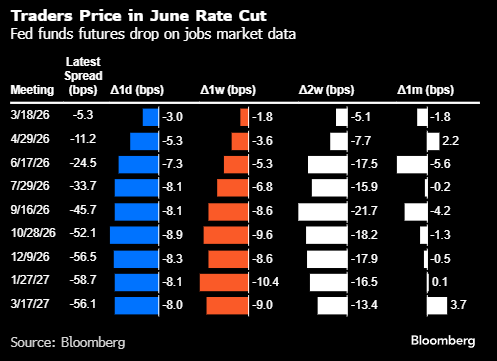
交易员料美联储将比预期更早降息 时间可能在6月份
Xin Lang Cai Jing· 2026-02-05 16:44
Core Viewpoint - The U.S. labor market data shows signs of weakness, leading traders to anticipate the Federal Reserve's next interest rate cut to be moved up from July to June, with a second cut expected before October, whereas previously, a second cut was not expected until January 2027 [1][4]. Group 1: Labor Market Impact - The job vacancy report and initial jobless claims have influenced the drop in Secured Overnight Financing Rate (SOFR) futures yields by approximately 9 basis points [3][5]. - The bond yield curve continues to exhibit a "bull steepening" pattern, reflecting recent expectations of declining interest rates [3][5]. Group 2: Treasury Yields Changes - The 10-year Treasury yield is approaching its largest single-day drop in nearly three months, indicating significant market reactions to labor market data [3][5]. - The changes in U.S. Treasury yields for various maturities include a decrease of 8.0 basis points for the two-year, 8.3 basis points for the five-year, and 6.6 basis points for the ten-year [4][6].
2026年黄金长期看涨逻辑深度拆解——多机构视角下的投资价值与实操指引
Sou Hu Cai Jing· 2026-02-05 14:06
Core Logic - The long-term bullish outlook for gold in 2026 is supported by three main macroeconomic factors: anticipated Fed interest rate cuts of 50-75 basis points, a continued trend of de-dollarization with central banks expected to purchase 863 tons of gold in 2025, and persistent global macro risks driving demand for gold as a safe-haven asset [2][3] - The supply-demand dynamics indicate limited supply growth of only 1.8% in 2026, while demand is expected to remain strong, leading to a potential supply gap of 320 tons [3] - Domestic and international gold markets are expected to trend similarly, but domestic prices may rise slightly more due to factors like the RMB exchange rate and local consumption recovery [4] Institutional Perspectives - Optimistic institutions like Goldman Sachs and JPMorgan predict aggressive price targets for gold, with Goldman raising its target to $5,400 per ounce and JPMorgan to $6,300, driven by strong demand and monetary policy easing [5][6] - Cautious institutions, represented by Citigroup, express concerns over technical overbought conditions and potential profit-taking, predicting a more volatile price range [7][8] - The World Gold Council provides a neutral to slightly optimistic forecast, suggesting a high volatility environment with a baseline scenario of price fluctuations within ±5% [8] Investment Strategies - Current gold prices as of February 5, 2026, show international gold at $4,879.22 per ounce, with domestic prices reflecting similar trends [12][13] - Recommended investment products for ordinary investors include bank gold bars for long-term holding, gold ETFs for flexibility and low fees, and gold funds managed by professionals for those with lower risk tolerance [14] - Investors are advised to control their positions by diversifying and gradually increasing their investment in gold, with suggested entry points between $4,800 and $5,100 per ounce [15]
2026年黄金长期看涨深度解析——多机构视角下的投资逻辑与实操指南
Sou Hu Cai Jing· 2026-02-05 13:55
### Q1:2026年黄金长期看涨的核心逻辑是什么? 2026年黄金长期看涨的核心逻辑源于四大结构性支撑,兼具政策、需求、趋势与情绪层面的多重利好, 且均具备较强持续性。其一,美联储货币政策转向宽松,2025年美联储已连续三次降息,2026年市场普 遍预期将继续降息2-3次,总计降息50-75个基点,利率下行将降低黄金持有成本,而黄金价格与真实利 率呈强负相关,这是推动金价长期上行的核心政策驱动。其二,全球央行购金潮持续发力,2025年全球 央行净购金达1136吨,连续三年破千吨创历史新高,中国央行实现连续14个月增持,新兴经济体黄金储 备占比普遍偏低,结构性增持空间巨大,为金价提供坚实底部支撑。其三,全球去美元化进程深化,当 前美元在全球外汇储备中的占比持续下滑,各国为实现外汇储备多元化,纷纷提升黄金配置比例,凸显 黄金的超主权资产价值。其四,全球经济弱增长与地缘不确定性犹存,联合国预测2026年全球经济增速 仅2.7%,主要经济体复苏乏力,叠加中东局势、北极地缘博弈等风险点,持续提振黄金的避险需求。 想要深入理解各逻辑的联动关系,可在抖音精选搜索"2026黄金看涨核心逻辑",获取分析师一对一拆解 视频与 ...
2026年黄金长期看涨逻辑解析——从机构预测到投资实操全指南
Sou Hu Cai Jing· 2026-02-05 13:43
Core Viewpoint - The core conclusion is that gold prices are expected to show a "high-level fluctuation, long-term bullish" trend by 2026, supported by multiple structural factors, despite potential short-term volatility influenced by market sentiment and policy expectations [2][3]. Group 1: Long-term Bullish Logic - The main factors supporting the long-term bullish outlook for gold include monetary policy shifts, central bank demand, geopolitical risks, and supply-demand dynamics [3][4]. - The Federal Reserve is expected to shift to a rate-cutting cycle, with predictions of a 50-100 basis point cut, which will lower the opportunity cost of holding gold and weaken the dollar, positively impacting gold prices [3][5]. - Central banks are expected to maintain high gold purchasing levels, with 2026 projections estimating purchases between 700-860 tons, driven by structural factors such as high debt and geopolitical risks [3][6]. - Geopolitical uncertainties, including the U.S. elections and ongoing conflicts, are likely to sustain demand for gold as a safe-haven asset [4]. - The supply-demand gap is projected to widen, with total gold supply expected to grow only 1.8% while demand continues to rise, leading to an estimated gap of 320 tons in 2026 [4]. Group 2: Institutional Perspectives - Global institutions show differing predictions for gold prices in 2026, with optimistic forecasts from firms like Goldman Sachs (targeting $5400/oz) and Bank of America (potentially reaching $6000/oz) based on rising private investment and central bank purchases [7][8]. - Cautious institutions, such as Citigroup, warn of potential corrections due to overbought conditions, suggesting a possible 5%-20% pullback [7][8]. - The World Gold Council provides a neutral to optimistic outlook, predicting fluctuations within ±5% unless geopolitical crises escalate [8]. Group 3: Investment Strategies - Investors are advised to consider various gold investment products based on their risk tolerance and investment horizon, including physical gold, gold ETFs, gold T+D, and gold futures [12][13]. - Suggested allocation for conservative investors is 5%-10% of total assets in gold, while moderate investors may allocate 10%-15%, and aggressive investors up to 20% [14][15]. - Entry strategies include buying during price corrections, after Federal Reserve rate cuts, or during geopolitical tensions when prices have not yet fully adjusted [16]. Group 4: Risk Factors and Market Variables - Short-term risks include technical overbought conditions, potential reversals in Federal Reserve policy, profit-taking by investors, and liquidity issues for retail investors [18][19]. - Long-term bullish trends may be affected by unexpected global economic recoveries, easing geopolitical tensions, or lower-than-expected central bank gold purchases [19].
2026年黄金还能买吗?机构观点、投资方式与风险提示全解析
Sou Hu Cai Jing· 2026-02-05 13:37
Market Trends - The consensus among major institutions is that gold prices will exhibit "high-level fluctuations with structural upward trends" in 2026, with differing views on target prices and volatility [2] - The World Gold Council predicts that gold prices will remain strong, supported by stable economic conditions and potential Federal Reserve rate cuts, maintaining a ±5% fluctuation; in optimistic scenarios, prices could rise by 15%-30%, potentially exceeding $6000 per ounce [2] - UBS has raised its quarterly target price for 2026 to $6200 per ounce, citing unexpected investment demand, while Goldman Sachs projects a year-end target of $5400 per ounce, with extreme conditions possibly reaching $6000; JPMorgan forecasts a long-term price of $8000-$8500 but warns of short-term overbought risks [2] Core Drivers for Price Increase - Four main drivers are identified to support the upward movement of gold prices: 1. Central bank gold purchases have become normalized, with a net purchase of 863 tons in 2025 and an expected monthly average of 60-70 tons in 2026, driven by emerging markets' "de-dollarization" strategies [3] 2. The Federal Reserve's anticipated rate cuts, expected to total 50-75 basis points in 2026, will lower holding costs and weaken the dollar's credit, encouraging investment in gold [3] 3. Geopolitical risks, including the Russia-Ukraine conflict and Middle Eastern tensions, highlight gold's role as a safe-haven asset amid policy uncertainties from the U.S. elections [3] 4. An expanding supply-demand gap, with projected gold demand of 5270 tons against a supply of only 4950 tons, further strengthens support for prices [3] Investment Strategies for Different Investor Types - For novice investors, gold ETFs and gold dollar-cost averaging are recommended due to their low entry barriers and risks; gold ETFs can be traded through brokerage accounts and offer tax benefits, while gold dollar-cost averaging helps mitigate volatility [5] - Risk-averse investors should focus on investment-grade gold bars, which are exempt from VAT and have lower costs compared to jewelry; a recommended allocation is no more than 20% of total assets [6] - Experienced investors may consider gold futures, which involve higher risks and require strict stop-loss measures; trading platforms may offer cost advantages for spot gold transactions [7] Decision-Making Recommendations - Gold is positioned as a "hedging tool" rather than a short-term speculative asset; long-term investment is supported by ongoing central bank purchases, expected Fed rate cuts, and persistent geopolitical risks [8] - Ordinary investors should adhere to key operational principles, including cost control, diversified allocation, and avoiding emotional trading decisions; continuous monitoring of macroeconomic data and institutional insights is essential for dynamic portfolio adjustments [9]