基差交易

Search documents
每周报告汇总-20250417
Guotai Junan Securities (Hong Kong)· 2025-04-17 09:10
Group 1: Hong Kong Stock Market Strategy - The Hong Kong stock market is expected to consolidate in the short term, with a "barbell" investment strategy recommended for balanced allocation[1] - After recent corrections, the Hong Kong stock market presents high investment value, supported by rising expectations of domestic counter-cyclical policies[1] - High-dividend stocks are likely to provide a certainty premium and may outperform in the current market environment[1] Group 2: Impact of Trump's Tariff Policies - Trump's tariff policies are expected to increase the tariff rate on China to 125%, potentially leading to a decline in corporate profits and reduced willingness to export to the U.S.[1] - The anticipated impact of tariffs could account for approximately 10% of China's total exports, affecting GDP by about 2%[1] - The market is likely to experience sideways movement due to uncertainties surrounding the implementation of tariffs and their economic implications[1] Group 3: U.S. Financial Market Volatility - The U.S. financial markets have experienced significant volatility, raising doubts about the effectiveness of fundamental and technical analysis[2] - A notable increase in U.S. Treasury yields, coupled with a decline in the dollar index, indicates a "trust crisis" in the dollar[2] - The Trump administration's tariff policies may lead to a reliance on achieving trade agreements to restore confidence in the U.S. economy[2] Group 4: Dollar Index and Credit Weakening - The dollar index has fallen significantly, reaching a two-year low of 99.01, primarily due to uncertainties surrounding Trump's tariff policies[3] - The weakening of the dollar's credit is accelerating, driven by a decline in U.S. economic advantages and an increase in de-dollarization trends[3] - The forecast for the dollar index has been adjusted to a range of 98-104, indicating a potential long-term weakening trend[3]

张瑜:暗流涌动——美国金融市场风险全景扫描
一瑜中的· 2025-04-14 14:08
文 : 华创证券研究所副所长 、首席宏观分析师 张瑜(执业证号:S0360518090001) 联系人:殷雯卿(19945767933) 核心观点 根据各金融市场距离美联储的远近,依次梳理美国金融市场目前存在的风险: 在岸货币市场:分为①联邦基金市场—— 观察指标为 EFFR 是否走高,现状是目前仍在正常水平。 ②回购市场 —— 观察指标为 SOFR-EFFR 利差转正,现状:近期利差反复转正,且 SOFR 利率已连续 2 天突破利率走廊 上限 IOER ,回购市场流动性紧张。 在岸资本市场:波动性加大,不过尚未达到历次危机时期的波动水平,后续仍需观察。该市场存在 3 大脆弱 性: ①脆弱性 1 ——美股美债同向性转正。 当前美国股债同向性较高,破坏了股债跷跷板原则下的资配基础,可能 带来在美股下跌过程中股债同跌,加剧流动性风险。 ②脆弱性 2 ——基差交易规模走高。 目前美债基差交易规模约 8000 亿美元,其高杠杆属性对资产价格高波动 敏感性高。已观察到 SOFR 互换利差、国债买卖价差走阔,反映国债市场流动性已在恶化,不过尚未达到历史 危机时的水平。 ③脆弱性 3 ——企业债到期高峰。 2025 年企业 ...
突发!反弹超600点!
天天基金网· 2025-04-13 03:00
当地时间周五(4月11日)美股三大指数集体收涨,纳指涨超2%。 截至收盘,道琼斯工业平均指数比前一 交易日上涨619.05点,收于40212.71点,涨幅为1.56%; 标准普尔500种股票指数上涨95.31点,收于 5363.36点,涨幅为1.81%; 纳斯达克综合指数上涨337.14点,收于16724.46点,涨幅为2.06%。 本周, 标普累计上涨5.7%,创2023年11月以来最佳单周表现,纳指累涨7.29%,道指累涨4.95%。 以下文章来源于东方财富网 ,作者十字路口 东方财富网 . 东方财富网,中国财经门户,提供7*24小时财经资讯及全球金融市场报价,汇聚全方位的综合财经新闻 和金融市场资讯。 柯林斯指出,"紧急降息不会是应对市场运行恶化的主要工具。我们通常用于货币政策的核心利率工 具,并不是工具箱中唯一的工具,而且可能也不是解决流动性或市场运行问题的最佳手段。美联储目前 还拥有一些'常设机制',这些机制已经在运行,可以进一步支持市场运作。" 她强调,美联储是否干预将取决于"我们观察到的具体市场状况"。 (图片来源: 东方财富APP,统计截至2025/4/11,不作投资推荐) 大型科技股普涨,苹 ...







关税冲击下美债危机逼近?从历史上五次危机看美联储何时出手?
对冲研投· 2025-04-10 14:14
Core Viewpoint - The article discusses the significant impact of President Trump's tariff policy on the financial markets, leading to substantial losses and concerns about the stability of the financial system, prompting questions about the Federal Reserve's potential interventions [1][2]. Group 1: Market Reactions and Concerns - The stock market experienced losses amounting to trillions of dollars following the introduction of new tariff policies, causing trading stagnation on Wall Street and prompting hedge funds to liquidate high-risk trades [1]. - Concerns are rising about the potential risks within the financial system due to the scale of the market disruptions, leading to discussions on what actions the Federal Reserve might take to stabilize the situation [2]. - The Bloomberg index indicates that U.S. financial conditions have deteriorated to their worst level since May 2020, reflecting increased financial pressure across various markets [2]. Group 2: Federal Reserve's Potential Actions - The Federal Reserve is likely to intervene only when clear signs of market dysfunction appear, such as a freeze in capital flows, which could hinder trading activities [2][3]. - The Fed's decision-making is complicated by a resilient labor market and persistent inflation issues, which may limit its ability to lower interest rates or take actions that could further increase prices [3]. - Historical instances of Federal Reserve interventions highlight the need for a proactive approach in times of market distress, as seen in past crises [6]. Group 3: Historical Context of Federal Reserve Interventions - The article outlines five significant instances where the Federal Reserve intervened in the financial markets, including the 1998 hedge fund crisis, the 2001 economic turmoil post-9/11, the 2007-08 global financial crisis, the 2020 pandemic response, and the 2023 regional banking crisis [6][7][11][14][18][21]. - Each instance illustrates the Fed's role in providing liquidity and stabilizing markets during periods of extreme financial stress, emphasizing the importance of timely intervention [7][11][14][18][21].
杠杆套利策略背后的机制:对冲基金如何引发美债暴跌
Sou Hu Cai Jing· 2025-04-10 12:31
Core Viewpoint - The recent significant sell-off in U.S. Treasuries has disrupted global markets, raising questions about the forces driving this volatility, with a focus on the large-scale unwinding of a leveraged hedge fund strategy known as "basis trading" [1] Group 1: Basis Trading Mechanism - Basis trading is a relative value strategy commonly used by hedge funds, involving buying U.S. Treasuries in the spot market while simultaneously selling equivalent Treasury futures contracts to profit from the price difference [2] - Under normal market conditions, prices of Treasury futures and the underlying bonds should converge at the futures contract expiration, but slight price discrepancies create arbitrage opportunities that rely heavily on leverage for meaningful returns [2] Group 2: Supportive Trading Environment - Basis trading thrived in a low-volatility and stable interest rate environment, prevalent from most of 2022 to early 2023, during which hedge funds significantly increased their exposure to this strategy, estimated to be in the hundreds of billions of dollars [3] - This trading strategy's safety was contingent on stable market conditions, which masked a critical vulnerability: its dependence on the smooth functioning of the repo and futures markets and sensitivity to sudden changes in interest rate expectations [3] Group 3: Unwinding of Trades - Increased volatility in the U.S. Treasury market over recent months, driven by persistent inflation, unexpected economic data, and uncertainty in the Federal Reserve's interest rate path, has destabilized the pricing relationship between spot and futures contracts [4] - The rise in volatility has directly impacted hedge funds engaged in basis trading, leading to increased margin requirements for futures positions, forcing funds to either provide additional collateral or reduce risk exposure [4] Group 4: Market Impact of Unwinding - The forced unwinding of leveraged positions has led to selling pressure on U.S. Treasuries, pushing yields higher and exacerbating broader concerns about inflation and interest rate expectations, creating a feedback loop of rising yields and further volatility [5] - The impact extends beyond the bond market, as hedge funds and other leveraged investors rebalance portfolios to reduce risk exposure, putting pressure on the stock market as well [5] Group 5: Historical Context and Regulatory Concerns - The current situation mirrors the chaos in the U.S. Treasury market in March 2020, when the COVID-19 crisis triggered a wave of selling by leveraged funds, prompting the Federal Reserve to intervene with large-scale asset purchases [6] - Regulatory bodies have since increased scrutiny on non-bank financial institutions, particularly hedge funds, regarding their activities in the U.S. Treasury market, raising concerns about systemic risks associated with high leverage in traditionally safe and liquid asset classes [6] Group 6: Systemic Importance of Basis Trading - Although basis trading is not a new concept, its systemic importance appears to be increasing, highlighting the significance of financial intermediation mechanisms in determining market outcomes alongside fundamental factors [7]
潜在的流动性灾难:抛售多少会引发股灾?
Sou Hu Cai Jing· 2025-04-10 06:19
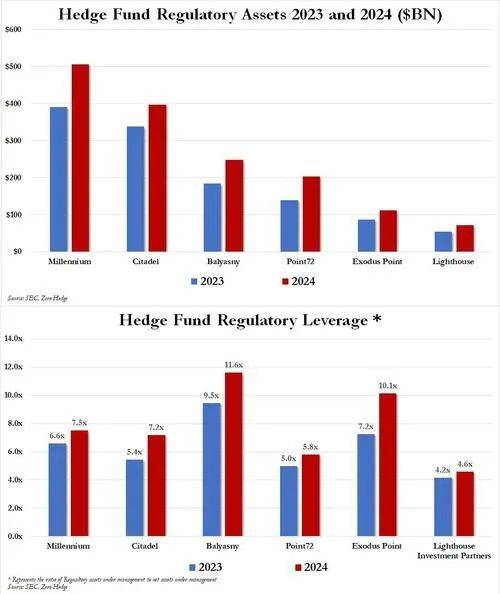
Core Viewpoint - The article highlights the alarming increase in leverage among major hedge funds involved in basis trading, raising concerns about potential market instability and the need for Federal Reserve intervention to prevent a crisis similar to past financial collapses [1][7][23]. Group 1: Hedge Fund Leverage and Basis Trading - Major hedge funds, including Millennium, Citadel, and Balyasny, have seen their regulatory leverage nearly double since the onset of the COVID-19 pandemic, approaching levels seen before the collapse of Long-Term Capital Management (LTCM) [1]. - The leverage used in these trades is reported to be around 20 times, indicating a high-risk environment for these institutions [4]. - A mere 5% loss in these leveraged positions could lead to catastrophic outcomes for the funds involved [7]. Group 2: Market Reactions and Implications - The current market conditions are characterized by a significant sell-off in U.S. Treasuries, with a record increase in yields, attributed to panic selling by hedge funds [12][14]. - The 10-year Treasury yield has surged by 50 basis points in just two days, reflecting the extreme volatility and fear in the market [14][16]. - The liquidity crisis is affecting all markets, leading to stock market declines and a potential dollar shortage due to the unwinding of synthetic dollar shorts [21]. Group 3: Federal Reserve's Role and Potential Actions - The Federal Reserve is under pressure to intervene, with discussions around potential measures such as rate cuts or quantitative easing to stabilize the market [18][22]. - There is a growing sentiment that the Fed may need to act soon, especially with significant events like the upcoming 10-year Treasury auction that could test market liquidity [21]. - The paradox exists where increasing liquidity issues could be misinterpreted as inflationary signals, complicating the Fed's decision-making process [21].
特朗普“对等关税”重创美债!抛售潮来了?美股巨震!
21世纪经济报道· 2025-04-10 02:18
作 者丨吴斌 编 辑丨和佳 "她那时候还太年轻,不知道所有命运赠送的礼物,早已在暗中标好了价码。" 1 9 3 2年,著名作家斯蒂芬·茨威格在《断头王后》中对玛丽·安托 瓦内特的命运唏嘘不已。 美元头上的王冠,象征着荣耀,也意味着责任,但滥用会遭遇"反噬",恰如"断头王后"的坠落。 随着美国总统特朗普"对等关税"引爆世界对 美国的"信任危机",美债的地位岌岌可危,一场抛售潮席卷而至,滥用优势的苦果开始显现。 在特朗普对世界推出百年未见的高关税后,短短数日, 美债市场已然"变天"。 上周避险情绪一度推动美债大涨,而到了本周,美债连日暴 跌。4月7日,1 0年期美债收益率飙升1 6个基点,8日再度大涨1 3个基点。4月9日,1 0年期美债收益率一度升破4 . 5%关口,较4月4日3 . 8 6%的 低位暴涨逾6 0个基点,3 0年期美债收益率更是直冲5%关口。 " 美债市场正在崩溃 ",4月9日,欧洲太平洋资本(Eu r o Pa c ifi c Ca p it a l)CEO兼首席全球策略师彼得·希夫(Pe t e r Sc h iff)在社交媒体上 发出警告。 但尴尬的是,在特朗普关税政策的通胀效应下,美联储 ...
美国滥施关税正在制造全球金融风险
21世纪经济报道· 2025-04-10 01:26
随着全球市场对美国所谓的"对等关税"担忧加剧,美国债券市场出现动荡,1 0年期、3 0年期 的美债收益率快速上涨。长期以来,美债是全球金融市场动荡时的避险资产,但这一次却成 为资本逃离的对象。这意味着美国发动的关税战正在制造全球系统性金融风险。 我国的挑战之一是需避免由外而内输入的市场担忧情绪。目前中国的输入性金融风险相对较 小,但是,如果投资者看到美国市场大跌,从而跟随性抛售手里的资产,比如股票、住宅, 就会打压资产价格,从而对金融体系产生影响,对信心与消费带来影响。因此,政府需以鲜 明的立场与真实的金融力量稳定股市和楼市,避免市场担忧和信心流失。 美国政府突然抛出加征"对等关税"的政策,试图以极限施压的方式让各国迅速妥协 。理论上 而 言 , 出 口 大 国 最 早 受 到 冲 击 , 而 美 国 作 为 进 口 大 国 则 可 能 因 为 囤 货 等 因 素 , 影 响 更 迟 出 现,且在前期具有一定心理优势。此外,美国政府试图通过冲击股市压低长期利率,从过去 的经验看,美国股市动荡往往会让债市成为全球资金避风港,从而压低债券收益率,有助于 减轻美国联邦债务的利息成本。 在过去,当一些国际投资者对中国 ...
中金:美国流动性冲击、重启QE与主权财富基金
中金点睛· 2025-04-09 23:31
Core Viewpoint - The article discusses the recent liquidity risks in the U.S. market due to the unwinding of basis trades by hedge funds, which may lead to a significant increase in U.S. Treasury yields and systemic financial risks [1][12]. Summary by Sections Basis Trading Overview - Basis trading involves arbitrage between the cash, futures, and repo markets of U.S. Treasuries, where investors buy cash Treasuries and sell futures to profit from the price difference [2]. - The cost of basis trading primarily consists of borrowing costs in the repo market, while the return is derived from the basis, which is the difference between futures and cash prices [2][6]. Risks of Basis Trading - The main risks associated with basis trading include: 1. **Repo Roll-Over Risk**: Increased borrowing costs if liquidity in the repo market tightens [6]. 2. **Margin Risk**: Potential losses if futures and cash prices diverge significantly [6]. 3. **Leverage Risk**: High leverage can amplify the aforementioned risks [6]. Current Market Conditions - As of Q3 2024, hedge funds hold approximately $2.06 trillion in long positions in cash Treasuries and have about $1 trillion in net repo borrowings, indicating a total basis trading volume between $1 trillion and $1.5 trillion [9][11]. - The market is currently characterized by high volatility, with the VIX and MOVE indices reaching recent highs, which may trigger increased margin requirements for hedge funds [12][16]. Supply and Demand Dynamics - The U.S. Treasury market is experiencing an oversupply, exacerbated by a new debt ceiling proposal that could increase the deficit by $5.8 trillion over the next decade [16][19]. - Weak demand, particularly from foreign investors, has been noted since late last year, which could further pressure liquidity in the market [16][19]. Geopolitical and Economic Factors - Escalating trade tensions and geopolitical risks may lead to capital outflows from the U.S., contributing to a potential "triple whammy" of declines in stocks, bonds, and the dollar [19][20]. - Hedge funds, as significant net buyers of Treasuries since the beginning of the balance sheet reduction, have substantial exposure across various asset classes, which could facilitate the spread of risks across markets [22][24]. Future Outlook - The likelihood of systemic financial risks is increasing, particularly with the potential for liquidity shocks following the resolution of the debt ceiling in May-June [26]. - The Federal Reserve may be compelled to restart quantitative easing (QE) to stabilize the market, which could further exacerbate wealth inequality and contradict current economic policies aimed at strengthening the middle class [26].
特朗普的灾难性败局开始显现:美债市场正在崩溃
美股研究社· 2025-04-09 10:50
如果 特朗普试图通过制造经济衰退来降低利率 ,以缓解36万亿美元国债压力,那么现在看来, 这个计划可能已经失败,并将带来灾难性的后果。 来源 | 华尔街见闻 | 4.430 +0.170 (+ 3.99%) | | --- | | 北京 | 图表 | | | | | | | | | | | | | --- | --- | --- | --- | --- | --- | --- | --- | --- | --- | --- | --- | --- | | 1m | 5m | 15m | 30m | 1H | 4H | 1D | 1W | 1M | | | | रे | | 4.500 | | | | | | | | | | | | | | 4.400 | | | | | | | | | | | | | | 4.300 | | | | | | | | | | | | | | 4.200 | | | | | | | | | | | | | | 07:45 | | 12:00 | | | 16:16 | | 20:30 | | 00:45 | 05:00 | 10:00 | 14:1 | " 美债市场正在崩溃 ", ...