指数投资

Search documents
时间为友,共赴红利之约:六个维度,看中证红利ETF(515080)上市6周年
Sou Hu Cai Jing· 2025-12-29 02:55
Core Viewpoint - The China Securities Dividend ETF (515080) has become a stable investment choice for many investors over its six years since listing, demonstrating strong performance and consistent dividend payouts [1][2]. Performance Summary - Since its inception, the China Securities Dividend ETF has outperformed its benchmark index, achieving a cumulative excess return of 69.83% as of Q3 2025 [2][3]. - The ETF has consistently outperformed the benchmark for five consecutive years since 2020, with annual returns as follows: - 2020: 21.81% vs. 3.49% - 2021: 22.56% vs. 13.37% - 2022: -0.37% vs. -5.45% - 2023: 5.21% vs. 0.89% - 2024: 17.63% vs. 12.31% [3][19]. Dividend Distribution - The ETF has completed its fourth dividend distribution for the year, with a distribution ratio of 1.26% and a total of 3.65 yuan distributed per ten units since its inception [4][5]. - The ETF has maintained a quarterly dividend assessment rhythm since 2024, with a total of eight distributions planned for 2024-2025 [4]. Growth in Scale and Investor Base - The fund's scale has increased from 340 million yuan at listing to 8.527 billion yuan, marking a 24-fold growth over six years [7]. - The average daily trading volume has risen to 217 million yuan, making it the top ETF in its index [7]. - The number of accounts has grown from 3,932 at listing to 64,987, also ranking first among similar ETFs [7]. Index Evolution - The underlying index has undergone significant changes, with no overlap in the top ten constituent stocks compared to six years ago, indicating the index's ability to adapt and maintain vitality [10][11]. Dividend Yield Advantage - The dividend yield of the China Securities Dividend Index has widened significantly compared to the 10-year government bond yield since 2019, with the current dividend yield at 5.12% versus 1.84% for government bonds [13]. - This trend suggests that dividend-paying stocks are becoming increasingly attractive in a low-interest-rate environment, appealing to long-term capital [13]. Future Outlook - Analysts expect that the low-interest-rate environment will continue, with a stable demand for dividend assets as they provide reliable cash flow [17]. - The market is anticipated to experience a "slow bull" trend in 2026, with dividend stocks expected to perform better than in 2025 due to their stable cash flow characteristics [17].


新纪录!ETF规模突破6万亿元
证券时报· 2025-12-27 11:34
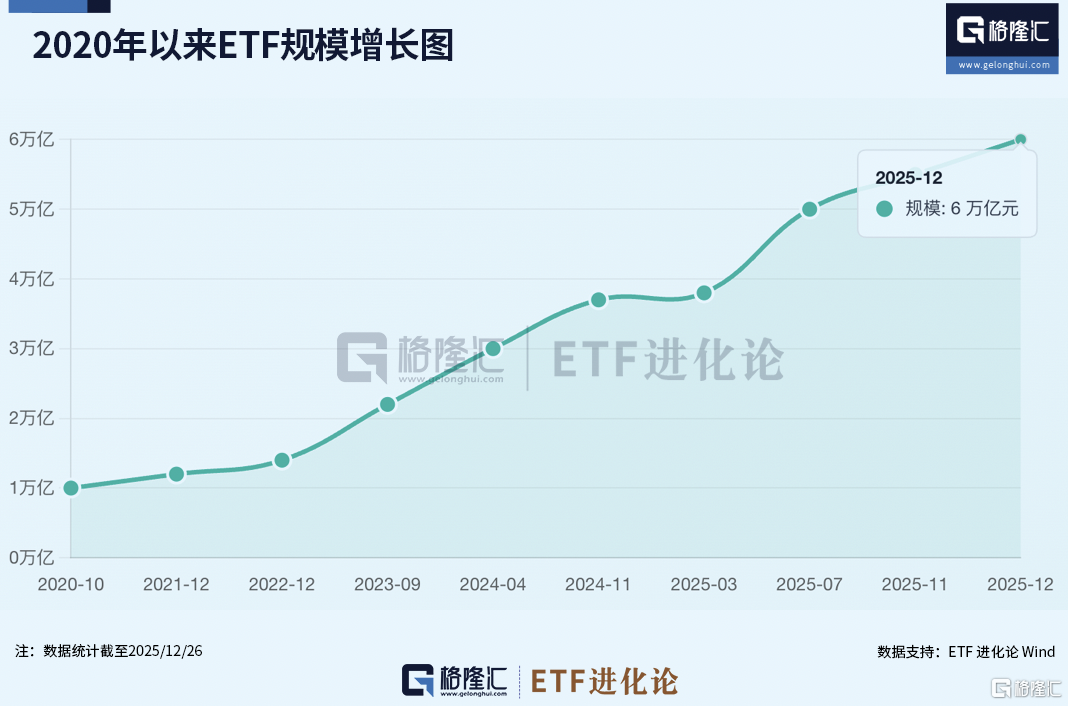
以下文章来源于数据宝 ,作者梁谦刚 数据宝 . 历史数据显示,近年来,中国ETF规模逐年递增。2020年,中国ETF规模首次跨越万亿元台阶,2023年迈过2万亿元台阶,2024年升至3万 亿元以上,2025年内实现了4万亿元、5万亿元、6万亿元的三级跨越。 数据宝——证券时报智能原创新媒体,中国股市大数据新媒体领先品牌,依托证券时报财经数据库和证监会指定信息披露媒体的权威信息,让您用手机也 能从海量数据中获得有用的决策信息支持,数据是个宝,炒股少烦恼! 中国ETF规模再创新纪录。 据证券时报·数据宝统计,截至12月27日,中国ETF规模达到6.03万亿元,历史上首次突破6万亿元大关。最新ETF规模与2024年底相比,增 幅达到61.59%。 转载与合作可联系证券时报小助理,微信ID:SecuritiesTimes END 点击关键字可查看 潜望系列深度报道丨 股事会专栏 丨 投资小红书 丨 e公司调查 丨 时报会客厅 丨 十大明星私募访谈 丨 保壳!300472,获赠不超3.3亿元现金资产+豁免不超 0.5亿元债务 丨 人形机器人与具身智能,突传大消息! 丨 数据产业,重磅利好来了→ 丨 国家统计局,最新公布 ...

史上最快!ETF,6万亿了!
Xin Lang Cai Jing· 2025-12-27 11:30
Core Insights - The domestic ETF market in China has reached a historic milestone, surpassing 6 trillion yuan for the first time, marking a significant transformation in the financial market [1][3] - The growth of the ETF market is driven by a combination of stock ETFs, bond ETFs, and cross-border ETFs, with stock ETFs being the primary contributor to the increase [5][6] Group 1: ETF Market Growth - As of December 26, 2025, the domestic ETF market reached 6.03 trillion yuan, a 62.6% increase from the beginning of the year, with a net increase of 2.29 trillion yuan during the year [1][6] - The ETF market has rapidly crossed significant thresholds, achieving 4 trillion yuan in 204 days, 5 trillion yuan in 131 days, and 6 trillion yuan in just 122 days, setting a record for the fastest growth between trillion yuan milestones [1][3] Group 2: ETF Types and Contributions - Stock ETFs account for 63.8% of the total ETF market, with a scale of approximately 38.47 trillion yuan, contributing over 40% of the total market increase this year [5][6] - Bond ETFs have seen a remarkable growth of 6.31 trillion yuan, representing a 27% contribution to the overall market increase, while cross-border ETFs have doubled in size to 9.39 trillion yuan, contributing 22.48% [6][20] Group 3: ETF Issuance and Innovation - A record 352 new ETFs were established in 2025, with a total fundraising of 263.59 billion yuan, marking a doubling in both the number and scale of new issuances compared to the previous year [8][10] - The ETF market has become a crucial tool for market stability, with significant participation from institutional investors, including insurance and pension funds, which have increased their ETF allocations [11][20] Group 4: Investment Trends - The trend towards index investing has intensified, with over 1.16 trillion yuan flowing into ETFs as investors seek to align with market performance rather than individual stock selection [16][30] - The top ten ETF managers account for 69% of the market's growth, highlighting a "winner-takes-all" effect in the industry, with leading firms like Huatai-PB and E Fund showing significant increases in their ETF management scales [24][26]
沪指放量收出8连阳,关注A500ETF易方达(159361)、沪深300ETF易方达(510310)等产品配置价值
Mei Ri Jing Ji Xin Wen· 2025-12-26 12:28
Market Performance - The Shanghai Composite Index recorded an 8-day consecutive rise with a total market turnover of 2.18 trillion yuan on December 26 [1] - The market maintained a strong performance over the week, with sectors such as Hainan, batteries, commercial aerospace, storage chips, and energy metals leading in gains, while dairy, retail, banking, and pharmaceutical sectors saw declines [1] Index Performance - The CSI 300 Index increased by 1.9%, the CSI A500 Index rose by 2.7%, the ChiNext Index climbed by 3.9%, the STAR Market 50 Index went up by 2.8%, and the Hang Seng China Enterprises Index saw a slight increase of 0.2% [1][3] - The rolling price-to-earnings (P/E) ratios for the indices are as follows: CSI 300 at 14.1 times, CSI A500 at 16.9 times, ChiNext at 41.2 times, STAR Market 50 at 161.2 times, and Hang Seng China Enterprises at 10.4 times [3] Historical Performance - Year-to-date performance shows the CSI 300 Index up by 18.4%, CSI A500 up by 23.0%, ChiNext up by 51.5%, STAR Market 50 up by 36.1%, and Hang Seng China Enterprises up by 22.3% [7] - Over the past year, the CSI 300 Index increased by 17.0%, CSI A500 by 21.1%, ChiNext by 47.1%, STAR Market 50 by 32.1%, and Hang Seng China Enterprises by 22.0% [7] Sector Composition - The CSI A500 Index covers 500 securities with large market capitalization and good liquidity, spanning 89 out of 93 three-level industries [4] - The ChiNext Index consists of 100 stocks with high market capitalization and liquidity, with a significant representation from strategic emerging industries, particularly in power equipment, communications, and electronics, which together account for nearly 60% [4] - The STAR Market 50 Index is composed of 50 stocks from the STAR Market, prominently featuring "hard technology" leaders, with semiconductors making up over 50% and combined with medical devices and photovoltaic equipment, accounting for nearly 75% [4]

全维布局+科技赋能,南方基金以专业实力领航指数投资
Sou Hu Cai Jing· 2025-12-25 10:05
Core Insights - The recent policies and initiatives, including the establishment of a fast-track approval channel for ETFs and the promotion of index investment, have significantly boosted the development of index funds, particularly ETFs, in China [1][3]. Group 1: ETF Growth and Market Impact - As of December 17, 2025, the number of ETF shares increased by 670 billion to 3.33 trillion, representing a growth rate of 25.43%, while the total scale rose by 2.06 trillion to 5.79 trillion, marking a 55.12% increase [1]. - A total of 328 new ETFs were issued, bringing the total number to 1,380 [1]. Group 2: Company Initiatives and Product Offerings - Fund companies, including Southern Fund, are actively participating in the index investment trend, providing low-cost and transparent passive investment options to investors [2]. - Southern Fund has developed a comprehensive product matrix that aligns with national strategies, covering various sectors and themes, including broad-based, industry-specific, and cross-border products [4][5]. Group 3: Technological Integration and Team Expertise - Southern Fund's index team emphasizes tracking accuracy as a core competitive advantage, achieving industry-leading tracking precision for stock ETFs over the past decade [8]. - The team consists of 33 members with diverse academic backgrounds, including 3 PhDs and 29 master's degree holders, enhancing their capability in product development and quantitative research [9]. Group 4: Future Directions and Commitment - Southern Fund aims to continue focusing on customer needs and professional capabilities to contribute to the high-quality development of the capital market [11].

2025年指数投资回忆录:锚点里的价值碎片
Sou Hu Cai Jing· 2025-12-25 01:13
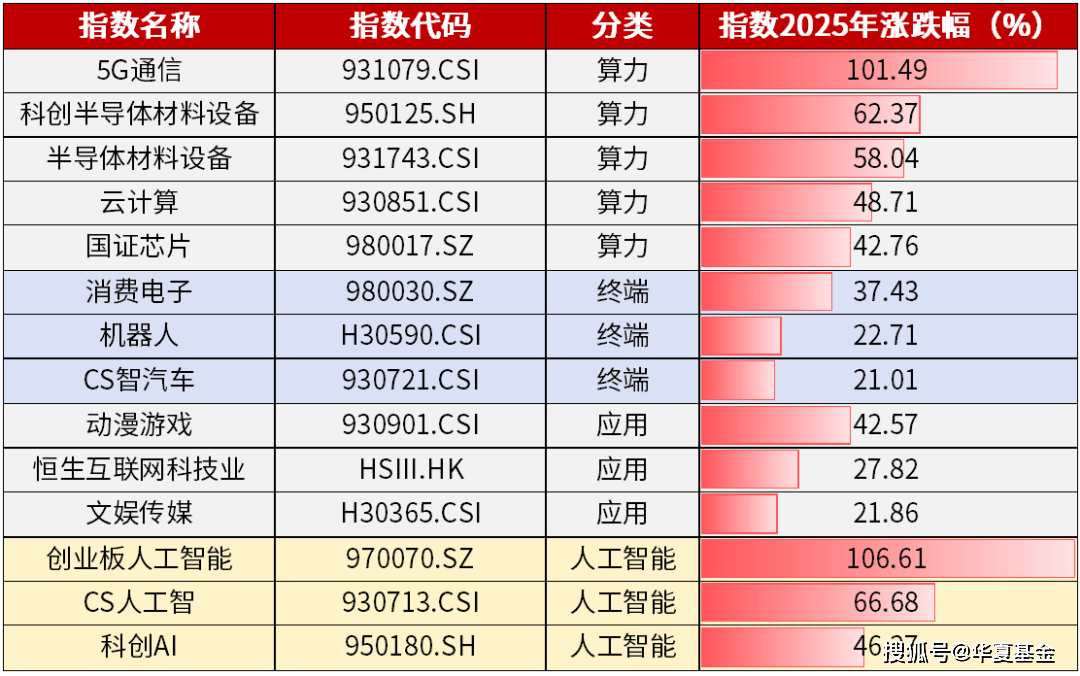
Core Insights - 2025 is recognized as a significant year for assets, with a shift in investment strategies focusing on industry trends, valuation restructuring, and global pricing power [1] - Understanding indices is crucial for grasping market consensus during specific periods, making it an essential skill for investors [1] Group 1: Seasonal Highlights - Spring marked a technological revaluation led by AI breakthroughs, reshaping market narratives around Chinese technology [2] - The AI and technology-related indices saw substantial annual gains, with the 5G communication index increasing by 101.49% and the AI-focused indices also performing strongly [3][6] - The introduction of new products related to the Sci-Tech Innovation Board simplified access to technology investments for the general public [4] Group 2: Mid-Year Developments - Mid-year saw a focus on dividend strategies, with low-volatility dividend indices gaining recognition for their stability and reliability [7] - The market acknowledged the value of dividends that do not rely on macroeconomic acceleration, with various categories of dividend assets being tailored to meet different investor needs [7] Group 3: Autumn Trends - Autumn brought renewed focus on fundamentals as US-China tariff negotiations began, with the AI industry and traditional sectors showing improved profitability [8] - The A-share market experienced significant trading volumes, with daily transactions exceeding 30 trillion, marking a ten-year high [8] Group 4: Year-End Reflections - By year-end, the Shanghai Composite Index briefly surpassed 4000 points, but concerns over AI sector bubbles and fluctuating monetary policy led to increased market volatility [9] - The A500 core index emerged as a balanced investment option, appealing to investors seeking stability amid market fluctuations [9] Group 5: Investment Trends - Industry-specific ETFs became the most attractive investment area, driven by technology and cyclical sectors, particularly in AI, semiconductors, and resource stocks [14] - The Hong Kong stock market attracted investor interest due to its differentiated value propositions, suggesting a strategy of gradual investment in undervalued assets [15] - Gold prices surged over 70% during the year, highlighting the importance of rational asset allocation in gold investments [16] - Broad-based indices like the CSI A500 and CSI 300 delivered solid returns, emphasizing the effectiveness of a balanced investment strategy [17] Group 6: Bond Market Insights - The bond ETF market saw significant growth, reflecting a strong demand for stable, low-risk assets despite the diminishing tax advantages of government bonds [18] Group 7: Future Outlook - The consensus around indices indicates a collective understanding of market dynamics, with ETFs experiencing rapid growth [19] - The narrative around AI technology is expected to continue evolving, with potential applications across various industries anticipated in 2026 [22] - The Hong Kong market presents promising opportunities, particularly in technology, consumer goods, and high-dividend stocks [22] - A diversified and balanced asset allocation strategy is projected to become increasingly important in the face of market uncertainties [23]
【晨星潜力基金系列】:盘点四只值得关注的ETF
Morningstar晨星· 2025-12-25 01:04
Core Insights - The article emphasizes the importance of independent research and long-term investment strategies in fund selection, highlighting four ETFs in the equity asset category that are worth attention for investors [1] Group 1: Market Trends - As of December 31, 2024, the one-year winning rate of active small-cap funds decreased from 49.6% in 2023 to 38.2%, and the three-year winning rate dropped from 58.7% to 37.6%, indicating a weakening ability of active funds to generate excess returns [2] - The market is increasingly favoring passive products, leading to improved pricing efficiency and overall market effectiveness [2] - The China Securities Regulatory Commission's action plan for promoting high-quality development of public funds is expected to further constrain the ability of active funds to create significant excess returns [2] Group 2: Index Overview - The index tracked by the passive funds is categorized as a mid-cap balanced stock fund, consisting of 500 stocks that are excluded from the CSI 300 index, reflecting the overall performance of mid to large-cap stocks [3][15] - The index is designed to balance market capitalization and liquidity, with a semi-annual adjustment mechanism to maintain stability and reduce turnover rates [4][16] Group 3: Fund Highlights - **E Fund CSI 500 ETF**: Established on August 27, 2015, this fund employs a full replication strategy to track the CSI 500 Index, managed by a team with extensive experience in index investment [7][8] - **Huatai-PB CSI 500 ETF**: Launched on May 13, 2015, this fund also follows a full replication method and is managed by a team with a clear division of responsibilities, focusing on daily index tracking and risk management [11][12] - **China Asset CSI 1000 ETF**: Founded on March 18, 2021, this fund utilizes a full replication strategy and has a robust operational framework supported by a stable team with significant experience in index fund management [19][20] - **E Fund CSI 1000 ETF**: Established on July 28, 2022, this fund follows a similar operational model as other E Fund products, focusing on systematic management and risk control [23][24] Group 4: Performance Metrics - As of September 30, 2025, the E Fund CSI 500 ETF had a scale of 2.95 billion, with a fee level in the lowest quartile among similar products [8] - The Huatai-PB CSI 500 ETF had a scale of 980 million as of September 30, 2025, also positioned in the lowest fee quartile [12] - The China Asset CSI 1000 ETF reached a scale of 45.47 billion by September 30, 2025, with a management fee reduced to 0.15%, placing it in the lowest fee quartile [20] - The E Fund CSI 1000 ETF had a scale of 1.56 billion as of September 30, 2025, with similar fee reductions, enhancing its cost competitiveness [24]

放弃预测,专注风控:交易员必读《漫步华尔街》的4个生存法则
Sou Hu Cai Jing· 2025-12-24 11:28
Core Insights - The central thesis of Burton Malkiel's "A Random Walk Down Wall Street" is that short-term price fluctuations are essentially unpredictable, and most efforts to outperform the market ultimately fail [2][4][19] - The book advocates for long-term investment in broadly diversified index funds, which often outperform most active trading strategies [2][4][19] Author's Background - Burton Malkiel combines practical experience as a former investment analyst and chairman of an investment committee with academic rigor as an economist at Princeton University, making his insights particularly credible [3] - His work has introduced generations of investors to the Efficient Market Hypothesis (EMH), which remains a staple in top business schools [3] Book Overview - "A Random Walk Down Wall Street" contrasts two classic theories: the "fundamental theory," which attributes stock value to fundamentals, and the "castle in the air theory," which suggests prices are driven by collective psychology and expectations [4] - The book reviews historical market bubbles, illustrating how speculative behavior recurs over time, and critiques both technical and fundamental analysis for their inherent flaws [4][6] Practical Applications - The book emphasizes that price movements are largely unpredictable, urging traders to focus on risk management rather than attempting to forecast every market fluctuation [8] - Diversification is highlighted as the only "free lunch" in investing, allowing traders to reduce risk without sacrificing returns by avoiding concentration in single assets or sectors [9] - It stresses the importance of being aware of costs, as trading fees and taxes can significantly erode returns over time, even for profitable strategies [10] - Behavioral biases such as overconfidence and herd mentality can lead traders to abandon sound strategies at critical moments, making emotional discipline essential [11] Common Mistakes to Avoid - The book warns against the illusion of market timing, stating that even professionals struggle to consistently time the market accurately [12] - It cautions against chasing popular narratives, as historical patterns show that such trends often end in significant downturns [12] - Risk management is equally important as pursuing returns, as neglecting volatility control can lead to disastrous outcomes [13] Target Audience - The book is not suited for day traders seeking short-term strategies but is ideal for those looking to build long-term wealth without being overwhelmed by daily market noise [17][18] - It provides a systematic investment framework for beginners and challenges experienced traders to evaluate whether their results justify their time and effort [18]

林伟斌的指数投资分享:在风格轮动中,构建高性价比组合
雪球· 2025-12-24 08:57
Group 1 - The core viewpoint of the article emphasizes the growing importance of index investment and the need for investors to establish a robust allocation framework amidst style rotation [1] - The development of index investment in China has significantly progressed, with ETFs becoming mainstream investment tools, surpassing active funds in holdings as of Q3 2024 [4][5] - The total scale of ETFs in China reached approximately 5 trillion yuan, with stock ETFs accounting for around 4 trillion yuan, representing about 3% of the total A-share market capitalization [4] Group 2 - The article discusses the increasing market differentiation, highlighting the performance of the ChiNext index compared to traditional large-cap indices, suggesting that investors should consider using style factor indices to enhance returns [6][8] - Style factor indices, which blend active and passive investment strategies, can provide higher excess returns by breaking the limitations of traditional market-cap-weighted indices [7][8] - The analysis of over 1,000 ETFs indicates that style factor indices exhibit superior mean and variance performance, suggesting better risk-adjusted returns [7] Group 3 - The article outlines a simple and practical configuration logic for utilizing style factors, emphasizing the importance of optimizing stock selection logic and avoiding pitfalls like value traps [9][10] - A recommended strategy for multi-factor combinations is the "constant proportion rebalancing" approach, which can potentially outperform the CSI 300 index through systematic adjustments [10] - The complexity behind index investment is acknowledged, with a focus on the intricate stock selection logic and asset allocation strategies that can lead to excess returns [10] Group 4 - Looking ahead, the article posits that China's capital market has entered a phase of high-quality development in index investment, driven by the maturation of market participants and the application of AI technology [11] - Continuous policy support is expected to enhance market vitality and attract more investors to index investment, particularly in the ETF market [11] - The article aims to encourage a deeper understanding of style factor indices among investors, promoting the construction of resilient investment portfolios in the evolving ETF era [12]

新手投资指数基金,适合从哪些品种入门?|第424期直播回放
银行螺丝钉· 2025-12-23 14:04
Core Viewpoint - The article discusses the suitability of index funds for novice investors, emphasizing the importance of diversified allocation and rebalancing strategies in index investing [1][4][37]. Group 1: Suitable Indexes for Beginners - For most households, investing in index funds is more appropriate than picking individual stocks due to the time and risk involved in stock selection [4][5]. - Commonly recommended index types for beginners include broad-based indexes like the CSI 300 and the CSI 500, which cover large and mid-cap stocks in the A-share market [23][24]. - The article highlights that the first batch of pension index funds corresponds to 85 index funds covering 16 mainstream indexes as of the end of 2024 [11]. Group 2: Characteristics of Indexes - The public fund performance benchmark library includes two categories: Category One and Category Two, with 69 and 72 indexes respectively, focusing on market representation and innovation [6][7]. - The article lists various indexes, including the CSI 300, CSI 500, and others, which are suitable for investment and have been included in pension accounts [8][12]. Group 3: Pension Accounts and Investment Strategies - The personal pension account allows individuals to deposit up to 12,000 yuan annually, with tax deductions available during contributions and a low tax rate of 3% upon withdrawal [9]. - The article outlines the characteristics of stock-bond constant proportion indexes, which maintain a fixed asset allocation and undergo regular rebalancing [13][15]. Group 4: Impact of Risk Factor Adjustments - In December, the risk factors for insurance companies investing in the CSI 300 and other indexes were lowered, allowing for more capital to be allocated to these assets [17][20]. - The adjustment from a risk factor of 0.3 to 0.27 for the CSI 300 means that an insurance company holding 10 billion yuan in stocks would see its required risk capital decrease from 3 billion to 2.7 billion yuan [19][20]. Group 5: Investment Styles and Strategies - The article categorizes investment strategies into six main types: leader strategy, dividend strategy, value strategy, low volatility strategy, growth strategy, and quality strategy [26]. - It notes that the A-share market exhibits characteristics of style rotation between growth and value, with both styles showing similar long-term returns despite short-term fluctuations [30][33].