
新兴市场投资

Search documents
独家!万亿巨头重磅发声,事关中国市场!
Zhong Guo Ji Jin Bao· 2025-08-22 06:27
Group 1: Investment Opportunities in China - Global investors are reassessing opportunities in China, moving beyond the pressures in the real estate sector to recognize broader potential [1][4] - Franklin Templeton's CEO highlights that many Chinese companies possess global competitiveness, and the firm believes emerging markets have reached a turning point [1][12] - The firm has a long history of investing in China, establishing research offices and partnerships with local firms to enhance its presence in the market [2] Group 2: Economic Insights and Market Dynamics - The impact of tariffs on U.S. inflation is expected to be moderate, with a 15% effective tariff rate potentially raising inflation by only about 1.5% [3] - Investors are increasingly focused on consumer sentiment and geopolitical risks, with a shift in growth drivers from investment to consumption in China [5][6] - The macroeconomic cycle in China is seen as an opportunity for investment, with a long-term structural transformation underway [4] Group 3: Regional Wealth Growth and Investment Strategies - The wealth growth in the Asia-Pacific region, particularly in China and India, presents significant opportunities for asset management firms [7] - Institutional investors are adopting a total portfolio approach, emphasizing diversification and climate risk in their investment strategies [8] - There is a growing interest in alternative investments, including private equity and real estate, as investors seek to navigate market volatility [8] Group 4: Emerging Markets and Global Investment Trends - Emerging markets are viewed as having reached a pivotal moment, with increased attractiveness for global investors seeking resilient portfolios [12][14] - The weakening of the U.S. dollar is expected to benefit several emerging markets, including China, by enhancing commodity prices and export growth [11] - Investors are encouraged to look beyond U.S. assets, with some reallocating to European markets due to valuation concerns and geopolitical factors [10]
野村:印度股市持续“失宠” 新兴市场投资者加仓AH股
Hua Er Jie Jian Wen· 2025-08-21 06:03
Group 1 - The investment landscape in emerging markets is shifting significantly, with Indian equities losing favor among fund managers, while capital is flowing towards more attractively valued Chinese mainland and Hong Kong stocks [1] - As of the end of July, India has become the largest underweight market for emerging market investors, with the underweight percentage rising from 60% to 71% [1] - In a sample of 45 funds analyzed by Nomura, 41 funds reduced their allocation to India on a monthly basis, while allocations to East Asian markets, including Hong Kong and mainland China, increased [1] Group 2 - The sharp change in market sentiment is closely linked to escalating trade tensions between the US and India, particularly following the imposition of a 25% additional tariff on Indian goods by the US [2] - In July, foreign investors withdrew approximately $3 billion from the Indian stock market, marking the largest monthly outflow since February [2] - Analysts have noted that the US tariffs negatively impact India's growth outlook as an export-driven economy, significantly affecting investor sentiment [2] Group 3 - Wall Street institutions are responding to the new market environment by reducing their allocations to Indian equities, with 30% of surveyed fund managers indicating they are underweight on India [3] - Goldman Sachs maintains a neutral rating on Indian stocks while reiterating an overweight stance on Chinese equities, driven by valuation differences [3] - The MSCI India index has a price-to-earnings ratio exceeding 21 times, compared to just 11.9 times for the MSCI China index, highlighting the valuation gap [3]
海外市场周观察(20250728~20250803)
Shanxi Securities· 2025-08-06 09:18
Economic Indicators - The July non-farm payrolls increased by 73,000, which was below the expected 108,000, indicating a cooling labor market[5] - The unemployment rate rose to 4.2%, while the labor participation rate decreased to 62.2%[5] - Initial jobless claims for the week ending July 26 were 218,000, showing a slight increase but maintaining a downward trend in the two-month moving average[5] Market Performance - Major U.S. stock indices experienced significant declines, with the Dow Jones falling by 2.92%, S&P 500 by 2.36%, and Nasdaq by 2.17% following the non-farm data release[6] - The U.S. dollar index rebounded above 100 but fell back to 98.69 after the non-farm data, resulting in a weekly increase of 1.04%[6] - Gold prices saw a slight increase of 0.79%, while Brent crude oil rose by 2.84% during the same period[6] Federal Reserve Outlook - The FOMC's July meeting indicated a hawkish stance, with no guidance on potential rate cuts in September, leading to mixed market expectations[4] - As of August 4, market expectations for rate cuts in September, October, and December were each set at 25 basis points, reflecting a shift in sentiment following the labor market data[4] Investment Strategy - The report suggests that the Federal Reserve is likely to resume rate cuts, recommending investment in gold and emerging markets during a weak dollar cycle[7] - The report highlights the importance of monitoring overseas liquidity and geopolitical risks as potential threats to market stability[7]
NATCO Pharma (NATCOPHARM) Earnings Call Presentation
2025-07-23 11:30
Transaction Overview - NATCO Pharma proposes to acquire a 35.75% shareholding in Adcock Ingram, a South African pharmaceutical company[3] - The price per share is ZAR 75, equating to US$4.271[3] - The total cost to NATCO is estimated at ZAR 4 Billion, approximately US$226 Million[3] - Transaction costs are projected to be around ₹ 2,000 Cr, roughly US$10 Million[3] Adcock Ingram Financials - Adcock Ingram's revenue was US$484 million in FY22, US$507 million in FY23, and US$536 million in FY24[3,22] - H1 FY25 revenue reached US$262 million[3,22] - EBITDA margins have been consistent, at 15% in FY22, 16% in FY23, and 15% in FY24, with 14% in H1 FY25[22] - Net profit margins were 9% in FY22, 10% in FY23, and 8% in FY24, with 8% in H1 FY25[22] Strategic Rationale - South Africa is a key emerging market and a gateway to the African continent, offering a strong regulatory environment[26] - Adcock Ingram is the second-largest pharmaceutical company in South Africa, with a presence across prescription, OTC, consumer, and hospital segments[5,26] Potential Synergies - NATCO aims to leverage Adcock Ingram's distribution network for its products in South Africa[29] - The partnership seeks to introduce affordable and innovative pharmaceutical products across African markets[29]
摩根士丹利:亚洲&新兴市场股市过山车迎来又一个高峰?随着改革推进,韩国综合股价指数(KOSPI)目标更新;中国 “反内卷” 行动 + 中印最新宏观 政策趋势
摩根· 2025-07-19 14:02
Investment Rating - The report maintains an optimistic outlook on the South Korean stock market despite potential foreign investor sell-off pressure and tariff risks, suggesting a cautious approach for investors in emerging markets [1][4]. Core Insights - The South Korean stock market has shown strong performance this year, with the MSCI Korea Index up nearly 40% in USD terms, and a projected price-to-earnings ratio of around 10 to 10.5 times, slightly above historical averages [4]. - The report emphasizes the importance of ongoing government reforms in South Korea, including real estate market cooling measures and capital market reforms, which are expected to benefit the stock market in the long term [5]. - The Indian stock market is highlighted as a key area of interest, particularly in the financial sector, with a recommendation for investors to focus on value stocks and high-yield equities [2][6]. Summary by Sections South Korean Market Performance - The South Korean stock market has rebounded with a 15% increase compared to last year's decline of 25%, supported by strong buying from pension funds and corporate buybacks [4]. - The report notes that the market's resilience is bolstered by ongoing reforms, although foreign investor activity may introduce volatility [4][24]. Government Reforms and Policies - The South Korean government is actively pursuing reforms aimed at cooling the real estate market and enhancing capital market regulations, which are expected to be resolved in the near term [5]. - Proposed reforms include updates to the Commercial Code and potential changes to dividend tax policies, which could further stimulate market growth [5]. Sector Focus - The report identifies financial stocks and high-yield equities as sectors with significant upside potential, particularly those offering dividend yields between 25% and 35% [6][7]. - The banking and financial sector has been upgraded to overweight due to anticipated benefits from ongoing reforms and pricing power [7]. Trade Relations and Tariff Issues - Ongoing trade negotiations between South Korea and the United States are critical, with potential tariff increases posing risks to the market if agreements are not reached [8][9]. - The report indicates that the U.S. has specific demands from South Korea, including the opening of agricultural markets and easing of data regulations, which could impact trade dynamics [12][13]. Economic Indicators and Inflation - Recent inflation data from India shows a CPI of 2.1%, prompting discussions on potential interest rate cuts by the Reserve Bank of India [17]. - The report also highlights the challenges facing China's economy, including demand weakness and export declines, which may affect broader market sentiment in emerging markets [20][21].
资管巨头GMO再喊话:新兴市场债券“世代难遇”的机会还没走完
Hua Er Jie Jian Wen· 2025-07-15 06:44
Group 1 - The attractiveness of emerging market assets is increasing as global investment managers seek alternatives due to uncertainty in U.S. policies [1] - GMO's portfolio manager Victoria Courmes emphasizes that emerging market bonds present a "once-in-a-generation" investment opportunity, driven by the trade and economic policies of the Trump administration [2] - Since GMO first highlighted this opportunity in January 2024, the index tracking emerging market bond returns has risen over 10%, outperforming investment-grade bonds which increased by about 5% during the same period [2] Group 2 - Courmes believes that the Trump administration's policies are key catalysts for the potential depreciation of the U.S. dollar, which would enhance the relative value of emerging market local currencies [2] - Currently, interest rates in emerging markets have returned to average levels seen between 2004 and 2011, offering total return potential that exceeds spot currency appreciation [2] - The opportunity to acquire a combination of cheap currency and high interest rates is rare and typically does not last long [3] Group 3 - Goldman Sachs also shares a positive outlook on emerging market bonds, indicating that their prospects will become more constructive in the second half of the year [3] - Analyst Tadas Gedminas from Goldman Sachs suggests that as the Federal Reserve approaches interest rate cuts and considering the expectation of further declines in oil prices, the outlook for local rates in emerging markets will become more optimistic in the latter half of the year [4]
加仓100%!全球巨头出手
天天基金网· 2025-07-11 05:06
Core Viewpoint - There is a significant trend of foreign capital inflow into Chinese companies, as evidenced by multiple global emerging market funds increasing their positions in Chinese stocks, particularly in the pharmaceutical sector [1][3]. Fund Activity - Invesco Developing Markets Fund increased its holdings in Hengrui Medicine by 100%, with a total market value of HKD 1.86 million after the increase [3]. - JPM China A-Share Opportunities Fund raised its stake in Hengrui Medicine by 18.49% [6]. - Allianz China A Shares Fund also increased its position in Hengrui Medicine by 8.47% [8]. Market Insights - The fund manager of Invesco, Justin Leverenz, expressed optimism about the Chinese pharmaceutical industry, noting that China has transitioned from a follower to a leader in drug development over the past five years [4]. - The Chinese biotechnology sector is still in its early stages, with significant potential for growth as companies have yet to fully engage in value-creating activities such as late-stage global clinical development and commercialization [4]. Performance Metrics - As of the end of May, the Invesco fund had a total size of approximately USD 14.1 billion (CNY 1012.41 billion) [3]. - The Allianz fund had a total size of USD 2.3 billion [8]. - The JPM fund had a total size of USD 2.8 billion [7]. Foreign Investment Sentiment - Temasek, Singapore's state investment firm, reported a net asset value of USD 340 billion, reflecting an 11.6% year-on-year growth, and continues to view China positively for long-term prospects [13].







加仓100%!全球巨头出手
Zhong Guo Ji Jin Bao· 2025-07-11 01:37
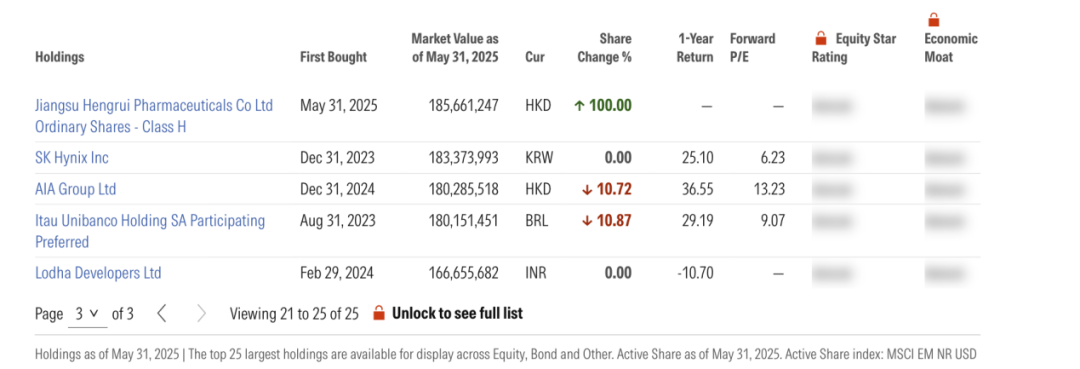
Group 1 - Invesco Developing Markets Fund increased its holdings in Jiangsu Hengrui Pharmaceuticals by 100% in May, with a total market value of HKD 185,661,247 [2][3] - The fund's total size is approximately USD 14.1 billion, equivalent to about CNY 101.24 billion [2] - The fund's top five holdings include TSMC, Tencent, Huazhu Group, Kotak Mahindra Bank, and Meituan, with reductions in Tencent and Meituan by 5.31% and 24.77% respectively [3] Group 2 - Justin Leverenz, the fund manager, expressed optimism about the Chinese pharmaceutical industry, noting China's transition to a leader in drug development [4] - China has established a significant position in the global clinical and commercial landscape for blood cancer treatment, with its share of biotech licensing transactions increasing from 4% in 2019-2020 to 12% in 2023-2024 [4] Group 3 - JPMorgan Asset Management increased its stake in Jiangsu Hengrui Pharmaceuticals by 18.49% in May [5] - Allianz Investment also raised its holdings in Jiangsu Hengrui Pharmaceuticals by 8.47% [7] Group 4 - Fidelity China Focus Fund and FSSA China Growth Fund have also shown interest in various Chinese companies, with Fidelity increasing its stake in Alibaba by 12.46% and in Trip.com by 9.41% [9][10] - Temasek Holdings reported a net asset value of USD 340 billion, with a focus on long-term prospects in China, which represents 18% of its portfolio [11]
景顺投资赵耀庭:美元贬值周期或开启 资产配置迎拐点
Shang Hai Zheng Quan Bao· 2025-07-06 14:57
Group 1: Global Financial Market Trends - The global financial market is undergoing significant changes, with the potential for a new depreciation cycle of the US dollar, which may decline by 5% in the second half of the year, impacting global asset allocation [1] - A weaker dollar typically opens up opportunities for non-dollar assets, particularly benefiting emerging markets by improving financing conditions and enhancing returns on local currency-denominated assets [1] - The current high valuation of the US stock market, with the S&P 500 index trading at a price-to-earnings ratio close to 22, contrasts with the historical average, highlighting the relative valuation advantage of non-US markets [1] Group 2: Emerging Market Dynamics - For emerging markets, particularly Asian stocks, to outperform developed markets, four key factors must align: moderate US economic growth, a depreciating dollar, stable oil prices below $80 per barrel, and accommodative monetary policies from emerging market central banks [2] - Increased interest from European investors in Asian markets and vice versa indicates a positive trend in capital flows between Europe and Asia, suggesting a shift towards seeking opportunities outside the US market [2] Group 3: Technology Sector Insights - Chinese technology companies are demonstrating strong innovation capabilities, as evidenced by the launch of the DeepSeek-R1 model, which is narrowing the valuation gap between US and Chinese tech stocks [3] - Despite the strong performance of US tech stocks, there are signs of cooling enthusiasm and concerns over high valuations, while Chinese tech companies are viewed as having higher investment value due to their growth potential [3] - Investment opportunities in Chinese companies are also seen in quantum computing, biotechnology, and high-end equipment manufacturing, supported by favorable policies and a complete industrial chain from R&D to commercialization [4]
墨西哥债券劲涨22%,机构称“交易远未结束”
news flash· 2025-07-02 18:16
Core Viewpoint - Mexican local bonds, specifically Mbonos, have delivered a remarkable 22% return for investors in 2025, making them one of the top performers in emerging market local debt indices, second only to Brazilian government bonds [1] Group 1: Investment Performance - Mbonos bonds issued by the Mexican government for public spending financing have achieved a 22% return for investors in 2025 [1] - The performance of these bonds is attributed to the attractive yield and the resilience of the Mexican peso amid the Trump tariff war [1] Group 2: Market Sentiment - Institutional investors such as Aberdeen Group, Neuberger Berman, and Pictet Asset Management believe there is still room for further gains in Mexican bonds due to their appealing yields [1] - Expectations of the Federal Reserve easing monetary policy in the coming months contribute to the positive outlook for these bonds [1] Group 3: Expert Opinions - Gorky Urquieta, co-head of emerging market debt at Neuberger, emphasizes the rationale for maintaining positions in Mexican bonds based on fundamentals, technicals, and interest rate valuations [1]