
红利指数

Search documents
红利指数自带低买高卖,还需要低估投资么?|投资小知识
银行螺丝钉· 2025-08-18 14:01
Core Viewpoint - The article emphasizes the importance of strategic asset allocation for high-net-worth families, highlighting the need for a diversified investment approach to optimize returns and manage risks effectively [1]. Group 1: Industry Insights - The current market environment presents both challenges and opportunities for investors, particularly in sectors such as technology and healthcare, which are expected to drive growth in the coming years [1]. - Interest rates and inflation trends are critical factors influencing investment decisions, with a projected increase in interest rates impacting borrowing costs and investment strategies [1]. Group 2: Company Analysis - Companies that adapt to changing market conditions and consumer preferences are likely to outperform their peers, particularly those investing in innovation and sustainability [1]. - Financial performance metrics, such as revenue growth and profit margins, are essential indicators for assessing company health and potential investment opportunities [1].


[8月8日]指数估值数据(红利近期上涨原因;A股融资额接近前高,风险如何;港股估值表更新;抽奖福利)
银行螺丝钉· 2025-08-08 14:05
Core Viewpoint - The article discusses the recent performance of the A-share and Hong Kong stock markets, highlighting the impact of tax changes on bond yields and the flow of funds into fixed-income assets, particularly those with value styles. Group 1: Market Performance - The overall market experienced a slight decline, with the closing rating at 4.6 stars [1] - Large, mid, and small-cap stocks showed minor declines, indicating low volatility [2] - Dividend and value-style indices in the A-share and Hong Kong markets saw significant increases this week [3] Group 2: Tax Changes and Bond Yields - Starting today, interest on new bonds will be subject to value-added tax, which reduces future yields on pure bonds [4] - This tax change has led to increased capital inflow into fixed-income plus assets [5] - The stock portion of fixed-income plus assets has a value style, contributing to a substantial rise in value style indices this week [6] Group 3: Investment Trends - The reduction in interest income from RMB bonds is expected to benefit Hong Kong dividend stocks [8] - Domestic insurance institutions are utilizing the Hong Kong Stock Connect to invest in dividend stocks, benefiting from lower tax rates compared to individual investors [9] - The recent performance of Hong Kong pharmaceutical stocks has been volatile, with a significant increase of 50-60% compared to A-share counterparts this year [11][14] Group 4: Financing and Market Indicators - The financing balance in A-shares reached 2 trillion yuan, a level not seen since the 2015 bull market [21] - This increase in financing indicates a trend of investors borrowing to invest, which can be a sign of market sentiment [21][29] - The current financing balance represents about 2% of the total A-share market capitalization, which is less than half of the ratio in 2015, suggesting that leverage is not excessively high at this time [28] Group 5: Valuation Insights - The article provides a valuation table for various indices, including dividend indices and value indices, which can be useful for investors [19][36] - The valuation metrics indicate that while some indices are approaching normal high valuations, others remain significantly undervalued [15][17]

[8月7日]指数估值数据(红利指数自带低买高卖,还要低估投资么;自由现金流指数估值更新;指数日报更新)
银行螺丝钉· 2025-08-07 13:54
Core Viewpoint - The article discusses the performance of various stock indices, particularly focusing on dividend indices and their investment strategies, highlighting the importance of valuation and market conditions in investment decisions. Group 1: Market Performance - The overall market opened lower but rebounded slightly by the close, with the CSI All Share Index showing a minor decline, maintaining a rating of 4.6 stars [1] - Large-cap stocks experienced slight gains, while small-cap stocks saw minor declines [2] - Dividend and value styles showed slight increases, whereas growth styles like the ChiNext Index experienced minor declines [3][4] Group 2: Dividend Indices - The article emphasizes that dividend indices are strategy-based indices that select stocks according to specific criteria [11] - Historical examples illustrate how certain sectors, like banking and real estate, have been included in dividend indices based on their high dividend yields during specific market conditions [13][16] - The mechanism of indices allows for a natural turnover, removing stocks that no longer meet the criteria, as seen in past market cycles [21][23] Group 3: Investment Strategies - Investors are encouraged to consider undervalued investments in dividend indices, as these tend to have lower volatility compared to the overall market, approximately 70% of the market's volatility [25] - Investing during undervalued periods can enhance future cash flow returns and reduce downside risk, making dividend indices suitable for such strategies [30][32] - The article provides a valuation table for various dividend indices, including metrics like earnings yield, P/E ratio, and dividend yield, to assist investors in making informed decisions [34] Group 4: Fund Performance - A summary of various funds tracking dividend indices is provided, detailing their performance metrics such as average annual dividends and tracking indices [36] - The article mentions the availability of updated valuation data for dividend indices through a mini-program, allowing investors to access real-time information [37] Group 5: Upcoming Events - A live session is scheduled to discuss the characteristics of the Free Cash Flow Index and its relationship with dividend and value indices, indicating ongoing educational efforts for investors [38]

A50,突发!
券商中国· 2025-08-04 04:34
Core Viewpoint - The recent market adjustments were primarily driven by expectations of secondary tariffs due to U.S. sanctions on Russia, alongside a strong performance in major A-share stocks, particularly in the banking and resource sectors [1][5]. Market Performance - On August 4, the A50 index experienced a sharp rise, with significant contributions from major banks such as Agricultural Bank of China, which rose over 2%, and other banks like Shanghai Pudong Development Bank and Qingdao Bank also showing gains [1][3]. - The performance of the bond market was notably strong, influenced by a new tax policy on bond interest income announced by the Ministry of Finance and the State Taxation Administration, which led to a wave of buying in existing bonds [1][5]. Economic Factors - The market's previous adjustments were linked to ongoing tariff issues and the U.S. sanctions on Russia, which have created uncertainty in trade relations [4][5]. - The U.S. dollar index saw fluctuations, with a significant drop following disappointing U.S. employment data, which positively impacted cyclical assets [4][5]. Future Market Outlook - Analysts predict that the market may experience a period of volatility in early August due to earnings disclosures, with potential adjustments in stocks that have seen significant gains [7][8]. - There is an expectation that the market will transition from a phase of profit-taking to a focus on growth potential, with the possibility of new highs later in August as earnings reports confirm improvements in free cash flow for listed companies [8].

上涨了,该如何止盈?|第397期直播回放
银行螺丝钉· 2025-07-25 13:58
Core Viewpoint - The article discusses various strategies for profit-taking in index funds, highlighting their advantages and disadvantages, and emphasizes the importance of market valuation in making investment decisions [1][3][20]. Summary by Sections Profit-Taking Strategies - Three main profit-taking strategies for individual index funds are outlined: 1. Profit-taking based on return rate 2. Profit-taking based on overvaluation 3. Long-term holding without selling, relying on dividends for profit [3][4][30]. Strategy 1: Profit-Taking Based on Return Rate - This strategy suggests considering profit-taking when the return reaches a predetermined level, typically around 30% [4][5]. - The advantage is its simplicity, while the downside is the potential to miss out on gains during bull markets [7][8]. Strategy 2: Profit-Taking Based on Overvaluation - Investors can use valuation metrics to determine when to sell, with a reference to a star rating and valuation table updated regularly [11][14]. - The valuation table indicates: - Green for undervalued (suitable for investment) - Yellow for normal valuation (hold) - Red for overvalued (consider selling) [12][18]. Strategy 3: Long-Term Holding - This strategy emphasizes the benefits of holding investments for the long term, particularly for high-dividend stocks [30][34]. - It is considered low-maintenance but requires careful selection of high-dividend stocks [35]. Market Valuation Insights - The article provides historical context on market valuations, noting significant changes from 5-star ratings in 2018 to 3-star ratings in 2021, indicating effective investment strategies during these periods [20][23]. Monthly Cash Flow Investment Strategy - The "Monthly Salary" investment strategy allows for flexible cash flow options, with a projected annual payout of approximately 6% of total assets [50][56]. - The strategy has shown stability even during market downturns, with a maximum drawdown of only 9.13% since inception [56]. Automated Portfolio Management - The article discusses automated features in investment portfolios that help manage profit-taking and rebalancing without requiring manual intervention [60][64]. - This includes automatic adjustments between equity and bond allocations based on market conditions [68][80].

红利指数,什么情况会比较低迷?|投资小知识
银行螺丝钉· 2025-07-21 13:58
Core Viewpoint - The article emphasizes the importance of strategic asset allocation for families to optimize their wealth management and investment returns [1] Group 1: Industry Insights - The current market environment presents both challenges and opportunities for investors, particularly in the context of rising interest rates and inflation [1] - Diversification across various asset classes is highlighted as a key strategy to mitigate risks and enhance returns [1] Group 2: Company Analysis - Companies that adapt to changing market conditions and consumer preferences are more likely to succeed in the long term [1] - The article discusses specific sectors that are expected to perform well, including technology and renewable energy, due to increasing demand and innovation [1]

E目了然 | 低利率环境下,配置红利低波资产或恰逢其时!
Sou Hu Cai Jing· 2025-07-21 05:37
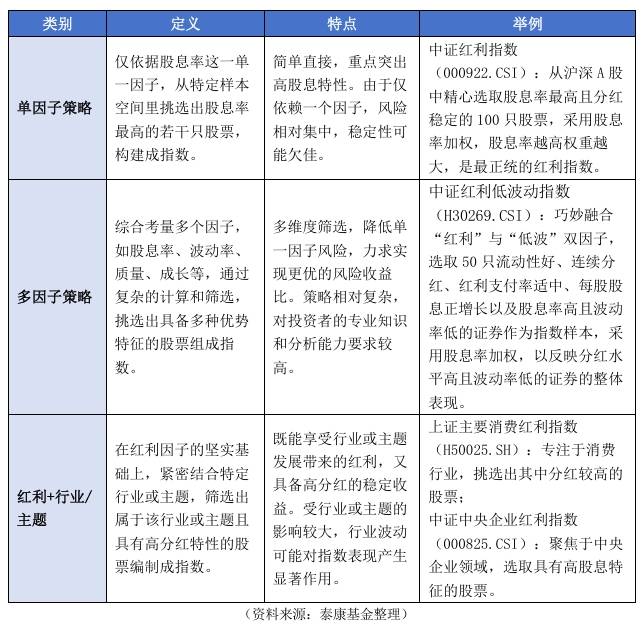
Group 1: Core Insights - The article highlights the increasing demand for stable returns in the context of low deposit rates, making high dividend yield indices, particularly the China Securities Dividend Low Volatility Index, a focal point for investors [1][11] - As of July 10, 2025, the China Securities Dividend Low Volatility Index reached a new high of 11,946.95 points, indicating strong performance in the current year [1] Group 2: Types of Dividend Indices - Dividend indices can be categorized into three main types: single-factor strategies, multi-factor strategies, and dividend + industry/theme strategies [2] - The single-factor strategy focuses solely on dividend yield, while the multi-factor strategy considers multiple factors such as dividend yield, volatility, quality, and growth [2] - The dividend + industry/theme strategy combines high dividend characteristics with specific industry or thematic focuses [2] Group 3: Advantages of the Dividend Low Volatility Index - The China Securities Dividend Low Volatility Index demonstrates strong risk resilience, with a maximum drawdown of -16.92% over the past five years, significantly lower than traditional dividend indices [3][4] - The index has a Sharpe ratio of 0.77 over the same period, indicating a superior risk-adjusted return compared to traditional dividend indices [5][6] - Since its inception, the index has achieved a cumulative return of 327.86%, outperforming traditional dividend indices and major broad market indices [6] - As of July 10, 2025, the index's 12-month dividend yield stands at 5.00%, well above the 10-year government bond yield of 1.66%, showcasing its attractive dividend characteristics [10] Group 4: Current Market Context - The current low deposit rate environment makes the high dividend yield of the Dividend Low Volatility Index particularly appealing to investors seeking asset appreciation [11] - Recent capital market reforms are expected to enhance dividend payouts from listed companies, further increasing the attractiveness of the Dividend Low Volatility Index [12] - Long-term capital, such as insurance funds, is increasingly favoring high dividend assets, creating a favorable environment for the Dividend Low Volatility Index [13] Group 5: Investment Opportunities - The Dividend Low Volatility ETF, such as the Taikang Dividend Low Volatility ETF (code: 560150), offers investors a convenient way to access high-quality dividend low volatility assets, with quarterly dividends enhancing cash returns [14]
[7月18日]指数估值数据(市场继续上涨;港股科技、医药估值如何;抽奖福利)
银行螺丝钉· 2025-07-18 14:00
Core Viewpoint - The article discusses the recent strong performance of both A-shares and Hong Kong stocks, highlighting the recovery of the Hong Kong market after a period of decline, driven by various factors including policy support and earnings recovery in key sectors [1][10][18]. Group 1: Market Performance - Both A-shares and Hong Kong stocks have shown strong upward trends, with Hong Kong stocks outperforming A-shares [1][6]. - Large-cap stocks have seen slightly more significant increases compared to small-cap stocks, with both value and growth styles experiencing gains [3][4]. - Key sectors such as consumer and technology have demonstrated robust performance [5][6]. Group 2: Historical Context - The Hong Kong market faced significant declines in 2021-2022, being one of the worst-performing markets globally, with the Hang Seng Index dropping from 33,484 points to a low of 14,597 points, a decline of 56% [13][16][17]. - Contributing factors included aggressive interest rate hikes by the Federal Reserve, fears surrounding Chinese companies listed in the U.S., and a general downturn in corporate earnings [14][15]. Group 3: Recovery Factors - The recovery of the Hong Kong market is attributed to several factors, including the Federal Reserve entering a rate-cutting cycle, which benefits RMB-denominated assets [18]. - Economic stimulus policies introduced in the past year have provided stronger support compared to previous years [19]. - The market is primarily driven by institutional investors who require visible signs of earnings growth before stock prices rise, which has been observed in sectors like technology and pharmaceuticals [20][21]. Group 4: Valuation and Investment Opportunities - Following the recent uptrend, some sectors are returning to normal valuation levels, particularly in technology and pharmaceuticals [23][24]. - The article emphasizes the importance of identifying undervalued opportunities in the market, especially in the context of potential volatility [31]. - A valuation table for various Hong Kong indices is provided, indicating current price-to-earnings ratios and other metrics for reference [32].

现金分红还是再投资?解锁红利指数投资的不同策略
Sou Hu Cai Jing· 2025-07-10 12:26
Group 1: Core Insights - The article discusses the increasing popularity of dividend indices among investors, highlighting their ability to provide regular cash flow and act as a compounding engine for wealth growth [2][9]. - Different investors adopt various strategies for dividend ETFs, such as using dividends for loan repayments, reinvesting for long-term growth, or investing in high-growth sectors [2][13][14]. Group 2: Dividend Indices and Selection Criteria - Dividend indices focus on companies with high dividend yields and consistent dividend payments, typically requiring at least three years of continuous dividends [4][5]. - The China Securities Dividend Index selects stocks based on criteria like past dividend payments and payout ratios, resulting in a sample pool of 1,816 stocks, from which the top 100 by average cash dividend yield are chosen [4][9]. Group 3: Performance and Adjustments - The China Securities Dividend Index had a dividend yield of 4.7% in early 2019, which increased to 5.7% by June 2025, despite a cumulative index increase of 41.2% [9]. - The index undergoes annual adjustments based on dividend yield, ensuring that stocks with lower yields are replaced by those with higher yields, maintaining a stable dividend income for investors [9]. Group 4: Investment Strategies - Investors focused on regular cash flow can benefit from holding multiple dividend ETFs with different payout schedules, allowing for monthly dividend income [10][15]. - Long-term investors can reinvest dividends from annual evaluation ETFs to maximize compounding effects, enhancing future returns [13]. - Investors seeking to invest dividends in high-growth sectors can allocate funds to emerging trend ETFs, balancing risk and potential returns [14]. - Those interested in combining dividend income with lower volatility can opt for "dividend+" series ETFs, which include factors like low volatility and valuation metrics [15].

股指日报:股指延续收涨,期指均贴水加深-20250701
Nan Hua Qi Huo· 2025-07-01 11:18
Group 1: Report Overview - Report Date: July 1, 2025 [1] - Authors: Wang Mengying (Z0015429), Liao Chenyue (F03120676) [1] - Investment Advisory Business Qualification: CSRC License [2011] No. 1290 [1] - Report Title: Stock Index Daily Report [1] Group 2: Market Review - Stock Index Performance: The stock index continued to rise, with the CSI 300 index closing up 0.17%. The trading volume of the two markets decreased by 20.842 billion yuan. Among the stock index futures, IF decreased in volume, IH and IC increased in volume, and IM decreased in volume. [2] Group 3: Important News - Tariff Announcement: With only 10 days left until the "tariff deadline" on July 9, Trump clearly stated that there is no need to extend the upcoming tariff deadline. He will directly send letters to hundreds of countries to notify them of the tariff rates and will no longer conduct individual trade negotiations. [3] Group 4: Core View - Market Outlook: The stock index continued to rise today, but the trading volume of the two markets continued to shrink. There is a lack of positive information to drive the index up, and the future strength of the RMB exchange rate remains to be seen. The market sentiment is cautious, and the sustainability of this round of the stock index rise is uncertain. If the trading volume continues to shrink and the upward momentum weakens, a short - term adjustment is expected. [4] Group 5: Strategy Recommendation - Strategy: Hold and wait for further development [5] Group 6: Futures Market Observation | Futures Type | Main Contract Intraday Change (%) | Volume (10,000 lots) | Volume MoM (10,000 lots) | Open Interest (10,000 lots) | Open Interest MoM (10,000 lots) | | --- | --- | --- | --- | --- | --- | | IF | -0.03 | 7.0001 | -0.8991 | 23.8772 | -0.5835 | | IH | 0.08 | 3.2102 | -0.8576 | 8.3173 | -0.2668 | | IC | 0.01 | 6.8686 | -0.2617 | 22.0821 | -0.054 | | IM | -0.36 | 18.1858 | 0.9846 | 32.7974 | 1.0329 | [5] Group 7: Spot Market Observation | Index Name | Value | | --- | --- | | Shanghai Composite Index Change (%) | 0.39 | | Shenzhen Component Index Change (%) | 0.11 | | Ratio of Rising to Falling Stocks | 1.03 | | Trading Volume of the Two Markets (billion yuan) | 146.6015 | | Trading Volume MoM (billion yuan) | -20.842 | [6]