
产能扩张

Search documents
纯碱仍有下行空间
Qi Huo Ri Bao· 2025-06-10 23:25
Core Viewpoint - The domestic soda ash industry has entered a downward cycle since 2025, with prices dropping nearly 200 yuan/ton due to oversupply from capacity expansion and a decline in demand from end-user industries like photovoltaic and real estate [1] Group 1: Supply and Capacity Expansion - The domestic soda ash industry experienced a bull market from 2021 to 2024, with profits peaking at over 1500 yuan/ton in 2021. However, a new capacity expansion cycle began in 2023, leading to a bearish market in 2024 [2] - Effective domestic soda ash capacity increased from 30 million tons to 40 million tons, a growth of over 30%. New capacity additions are expected to continue, with 2.1 million tons planned for the first half of 2025 and additional expansions from various companies [2][3] - The industry is transitioning towards lower-cost production methods, with natural soda ash expected to account for about 50% of total capacity, while ammonia-based production is anticipated to decline below 20% [2] Group 2: Demand and Market Conditions - The soda ash industry is facing significant price pressure due to high supply and stagnant or declining demand. As of early June 2025, total inventory levels exceeded 300,000 tons, contributing to downward price pressure [3] - Demand for soda ash is particularly affected by the glass industry, with a notable decline in daily melting capacity for both float glass and photovoltaic glass since July 2024. This decline is expected to continue, further impacting soda ash demand [4] - The real estate sector remains under pressure, with a 17% decrease in completed housing area from January to April 2025, leading to weak glass demand and increased inventory levels [4] Group 3: Cost and Price Outlook - The soda ash price is expected to continue its downward trend, with support levels projected between 1100 and 1150 yuan/ton. The cost structure is shifting downward due to falling raw material prices, including a nearly 70 yuan/ton drop in raw salt prices since 2025 [5][6] - The production cost of soda ash is anticipated to decrease by 170 to 200 yuan/ton compared to the end of 2024, with potential further declines in raw salt and coal prices [5][6] - The theoretical price floor for soda ash could reach between 950 and 1000 yuan/ton in the medium to long term, indicating a challenging market environment [6] Group 4: Market Strategy - The industry is advised to adopt a bearish outlook, monitoring for opportunities to hedge against price declines. Companies should focus on macroeconomic factors and potential production cuts to identify selling opportunities [7]
天山铝业:20万吨电解铝富余指标拟开始建设,达产后产量增量21%-20250610
Tianfeng Securities· 2025-06-10 05:23
公司报告 | 公司点评 天山铝业(002532) 证券研究报告 20 万吨电解铝富余指标拟开始建设,达产后产量增量 21% 事件:6 月 6 日公司发布公告,拟对公司 140 万吨电解铝产能进行绿色低 碳能效提升改造。项目完工后,公司电解铝产量将提升至 140 万吨/年左右, 铝液综合交流电耗将达到行业领先水平。 项目概况:1)建设期:暂定 10 个月,按照目前时间点推算,项目将于 26 年 4 月投产/达产;2)项目投资:约 22.31 亿元;3)场地:石河子厂区东 侧预留场地;4)技术路线:本项目采用全石墨化阴极炭块和新式节能阴 极结构技术,具有内衬寿命高、电阻率低、钠膨胀率低、抗热冲击性好、 电阻率低、运行稳定性和电流效率高等诸多优点;5)项目进度:项目已 获得相关政府部门的备案及批复,议案已获得公司董事会审议通过。 电解铝产能 120 万吨→140 万吨,达产后产量增量 21% 公司拥有 140 万吨电解铝产能指标,目前已建成 120 万吨电解铝产能, 实际年产量约 116 万吨左右(25 年经营计划原铝产量 116 万吨),尚余 24 万吨产能待建,预计该项目建成后形成 24 万吨产量净增量,增幅 ...

中矿资源20250605
2025-06-06 02:37
Summary of Zhongmin Resources Conference Call Company Overview - Zhongmin Resources is involved in the mining and processing of lithium and copper, with ongoing projects in Namibia, Zambia, and Zimbabwe [2][4][8]. Key Points Industry and Company Developments - Zhongmin Resources plans to upgrade a 25,000-ton smelting line, expected to take four months, increasing capacity to 30,000 tons by year-end [2][4]. - The company aims to establish a 10,000-ton lithium sulfate production line by the end of the year to reduce costs [2][5]. - The Namibian copper smelting plant will cease operations in Q3 due to losses, with personnel redirected to the germanium smelting plant [2][7]. - The Zambian copper project is on track for production in the second half of 2026, with a goal to reach full capacity by 2027 [2][8]. Financial Performance and Projections - The company expects a compound annual growth rate (CAGR) of 10% to 20% over the next three years, with capital expenditures projected at $1 billion, funded through internal resources and bank loans [4][29][32]. - The company reported a first-quarter shipment of 9,000 tons and anticipates total shipments of approximately 45,000 tons for the year [3]. Cost Management and Pricing - The CIF cost of spodumene from the Bikita mine is approximately $500, with smelting fees between 17,000 to 18,000 RMB [10]. - The company aims to reduce total costs to below 60,000 RMB, as current lithium carbonate prices have fallen to this level [11][12]. - The industry is experiencing pricing pressures, with costs closely aligned with selling prices, indicating a potential for further price declines in the short term [12][30]. Tax and Regulatory Issues - The company is addressing a 5% resource tax on lithium salt exports in Zimbabwe by constructing a downstream aluminum sulfate plant and negotiating tax adjustments with local authorities [13][14]. Production and Operational Updates - The mining operations maintain a monthly production of approximately 30,000 tons of concentrate, with ongoing efforts to reduce mining and processing costs [5]. - The company has initiated the divestment of its copper project, with progress reported as smooth [18]. Inventory and Market Conditions - The company has accumulated some inventory due to low prices, while overall industry inventory levels remain uncertain [17]. - The market is currently viewed as being at a low point, with potential for price adjustments driven by strong demand in the long term [12][30]. Future Plans and Shareholder Returns - The company has approved a dividend plan, distributing dividends for every 10 shares, reflecting a commitment to share profits with shareholders [34]. Conclusion - Zhongmin Resources is strategically positioning itself to enhance production capacity, manage costs, and navigate regulatory challenges while maintaining a focus on shareholder returns and long-term growth in a fluctuating market environment [2][4][11][34].

爱旭股份拟7.5亿元加码风电项目 产能扩张首季营收增超6成
Chang Jiang Shang Bao· 2025-06-05 20:13
Group 1 - Company Aishuo Co., Ltd. officially enters the renewable energy generation sector with a total investment of approximately 750 million yuan to construct a 112.5MW wind power project in Shandong Province, expected to be completed and connected to the grid by 2027 [1] - The project is projected to generate an annual revenue of approximately 118 million yuan based on an estimated annual power generation of about 300 million kilowatt-hours and a benchmark on-grid price of 0.3949 yuan per kilowatt-hour for onshore wind power in Shandong [1] - Aishuo's production capacity expansion focuses on N-type ABC battery modules, with a production efficiency of 24.6% and potential to exceed 25% with advanced technologies [1] Group 2 - By the first quarter of 2025, Aishuo has established three major production bases for ABC battery modules, with a total capacity of 35GW planned by the end of 2025 and a long-term target exceeding 100GW [2] - Despite the photovoltaic industry being at a cyclical low, Aishuo achieved a revenue of 4.136 billion yuan in the first quarter of 2025, a year-on-year increase of 64.53%, while the net profit attributable to shareholders was a loss of 300 million yuan [2] - The company expects significant reduction in losses in 2025 and a potential net profit of 1.68 billion yuan in 2026, with ABC module gross profit accounting for 71% [2] Group 3 - To support its capacity expansion, Aishuo is advancing capital operations, including a planned fundraising of 6 billion yuan for the construction of the Jinan base and TOPCon capacity upgrades, currently under review by the Shanghai Stock Exchange [3] - In May 2025, the company provided a guarantee of 2 billion yuan for its subsidiary to ensure stable supply chain operations for raw material and equipment procurement [3]

泰禾股份(301665) - 2025年6月4日投资者关系活动记录表
2025-06-04 09:30
Group 1: Core Products and Market Impact - The company's key product, Bacillus thuringiensis (百菌清), maintains a global market share of approximately 60% with an annual growth rate of 3%-5% [3] - The star product, Pyraclostrobin (嘧菌酯), accounts for about 20% of the global market share this year [3] - The herbicide 2,4-D remains profitable despite market price fluctuations due to strategic partnerships with raw material suppliers [3] Group 2: Market Trends and Strategic Adjustments - Overall, the core products are minimally affected by U.S. tariffs, although anti-dumping measures impact some products [3] - Increased procurement from Latin America, particularly Brazil, is noted as a key market [3] - The company is cautious about the market opportunities for alternative products like Glyphosate, with no current plans for related investments [3] Group 3: Production and Capacity Plans - The company plans to adjust and restart the production of the Thiamethoxam project in the second half of the year, with a focus on the European market [3] - The company has invested €14 million in 2019 to acquire registration for Thiamethoxam and is collaborating with several international agrochemical companies [3] - The company is evaluating capacity expansion to match the significant increase in export volume this year compared to the previous two years [4] Group 4: Risk Management and Financial Strategies - In Brazil, all transactions are conducted in USD to mitigate risks associated with local currency fluctuations [4] - The company is implementing measures to manage exchange rate risks, including financial tools to lock in exchange rates [4] - Ongoing discussions with major clients regarding contract details are expected to align with their annual ordering cycles [4] Group 5: Future Development and Investment - The company is advancing overseas investment and financing plans in response to the growing demand for multi-component pesticides in Latin America and the U.S. [4] - Domestic projects will be prioritized based on capacity planning, while the Egypt project is a key focus for overseas expansion [4] - The strategy for expanding new pesticide categories will prioritize products that complement existing fungicides and herbicides [4]
四大矿山为何仅微调指导产量?
Qi Huo Ri Bao Wang· 2025-06-03 22:30
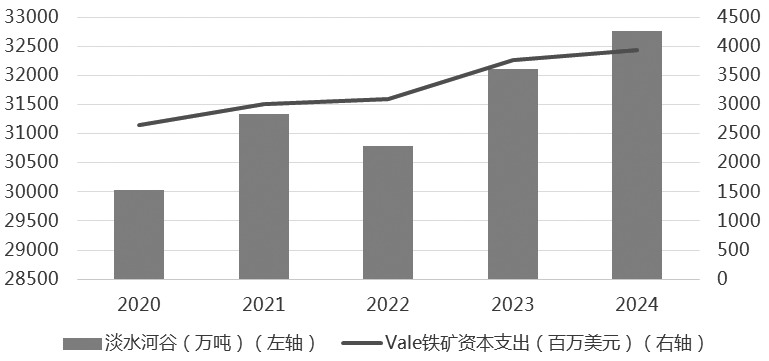
Group 1: Production Capacity and Guidance - In 2024, Vale and Rio Tinto's combined actual production is 65.565 million tons, with a slight increase in guidance for 2025 to 66.050 million tons, reflecting a cautious approach despite significant planned capacity increases of 40.05 million tons [1] - BHP and FMG's combined production for FY2024 is 45.376 million tons, with a downward adjustment in guidance for FY2025 to 45 million tons, indicating a divergence between planned capacity increases and production guidance [1] - Vale's capital expenditure for iron ore projects in 2024 is $3.943 billion, showing ongoing investment in capacity expansion [2] Group 2: Specific Projects and Their Impact - The Serra Sul+20 project aims to increase annual capacity to 12 million tons, with a total investment of approximately $2.844 billion, expected to contribute 500,000 tons of new capacity in 2025 [5] - The VGR1 plant renovation project is designed to restore wet processing capacity, with an annual capacity of 1.7 million tons and an investment of $67 million, expected to contribute 560,000 tons in 2025 [6] - The Capanema capacity maximization project aims to add 1.5 million tons of capacity by 2026, with a total investment of $913 million, contributing 495,000 tons in 2025 [7] Group 3: Production Management and Challenges - Vale maintains a production guidance range of 32.5 to 33.5 million tons for 2025, despite a significant planned capacity increase, reflecting careful management of resource depletion and production rates [11] - BHP's production guidance for FY2025 is adjusted to 25 million to 26 million tons, primarily due to ongoing capacity ramp-up and resource depletion management [14] - FMG's production guidance for FY2025 is set at 19 million to 20 million tons, with a focus on the Iron Bridge magnetite project, which is expected to contribute 700,000 tons of new capacity [19] Group 4: Overall Industry Trends - The overall trend shows a significant mismatch between new capacity additions and production guidance across the four major mining companies, primarily driven by resource depletion and declining ore grades [21] - The combined depletion rate for the four major mines is estimated at 3.9%, leading to substantial reductions in expected production despite planned capacity increases [21]



研判2025!中国乙烯-醋酸乙烯共聚物(EVA)行业产业链图谱、市场现状、进出口及发展趋势分析:国内EVA产能达291万吨,行业进出口格局或将重塑[图]
Chan Ye Xin Xi Wang· 2025-06-02 04:38
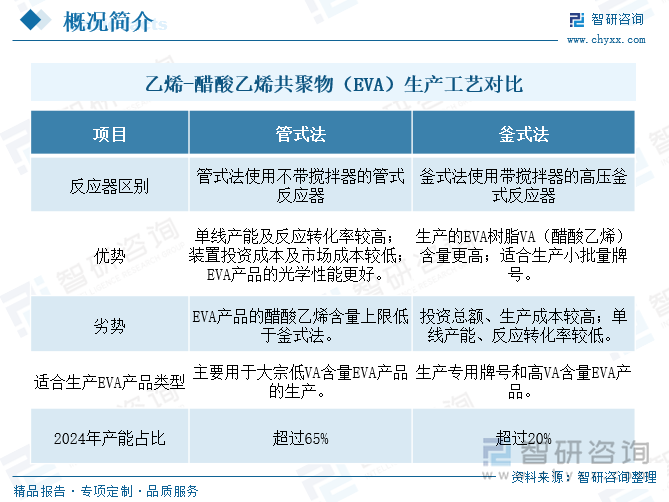
Industry Overview - Ethylene-vinyl acetate copolymer (EVA) is the fourth largest ethylene series polymer, produced through the copolymerization of ethylene and vinyl acetate [2][6] - China's EVA production capacity has grown significantly, from 972,000 tons in 2017 to 2.91 million tons in 2024, with a compound annual growth rate (CAGR) exceeding 30% from 2020 to 2024 [6][8] - The production process in China primarily utilizes tubular and kettle methods, with tubular method accounting for over 65% of production capacity in 2024 [4][6] Production and Demand Trends - China's EVA production has increased from 756,000 tons in 2019 to 2.3835 million tons in 2024, achieving a CAGR of 33.25% [8][10] - However, the growth rate is expected to slow down, with a year-on-year increase of only 10.68% in 2024 due to a slowdown in downstream demand [8][10] - Despite the increase in domestic production, China still relies on imports, with EVA imports decreasing by 34.22% to 915,600 tons in 2024, reflecting improved domestic supply capabilities [10][11] Competitive Landscape - The EVA industry in China is characterized by a "four strong" competitive landscape, with companies like Oriental Rainbow, Zhejiang Petrochemical, Gulei Petrochemical, and Yulin Energy Coal holding significant market shares [13] - In 2024, Oriental Rainbow became the first company to exceed 500,000 tons in production capacity, significantly outpacing its competitors [13][19] Future Outlook - The EVA industry is expected to continue its capacity expansion cycle, with planned capacities exceeding 4 million tons from 2025 to 2028 [11][19] - The industry is likely to transition from a net importer to a net exporter, enhancing China's competitiveness in high-end polymer materials [11][20] - The demand for EVA is expanding into new fields such as photovoltaics and medical applications, with photovoltaic film demand exceeding 50% of total EVA demand [21][20]


SQM(SQM) - 2025 Q1 - Earnings Call Transcript
2025-05-28 17:02
Financial Data and Key Metrics Changes - SQM reported the highest first quarter lithium sales volumes in the company's history, with a 20% year-on-year increase, driven by strong demand from the electric vehicle market in China and Europe [5] - Average realized prices for lithium in Q2 2025 are expected to be lower than in Q1 2025 due to recent price declines [6][56] - The iodine business experienced record average prices amid tight supply and steady demand, particularly for X-ray contrast media applications [8] Business Line Data and Key Metrics Changes - Lithium sales volumes increased significantly, while the potassium business saw a substantial decrease in volumes compared to the previous year due to a strategic focus on high lithium content brines [10] - Specialty Plant Nutrition (SPN) sales volumes grew healthily, with an upward trend in prices driven by strong demand for potassium chloride [9] Market Data and Key Metrics Changes - The global lithium demand is expected to grow by 17% in 2025, with SQM's sales projected to grow by approximately 15% year-on-year [28][61] - The market is currently experiencing oversupply, which has led to price pressures, particularly in China [68] Company Strategy and Development Direction - SQM is focused on expanding lithium production capacity to meet growing demand, with plans to reach 240,000 metric tons of lithium carbonate and 100,000 metric tons of lithium hydroxide [8] - The company is investing in operational efficiencies and capacity expansions across its business lines, including iodine and specialty plant nutrition [9][10] Management's Comments on Operating Environment and Future Outlook - Management expressed confidence in the long-term fundamentals of the lithium market, despite current pricing challenges, and believes that the price environment is not sustainable for the industry [82] - The company is well-prepared to take advantage of future market recoveries, with a strong balance sheet and low-cost production capabilities [18][84] Other Important Information - SQM's dividend policy stipulates a distribution of 30% of net income for 2025, with no interim dividends planned for the first quarter [46] - The Mt. Holland project is progressing well, with expectations of cash-positive operations even at current prices [80] Q&A Session Summary Question: Expectations for operating cash flow in Q2 - Management indicated that they are far from breakeven costs and expect to be significantly above that in Q2 [14][15] Question: Impact of lower lithium prices on capital structure - Management reassured that the strong balance sheet allows for continued investment in growth projects despite lower operating cash flow [16][18] Question: Current political noise in Chile regarding Codelco JV - Management described the situation as "noise" and confirmed that the transaction is proceeding as planned, with execution expected in the second half of the year [21][25] Question: Lithium sales growth forecast - Management maintained that they have not updated their annual volume forecast for 2025, but expect similar or slightly lower volumes in Q2 compared to Q1 [28] Question: Pricing dynamics in China - Management noted that they have various pricing mechanisms with customers, but could not provide specifics due to confidentiality [34] Question: CapEx requirements for growth plans - Management stated that the CapEx plan will be reviewed and shared with the market in the upcoming months, with no updates currently available [52] Question: Production costs and expectations - Management confirmed that they expect to reduce operational costs during the year and are implementing several cost reduction initiatives [77] Question: Outlook for Mt. Holland project - Management indicated that the Mt. Holland operation is cash positive and progressing as planned, with a focus on ramping up production [80][92]
高盛:中微公司-刻蚀、沉积、计量与检测产品拓展;提升人均销售额;买入
Goldman Sachs· 2025-05-28 05:45
Investment Rating - The report maintains a "Buy" rating for AMEC, with a 12-month price target of Rmb275, indicating an upside potential of 58.8% from the current price of Rmb173.13 [12]. Core Insights - AMEC is positioned as a key supplier in the semiconductor equipment industry, focusing on etching and metal-organic chemical vapor deposition (MOCVD) equipment. The company is expanding its product lineup to include advanced etchers and deposition tools, which are expected to drive growth [9][10]. - The management is optimistic about the growth in China's semiconductor equipment demand and plans to continue investing in R&D and capacity expansions to leverage market opportunities [1][9]. Summary by Sections R&D and Product Expansion - AMEC is committed to continuous R&D spending, focusing on product expansions in etching, deposition, EPI, and advanced packaging tools. The CCP etcher's aspect ratio has improved from 60:1 to 90:1, and the company has over 40 deposition tools in the R&D pipeline [2][8]. Employee Efficiency - The total number of employees has increased by an average of 22% year-over-year since 2016, reaching 2,480 by 2024. The average sales per employee have exceeded Rmb4 million, up from Rmb3.5 million in 2022, indicating improved operational efficiency [3][4]. Capacity Expansion - AMEC's factory size was 348,000 square meters in 2024, expected to grow to 453,000 square meters in 2025 with the new headquarters. By 2028, the company anticipates reaching over 750,000 square meters of total factory space, significantly expanding its production capabilities [4][8]. Market Position and Valuation - AMEC is trading below its historical average 12-month forward P/E ratio, suggesting an attractive valuation. The company is expected to benefit from ongoing capacity expansions and the growing adoption of domestic semiconductor equipment [9][10].

外资石膏板专家交流
2025-05-26 15:17
Summary of Conference Call on Gypsum Board Industry Industry Overview - The gypsum board industry is experiencing intense price competition, with average sales in April and May down approximately 15% year-on-year. Major companies affected include Beixin, Taishan Longhai, Saint-Gobain, and Knauf, with some lesser-known brands seeing declines of up to 20% [1][2][3] - The price reduction space is limited, and further price cuts could severely compress profits for companies [2][3] Key Players and Strategies - Foreign companies like Knauf are expanding production capacity in China to enhance logistics efficiency and reduce costs. Their factories are typically located in first-tier or new first-tier cities such as Tianjin, Shandong, Shanghai, and Dongguan [1][6] - Knauf's sales and profits are expected to decline in 2025 due to a lag in price adjustments compared to competitors. State-owned enterprises tend to prefer Beixin products, which affects Knauf's competitiveness in large projects, although it maintains a strong presence in small owner, retail wholesale, and home decoration sectors [1][16] Market Dynamics - The demand for lightweight steel keel and gypsum board is gradually replacing traditional building materials, but market coverage remains a challenge. Companies are shifting focus to third- and fourth-tier cities as demand in first-tier cities saturates [1][7][8] - New gypsum board factories are primarily aimed at saving transportation costs and meeting market demand, despite a decrease in gypsum board prices [10][11] Logistics and Cost Challenges - The gypsum board industry is significantly impacted by logistics costs due to the heavy weight and large volume of the product. Transporting gypsum board over long distances can increase costs by 20% to 30% [12][13] - The need for specialized transportation and labor for gypsum board handling adds to the overall cost structure, making logistics a critical factor in profitability [12][13] Sales Performance and Future Outlook - Knauf's sales volume and profit have declined in 2025, with a projected growth target of only 5% for the year, down from an initial target of 13%. The company plans to reassess its annual budget in mid-2025 due to current market conditions [17][18] - The company will not engage in aggressive price wars to boost sales, focusing instead on improving service quality and operational efficiency to achieve growth [19] Regional Insights - Knauf has six factories across China, with plans for expansion based on capacity analysis, particularly in regions like Yunnan and Guizhou to meet local demand and reduce logistics costs [9][20] - The central region accounts for about 50% of Knauf's sales, while the southern region contributes approximately 60% of profits [20] Competitive Landscape - The overall market for gypsum board is seeing a shift in project and home decoration demand, with Knauf's project share at 40% and home decoration at 60%, compared to the market's 60% and 40% respectively [25] - Beixin's scale and aggressive pricing strategies pose a challenge to foreign brands, particularly in third- and fourth-tier cities where brand recognition is lower [31][32] Conclusion - The gypsum board industry is navigating a challenging landscape marked by price competition, logistics costs, and shifting demand patterns. Companies like Knauf are adapting their strategies to maintain competitiveness while focusing on service quality and operational efficiency rather than engaging in detrimental price wars.