
适度宽松的货币政策

Search documents
瑞达期货沪锌产业日报-20250911
Rui Da Qi Huo· 2025-09-11 08:50
Report Industry Investment Rating - Not provided Core Viewpoints of the Report - Macroeconomic policies aim to strengthen the domestic market, with China's August CPI, core CPI, and PPI showing specific trends, and US inflation unexpectedly falling. Fundamentally, zinc ore imports and processing fees are rising, along with increased smelter profits and supply growth. Import losses are widening, reducing imported zinc inflows. On the demand side, downstream is at the end of the off - season, with stable and rising processing enterprise operating rates. Zinc prices are at a low level, downstream purchases on - demand, domestic social inventories are increasing, and overseas LME inventories are decreasing, supporting zinc prices. Technically, with decreasing positions and price fluctuations, it's recommended to wait and see or go long on dips [3]. Summary by Relevant Catalogs Futures Market - The closing price of the Shanghai Zinc main contract is 22,250 yuan/ton, up 35 yuan; the 10 - 11 month contract spread is - 5 yuan/ton, down 10 yuan. The LME three - month zinc quote is 2,887.5 dollars/ton, up 20.5 dollars. The total Shanghai Zinc open interest is 222,719 lots, up 970 lots; the net position of the top 20 in Shanghai Zinc is - 6,229 lots, up 3,619 lots. Shanghai Zinc warehouse receipts are 44,925 tons, up 596 tons. The SHFE inventory is 87,032 tons, up 1,052 tons; the LME inventory is 50,825 tons, down 200 tons [3]. Spot Market - The SMM 0 zinc spot price is 22,180 yuan/ton, up 90 yuan; the Yangtze River Non - ferrous market 1 zinc spot price is 22,180 yuan/ton, up 260 yuan. The ZN main contract basis is - 70 yuan/ton, up 55 yuan; the LME zinc cash - 3 months spread is 23.01 dollars/ton, up 5.39 dollars. The Kunming 50% zinc concentrate arrival price is 16,860 yuan/ton, down 50 yuan; the Shanghai 85% - 86% broken zinc price is 15,600 yuan/ton, unchanged [3]. Upstream Situation - The WBMS zinc supply - demand balance is - 124,700 tons, down 104,100 tons; the ILZSG zinc supply - demand balance is - 69,100 tons, up 10,400 tons. The ILZSG global zinc mine production is 1,007,500 tons, down 4,300 tons; domestic refined zinc production is 617,000 tons, down 11,000 tons. Zinc ore imports are 455,900 tons, up 124,900 tons [3]. Industry Situation - Refined zinc imports are 35,156.02 tons, down 22,615.39 tons; refined zinc exports are 483.88 tons, up 266.83 tons. Zinc social inventories are 140,100 tons, up 1,800 tons [3]. Downstream Situation - Galvanized sheet production is 2.32 million tons, down 130,000 tons; sales are 2.34 million tons, down 120,000 tons. The new housing construction area is 352.06 million square meters, up 48.4168 million square meters; the housing completion area is 250.34 million square meters, up 24.6739 million square meters. Automobile production is 2.51 million vehicles, down 298,600 vehicles; air - conditioner production is 19.6788 million units, up 3.4764 million units [3]. Option Market - The implied volatility of the at - the - money zinc call option is 13.01%, down 0.03%; the 20 - day historical volatility of the at - the - money zinc option is 6.16%. The implied volatility of the at - the - money zinc put option is 13.02%, down 0.02%; the 60 - day historical volatility of the at - the - money zinc option is 11.12%, down 0.04% [3]. Industry News - China aims to stabilize employment, enterprises, markets, and expectations, implement active fiscal and moderately loose monetary policies, and promote various aspects of development. China's August CPI, core CPI, and PPI show specific trends, and US inflation unexpectedly falls [3].
从计划执行报告看下半年经济工作重点:加快稳就业、稳企业、稳市场、稳预期 推动相关举措落地见效
Xin Hua She· 2025-09-10 15:00
Group 1 - The report highlights the implementation of various policies and measures deployed by the central government to stabilize employment, businesses, markets, and expectations [1] - It emphasizes the need for a more proactive fiscal policy and moderately loose monetary policy to fully unleash policy effects [1] - The report calls for a thorough evaluation of policy implementation and suggests optimizing policies and measures based on assessment results to enhance their effectiveness [1] Group 2 - There is a focus on normalizing policy research and reserve, continuously improving the policy toolbox [1] - The report stresses the importance of addressing capacity governance in key industries and implementing measures to resolve structural contradictions while promoting quality upgrades [1] - It also mentions the need for comprehensive regulation of irrational competition and strengthening policy coordination and expectation guidance [1]
加力实施更加积极的财政政策
Jing Ji Ri Bao· 2025-09-07 01:02
Core Viewpoint - The central economic work conference in 2024 emphasizes the implementation of a more proactive fiscal policy to stimulate economic growth and address insufficient domestic demand [2][3]. Fiscal Policy Adjustment - The shift from "active" to "more active" fiscal policy marks a significant adjustment in China's fiscal stance since 2008, aimed at promoting high-quality economic development and addressing total demand insufficiency [2][3]. Fiscal Deficit and Debt Management - The fiscal deficit is set at around 4% for the year, with a deficit scale of 5.66 trillion yuan, and plans to issue 1.3 trillion yuan in ultra-long-term special bonds, alongside 4.4 trillion yuan in new local government special bonds [3][5]. - The government maintains that the current deficit level is within a safe threshold, with China's government debt ratio at 90.12%, significantly lower than the G7 average of 127.42% [7][8]. Economic Stimulus and Confidence Building - The more proactive fiscal policy aims to expand domestic demand and stabilize confidence, providing strong financial support to stimulate consumption and investment [9][10]. - It is expected to enhance the resilience and vitality of economic development through coordinated fiscal and monetary policies [4][9]. Support for Key Areas - The fiscal policy focuses on supporting the construction of the livelihood sector, ensuring the implementation of major national strategies, and optimizing expenditure structures to enhance public service quality [11][12]. - Specific measures include increasing spending on education, healthcare, and social security, while also promoting green development and technological innovation [11][22]. Policy Coordination - Strengthening the coordination between fiscal and monetary policies is crucial for enhancing macroeconomic stability and promoting a virtuous economic cycle [4][13]. - The government aims to leverage fiscal policy to attract social capital and ensure effective implementation of macroeconomic strategies [13][19]. Challenges and Future Directions - The effectiveness of the more proactive fiscal policy may face challenges such as inherent inertia in fiscal concepts, demographic changes, and external economic pressures [14][16][17]. - Future efforts should focus on balancing short-term economic stability with long-term fiscal sustainability, optimizing the allocation of fiscal resources, and enhancing support for key sectors [19][20][23].


加力实施更加积极的财政政策——对话中央财经大学校长马海涛
Sou Hu Cai Jing· 2025-09-06 23:04
Group 1 - The core viewpoint of the article emphasizes the need for a more proactive fiscal policy to stimulate economic growth and address insufficient domestic demand, marking a significant adjustment in China's fiscal policy since 2008 [2][3][9] - The fiscal policy will see an increase in the deficit rate to around 4%, with a deficit scale of 5.66 trillion yuan, and plans to issue 1.3 trillion yuan in ultra-long-term special bonds, along with 4.4 trillion yuan in new local government special bonds [3][5][9] - The proactive fiscal policy aims to enhance confidence among business entities, provide strong financial support for expanding domestic demand, and effectively prevent and resolve risks in key areas [2][10][11] Group 2 - The proactive fiscal policy is expected to play a crucial role in driving economic recovery by expanding domestic demand and stabilizing confidence, thus addressing economic circulation bottlenecks [9][10] - It will focus on supporting the construction of the livelihood sector and major national strategies, optimizing expenditure structures to enhance public service quality and alleviate pressures on residents [11][12][22] - The government aims to strengthen the coordination between fiscal and monetary policies to enhance macroeconomic stability and resilience [4][13][23] Group 3 - The article discusses the importance of addressing structural challenges and external pressures while implementing a more proactive fiscal policy, emphasizing the need for effective resource allocation and risk prevention [14][19][20] - It highlights the necessity of balancing economic construction spending with livelihood spending to ensure social harmony and improve living standards [20][21] - The government is encouraged to deepen fiscal and tax system reforms to support high-quality development and mitigate risks in key areas [23][24]
加力实施更加积极的财政政策 ——对话中央财经大学校长马海涛
Jing Ji Ri Bao· 2025-09-06 22:08
Core Viewpoint - The central economic work conference in 2024 emphasizes the implementation of a more proactive fiscal policy to stimulate economic growth, enhance employment, and support industrial transformation [1][2]. Fiscal Policy Adjustment - The shift from "active" to "more active" fiscal policy marks a significant adjustment in China's fiscal stance since 2008, aimed at addressing insufficient total demand and promoting high-quality economic development [2][3]. Fiscal Deficit and Debt Management - The fiscal deficit is set at around 4% for the year, with a deficit scale of 5.66 trillion yuan and plans to issue 1.3 trillion yuan in ultra-long-term special bonds, alongside 4.4 trillion yuan in new local government special bonds [3][4]. - The government maintains that the current deficit level is within a safe threshold, despite surpassing the traditional 3% warning line, as it reflects a strategic approach to fiscal space and debt management [5][7]. Economic Stimulus and Confidence Building - The proactive fiscal policy aims to expand domestic demand and stabilize confidence, providing financial support to stimulate consumption and investment, thereby enhancing overall economic activity [9][10]. - It also focuses on risk prevention in key areas, ensuring stable macroeconomic operations through targeted fiscal measures [10][11]. Support for Livelihood and Strategic Initiatives - The policy prioritizes investments in social welfare, education, healthcare, and other critical areas to enhance public services and support major national strategies, including green development and technological innovation [11][12]. - Specific measures include increasing subsidies for consumption, enhancing social security, and providing targeted support for vulnerable groups [12][22]. Coordination of Policies - There is a strong emphasis on the coordination between fiscal and monetary policies to enhance macroeconomic stability and promote a virtuous economic cycle [4][13]. - The government aims to leverage fiscal tools to attract social capital and ensure effective implementation of fiscal policies [13][19]. Challenges and Future Directions - The effectiveness of the more proactive fiscal policy may be constrained by existing inertia, systemic issues, and external economic pressures [14][16][17]. - Future efforts should focus on balancing short-term fiscal stability with long-term sustainability, optimizing fiscal resource allocation, and enhancing the overall impact of fiscal measures [19][20][21].
股债“跷跷板效应”将延续
Qi Huo Ri Bao· 2025-09-05 23:42
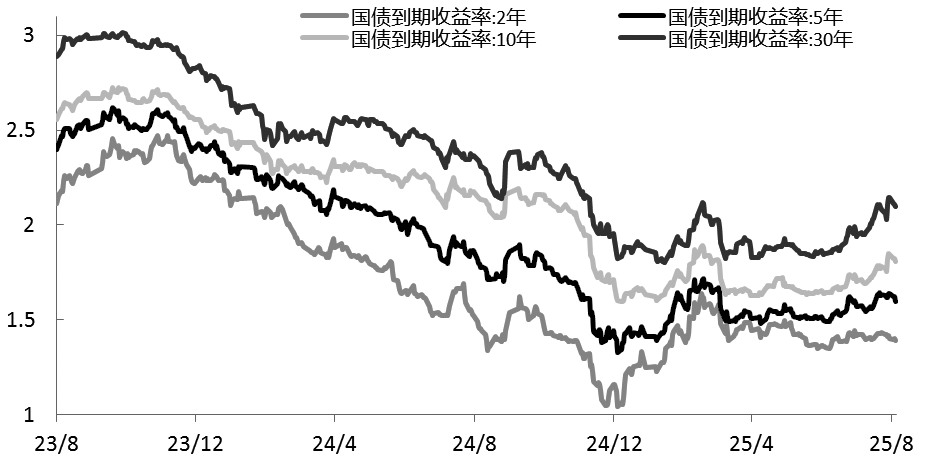
Group 1 - In August, government bond futures prices experienced a general decline, with the T2512 contract price dropping by 0.58%, leading to a rise in the 10-year government bond yield to 1.84%, an increase of 14 basis points from the end of July, marking the highest level since March of this year [1] - Domestic industrial production maintained rapid growth in July, with government bond financing remaining high, contributing to a rebound in social financing growth rate to 9%. Both M1 and M2 growth rates also increased, indicating a significant improvement in fund activation and market expectations for economic growth [1][3] - The Shanghai Composite Index reached a 10-year high in mid-August, reflecting a "see-saw effect" between bond and equity markets, as funds flowed from bonds and deposits into higher-yielding non-bank sectors, suppressing bond market sentiment and enhancing market risk appetite [1] Group 2 - In August, the People's Bank of China (PBOC) conducted a total of 600 billion yuan in medium-term lending facility (MLF) operations, with a net injection of 300 billion yuan, marking the sixth consecutive month of increased operations. Additionally, the PBOC intensified open market operations, resulting in a net injection of 11,464 billion yuan through reverse repos [4] - The PBOC's second-quarter monetary policy report emphasized the need for a moderately accommodative monetary policy, ensuring ample liquidity in the banking system [4][5] - As of the end of August, the total scale of China's bond market exceeded 191.71 trillion yuan, with a net financing amount of 17,571 billion yuan in August, remaining at a high level despite a slight decrease compared to previous months [7]
关注二季度货币政策报告释放的四大信号
Zhong Cheng Xin Guo Ji· 2025-08-29 07:55
Group 1: Economic Overview - The national economy is showing steady progress, with key economic indicators performing well, but still facing risks such as a complex external environment and insufficient domestic demand[2] - In July, industrial added value growth was 5.7%, down 1.1 percentage points from the previous month, while retail sales growth fell to 3.7%, also down 1.1 percentage points[3] - Fixed asset investment growth was 1.6%, a decrease of 1.2 percentage points from the previous value, indicating weakened supply and demand[3] Group 2: Monetary Policy Signals - The report emphasizes the need for "appropriate and detailed implementation of a moderately loose monetary policy," suggesting that comprehensive rate cuts may be delayed[3] - The Consumer Price Index (CPI) in July was 0%, indicating a shift from positive to flat, while the core CPI rose to 0.8%, the highest since March 2024[5] - The report highlights the importance of enhancing price levels to lower real financing costs, as the current level is historically high compared to the U.S.[5] Group 3: Structural Adjustments - The focus has shifted from increasing credit volume to optimizing credit structure, with an emphasis on supporting small and micro enterprises, technology, and consumption[7] - The report indicates a need for diversified financing channels, moving from indirect to direct financing methods, particularly in technology innovation[8] - There is a renewed emphasis on preventing fund "circulation" and ensuring that funds are effectively utilized in the real economy to avoid financial risks[9]
格林大华期货早盘提示-20250828
Ge Lin Qi Huo· 2025-08-28 01:16
Report Industry Investment Rating - No specific industry investment rating is provided in the report. Report's Core View - The central bank aims to implement a moderately loose monetary policy, maintain ample liquidity, promote a reasonable recovery of prices, lower bank liability costs, and reduce the overall social financing cost. The National Development and Reform Commission will approve the establishment and deployment of new policy - based financial instruments, and the Ministry of Commerce will introduce policies to expand service consumption in September. Short - term stock market adjustments are conducive to the stabilization of treasury bond futures. Traders are advised to conduct band trading [1][2]. Summary by Relevant Directory 1. Market Performance - On Wednesday, the main contracts of treasury bond futures showed mixed performance. The 30 - year treasury bond futures main contract TL2512 rose 0.24%, the 10 - year T2512 rose 0.08%, the 5 - year TF2512 rose 0.07%, and the 2 - year TS2512 rose 0.02%. The Wande All - A Index opened slightly higher in the morning and then declined in the afternoon, closing with a mid - length negative line [1][2]. 2. Important Information - **Open Market**: On Wednesday, the central bank conducted 379.9 billion yuan of 7 - day reverse repurchase operations. With 616 billion yuan of reverse repurchases and 300 billion yuan of MLF maturing, the net withdrawal was 236.1 billion yuan [1]. - **Funds Market**: On Wednesday, the overnight interest rate in the inter - bank funds market remained flat compared to the previous trading day. The weighted average of DR001 was 1.31%, and that of DR007 was 1.51%, up from 1.49% the previous day [1]. - **Cash Bond Market**: On Wednesday, most of the closing yields of inter - bank treasury bonds rose compared to the previous trading day. The 2 - year yield decreased by 0.60 BP to 1.41%, the 5 - year rose 0.44 BP to 1.63%, the 10 - year rose 3.90 BP to 1.80%, and the 30 - year rose 3.50 BP to 2.07% [1]. - **Industrial Enterprises**: From January to July, the operating income of industrial enterprises above designated size was 78.07 trillion yuan, a year - on - year increase of 2.3% (2.5% from January to June and 2.1% in 2024). The total profit was 4.02035 trillion yuan, a year - on - year decrease of 1.7% (1.8% from January to June and 3.3% in 2024). In July, the profit of industrial enterprises above designated size increased by 1.5% year - on - year, compared with a 4.3% decline in June [1]. - **Policy**: The Ministry of Commerce will introduce policies to expand service consumption in September, using fiscal and financial means to optimize service supply and stimulate new service consumption [1][2]. 3. Market Logic - The central bank's second - quarter monetary policy report emphasizes implementing a moderately loose monetary policy. The National Development and Reform Commission will approve new policy - based financial instruments for emerging industries and infrastructure projects [1][2]. 4. Trading Strategy - Traders are advised to conduct band trading [2].
贷款市场报价利率连续3个月不变
Jing Ji Ri Bao· 2025-08-26 22:01
Core Viewpoint - The People's Bank of China (PBOC) has maintained the Loan Prime Rate (LPR) for both 1-year and 5-year terms at 3% and 3.5% respectively for three consecutive months, aligning with market expectations [1]. Group 1: Monetary Policy and LPR - The stability of the LPR is attributed to the current monetary policy framework, where the 7-day reverse repurchase rate serves as the new pricing anchor, enhancing the coordination among various interest rates [1]. - Since May, after a rate cut, the recent stabilization of policy rates has kept the pricing basis for LPR unchanged [1]. - The continuous maintenance of the LPR reflects a strong macroeconomic performance in the first half of the year, reducing the necessity for immediate downward adjustments [1]. Group 2: Historical Context and Future Outlook - Since 2020, the PBOC has implemented 12 reserve requirement ratio cuts and 9 policy rate reductions, leading to a decrease of 115 basis points for the 1-year LPR and 130 basis points for the 5-year LPR [2]. - The PBOC's recent report indicates that the effects of counter-cyclical monetary policy have been significant, with stable financial growth and low social financing costs [2]. - The report emphasizes the need for a moderately loose monetary policy moving forward, ensuring liquidity remains abundant and aligns with economic growth and price expectations [2]. Group 3: Policy Implementation and Economic Coordination - The report retains the term "moderately loose," indicating continued support for credit stability and domestic demand, while focusing on the effective implementation of existing policies [3]. - Structural policies are expected to precisely target financing costs, avoiding idle funds, and responding to trends of accelerating deposits and moderate price increases [3]. - Future policy measures will require close monitoring of the transmission effects and actual outcomes to enhance flexibility and maximize policy impact [3].
国债期货日报:美联储转鸽,国债期货全线收涨-20250826
Hua Tai Qi Huo· 2025-08-26 05:49
Report Industry Investment Rating No relevant content provided. Core Viewpoints - Domestic bond market faces short - term pressure from supply and capital disturbances. The central bank maintains a loose stance but with limited policy support, causing the rebound of Treasury bond futures to be weak. The Fed's dovish shift in the US improves short - term risk appetite and increases the pressure on the steepening of the interest rate curve. The differences in the capital and policy stances between the Chinese and US bond markets are widening, with China being moderately tight and the US moving towards easing [3]. Summary by Directory I. Interest Rate Pricing Tracking Indicators - **Price Indicators**: China's monthly CPI has a 0.40% month - on - month increase and 0.00% year - on - year change, while the monthly PPI has a - 0.20% month - on - month and - 3.60% year - on - year change [9]. - **Monthly Economic Indicators**: The social financing scale is 431.26 trillion yuan, with a 1.04 trillion yuan increase and a 0.24% month - on - month change. M2 year - on - year growth is 8.80%, up 0.50% with a 6.02% change rate. The manufacturing PMI is 49.30%, down 0.40% with a - 0.80% change rate [9]. - **Daily Economic Indicators**: The US dollar index is 98.42, up 0.70 with a 0.72% change. The offshore US dollar - to - RMB exchange rate is 7.1680, down 0.018 with a - 0.25% change. SHIBOR 7 - day is 1.48, up 0.02 with a 1.44% change, etc. [10]. II. Overview of Treasury Bonds and Treasury Bond Futures Market - The report presents figures related to the closing price trends, price change rates, precipitation funds, positions, net positions, long - short position ratios, spreads between national development bonds and Treasury bonds, and Treasury bond issuance of Treasury bond futures main - continuous contracts [12][15][20]. III. Overview of the Money Market Capital Situation - It includes figures on Shibor interest rate trends, yields of inter - bank certificates of deposit (AAA), bank - to - bank pledged repurchase transaction statistics, and local bond issuance [32][26]. IV. Spread Overview - Figures show the inter - period spread trends of Treasury bond futures and the term spreads of spot bonds and cross - variety spreads of futures [29][34][35]. V. Two - year Treasury Bond Futures - The report provides figures on the implied interest rate and maturity yield of the two - year Treasury bond futures main contract, the IRR and capital interest rate of the TS main contract, and the three - year basis and net basis trends of the TS main contract [45][40][48]. VI. Five - year Treasury Bond Futures - It includes figures on the implied interest rate and maturity yield of the five - year Treasury bond futures main contract, the IRR and capital interest rate of the TF main contract, and the three - year basis and net basis trends of the TF main contract [50][56]. VII. Ten - year Treasury Bond Futures - Figures show the implied yield and maturity yield of the ten - year Treasury bond futures main contract, the IRR and capital interest rate of the T main contract, and the three - year basis and net basis trends of the T main contract [57][60][58]. VIII. Thirty - year Treasury Bond Futures - The report presents figures on the implied yield and maturity yield of the thirty - year Treasury bond futures main contract, the IRR and capital interest rate of the TL main contract, and the three - year basis and net basis trends of the TL main contract [64][67][70]. Strategy - **Unilateral Strategy**: With the decline of repurchase interest rates and the volatile prices of Treasury bond futures, it is recommended to short at high levels for the 2512 contract [4]. - **Arbitrage Strategy**: Pay attention to the decline of the TF2512 basis [4]. - **Hedging Strategy**: There is medium - term adjustment pressure, and short - side investors can use far - month contracts for appropriate hedging [4].