
人民币汇率

Search documents
管涛:不宜押注人民币汇率的单边走势|宏观经济
清华金融评论· 2025-12-05 10:23
Core Viewpoint - The article discusses the recent performance of the Chinese yuan (RMB) against the US dollar, highlighting a rebound in the RMB exchange rate after a prolonged period of depreciation, and emphasizes the need for adaptability to a new normal of two-way fluctuations in the currency market [1][2]. Summary by Sections RMB Exchange Rate Performance - In 2023, the RMB has shown resilience against external shocks, with the onshore RMB appreciating by 1.55% in the first eleven months, the spot exchange rate rising by 3.10%, and the offshore RMB (CNH) increasing by 3.76% [1]. - The RMB exchange rate has experienced a significant narrowing of volatility, with the maximum fluctuation of the onshore midpoint rate at 1.9%, the lowest since 2016, and the spot rate's maximum fluctuation at 3.8%, also the lowest since 2016 [4]. Stability Measures and Market Reactions - The Chinese government has emphasized maintaining the RMB exchange rate at a reasonable and balanced level, which has led to reduced exchange rate elasticity and suppressed depreciation pressures [5][4]. - In September, the bank's foreign exchange settlement surplus surged to $73.4 billion, the second-highest since the 2015 exchange rate reform, but dropped to $27.3 billion in October, indicating that the market's expectations for RMB appreciation may have been overstated [8]. Factors Influencing Future RMB Trends - Several factors are contributing to the recent optimism regarding the RMB, including potential interest rate cuts by the Federal Reserve, discussions between Chinese and US leaders, and the possibility of a more stable US-China trade relationship [10][11]. - The Chinese economy is expected to continue its recovery, supported by proactive macroeconomic policies and structural reforms aimed at enhancing productivity and innovation [12]. Challenges and Uncertainties - Despite positive trends, the RMB faces uncertainties due to domestic economic challenges, external trade environment fluctuations, and the potential strength of the US dollar [13][14][15]. - The article suggests that while the RMB may break the 7.0 mark against the dollar, its ability to maintain stability below this level remains uncertain, depending on future policy directions and market conditions [16].


人民币市场汇价(12月5日)
Xin Hua She· 2025-12-05 07:40
100新西兰元 407.67人民币 100新加坡元 545.73人民币 新华社北京12月5日电 中国外汇交易中心12月5日受权公布人民币对美元、欧元、日元、港元、英 镑、澳元、新西兰元、新加坡元、瑞士法郎、加元、澳门元、林吉特、卢布、兰特、韩元、迪拉姆、里 亚尔、福林、兹罗提、丹麦克朗、瑞典克朗、挪威克朗、里拉、墨西哥比索及泰铢的市场汇价。 12月5日人民币汇率中间价如下: 100美元 707.49人民币 100欧元 823.76人民币 100日元 4.5597人民币 100瑞士法郎 880.16人民币 100加元 506.82人民币 100人民币 113.3澳门元 100人民币 53.057沙特里亚尔 100人民币 4649.39匈牙利福林 100人民币 51.405波兰兹罗提 100人民币 90.68丹麦克朗 100人民币 58.145马来西亚林吉特 100人民币 1084.32俄罗斯卢布 100人民币 240.17南非兰特 100人民币 20837韩元 100人民币 51.924阿联酋迪拉姆 100人民币 600.776土耳其里拉 100人民币 257.79墨西哥比索 100人民币 452.91泰铢 责 ...
如何看待近期人民币汇率的变化︱重阳问答
重阳投资· 2025-12-05 07:32
Core Viewpoint - The recent appreciation of the Renminbi (RMB) against the US dollar is attributed to a weakening dollar index and improved market sentiment towards the RMB, following a period of trade tensions and policy adjustments [2][3][4]. Group 1: RMB Exchange Rate Changes - Since late November, the offshore RMB has appreciated over 550 pips, while the onshore RMB has appreciated over 400 pips, indicating a return to an appreciation trend [2]. - The RMB's appreciation is supported by a weakening dollar index, which has declined by 1% from its peak, aligning with the RMB's appreciation [2][4]. Group 2: Factors Influencing RMB Appreciation - The driving force behind the RMB's appreciation is the increase in foreign exchange settlement (结汇) by exporters, which had been low earlier due to tariff impacts and unstable exchange rate expectations [3]. - Since the third quarter, there has been a notable improvement in the willingness to settle foreign exchange, leading to a compensatory settlement that supports RMB appreciation [3]. Group 3: Future Outlook for RMB - Looking ahead, the RMB is expected to continue appreciating slowly, contingent on a further weakening of the dollar index [4]. - The central bank's policy aims for a gradual appreciation of the RMB, with recent indicators suggesting a shift towards preventing rapid appreciation to avoid negative impacts on exports [4]. - The market has priced in three potential interest rate cuts by the Federal Reserve next year, limiting the scope for further declines in long-term US Treasury yields and maintaining the interest rate differential between China and the US [4].

人民币中间价调贬16个基点报7.0749
Bei Jing Shang Bao· 2025-12-05 02:37
Core Viewpoint - The People's Bank of China has authorized the China Foreign Exchange Trade System to announce the central parity rate of the RMB against the USD, which has depreciated slightly compared to the previous trading day [1] Group 1: Exchange Rate Information - On December 5, the central parity rate of the RMB against the USD was set at 7.0749, a depreciation of 16 basis points from the previous day's rate of 7.0733 [1] - As of 9:42 AM on the same day, the onshore and offshore RMB against the USD were reported at 7.0698 and 7.0678 respectively, showing an appreciation of 0.02% and 0.05% during the day [1]
人民币对美元中间价报7.0749 调贬16个基点
Zhong Guo Jing Ji Wang· 2025-12-05 01:47
(责任编辑:韩艺嘉) 中国人民银行授权中国外汇交易中心公布,2025年12月5日银行间外汇市场人民币汇率中间价为:1 美元对人民币7.0749元,1欧元对人民币8.2376元,100日元对人民币4.5597元,1港元对人民币0.90906 元,1英镑对人民币9.4269元,1澳大利亚元对人民币4.6754元,1新西兰元对人民币4.0767元,1新加坡 元对人民币5.4573元,1瑞士法郎对人民币8.8016元,1加拿大元对人民币5.0682元,人民币1元对1.1330 澳门元,人民币1元对0.58145马来西亚林吉特,人民币1元对10.8432俄罗斯卢布,人民币1元对2.4017南 非兰特,人民币1元对208.37韩元,人民币1元对0.51924阿联酋迪拉姆,人民币1元对0.53057沙特里亚 尔,人民币1元对46.4939匈牙利福林,人民币1元对0.51405波兰兹罗提,人民币1元对0.9068丹麦克朗, 人民币1元对1.3323瑞典克朗,人民币1元对1.4300挪威克朗,人民币1元对6.00776土耳其里拉,人民币1 元对2.5779墨西哥比索,人民币1元对4.5291泰铢。 中国经济网北京12月5日讯 ...
三价合一后,人民币年末会破7吗?
Xin Lang Cai Jing· 2025-12-05 00:28
Core Viewpoint - The Chinese Yuan (CNY) is approaching the 7.05 mark against the US Dollar (USD), with concerns about the possibility of breaking the 7.00 level by year-end being raised. However, the expectation remains that the CNY will end the year around 7.05, with a low probability of breaking 7.00 [1][8]. Group 1: Baseline Scenario - The strong settlement power observed daily supports the expectation of a CNY appreciation, although the pace is expected to be moderate. The focus this week is on the realization of the "three-price unity" for the USDCNY central parity, which has been maintained for over a year [2][8]. - The baseline scenario predicts that the USDCNY central parity will be around 7.05 by year-end, corresponding to a closing range of 7.04-7.06 [8][12]. Group 2: Right Tail Risks - Potential upward risks for the CNY include factors that could drive a rebound in the US Dollar Index (DXY), such as a hawkish Federal Open Market Committee (FOMC) stance leading to a significant market reaction. Current market expectations suggest a 25 basis point rate cut in December, with an additional 2.3 cuts anticipated next year. If the December dot plot indicates only one cut for 2026, both the dollar rates and DXY could rebound sharply [6][10]. - Additionally, stronger-than-expected non-farm payrolls in October and November could also contribute to upward pressure on the USD [12]. Group 3: Left Tail Risks - Conversely, if the DXY falls below the 100-day moving average towards the previous low of around 97, the CNY may also decline. Potential triggers for this scenario include a dovish FOMC stance indicating more than two rate cuts for 2026, or significant dovish comments from the new Federal Reserve Chair [6][12]. - Other factors that could lead to a weaker CNY include disappointing non-farm payroll results and rising unemployment rates, as well as a comprehensive peace agreement between Russia and Ukraine, which could strengthen the Euro [12].
多重因素协同助推 人民币短期“破7”概率大
Sou Hu Cai Jing· 2025-12-04 16:52
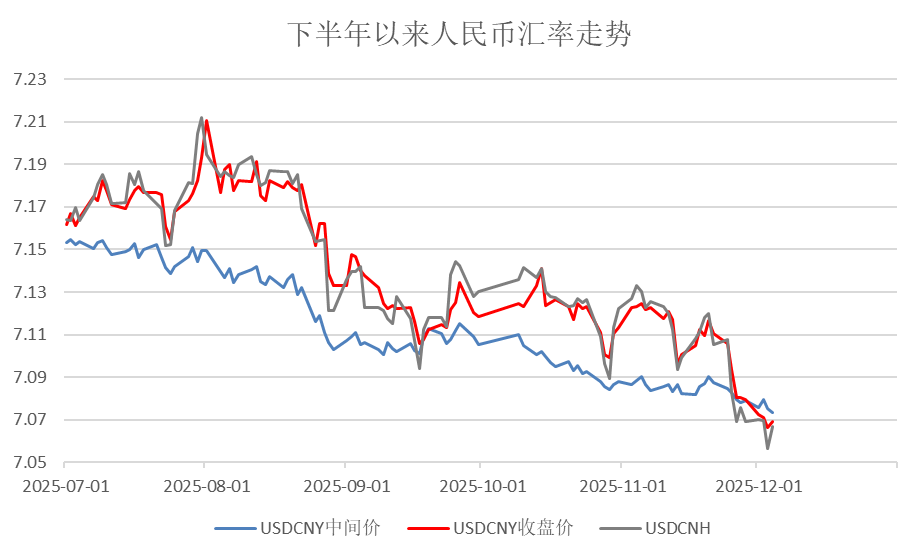
Core Viewpoint - The recent acceleration of the Chinese yuan's appreciation against the US dollar has sparked market interest, with increasing discussions about whether the exchange rate can break the 7.0 mark. Group 1: Exchange Rate Trends - As of December 4, the yuan's central parity against the US dollar was adjusted up by 21 basis points to 7.0733, the highest level since October 14, 2024. The onshore yuan closed at 7.069, down 29 basis points from the previous trading day [1][2] - Since November, the yuan has entered a rapid appreciation phase, with significant increases of 506 basis points and 595 basis points against the US dollar for onshore and offshore rates, respectively, since November 20 [2] - The central parity has shown a narrow upward trend, with fluctuations observed in early December, indicating a potential for further appreciation [2][3] Group 2: Factors Supporting Appreciation - Market expectations for a Federal Reserve rate cut in December have been a direct driver of the yuan's appreciation, contributing to a decline in the US dollar index below 100 [5] - The approaching year-end has led to a surge in corporate foreign exchange settlement demand, which has further supported the yuan's exchange rate. In September, banks reported a settlement surplus of $51 billion, and this trend is expected to continue into the fourth quarter [6][7] - The overall export performance has been strong, with a 5.3% year-on-year increase in dollar-denominated exports in the first ten months of the year, contributing to concentrated settlement demand from enterprises [7] Group 3: Market Predictions - Experts predict a high probability of the yuan breaking the 7.0 mark in the short term, supported by seasonal settlement demand and a weaker dollar index due to anticipated Fed rate cuts [8] - Attention is drawn to the upcoming Federal Reserve meeting on December 11, which may influence the dollar's performance and the yuan's central parity adjustments [8] - Despite the potential for short-term appreciation, uncertainties remain regarding the yuan's ability to maintain levels below 7.0 in the long term, influenced by various factors including US tariffs and global trade dynamics [9]
穿越噪音——2026年外汇市场的脉搏与底色
2025-12-04 15:37
Summary of Key Points from Conference Call Records Industry Overview - The records focus on the foreign exchange market dynamics, particularly the outlook for the Chinese Yuan (RMB) against the US Dollar (USD) through 2026, highlighting the implications of monetary policy differences between the US and China [1][2]. Core Insights and Arguments - **Interest Rate Expectations**: The market anticipates a significant divergence in interest rate cuts between the US and China, with expectations of over 75 basis points in the US and around 25 basis points in China, which could favor RMB appreciation [1][2]. - **Unsettled Foreign Exchange Amounts**: Current assessments suggest that the actual unsettled foreign exchange amounts are closer to $150-200 billion, rather than the previously estimated $800-1,200 billion, due to the inversion of interest rates leading to increased overseas direct investments [1][3][4]. - **Weak Dollar Cycle**: The USD is entering a new weak cycle expected to last 3-5 years, influenced by factors such as de-dollarization trends, reduced US Treasury holdings, and fiscal deficits, which may provide long-term appreciation opportunities for the RMB [1][5]. - **China's Current Account Surplus**: A robust current account surplus, combined with the repatriation of overseas investment profits, supports the RMB's mid-term fundamentals, with seasonal settlement becoming increasingly important for RMB appreciation [1][6]. - **Federal Reserve's Dovish Stance**: The Federal Reserve's internal divisions suggest a continued dovish approach, with personnel changes potentially accelerating rate cuts, further pressuring the USD and enhancing RMB appreciation [1][7]. Additional Important Insights - **RMB Stability Amidst Weak USD**: Despite the weak USD, the RMB has not experienced significant volatility due to a shift in settlement structures from USD dominance to a diversified currency basket, reducing sensitivity to USD fluctuations [1][8]. - **Long-term RMB Policy**: China's RMB policy currently aims for stability, with a long-term trend towards appreciation to alleviate economic growth pressures, particularly in light of the 2035 GDP doubling goal [1][9][10]. - **Factors Influencing RMB Exchange Rate**: Future RMB exchange rates will be influenced by political uncertainties, changes in US-China interest rate differentials, and economic expectations, with a stable global economy supporting RMB appreciation [1][11]. - **2026 RMB Exchange Rate Outlook**: The expectation for 2026 includes a potential 7% appreciation of the RMB against the USD, with various hedging tools available for enterprises to manage foreign exchange risks [1][12][14]. Hedging Strategies - **Choosing Hedging Tools**: Enterprises are advised to consider different contract types and rolling methods for hedging, with forward contracts generally being more expensive than futures. Strategies to optimize costs include using deep discount contracts and adjusting hedging ratios based on market conditions [1][14][16]. Arbitrage Opportunities - **HKD and USD Arbitrage**: Under the Hong Kong dollar's peg to the USD, there are opportunities for arbitrage, particularly when interest rate differentials widen, and during periods of market intervention by the Hong Kong Monetary Authority [1][15]. This summary encapsulates the key points from the conference call records, providing a comprehensive overview of the foreign exchange market dynamics and the outlook for the RMB.
人民币汇率短期“破7”概率大
第一财经· 2025-12-04 13:45
Core Viewpoint - The recent acceleration of the RMB appreciation has sparked market attention, with increasing discussions on whether the exchange rate against the USD can break the 7.0 mark. As of December 4, the RMB's central parity against the USD was adjusted up by 21 basis points to 7.0733, the highest level since October 14, 2024. The market sentiment is optimistic about the short-term outlook for the RMB exchange rate, driven by multiple favorable factors, including expectations of a Fed rate cut, concentrated year-end corporate settlement demand, and stable domestic economic fundamentals [3][4][5][6]. Exchange Rate Trends - Since November, the RMB has entered a rapid appreciation cycle against the USD, with further consolidation in December. Data shows that as of December 3, the onshore and offshore RMB exchange rates were 7.0661 and 7.0583, respectively, marking an increase of 506 and 595 basis points since November 20 [5][6]. - The RMB's central parity has shown a narrow upward trend in December, with fluctuations in the middle price indicating a potential central bank strategy to stabilize the exchange rate and guide two-way fluctuations [7][8]. Factors Supporting Appreciation - The market's expectation of a Fed rate cut in December has been a direct driver of the RMB's appreciation, with the USD index falling below 100, leading to a general appreciation of non-USD currencies, including the RMB [9]. - Year-end corporate settlement demand is also contributing to the RMB's strength, with significant settlement activity expected as companies convert foreign exchange earnings into RMB. Data from the foreign exchange administration indicates a surplus in bank settlements, with a notable increase in corporate settlement intentions as the year-end approaches [10][11]. Short-term Outlook - Experts predict a high probability of the RMB breaking the 7.0 mark in the short term, supported by seasonal settlement demand and a weaker USD index due to anticipated Fed rate cuts. The market sentiment is buoyed, suggesting that the RMB may reach this threshold before the end of the year [14][15]. - However, there are uncertainties regarding the RMB's ability to maintain levels below 7.0 in the long term, with various factors influencing its stability [16]. Long-term Considerations - Looking ahead to 2026, the likelihood of significant RMB appreciation driven by a depreciating USD is considered low. Factors such as high tariffs impacting global trade and China's exports may exert downward pressure on the RMB [17][18]. - The regulatory environment is expected to provide support for the RMB, with the potential for a stable exchange rate around the 7.0 to 7.2 range, allowing for two-way fluctuations [18].
人民币汇率短期“破7”概率大,潜在“结汇潮”影响有多大
Di Yi Cai Jing· 2025-12-04 13:21
Core Viewpoint - The recent appreciation of the Renminbi (RMB) against the US dollar has sparked discussions about whether it can break the 7.0 mark, with short-term optimism but long-term uncertainties remaining [1][10][12]. Exchange Rate Trends - The RMB entered a rapid appreciation phase in November, with further consolidation in December, showing significant short-term gains against the US dollar [2][6]. - As of December 4, the onshore RMB closed at 7.069, slightly down from the previous trading day, while the central parity rate reached its highest level since October 14, 2024, at 7.0733 [3][10]. Market Influences - The market's expectation of a Federal Reserve rate cut in December has been a direct driver of the RMB's appreciation, alongside seasonal corporate demand for currency conversion at year-end [6][8]. - Data from the foreign exchange administration indicates a significant surplus in bank settlements, with a notable increase in corporate settlement demand expected in the fourth quarter [7][9]. Economic Support Factors - The stability of the domestic economic fundamentals is providing core support for the RMB exchange rate, with multiple favorable factors contributing to its appreciation [9][13]. - The "14th Five-Year Plan" has also bolstered market confidence in the long-term stability of the Chinese economy, further supporting the RMB [1][12]. Future Outlook - Experts predict a high probability of the RMB breaking the 7.0 mark in the short term, driven by seasonal demand and favorable market conditions [11][14]. - However, uncertainties remain regarding the RMB's ability to maintain levels below 7.0 in the long term, influenced by various domestic and international factors [12][14].