宠物经济

Search documents
永新股份(002014):2025年半年报点评:上半年业绩稳健增长,市场竞争压力较大影响毛利率表现
EBSCN· 2025-08-27 09:06
Investment Rating - The report maintains a "Buy" rating for Yongxin Co., Ltd. (002014.SZ) with a current price of 11.60 CNY [1] Core Views - The company achieved steady revenue growth in the first half of 2025, with a revenue of 1.75 billion CNY, up 5.8% year-on-year, and a net profit of 180 million CNY, up 1.7% year-on-year [5][6] - The domestic market showed stable growth, while international business revenue grew significantly, with a 39.7% increase year-on-year [6] - The company plans to establish a wholly-owned subsidiary in Shanghai with an investment of 5 million CNY to enhance R&D capabilities and support international business expansion [6] - Increased market competition has led to a decline in gross margin, which was 21.2% in the first half of 2025, down 1.2 percentage points year-on-year [6][7] - The company continues to maintain a high dividend policy, proposing a cash dividend of 2.8 CNY per 10 shares, resulting in a total cash dividend of 170 million CNY, with a dynamic dividend yield of 5.3% [8][9] Summary by Sections Financial Performance - In 1H2025, revenue from various product lines was as follows: color printing packaging (1.22 billion CNY, +2.6%), aluminum-plated packaging (40 million CNY, +22.3%), plastic flexible packaging (370 million CNY, +20.3%), and ink (70 million CNY, +3.8%) [6] - The company’s gross margin by product line was: color printing packaging (21.9%), aluminum-plated packaging (2.6%), plastic flexible packaging (14.7%), and ink (22.2%) [7] - The company’s operating expense ratio was 9.5%, down 1.0 percentage points year-on-year, with a notable decrease in management expenses due to reduced employee compensation [8] Profit Forecast and Valuation - The report slightly lowers the profit forecast for 2025-2027, estimating net profits of 500 million CNY, 550 million CNY, and 600 million CNY respectively, with corresponding EPS of 0.81, 0.89, and 0.99 CNY [9][10] - The current price-to-earnings (P/E) ratios for 2025-2027 are projected to be 14, 13, and 12 times respectively [9] Market Position - Yongxin Co., Ltd. is recognized as a leading enterprise in the soft plastic packaging industry, with stable domestic operations and accelerated international expansion [9]

贝仕达克(300822.SZ):目前智能产品暂未涉及宠物智能手机
Ge Long Hui· 2025-08-27 07:49
Core Viewpoint - The company Beishidake (300822.SZ) has indicated that its current smart products do not include pet smart phones, but it plans to explore applications related to the pet economy in the future [1] Group 1 - The company is currently not involved in the development of smart phones for pets [1] - Future plans include leveraging its expertise in recognition technology to explore related application scenarios in the pet economy [1] - The company aims to continuously enrich its smart product matrix [1]

依依股份涨2.02%,成交额9093.82万元,主力资金净流入747.65万元
Xin Lang Zheng Quan· 2025-08-27 06:21
Company Overview - Yiyi Co., Ltd. is located in the Zhangjiawo Industrial Zone, Xiqing District, Tianjin, and was established on May 10, 1990. The company was listed on May 18, 2021. Its main business involves the research, production, and sales of disposable hygiene products and non-woven fabrics [2]. Financial Performance - As of August 20, 2023, Yiyi Co., Ltd. reported a total revenue of 888 million yuan for the first half of 2025, representing a year-on-year growth of 9.34%. The net profit attributable to the parent company was 102 million yuan, with a year-on-year increase of 7.37% [2]. - The company has distributed a total of 487 million yuan in dividends since its A-share listing, with 345 million yuan distributed over the past three years [3]. Stock Performance - Yiyi Co., Ltd.'s stock price has increased by 56.49% year-to-date, but it has seen a decline of 3.40% over the last five trading days and a slight decrease of 0.75% over the past 20 days. In contrast, the stock rose by 13.00% over the last 60 days [2]. - As of August 27, 2023, the stock was trading at 25.29 yuan per share, with a market capitalization of 4.676 billion yuan. The trading volume was 90.9382 million yuan, with a turnover rate of 3.43% [1]. Shareholder Information - As of June 30, 2025, the number of shareholders for Yiyi Co., Ltd. was 18,100, a decrease of 2.09% from the previous period. The average number of circulating shares per person increased by 2.13% to 5,870 shares [2][3]. - The company has appeared on the stock market's "Dragon and Tiger List" once this year, with the most recent occurrence on May 21 [2]. Business Segmentation - The main revenue sources for Yiyi Co., Ltd. include pet pads (86.05%), pet diapers (7.42%), non-woven fabrics (4.85%), and other disposable hygiene products [2]. - The company operates within the beauty and personal care industry, specifically in the personal care and household paper segment, and is associated with concepts such as small-cap stocks, multi-child concepts, pet economy, share buybacks, and cross-border e-commerce [2]. Institutional Holdings - As of June 30, 2025, the top ten circulating shareholders of Yiyi Co., Ltd. saw the exit of Yinhua Value Preferred Mixed Fund (519001) from the list [3].
海大集团跌2.12%,成交额2.27亿元,主力资金净流出1551.76万元
Xin Lang Cai Jing· 2025-08-27 06:21
Company Overview - Haida Group's stock price decreased by 2.12% on August 27, closing at 61.01 CNY per share, with a total market capitalization of 101.5 billion CNY [1] - The company specializes in the research, production, and sales of aquatic premixes, aquatic compound feed, and livestock and poultry compound feed, with feed sales accounting for 80.13% of its revenue [1] Financial Performance - For the first half of 2025, Haida Group reported a revenue of 58.83 billion CNY, representing a year-on-year growth of 12.50%, and a net profit attributable to shareholders of 2.639 billion CNY, up 24.16% year-on-year [2] - The company has distributed a total of 7.267 billion CNY in dividends since its A-share listing, with 3.406 billion CNY distributed in the last three years [3] Shareholder Structure - As of June 30, 2025, the number of shareholders increased by 2.49% to 21,500, with an average of 77,222 circulating shares per shareholder, a decrease of 2.43% [2] - Major shareholders include Hong Kong Central Clearing Limited, which holds 62.855 million shares, and Invesco Great Wall New Growth Mixed Fund, holding 31.90 million shares, both showing changes in their holdings compared to the previous period [3]

乖宝宠物净利增22%考核完成过半 自主品牌持续发力国内市占率第一
Chang Jiang Shang Bao· 2025-08-26 23:41
Core Viewpoint - The company, Guibao Pet (301498.SZ), reported stable growth in its performance, with significant increases in revenue and net profit for the first half of 2025, driven by its self-owned brand, Maifudi [1][2][4]. Financial Performance - In the first half of 2025, Guibao Pet achieved revenue of 3.221 billion yuan, a year-on-year increase of 32.72%, and a net profit of 378 million yuan, up 22.55% year-on-year [1][2]. - The net cash flow from operating activities reached 350 million yuan, marking a substantial increase of 42.97% compared to the previous year [2]. - Historical performance shows that from 2020 to 2024, the company's revenue grew from 2.013 billion yuan to 5.245 billion yuan, and net profit increased from 112 million yuan to 625 million yuan, maintaining double-digit growth [2]. Growth Drivers - The core growth engine for Guibao Pet is its domestic self-owned brand business, with Maifudi leading the industry and high-end sub-brands like Bafu Natural Grain rapidly emerging [2][5]. - The company has launched new high-end products, such as Wangzhenchun, filling gaps in the domestic market [2]. - Sales through third-party platforms like Alibaba, Douyin, JD, and Pinduoduo exceeded 1.21 billion yuan, a year-on-year growth of 39.72%, with total orders reaching 16.4282 million [2]. Market Position - Guibao Pet's main brand, Maifudi, has become the leading domestic brand, with its market share increasing from 2.4% in 2015 to 6.2% in 2024, ranking first among domestic brands [1][5]. - The company has maintained a strong presence in the market, with Maifudi ranking first on Tmall for five consecutive years [5]. Future Targets - The company announced a second phase of its restricted stock incentive plan, with performance targets for 2025 set at a revenue growth rate of no less than 25% and a net profit growth rate of no less than 16% [3]. - The revenue targets for 2025, 2026, and 2027 are set at 6.556 billion yuan, 8.025 billion yuan, and 9.651 billion yuan, respectively, with corresponding net profit targets of 725 million yuan, 825 million yuan, and 906 million yuan [3]. R&D and Infrastructure - In the first half of 2025, the company invested 48.63 million yuan in R&D, a year-on-year increase of 27.06%, with a total of 341 domestic patents granted [6]. - Guibao Pet is also investing 650 million yuan in building smart warehousing and digital sorting centers to enhance its supply chain capabilities [6].
乖宝宠物2025年中报简析:营收净利润同比双双增长,公司应收账款体量较大
Zheng Quan Zhi Xing· 2025-08-26 23:09
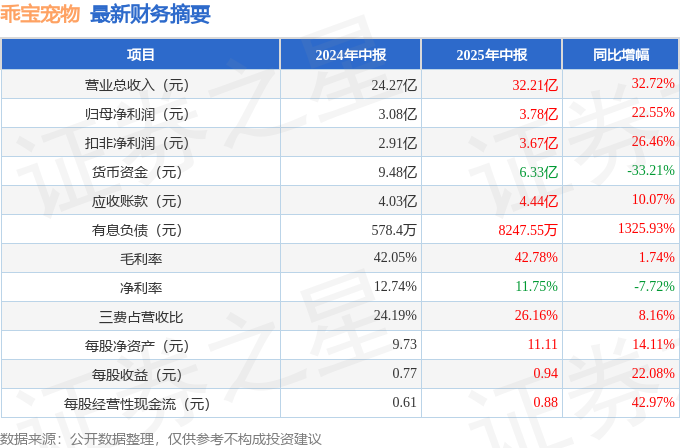
Core Viewpoint - The recent financial report of Guibao Pet (301498) shows strong growth in revenue and net profit for the first half of 2025, indicating a robust performance driven by domestic brand business growth [1][6]. Financial Performance - Total revenue for the first half of 2025 reached 3.221 billion yuan, a year-on-year increase of 32.72% compared to 2.427 billion yuan in 2024 [1]. - Net profit attributable to shareholders was 378 million yuan, up 22.55% from 308 million yuan in the previous year [1]. - The gross profit margin improved to 42.78%, an increase of 1.74% year-on-year, while the net profit margin decreased to 11.75%, down 7.72% [1]. - The total of selling, administrative, and financial expenses was 842 million yuan, accounting for 26.16% of revenue, which is an increase of 8.16% year-on-year [1]. Cash Flow and Debt - Operating cash flow per share increased by 42.97% to 0.88 yuan, reflecting strong cash generation from operations [1][7]. - Interest-bearing debt rose significantly by 1325.93% to 82.475 million yuan, indicating a substantial increase in leverage [1][4]. R&D and Business Model - The company has invested 227 million yuan in R&D over the past three years, focusing on core technologies and product innovation [15]. - The Shanghai R&D center emphasizes future core technologies and market-driven product development, while the Liaocheng center focuses on product innovation based on market needs and pet physiology [13][14]. Market Position and Analyst Insights - The company has a historical median ROIC of 10.72%, with a strong capital return rate of 15.26% in the previous year [10]. - Analysts expect the company's performance in 2025 to reach 757 million yuan, with an average earnings per share of 1.9 yuan [10]. - Notably, the company is held by prominent fund managers, including the top holdings from the Fortune Tianyi Value Mixed Fund [11][13].

能给主人“打电话”! 全球首款宠物智能手机来了
Mei Ri Jing Ji Xin Wen· 2025-08-26 13:05
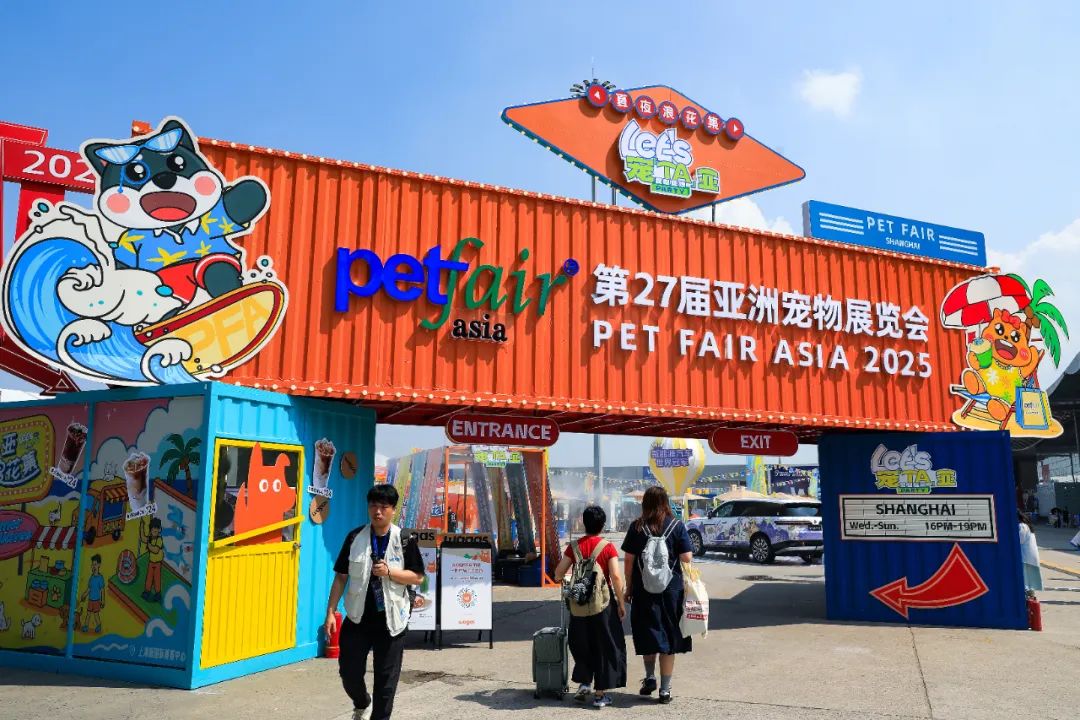
Core Insights - The pet industry in China is experiencing significant growth, driven by rising disposable income, an expanding pet owner demographic, and consumption upgrades [4][10] - The 27th Asia Pet Expo set new records, attracting over 130,000 professional visitors and more than 390,000 pet enthusiasts, with over 2,600 exhibitors [3][4] - The market for pet products and services is projected to reach 300.2 billion yuan in 2024, reflecting a 7.5% increase from 2023 [4] Industry Trends - Pet food remains the primary consumption category, accounting for 52.8% of the market share [5] - Major pet companies reported substantial revenue growth in the first half of 2025, with Guai Bao Pet achieving 3.221 billion yuan in revenue, a 32.72% increase year-on-year [5][6] - The pet industry is witnessing four key trends: the rise of domestic brands, increased penetration and consumption upgrades, market concentration, and the importance of supply chain and product quality [5][6] Competitive Landscape - The competition in the pet food market is shifting from price and channel competition to brand competition, with a focus on private label brands [7] - Sales expenses for leading companies have increased significantly, with Guai Bao Pet's sales expenses rising by 47.34% to 680 million yuan [7][8] - E-commerce platforms are evolving, influencing how pet brands engage with consumers through targeted marketing strategies [7] Technological Innovations - The Asia Pet Expo showcased advanced pet technology, including the world's first pet smartphone, PetPhone, which features AI communication and health monitoring capabilities [9] - The pet insurance sector is rapidly growing, with Zhong An Online reporting a total premium scale of approximately 563 million yuan, a year-on-year increase of over 51.3% [10] - The pet insurance market is projected to reach 3.2 billion yuan by 2025, with a penetration rate nearing 10%, indicating substantial growth potential [10]
能给主人“打电话”的宠物智能手机也来了,宠物产业3000亿元市场大爆发,行业上市公司“涨”声一片
3 6 Ke· 2025-08-26 10:54
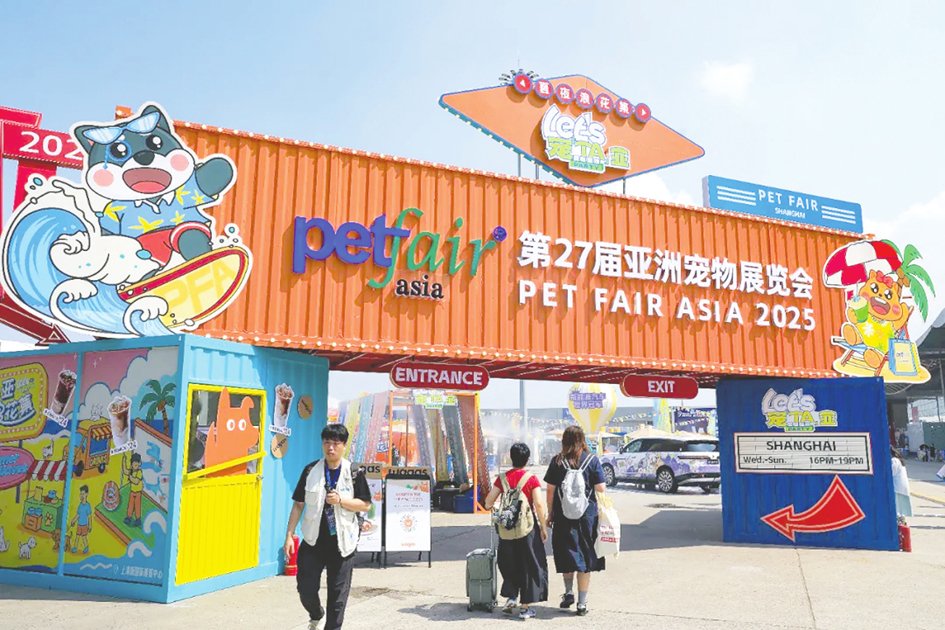
Industry Overview - The 27th Asia Pet Expo held in Shanghai attracted over 130,000 professional visitors and 390,000 pet enthusiasts, with more than 2,600 exhibitors, setting a new record [1][3] - The pet economy in China is experiencing significant growth, with the urban pet (dog and cat) consumption market expected to reach 300.2 billion yuan in 2024, a year-on-year increase of 7.5% [1][4] Market Trends - The number of urban pet owners is projected to reach 76.89 million in 2024, a 2.4% increase from 2023, with pet dog and cat populations growing by 1.6% and 2.5% respectively [4] - Pet food remains the primary consumption market, holding a market share of 52.8% [4] Company Performance - Several listed pet companies reported growth in the first half of 2025, with Guai Bao Pet achieving revenue of 3.221 billion yuan, a 32.72% increase, and a net profit of 378 million yuan, up 22.55% [5] - Tian Yuan Pet reported revenue of 1.435 billion yuan, a 14.59% increase, and a net profit of 37.46 million yuan, up 20.14% [5] - Petty Co. focused on its domestic brand "Jue Yan," which saw nearly 50% revenue growth in the first half of 2025 [5] Competitive Landscape - The pet industry is witnessing a rise in private label competition, with companies increasingly focusing on their own brands as a key development strategy [6] - Sales expenses for major companies like Guai Bao Pet, Tian Yuan Pet, and Petty Co. increased significantly, reflecting the competitive nature of the market [6][7] Technological Innovations - The Asia Pet Expo showcased the world's first pet smartphone, PetPhone, which supports AI real-time communication and health monitoring, indicating advancements in pet technology [8] Insurance Sector Growth - The pet insurance market is rapidly expanding, with Zhong An Online reporting a total premium scale of approximately 563 million yuan, a year-on-year increase of over 51.3% [10] - The pet insurance market in China is projected to reach 3.2 billion yuan by 2025, with a penetration rate nearing 10% [10]
乖宝宠物(301498):2025年中报点评:业绩符合预期,自有品牌再加速
Soochow Securities· 2025-08-26 10:02
Investment Rating - The investment rating for the company is "Buy" (maintained) [1] Core Views - The company's performance in the first half of 2025 met expectations, with total revenue reaching 3.221 billion yuan, a year-on-year increase of 32.72%, and net profit attributable to shareholders of 378 million yuan, up 22.55% year-on-year [7] - The self-owned brand and online sales channels are experiencing strong growth, with self-owned brand revenue expected to grow over 40% in the first half of 2025 [7] - The company continues to innovate and lead the industry, with a new high-end brand strategy and successful product launches [7] - The profit forecast has been slightly adjusted downwards, with net profits expected to be 750 million yuan, 981 million yuan, and 1.231 billion yuan for 2025, 2026, and 2027 respectively [7] Financial Summary - Total revenue projections for the company are as follows: 4.327 billion yuan in 2023, 5.245 billion yuan in 2024, 6.579 billion yuan in 2025, 8.067 billion yuan in 2026, and 9.794 billion yuan in 2027, with year-on-year growth rates of 27.36%, 21.22%, 25.43%, 22.62%, and 21.41% respectively [1] - Net profit attributable to shareholders is projected to be 428.84 million yuan in 2023, 624.72 million yuan in 2024, 750.09 million yuan in 2025, 981.41 million yuan in 2026, and 1.23074 billion yuan in 2027, with year-on-year growth rates of 60.68%, 45.68%, 20.07%, 30.84%, and 25.41% respectively [1] - The latest diluted EPS is expected to be 1.07 yuan in 2023, 1.56 yuan in 2024, 1.88 yuan in 2025, 2.45 yuan in 2026, and 3.08 yuan in 2027 [1]
能给主人“打电话”的宠物智能手机也来了!宠物产业3000亿元市场大爆发,行业上市公司“涨”声一片
Mei Ri Jing Ji Xin Wen· 2025-08-26 10:01
Core Insights - The pet industry in China is experiencing significant growth, driven by rising disposable income, an expanding pet owner demographic, and consumption upgrades [2][5][16] - The 27th Asia Pet Expo in Shanghai set new records, attracting over 130,000 professional visitors and more than 390,000 pet enthusiasts, with over 2,600 exhibitors [1][5] - The market for pet consumption reached 300.2 billion yuan, a 7.5% increase from 2023, with pet food accounting for 52.8% of the market share [5][16] Industry Trends - The number of urban pet owners is projected to reach 76.89 million by 2024, a 2.4% increase from 2023, with pet dogs and cats also showing growth [2] - Major pet companies reported substantial revenue growth in the first half of 2025, with Guobao Pet achieving a revenue of 3.221 billion yuan, up 32.72% year-on-year [5][10] - The pet industry is witnessing four key trends: the rise of domestic brands, increased penetration and consumption upgrades, higher market concentration, and the importance of supply chain and product quality [5][6] Competitive Landscape - The competition in the pet food market is shifting from price and channel competition to brand competition, with a focus on proprietary brands [8][10] - Sales expenses for leading companies have increased significantly, with Guobao Pet's sales expenses rising by 47.34% to 680 million yuan [10] - E-commerce platforms are evolving, with brands increasingly focusing on data-driven strategies for marketing and sales [8] Technological Innovations - The Asia Pet Expo showcased the world's first pet smartphone, PetPhone, which supports AI real-time communication and health monitoring [11][12] - The integration of technology in pet care is redefining the value of pet tech products, emphasizing emotional interaction [12] Growth of Pet Insurance - The pet insurance sector is rapidly growing, with ZhongAn Online reporting a total premium scale of approximately 563 million yuan, a 51.3% increase [14][16] - The pet insurance market in China is expected to reach 3.2 billion yuan by 2025, with a projected penetration rate of nearly 10% [16]