硬科技

Search documents
“汽车+机器人Tier1”新定位打开长期增长空间,如何看待均胜电子(00699,600699.SH)“入通”后的投资机会?
智通财经网· 2025-12-01 01:51
Core Viewpoint - Junsheng Electronics is set to accelerate value discovery and revaluation as it is expected to enter the Hong Kong Stock Connect list on December 4, attracting significant mainland capital due to its unique positioning in both the automotive and robotics sectors [1][9]. Group 1: Business Overview - Junsheng Electronics, established in 2004, initially focused on automotive components and has since expanded internationally through multiple acquisitions, establishing over 25 R&D centers and 60 production bases globally by April 30 this year [2]. - The company has successfully transitioned into the robotics sector, leveraging its automotive expertise to develop key components such as humanoid robot controllers and energy management modules [4]. Group 2: Financial Performance - For the first three quarters of this year, Junsheng Electronics reported revenue of 45.844 billion, a year-on-year increase of 11.45%, with Q3 revenue reaching 15.497 billion, up 10.25% year-on-year [4]. - The overall gross margin improved by 2.7 percentage points to 18.3% for the first three quarters, with Q3 gross margin at 18.6%, reflecting ongoing optimization of profitability [4][5]. Group 3: Business Segmentation - The automotive safety segment showed significant improvement, with a gross margin of approximately 16.4% for the first three quarters, up 2.4 percentage points year-on-year, and Q3 margin at 17.2% [5]. - New orders totaled 71.4 billion for the first three quarters, with Q3 alone accounting for 40.2 billion, indicating a strong upward trend in order acquisition [5]. Group 4: Strategic Positioning - Junsheng Electronics aims to cultivate long-term competitiveness globally by integrating its supply chain, production strategies, and R&D efforts, focusing on cost optimization and operational efficiency [8]. - The company is positioned as a Tier 1 supplier in both automotive and robotics sectors, leveraging its established methodologies and successful experiences to support the deployment of intelligent robots across various applications [8]. Group 5: Market Outlook - With its upcoming inclusion in the Hong Kong Stock Connect, Junsheng Electronics is expected to attract more investors, enhancing liquidity and accelerating its value revaluation process [9].


国金基金马芳:主动量化投资策略赋能 掘金硬科技与新成长
Zhong Guo Zheng Quan Bao· 2025-12-01 00:43
Core Insights - The article emphasizes that technological innovation and industrial upgrading are key drivers of high-quality economic development in China, with the Sci-Tech Innovation Board and the Growth Enterprise Market as primary platforms supporting this innovation [1][3]. Group 1: Investment Strategy - The Guojin Sci-Tech Innovation and Entrepreneurship Quantitative Stock Fund aims to leverage active quantitative investment strategies focused on the "Double Innovation" sector, selecting individual stocks to capitalize on "hard technology" and "new growth" opportunities [1][3]. - The fund invests at least 80% of its non-cash assets in the Sci-Tech Innovation Board and the Growth Enterprise Market, allowing for diversified allocation across sectors and market capitalizations [3][4]. Group 2: Market Characteristics - The "Double Innovation" sector is characterized by high levels of information, specialization, and volatility, making investment challenging; however, it also presents significant growth potential due to high R&D investments driving performance well above market averages [4][5]. - The Wande Double Innovation Index has shown significantly higher returns and risk-adjusted performance metrics compared to mainstream indices like the CSI 300 and the CSI 500 since 2020 [4]. Group 3: Quantitative Investment Approach - The fund employs a systematic model and strict risk control to address the challenges of investing in the "Double Innovation" sector, enhancing the probability of capturing quality growth stocks while minimizing non-systematic risks [5][6]. - Unlike traditional actively managed funds, the quantitative fund relies on model-driven strategies and comprehensive market coverage rather than deep fundamental research [5][6]. Group 4: Team and Technology - The Guojin Fund has a well-established quantitative research team with a strong background in mathematics and investment, having built its quantitative investment framework since 2013 [7]. - The team utilizes a wide range of data sources, including research reports and trading data, to construct dynamic predictive models that identify market opportunities that traditional strategies may overlook [7].

“硬科技”ETF迎来发售热潮 增量资金涌入前沿科技赛道
Zhong Guo Zheng Quan Bao· 2025-12-01 00:43
Core Viewpoint - The recent surge in the issuance of "hard technology" themed ETFs indicates strong investor interest and potential for growth in sectors like semiconductors and artificial intelligence, driven by policy support and industry trends [1][4]. Fund Issuance - On November 28, the GF Securities' Shanghai Stock Exchange Sci-Tech Innovation Board Chip Design ETF was launched, leading the issuance of six similar funds [2]. - Seven AI-themed ETFs were also launched on the same day, with initial fundraising caps set at 80 billion yuan for some and 50 billion yuan for others [2]. - The Yongying CSI Sci-Tech Innovation Entrepreneurship AI ETF announced an early closure of its fundraising period due to high demand, reaching over 9 billion yuan on its first day [3]. Capital Inflow - An additional 40 new funds are set to be issued next week, with many targeting the technology sector and the Sci-Tech Innovation Board, indicating a significant influx of capital into these areas [4]. - The concentration of "hard technology" products is expected to attract more incremental funds, facilitating precise investments in the semiconductor industry and directing market resources towards "hard technology" sectors [4]. Market Trends - Despite short-term market fluctuations, the long-term growth logic for "hard technology" remains solid, supported by policy and industry trends [1][5]. - Analysts suggest that the current market is at a critical juncture, with fluctuations expected but the core drivers of the current market cycle still intact [5]. - The technology sector is experiencing a "back-and-forth" trend, but macroeconomic factors are becoming more favorable, particularly with rising expectations for overseas interest rate cuts [5][6].
四大证券报精华摘要:12月1日
Xin Hua Cai Jing· 2025-12-01 00:20
Group 1: Economic Indicators - In November, the manufacturing PMI rose to 49.2%, an increase of 0.2 percentage points from the previous month, while the non-manufacturing business activity index fell to 49.5%, a decrease of 0.6 percentage points [1] - The PMI for medium-sized enterprises improved to 48.9%, up 0.2 percentage points, and small enterprises saw a significant rise to 49.1%, up 2.0 percentage points, marking a six-month high [1] - High-tech manufacturing PMI remained in expansion territory at 50.1%, continuing above the critical point for ten consecutive months [1] Group 2: ETF Market Activity - The technology sector, led by computing power, saw strong performance with several AI-themed ETFs rising over 8% [2] - In the context of market volatility, broad-based ETFs experienced significant trading activity, with over 2.5 billion yuan net inflow into ETFs tracking the Shanghai Stock Exchange 50 index [2] - The recent discussions around AI market bubbles have not deterred long-term investment interest, as institutions believe the fundamentals supporting AI growth remain intact [2] Group 3: Fundraising and Investment Trends - A surge in "hard technology" themed ETFs has been observed, with multiple new funds launched targeting semiconductor and AI sectors [3] - Public fund self-purchases have increased, with net subscriptions for equity funds reaching 210 million yuan in November, and total net subscriptions for the year exceeding 4.5 billion yuan [5] - Global asset management firms are optimistic about 2026, with a focus on technology innovation as a core investment theme [6][7] Group 4: Regulatory Environment - The People's Bank of China reiterated its prohibitive stance on virtual currencies, emphasizing that stablecoins do not hold the same legal status as fiat currencies and are associated with illegal financial activities [4] Group 5: Fund Performance and Market Dynamics - The total net asset value of public funds in China reached 36.96 trillion yuan, marking a historical high with a monthly increase of 218.27 billion yuan [8] - As the year-end approaches, many high-performing funds are implementing purchase limits to manage inflows, particularly among "mini funds" that have shown exceptional returns [9][10] - The pharmaceutical sector has seen a reduction in the number of funds achieving double returns, indicating a shift in market sentiment towards a more cautious approach [10] Group 6: Market Liquidity - The liquidity environment remains stable, with the People's Bank of China maintaining ample liquidity through various monetary policy tools [11] - Major public fund institutions are enhancing liquidity services for ETFs, indicating a shift towards improving trading conditions in the ETF market [12][13] Group 7: AI and Storage Demand - The demand for storage products has surged due to advancements in AI technology, with prices for certain memory products increasing significantly since September [14] - Projections indicate that the average price of DRAM is expected to rise by 58% by 2026, suggesting a prolonged cycle of demand for storage products [14]
国金基金马芳: 主动量化投资策略赋能 掘金硬科技与新成长
Zhong Guo Zheng Quan Bao· 2025-11-30 20:33
Core Viewpoint - The article emphasizes that technological innovation and industrial upgrading are key drivers of high-quality economic development in China, with the Sci-Tech Innovation Board and the Growth Enterprise Market serving as primary platforms for supporting these initiatives [1] Group 1: Investment Strategy - The Guojin Sci-Tech Innovation and Entrepreneurship Quantitative Stock Fund aims to leverage active quantitative investment strategies focused on the "Double Innovation" sector, selecting individual stocks to capitalize on "hard technology" and "new growth" opportunities [1][2] - The fund will invest at least 80% of its non-cash assets in the Sci-Tech Innovation Board and the Growth Enterprise Market, allowing for diversified allocation across sectors and market capitalizations [2] - The fund's strategy includes a focus on sectors such as semiconductors, innovative pharmaceuticals, and high-end equipment, which are critical for technological breakthroughs [2] Group 2: Performance Metrics - The "Double Innovation" sector has shown significant performance metrics, with the Wind Double Innovation Index demonstrating higher returns, Sharpe ratios, and Calmar ratios compared to mainstream indices like the CSI 300 and CSI 500 since 2020 [2] - Companies within this sector exhibit high R&D investment, leading to performance growth that outpaces market averages, making them key drivers in various market conditions [2] Group 3: Risk and Return Profile - The "Double Innovation" sector is characterized by high growth, volatility, and elasticity, offering a higher cost-performance ratio by accepting controllable, phase-based volatility in exchange for long-term growth potential [3] - This sector is seen as a viable investment choice for those looking to benefit from China's economic transformation and seeking long-term excess returns [3] Group 4: Quantitative Investment Approach - The Guojin fund employs an active quantitative investment strategy, which provides a scientific allocation path for investing in the "Double Innovation" sector, addressing challenges such as information overload and high volatility [4] - Quantitative investment enhances stock selection through systematic models, strict risk control, and aims for smoother long-term excess performance, helping investors share in the sector's growth [4][5] - The fund's approach contrasts with traditional active management by relying on model-driven strategies rather than deep fundamental research [4] Group 5: Team and Technology - The Guojin fund has a strong quantitative team with extensive experience and a solid educational background, having established its quantitative investment framework since 2013 [7] - The team utilizes a wide range of data sources, including research reports and trading data, to build dynamic predictive models and capture market opportunities that traditional strategies may overlook [7] - Future plans include continuous optimization of investment strategies and models to provide high-quality investment tools for investors [7]
“硬科技”ETF迎来发售热潮
Zhong Guo Zheng Quan Bao· 2025-11-30 20:21
Group 1 - The recent surge in the issuance of "hard technology" themed ETFs indicates strong market interest, with multiple funds launching on November 28, including the GF Securities Shanghai Stock Exchange Sci-Tech Innovation Board Chip Design ETF and seven AI-themed ETFs [1][2] - The first batch of AI-themed ETFs has set fundraising caps, with E Fund, Invesco Great Wall, and Morgan Asset Management each having a cap of 8 billion, while Huatai-PB has a cap of 5 billion, and Penghua has a cap of 2 billion [2] - The early closure of the Yongying CSI Sci-Tech Innovation Entrepreneurship AI ETF's fundraising period, due to overwhelming demand, highlights the strong market appetite, with subscriptions exceeding 900 million on the first day [2][3] Group 2 - The upcoming issuance of 40 new funds, with many targeting the technology sector and the Sci-Tech Innovation Board, is expected to bring additional capital into the market [1][3] - Industry experts believe that the concentrated issuance of "hard technology" products will attract more incremental funds to related sectors, providing investors with tools to strategically invest in the semiconductor industry [3] - Despite short-term market fluctuations, the long-term growth logic of "hard technology" remains solid, supported by policy and industry trends [1][4] Group 3 - The current market is experiencing a critical phase, with fluctuations between 3,800 and 4,000 points, driven by multiple factors including policy expectations and external environments [3][4] - The global technology stock indices have shown volatile movements, but the macroeconomic environment is becoming more favorable for technology stocks as expectations for overseas interest rate cuts rise [4] - The technology sector has undergone a month-long adjustment, with expectations of a potential bottoming out in mid to late November, prompting a gradual increase in focus on broad technology ETFs [4]
主动量化投资策略赋能 掘金硬科技与新成长
Zhong Guo Zheng Quan Bao· 2025-11-30 20:21
Core Insights - The article emphasizes that technological innovation and industrial upgrading are key drivers of high-quality economic development in China, with the Sci-Tech Innovation Board and the Growth Enterprise Market as primary platforms supporting this innovation [1][2] Investment Focus - The newly launched Guojin Sci-Tech Innovation and Entrepreneurship Quantitative Stock Fund aims to leverage active quantitative investment strategies, focusing on "hard technology" and "new growth" sectors to capitalize on economic growth and industrial transformation [1][2] - The fund will invest at least 80% of its non-cash assets in the Sci-Tech Innovation Board and the Growth Enterprise Market, allowing for diversified allocation across sectors and market capitalizations [1][2] Sector Characteristics - The "double innovation" sector is characterized by information explosion, high specialization, and strong volatility, making stock selection challenging due to rapid technological changes and varying company quality [3] - Companies in this sector exhibit high R&D investment, leading to performance growth that significantly outpaces market averages, as evidenced by the Wind Double Innovation Index outperforming major indices like CSI 300 and CSI 500 since 2020 [2][3] Quantitative Investment Strategy - The Guojin fund employs a systematic quantitative investment approach, which includes broad stock selection through technical models, strict risk control, and optimization of portfolios to achieve smoother long-term excess returns [3][4] - Unlike traditional actively managed funds, the quantitative fund relies on model-driven strategies and comprehensive market coverage rather than deep fundamental research [3][4] Team and Technology - Guojin Fund has a strong quantitative research team with extensive experience and a solid mathematical background, having established its quantitative investment framework since 2013 [4][5] - The team utilizes a wide range of data sources, including research reports and trading data, to build dynamic predictive models and enhance strategy effectiveness [4][5]
私募超44000次调研,去了哪些行业?
Zhong Guo Ji Jin Bao· 2025-11-30 15:06
Core Insights - Private equity firms have conducted over 44,000 research activities on A-share listed companies in 2023, with a focus on hard technology sectors such as electronics, biomedicine, and machinery [1][2] - The most researched industries include electronics, biomedicine, and machinery, with significant interest in artificial intelligence, innovative pharmaceuticals, and new consumption trends [1][4] Group 1: Research Activities - A total of 2,579 private equity firms participated in A-share research, covering 2,184 stocks across 30 primary industries, resulting in 44,702 research instances [2] - The electronics sector was the most researched, with 8,732 instances, followed by biomedicine with 6,341 and machinery with 5,437 [2][4] - Notable companies in the electronics sector include Luxshare Precision, which was researched 335 times, and other leading firms in biomedicine such as United Imaging Healthcare and Mindray Medical [2][3] Group 2: Private Equity Firm Activities - The most active private equity firm, Zhengyuan Investment, conducted 1,002 research activities, while other major firms like Panjing Investment and Gao Yi Asset also showed high engagement [2][3] - Panjing Investment focused on nearly 30 stocks with multiple research instances, including Luxshare Precision and Jiangbolong [3] - Gao Yi Asset showed a preference for biomedicine, electronics, and machinery, conducting six research activities on Zhongkong Technology [3] Group 3: Market Trends and Insights - The electronics industry is thriving due to accelerated domestic semiconductor replacement and the initiation of a consumer electronics innovation cycle [4] - The biomedicine sector is favored for its diverse stock options and the rapid approval of innovative drugs, alongside a recovery in medical consumption [4] - The power equipment sector benefits from the continuous growth of new energy installations, attracting significant research interest from private equity firms [4] Group 4: Future Outlook - The market is expected to shift from valuation-driven to performance-driven, with a focus on high-growth sectors such as artificial intelligence, innovative pharmaceuticals, and machinery [5][6] - Investment strategies will emphasize structural growth potential in emerging sectors and cyclical opportunities arising from "anti-involution" policies [6]




精彩片花丨科创尖端 硬客前瞻
Zhong Guo Jing Ying Bao· 2025-11-30 13:37
Group 1 - The core viewpoint of the article is the upcoming release of the sixth episode of the second season of the program "Hard Science and Hard Guests," focusing on the theme of "Supply Chain Going Overseas" [1] - The program is a high-end interview series co-launched by the Shanghai Stock Exchange, China Business News, and China National Radio Capital Eye, aimed at showcasing and facilitating deep exchanges among key figures in the hard technology sector [1] - The initiative aims to enhance the ecosystem of the Science and Technology Innovation Board by providing a platform for entrepreneurs and scientists to share experiences, review paths, forecast industry trends, and offer suggestions for high-quality development [1]
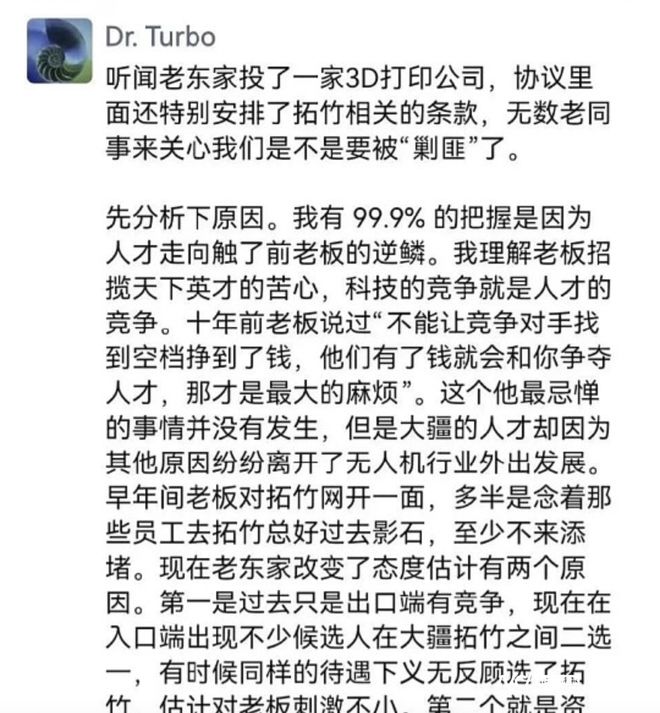
资本狂热押注!一年近 20 家“大疆系”企业获投
Nan Fang Du Shi Bao· 2025-11-30 12:00
Core Insights - The article highlights the emergence of "DJI alumni" entrepreneurs who are leveraging their experience to drive innovation in various high-tech sectors, including 3D printing, energy storage, and robotics, contributing significantly to China's smart manufacturing upgrade [2][14]. Group 1: Talent Movement and Industry Impact - Tao Ye, founder of Tuozhu Technology, criticized DJI for investing in competitors, indicating a competitive talent landscape that has implications for industry dynamics [1][2]. - The departure of talent from DJI has led to the creation of numerous startups that are becoming key players in critical areas of China's manufacturing transformation [13][14]. Group 2: Growth of Tuozhu Technology - Tuozhu Technology, founded in 2020, has seen rapid growth, with annual revenue increasing from 2.7 billion yuan to over 5 billion yuan in just four years, capturing half of the global consumer 3D printing market growth [4][6]. - The company's first product, the X1, achieved significant crowdfunding success and was recognized as one of Time magazine's "100 Best Inventions" [6]. Group 3: Success of DJI Alumni Startups - Several startups founded by former DJI employees have emerged as unicorns, such as Zhenghao Innovation and Wuzhong Technology, which are addressing consumer pain points in energy storage and personal care [8][9]. - The "DJI alumni" have collectively attracted significant investment, with nearly 20 startups receiving funding in 2025 alone, marking a five-year high [10]. Group 4: Investment Trends - Major investment firms are actively pursuing "DJI alumni" startups, with Sequoia China leading the way with multiple investments across various stages [10]. - Investors are drawn to these entrepreneurs due to their proven technical capabilities and efficient execution, which are critical in the hard tech sector [10]. Group 5: The "DJI Methodology" - The unique training system at DJI has equipped its engineers with a comprehensive skill set, enabling them to excel in various fields and fostering a culture of high-quality product development [11][12]. - The global experience gained at DJI provides these entrepreneurs with a "cold start template" for entering international markets, enhancing their competitive edge [11][12]. Group 6: Future Outlook - The article suggests that the rise of "DJI alumni" startups is not just about individual success but represents a broader shift in China's manufacturing landscape, positioning the country as a leader in global hard tech competition [14].